If fraud labels come in late and attack patterns keep shifting, I’d use both supervised and unsupervised learning. That’s the short answer.
In plain English:
- Supervised models catch fraud that looks like past fraud
- Unsupervised models flag activity that looks odd, even without a fraud label
- Using both helps me catch known attacks and spot new ones sooner
- The setup only works well if I use time-safe data, watch false positives, and feed review outcomes back into training
That matters because fraud is expensive. In 2024, U.S. consumers reported more than $12.5 billion in fraud losses. And reported losses are only part of the picture.
Here’s the simple rule I’d follow:
- I’d lean on supervised learning when I have enough confirmed fraud history
- I’d add unsupervised learning when labels are delayed, fraud patterns shift, or I need help finding what my labeled data misses
- I’d use a hybrid pipeline when I need to balance fraud loss, approval rate, and review workload at the same time
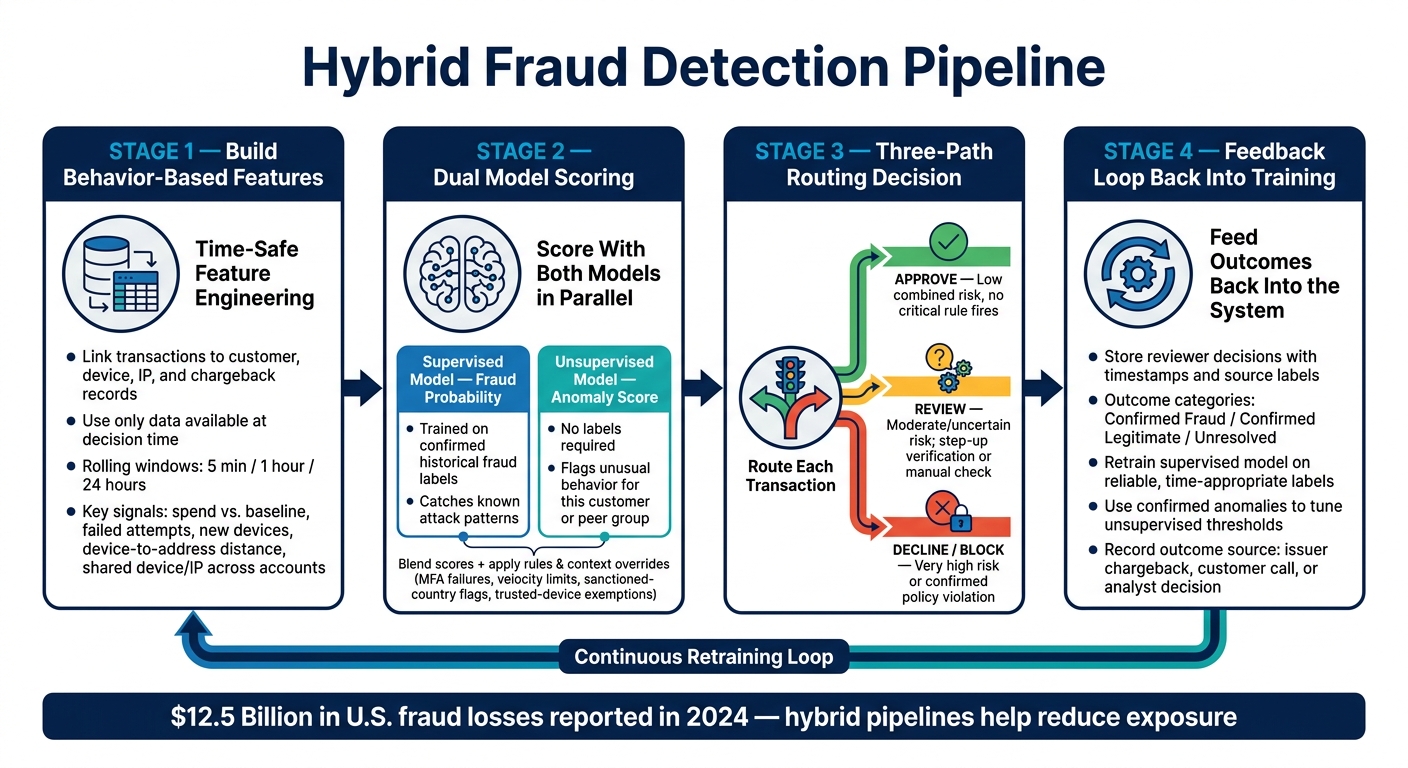
A hybrid fraud system usually comes down to 4 steps:
- Build time-based behavior features
- Score each transaction with both models
- Route it to approve, review, or decline
- Feed analyst decisions and chargebacks back into the system
The main idea is simple: one model looks for known fraud, and the other looks for unusual behavior. On their own, each has blind spots. Together, they give me better coverage with more control over false positives.
Below, I’ll walk through when this mix makes sense, how I’d set it up, and what I’d monitor after launch.
When a hybrid model is the right choice
You have known fraud patterns but labels are limited or delayed
Chargebacks and dispute outcomes show up late. That means supervised models often learn from old labels, not what’s happening right now.
A better setup is to train the supervised model on confirmed fraud cases while an anomaly model scores unlabeled transactions at the same time.
For example, a supervised model might flag a transaction that matches a known stolen-card pattern. At the same time, the anomaly model might flag a different transaction that looks fine at first glance but uses a new device, an unusual shipping address, and odd purchase velocity. One model won’t catch both. Together, they cover more ground.
That’s why hybrid scoring works well when labels arrive after live payment decisions have already been made.
Fraud tactics are changing faster than your labels
Fraud moves fast. Labels usually don’t.
When tactics change before labels come in, unsupervised scores can spot that new behavior first. Feature drift monitoring can also show shifts in customer behavior or fraud patterns before confirmed cases start piling up.
That lag leaves drift detection filling the gap between live activity and confirmed fraud cases.
False positives are expensive and analyst capacity is limited
False positives cost money and time. You can lose good customers, swamp investigators, and burn through team capacity fast. If a fraud team can only review 20 cases per business day, the alert queue needs to stay close to that number.
Hybrid scoring helps by splitting transactions into three bands:
- Approve for low-risk transactions
- Review for mid-risk transactions that need manual checks or extra verification
- Decline or hold for high-risk transactions
That setup keeps the queue more controlled while focusing analyst time where it matters most.
Next, turn those two scores into one fraud-detection pipeline.
sbb-itb-17e8ec9
Detecting Financial Fraud at Scale with Machine Learning - Elena Boiarskaia (H2O ai)
How to combine models in a fraud-detection pipeline
Hybrid Fraud Detection Pipeline: 4-Step Setup
Once a hybrid setup makes sense, the next step is turning it into a time-safe pipeline. That matters more than it might seem. If your system learns from data that wasn't available at the moment a decision was made, your results can look better on paper than they will in production.
Prepare data and build behavior-based features
Start by linking transactions to customer, device, IP, authentication, chargeback, and case records with stable IDs. Then be strict about timing: only use data that existed at decision time. Later chargebacks and final outcomes should be used only for training.
The features that help most usually aren't the raw transaction fields. They’re the behavioral signals that show whether a transaction fits a customer's normal pattern or sticks out.
Useful examples include:
- spend versus baseline
- failed attempts in a short window
- new devices
- device-to-address distance
- time since the last transaction
- whether a device fingerprint or IP address is shared across multiple accounts
Rolling windows such as 5 minutes, 1 hour, and 24 hours make these signals much more useful. Instead of a frozen snapshot, you get a live read on what’s happening around the transaction.
Score transactions with both models, then combine the results
With clean, time-safe features ready, score each transaction through both models.
Run two scores in parallel: a supervised fraud probability and an unsupervised anomaly score. The first estimates the chance of fraud based on past labeled cases. The second asks a different question: How unusual is this transaction for this customer or for a similar customer group?
Then blend those scores and adjust them with rules and context. Don’t set weights by gut feel. Validate them on time-ordered history so the mix reflects how the system would have worked in practice.
Rules and context act as direct controls. They can override the blended score or push it up or down. Common examples include failed multifactor authentication, velocity limits, sanctioned-country flags, and trusted-device exemptions.
From there, route each transaction into one of three paths:
| Decision | When it applies |
|---|---|
| Approve | Low combined risk, no critical rule fires |
| Review | Moderate or uncertain risk; includes step-up verification and hold |
| Decline/block | Very high risk or confirmed policy violation |
Feed reviewer outcomes back as future training labels
Reviewer outcomes are what keep the system learning as fraud tactics shift.
A hybrid model gets better only when outcomes flow back into training. That means reviewer decisions, customer disputes, and confirmed fraud outcomes should be stored with timestamps and source labels. Those details matter. You need to know not just what the outcome was, but when it became known and where it came from.
Keep the outcome categories clean: confirmed fraud, confirmed legitimate activity, and unresolved cases. This is a spot where teams can get into trouble fast. If unresolved transactions are treated as legitimate, the training data gets polluted. In plain English, the supervised model starts learning that some fraud is normal.
It also helps to record whether an outcome came from an issuer chargeback, a customer verification call, or an analyst decision, along with the date that outcome became known. Retrain the supervised model only on reliable, time-appropriate labels. At the same time, use reviewer-confirmed anomalies to tune anomaly thresholds or surface new fraud clusters for investigation.
That feedback loop helps close the label lag that holds back supervised-only systems.
Implementation steps and rollout for startups
Use time-aware data, clean identifiers, and fraud-specific metrics
For fraud work, time matters. Split data in chronological order: train on older transactions, tune on a later period, and keep the newest data aside for final testing. If you use random splits, future outcomes can leak into training. That makes results look better than they’ll be in production.
Data cleanup matters just as much. Normalize customer, account, payment instrument, device, merchant, transaction, and IP IDs. Standardize timestamps and time zones. Remove duplicates. Reconcile refunds and chargebacks across related records so the model sees the full picture instead of a messy trail of partial events.
On measurement, don’t treat accuracy as the main number. When fraud is rare, a model can post high accuracy and still miss a lot of bad transactions. Focus on metrics that show what’s actually happening:
- Precision
- Recall
- False-positive volume
- Approval rate
- Review rate
- Net fraud loss
Then break performance down by payment method, transaction value, geography, and customer segment. A model can look strong at the top level and still fail in one corner of the business.
Roll out in phases before making live approval decisions
Once the scoring pipeline is in place, rollout discipline decides whether it holds up in production. Don’t switch on live approvals on day one. Keep your current rules in place during the transition. A phased rollout keeps risk under control.
- Audit and baseline: Clean the data, document the current rules, and train a supervised model on confirmed historical fraud.
- Shadow anomaly detection: Run the unsupervised model in alert-only mode. It should score every transaction without changing customer outcomes. Log the alerts, then have analysts sample them.
- Compare and validate: Measure the new signals against current rules on the chronological holdout. After that, validate final performance on a separate time-based test set that was not used for training or threshold tuning. Check alert volume, approval rate, latency, and how many anomaly alerts later become confirmed fraud.
- Pilot the review queue: Send only high-confidence alerts to reviewers, especially where model scores and rules point in the same direction. Give analysts plain-language explanations, not just scores.
- Gradual production use: Auto-approve low-risk cases, send medium-risk cases to review or step-up verification, and keep automatic declines for high-confidence cases backed by policy.
- Rollback controls: Keep the previous ruleset versioned and define clear pullback criteria, such as a sudden spike in fraud losses or alert volume that goes past review capacity.
Connect fraud signals to finance and reporting workflows
Fraud decisions can’t stop at the risk system. The outputs need to flow into finance workflows too. Record confirmed losses, recoveries, refunds, chargebacks, investigation costs, and disputed amounts so finance can match them against payment processor and bank data. These numbers feed cash forecasting, loss tracking, reserves, revenue adjustments, and investor reporting.
Lucid Financials can serve as the finance layer, syncing losses, recoveries, refunds, chargebacks, and disputed amounts into books and investor reporting.
Monitoring, governance, and next steps
Once the hybrid pipeline is live and feeding finance workflows, keep a close eye on one thing: is it still cutting loss without piling on review work or making life harder for good customers?
What to monitor after deployment
After launch, watch for drift in fraud patterns, customer behavior, and data quality.
The table below shows what each metric tells you and what to do when it starts to slip. The goal is simple: make sure the supervised and unsupervised scores are still working together the way they should.
| Metric | What it reveals | Warning signal | Response |
|---|---|---|---|
| Fraud recall | Share of confirmed fraud the system catches | Recall drops for two or more review periods | Investigate new fraud patterns; retrain the supervised model or lower the alert threshold |
| Precision | Share of alerts that are truly fraudulent | Precision falls while review volume rises | Reduce noisy features, recalibrate scores, or adjust the anomaly threshold |
| False-positive rate | Legitimate activity incorrectly flagged | Legitimate declines or complaints increase | Add trusted-customer and transaction-context features; route borderline cases to human review |
| Approval rate | How much valid activity passes automatically | Approval rate drops without a corresponding fraud reduction | Review thresholds and separate approval, review, and decline bands |
| Chargeback rate | Confirmed downstream fraud loss | Chargebacks rise after stable model scores | Check delayed labels, payment-method segments, and emerging attack patterns |
| Manual-review volume | Whether investigators can handle the alert load | Queue exceeds staffing capacity or service-level target | Prioritize by expected loss and confidence; tune thresholds or add automation |
| Customer friction | Operational and reputational impact | Complaints, declined legitimate transactions, account lockouts, support contacts, or checkout abandonment increase | Audit affected segments and require human review for ambiguous cases |
Treat anomaly spikes as signals, not proof. A spike can mean something is changing, but it doesn't automatically mean fraud is up. Check it against confirmed losses and business context before you change thresholds or relabel data.
Governance controls for high-risk fraud decisions
Performance metrics alone won't cut it. Fraud decisions also need a clear record and firm controls.
Store a timestamped, tamper-evident audit trail for each decision. That trail should include the model and feature versions, supervised score, anomaly score, combined score, threshold, triggered rules, reviewer override, and final outcome.
Production changes should be locked down. Every update to a model, feature, rule, or threshold should go through approval, code review, and versioned change management. That's not red tape for its own sake. Fraud decisions shape approvals, declines, customer experience, and downstream financial reporting.
Human review should be mandatory for high-value transactions, account closures, permanent restrictions, and any case where the supervised and anomaly scores disagree. Define, test, and document the human review process for major decisions. Federal Reserve model-risk guidance also highlights governance, validation, monitoring, limitations, and appropriate-use controls as ongoing responsibilities.
On the data side, apply data minimization. Keep only what you need for detection, investigation, disputes, regulatory obligations, and model validation. Tokenize or hash payment identifiers when analysts don't need the raw values. Set retention periods by data type, with legal, contractual, tax, accounting, payment-network, and dispute requirements in mind. Delete data without a clear policy, and you may lose the records needed to explain a past high-risk decision.
Conclusion: Use both methods when labels lag and tactics change
Supervised learning handles known fraud. Unsupervised learning helps surface new behavior. Use both when labels lag, tactics shift fast, and false positives come with real cost.
FAQs
How do I know if I need a hybrid fraud model?
You likely need a hybrid fraud model if your current setup has trouble balancing accuracy with new and changing threats.
It’s a good fit when static, rule-based systems create too many false positives or miss subtle fraud patterns that don’t match old rules.
Consider it if you need to:
- catch known fraud and new anomalies
- improve precision and recall
- support auditability and real-time scoring
What data do I need to combine supervised and unsupervised learning?
You need high-quality data pulled together from across your financial ecosystem, including:
- transaction records
- bank feeds
- ledger entries
- payroll, expense, and tax data
- vendor or employee information
For supervised learning, use labeled historical fraud and legitimate cases. For unsupervised learning, use raw, unlabeled data to spot new anomalies. Add behavioral signals when you have them, and make sure the data is cleaned, standardized, and split into training, validation, and test sets.
How can I reduce false positives without missing new fraud?
Move past static rules and use dynamic, context-aware AI instead. When you combine supervised and unsupervised learning, you can catch fraud patterns you already know about while also spotting unusual activity that doesn’t fit your normal business profile.
To sharpen precision and recall, use ensemble models, behavioral analytics, continuous retraining, and feedback loops. It also helps to add explainable AI and a human-in-the-loop review for low-confidence cases, so analysts can sort real threats from legitimate activity much faster.