Deep learning helps payment teams catch more fraud with fewer bad declines. In plain terms, it reads transaction data, behavior over time, and links between accounts faster than fixed rules can.
Here’s the short version:
- Rules alone fall behind when fraud patterns shift.
- Deep neural models score each payment using signals like amount, merchant, device, and channel.
- Sequence models track behavior over time to spot odd changes in timing, location, or spend.
- Graph models map links across cards, devices, IPs, and merchants to find fraud rings.
- Speed matters: many systems must score a payment in about 10 milliseconds.
- Data matters too: weak labels and messy records can hurt results.
- The main tradeoff is simple: catch more fraud without blocking too many good customers.
One number shows the problem well: in a dataset with 284,807 card transactions, only 0.17% were fraud. That means fraud is hard to find, and blunt rules can miss bad payments while stopping good ones.
Real-Time Payment Fraud Detection, Powered by AI and AWS
sbb-itb-17e8ec9
Quick comparison
| Method | What it does best | Main limit |
|---|---|---|
| Rules | Stops known fraud patterns | Needs manual updates |
| Standard ML | Learns from past fraud data | Depends a lot on hand-built features |
| Deep learning | Finds subtle patterns in complex data | Harder to explain and run |
If I had to sum it up in one line: deep learning improves fraud checks by scoring single payments, spotting behavior shifts, and finding linked attacks across networks.
How deep learning models detect payment fraud
Different fraud patterns call for different model types. That’s why payment systems often use a mix of neural, sequence, and graph models. Each one is built to spot a different kind of signal.
Neural networks for transaction risk scoring
The first line of defense looks at each transaction by itself. Neural networks are a common choice here. They take in data like transaction amount, merchant type, channel, and linked-entity signals, then produce a risk score. Deep tabular networks can learn useful signals straight from structured payment data.
Many teams don’t stop at one model. Instead, they use ensemble scoring, where several models review the same transaction and their outputs are combined into one final risk score. That all has to happen fast, often within a 10-millisecond window.
Sequence and anomaly models for shifting customer behavior
A single transaction only shows part of the picture. Sequence models look at how a customer usually behaves over time, then flag sharp changes. That might mean unusual timing, a different amount, a new location, or an odd channel.
In plain English, these models learn what “normal” looks like for a given customer. When something drifts too far from that pattern, the system can treat it as a warning sign.
Graph models for linked fraud across cards, devices, and merchants
Some fraud doesn’t stand out until you look at accounts as a network. Sequence models follow time. Graph models follow connections.
Graph Neural Networks (GNNs) examine relationships across cards, devices, IP addresses, and merchants to find linked fraud patterns. That makes them useful for spotting fraud rings working across many accounts at the same time.
GNNs need cleaner data and more compute, but they can reveal linked fraud patterns that transaction-level models miss.
Taken together, these models help payment systems score risk, track behavior over time, and spot connected fraud.
How deep learning works inside real payment flows
Real-time transaction scoring in milliseconds
After training, the next thing that matters is simple: what happens during a live payment?
At checkout, the fraud engine usually has about 10 milliseconds to score a transaction and send back a decision. That’s a tiny window. In that time, the system doesn’t just say yes or no. It can:
- approve the payment
- decline it
- trigger step-up authentication
- send it to manual review
That extra layer matters because fraud decisions aren’t always black and white. Some payments look clean. Some look risky. And some sit in the messy middle, where an extra check makes more sense than an instant decline. SHAP explanations can show which features drove the score.
Cutting false positives without missing real fraud
Issuers can adjust risk thresholds to control how strict the system is. Set the threshold lower, and more transactions get flagged for review. Set it higher, and more payments move through on their own.
That tradeoff is where a lot of the work happens. Go too hard on risk, and good customers get blocked for no good reason. Go too soft, and fraud slips through. The goal is to trim false declines without letting fraud catch rates fall.
How clean financial data improves model performance
Fraud models are only as good as the data fed into them. Clean transaction records, reconciled histories, and stable merchant codes make it easier to tell normal behavior from fraud.
When labels are messy or the data structure is weak, the model starts learning patterns it shouldn’t. That can lead to two costly problems at once: fraud that gets missed and legitimate payments that get declined.
Clean data also makes the next comparison easier to see: rules, standard ML, and deep learning don’t react the same way when they’re given the same fraud signals.
Deep learning vs. other fraud detection methods
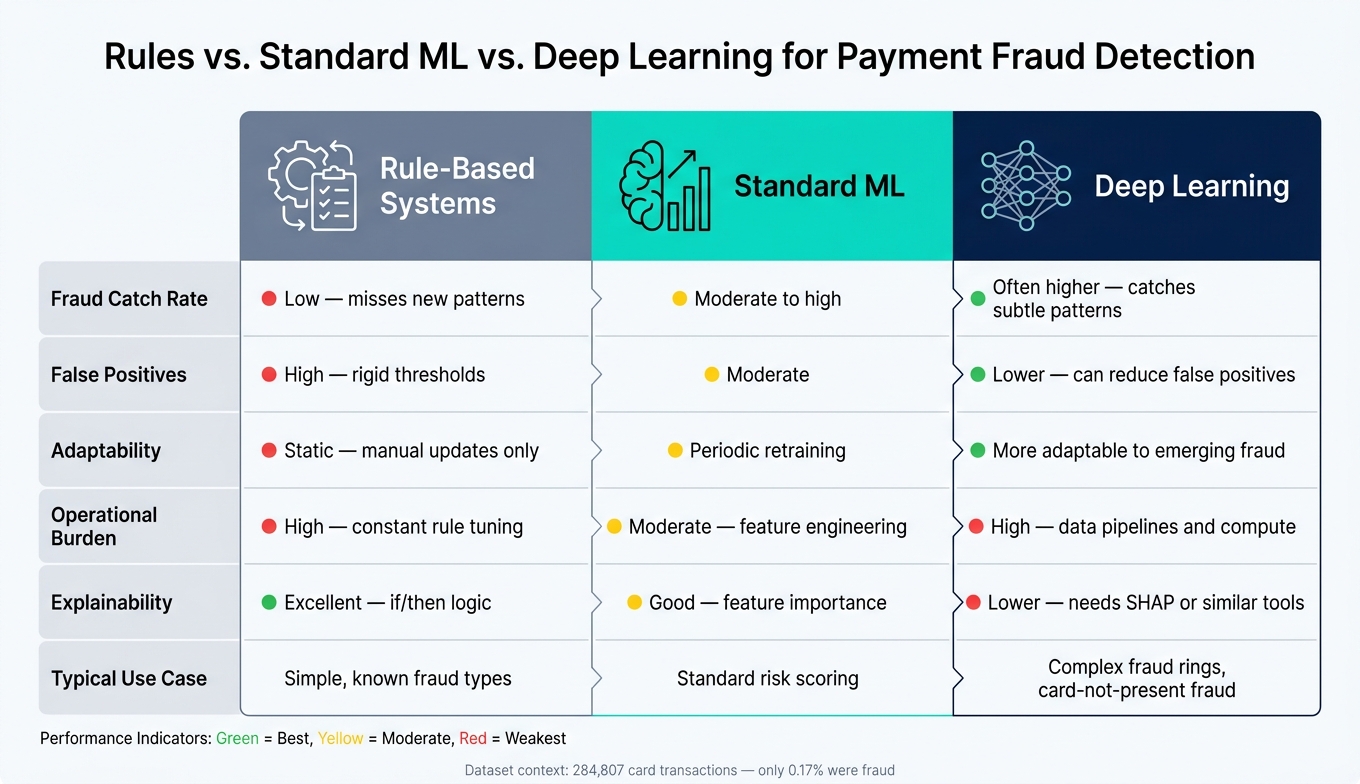
Rules vs. Standard ML vs. Deep Learning for Payment Fraud Detection
The next question is how deep learning stacks up against the systems most payment teams already have in place.
Rules, standard ML, and deep learning side by side
Fraud systems always involve tradeoffs. Some are easier to audit. Some adjust better when fraud shifts. Some simply catch more bad transactions.
Rules are the most basic option. They're easy to review and document, but they mostly catch patterns you already know about. Standard ML learns from labeled historical data, but it still leans on hand-built features. Deep learning goes further. It can pick up interactions that rules and standard ML often miss, pulling non-linear signals straight from raw data.
| Feature | Rule-Based Systems | Standard ML | Deep Learning |
|---|---|---|---|
| Fraud catch rate | Low - misses new patterns | Moderate to high | Often higher - catches subtle patterns |
| False Positives | High - rigid thresholds | Moderate | Lower - can reduce false positives |
| Adaptability | Static - manual updates only | Periodic retraining | More adaptable to emerging fraud |
| Operational burden | High - constant rule tuning | Moderate - feature engineering | High - data pipelines and compute |
| Explainability | Excellent - if/then logic | Good - feature importance | Lower - needs SHAP or similar tools |
| Typical Use Case | Simple, known fraud types | Standard risk scoring | Complex fraud rings, card-not-present fraud |
Industry deployments show a move away from rules alone and toward learned fraud scoring.
Those gaps show up fast in day-to-day fraud work.
What these differences mean for startups and finance operators
For finance teams, the impact is pretty direct. Fewer false positives mean less friction for customers and fewer false declines. Better detection means lower chargeback costs and less manual review.
The Nets deployment shows that operational upside. In plain terms, that means fewer false declines, lower manual review, and less chargeback exposure.
Deep learning also adds a documentation challenge. Rules are easy to write down for compliance. Deep learning decisions aren't. That's why explainability tools matter. SHAP-based tools can help show why a transaction was flagged for compliance and manual review.
The main limits are data quality, latency, explainability, and monitoring.
Limits, data challenges, and key takeaways
Even strong fraud models hit limits in production. At that point, the hard part isn't just spotting fraud. It's making the system work under tight deployment rules.
Common challenges: data imbalance, latency, explainability, and monitoring
Fraud is rare, so models often learn normal behavior far better than fraud behavior. That can lead to missed fraud cases simply because there are fewer examples to learn from. Oversampling can help rebalance the training set, but the class imbalance problem doesn't go away.
Real-time financial insights and scoring are tough constraints. In a payment flow, every millisecond counts. If a model is too slow, or if the data pipeline is too heavy, it can disrupt authorization decisions and add a different kind of risk.
Teams also need clear, auditable reasons for flagged transactions. And they can't just set a model live and walk away. Fraud patterns change, and models need close monitoring as that happens. Without that oversight, a model that worked well at launch can drift quietly as fraudsters switch tactics.
Conclusion: what deep learning actually improves in fraud prevention
Deep learning helps fraud prevention when it's backed by clean data, close monitoring, and calibrated thresholds that keep decisions accurate without adding too much friction.
FAQs
Why is deep learning better than rules alone for fraud detection?
Rules use fixed thresholds, so they mostly catch the obvious stuff. If someone keeps fraud just under those limits, or shifts tactics over time, those rules can miss it.
Deep learning looks for patterns across large datasets, not just one event at a time. It can spot sequences, relationships, and network behavior. That means it can find linked or coordinated activity that transaction-by-transaction rules often miss. It also helps cut false positives because it judges signals in context instead of treating each one on its own.
How do sequence and graph models catch fraud that single-payment scoring misses?
Sequence models look at events in the order they happen and spot changes in behavior over time, even when each payment seems normal on its own. They use time-based context like logins, vendor or profile changes, bank detail edits, and payment streams.
Graph models map the relationships between accounts, devices, IPs, merchants, and counterparties. That makes it easier to find indirect risk and connected schemes like circular flows or mule activity that a single-payment score might miss.
What does a payment team need to use deep learning well?
A payment team needs reliable, connected payment and finance data with matching timestamps and entity IDs.
They also need a governance-ready setup so people can explain model decisions and review them later. That means clear records, clean logic, and audit trails that hold up when finance, risk, or compliance teams take a closer look.
Just as important, there needs to be a clear integration path. Model outputs can't sit in a dashboard and do nothing. They need to flow into finance workflows and create tamper-evident audit trails.
And because fraud patterns shift over time, the work doesn't stop after launch. Teams need ongoing monitoring and retraining so models keep up with new behavior instead of falling behind.