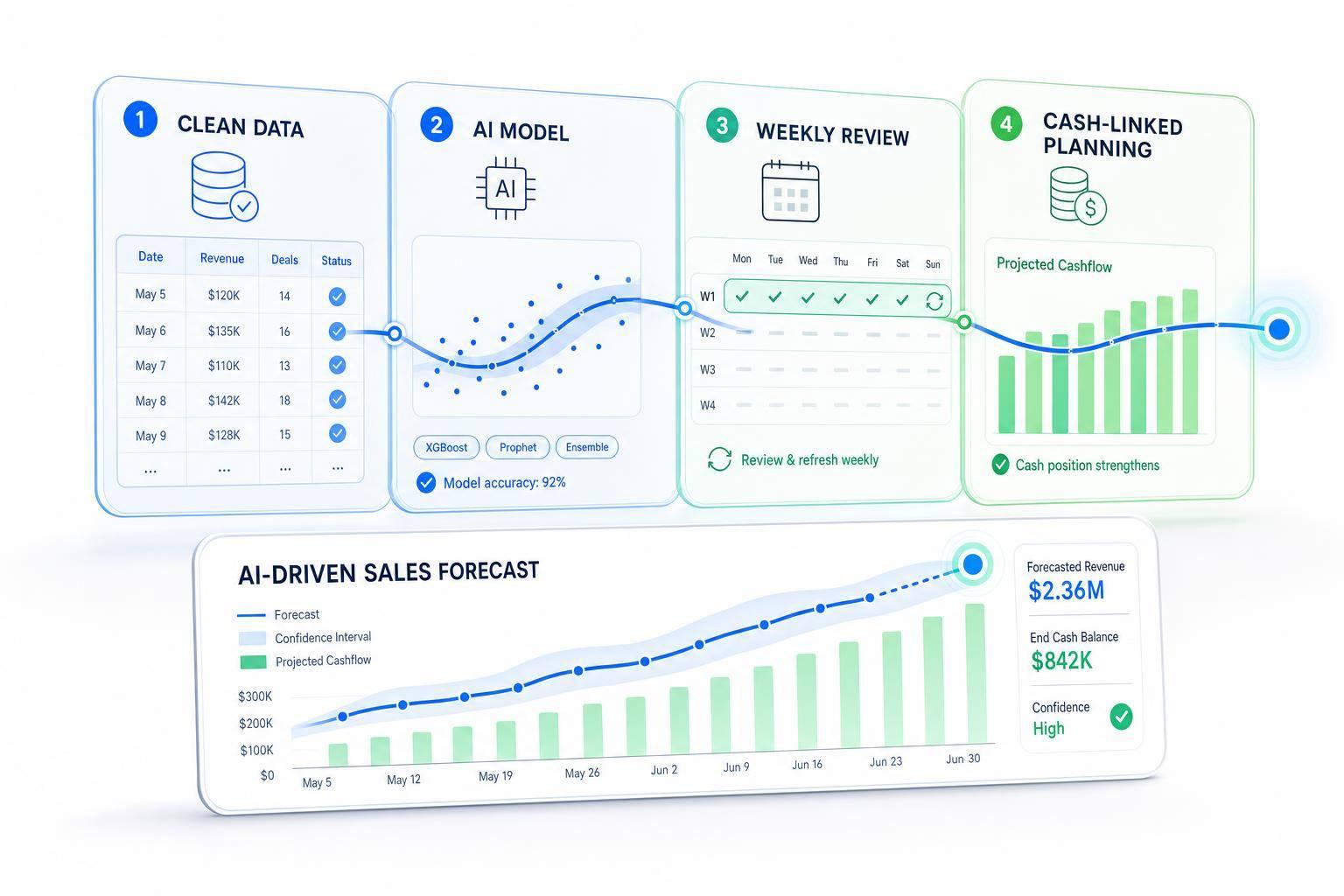
I’d sum it up like this: startups use AI to spot demand changes, competitor moves, and customer sentiment early enough to change forecasts, pricing, and hiring before the damage hits the P&L.
What stood out to me is how practical the pattern is:
- AI can flag early trends 6–12 months before broad adoption in some cases
- Short-term forecasts can hit 75%–85% accuracy, while 1–3 month forecasts often land around 60%–70%
- AI-based finance tools can improve forecast accuracy by 20%–40%
- Automated monitoring can save 30–60 hours per month
- Bad data is still the main failure point, tied to 60% of AI misses
The core idea is simple. I don’t need AI to guess the future perfectly. I need it to help me see weak signals sooner, connect those signals to revenue and burn, and update decisions fast.
Here’s the short version of what matters:
- Time-series models help track demand, revenue swings, and volatility
- NLP and sentiment analysis help read reviews, news, forums, and competitor messaging
- Search, pricing pages, job posts, and social chatter often show market movement before internal reports do
- Scenario planning works better when outside signals flow into finance and sales systems
- Human review still matters, because noise, sarcasm, and odd market events can throw models off
I also see a clear rule in the research: AI works best when the startup starts small, tracks a short list of competitors, and ties alerts to one owner and one decision process.
| Area | What AI Helps With | Main Limit |
|---|---|---|
| Demand and revenue | Forecasts and scenario planning | Needs enough clean history |
| Competitor tracking | Pricing, hiring, and product change alerts | Too much noise without filters |
| Customer sentiment | Reviews, forums, and market perception | Text can be messy or misleading |
| Finance response | Burn, runway, and hiring updates | Bad source data weakens output |
If I were turning this into action, I’d start with one use case: connect market signals to quarterly revenue forecasting, review alerts every week, and use the output to test pricing, hiring, or go-to-market changes.
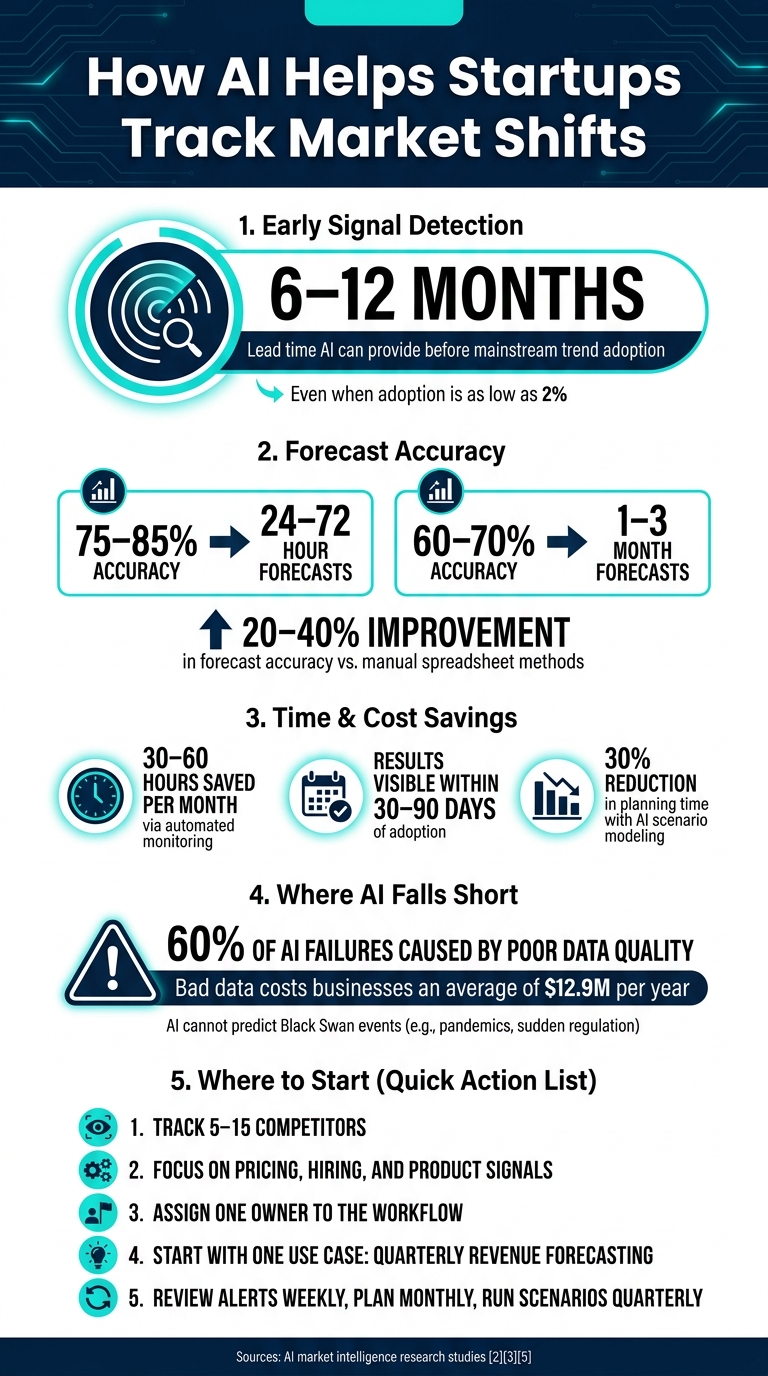
How AI Helps Startups Track Market Shifts: Key Stats & Benefits
What the research says about AI methods for tracking market shifts
Time-series models for demand, revenue, and volatility changes
Time-series forecasting tracks changes in demand, search volume, revenue, and pricing. In plain English, it looks at patterns over time and tries to spot where things are headed next.
For longer horizons, these models can flag trends 6–12 months before mainstream adoption, sometimes when adoption is only about 2%. That kind of lead time can be a big deal for startups trying to spot movement before everyone else does.
There’s a catch, though. These models need enough past data to learn from. If a startup is still early and doesn’t have much history, internal metrics alone may not be enough. In those cases, teams often add outside signals to improve model confidence.
NLP and sentiment analysis for news, reviews, and competitor signals
Numeric trends show what is changing. Text signals often show why.
Natural language processing (NLP) helps teams sort through large amounts of unstructured data, including social media posts, job postings, patent filings, news stories, and regulatory documents. That makes it useful for spotting competitor moves, customer concerns, and policy signals that raw sales numbers may miss.
Sentiment analysis adds another layer. It tracks customer reviews and analyst commentary to show how stakeholder perception is shifting over time. That can help a startup see when interest is building, when trust is slipping, or when a competitor’s message starts landing better.
The main downside is noise. Sarcasm, messy language, and niche terms can throw off results, especially when the dataset is small.
Data sources and model evaluation metrics
Market monitoring tends to work best when teams combine structured signals, like search volume and pricing, with unstructured text sources, like reviews and analyst notes. One data type shows the pattern. The other helps explain it.
Researchers usually judge these models by forecast horizon, directional accuracy, and lead time. Short-range forecasts in the 24–72 hour window can reach 75–85% accuracy, while 1- to 3-month forecasts often drop to 60–70%.
Together, these methods turn scattered market signals into inputs a team can track, test, and use for forecasting.
| Model Type | Startup Use Case | Strengths | Limitations |
|---|---|---|---|
| Search-Based Forecasting | Demand forecasting and seasonal planning | High accuracy in predicting search demand over a 12-month horizon | Reflects search behavior rather than absolute purchase intent |
| Early Trend Detection | Product discovery and opportunity spotting | Can identify trends at low adoption rates with 6–12 months of lead time | Accuracy drops significantly beyond the 12-month window |
| NLP/Sentiment Analysis | Tracking competitor messaging and customer reviews | Summarizes large volumes of unstructured data and detects shifts in perception | Can struggle with sarcasm or niche industry terminology |
| CI Automation | Pricing and product tracking | Automated monitoring with structured alert outputs | Can produce high noise without proper filtering |
One more limit matters here: AI cannot predict Black Swan events, such as pandemics or sudden regulatory shifts, because those events can break historical patterns. These methods are most useful when they connect directly to live revenue and market data.
sbb-itb-17e8ec9
How startups apply AI to respond to changing markets
Revenue forecasting under market volatility
When demand moves, founders need a runway forecast that reflects what's happening now, not what was true last week.
AI forecasting helps by pulling together accounting and CRM data and updating revenue projections on its own. That means less time stuck in spreadsheets and more time making decisions. The first job here is simple: show how market shifts change revenue and runway.
Forecast accuracy improves by 20–40% when teams use AI-driven tools instead of manual methods. On top of that, AI scenario planning cuts planning time by about 30%. So founders can stop rebuilding models over and over and start responding faster.
The main use case is AI vs. traditional scenario planning. AI can run best-case, base-case, and worst-case models at the same time. If churn spikes or the sales cycle gets longer, cash flow and hiring capacity update right away. And because the same system pulls in outside signals, teams can also spot what's pushing the change.
Competitive tracking and emerging opportunity detection
AI also gives startups a better read on the market around them.
Teams can use LLMs to watch competitor pricing pages, job postings, and product updates for early signs of a shift in direction. A company hiring for enterprise sales, for example, might be moving upmarket. A pricing page change can hint at a new packaging plan before the market talks about it.
AI tools can also track search and social signals to spot rising demand early. Those signals can then shape pricing and go-to-market moves, instead of leaving teams to react after the fact.
Pricing and go-to-market adjustments based on live signals
When conversion rates or win rates drop, it's easy to assume sales is the problem. But that's not always true.
AI can help teams figure out whether the issue is pricing, a competitor move, or something else in the market. Startups can use live pricing data and win/loss signals to decide whether to keep prices steady or make a change.
This works best when outside market signals plug straight into the finance and go-to-market systems teams already use. When market alerts connect with revenue and finance data, the team gets a clearer picture and can act with less guesswork.
Tools, finance workflows, and the conditions that make AI work
Why startups need connected financial and market data
Once a shift shows up, finance has to move fast. Spotting a market change only matters if finance can turn that signal into burn, runway, and hiring calls.
For that to happen, financial data needs to be clean and up to date. Poor data quality causes 60% of AI failures and costs businesses an average of $12.9 million per year. If the books are behind or revenue categories don't match across systems, AI monitoring tools are working with shaky inputs. And shaky inputs lead to shaky outputs.
The fix is pretty simple in theory, even if it takes work in practice: feed external market signals into the same system that tracks cash flow, revenue by segment, burn, runway, and hiring plans.
That only works when the finance stack keeps the underlying numbers current.
How Lucid Financials supports faster response to changing markets
This is where finance ops starts to matter far beyond bookkeeping. Lucid Financials is built for startups that need their numbers to move as fast as the market does.
Lucid combines bookkeeping and CFO support in one platform. It connects directly with Slack, gives real-time answers, and keeps books clean in seven days. It also supports what-if scenario modeling and always-on investor-ready reports. So when a market signal hits, the numbers behind the next decision are already in place.
Getting started: what small startup teams need in place
Before AI market signals become useful, small teams need a few basics locked in. Start with clean financial and operating data. Then connect the tools your team already uses, like QuickBooks, ERP, and CRM systems, so updates move automatically.
A fixed review rhythm also helps:
- Weekly for tactical decisions
- Monthly for planning
- Quarterly for scenario work
AI can flag changes. Finance and sales still need to judge what those changes mean and how the company should respond.
In practice, the biggest gap between teams isn't whether they have data. It's how fast they can update assumptions and act on them.
| Feature | AI-Driven Analysis | Spreadsheet-Based Monitoring |
|---|---|---|
| Speed | Real-time updates; instant scenario generation | Manual data entry; days/weeks to update models |
| Accuracy | 20–40% improvement via ML models | Prone to manual formula errors and stale data |
| Setup Effort | 3–6 weeks for full integration; hours for basic tools | Low initial effort; high ongoing maintenance |
The smart move is to start small. Pick one forecasting problem, like quarterly revenue, and prove the method before rolling it out more broadly. That gives the team time to build trust in the output before using it for bigger calls.
Benefits, limitations, and key takeaways for founders
What studies consistently find
In practice, the upside shows up in speed and coverage. Study after study points in the same direction: AI helps startups watch competitors on a steady basis, spot changes within hours, and find patterns that human analysts might need weeks to piece together.
Adoption is climbing fast, and many CI teams now use these tools every day. Automated monitoring can save 30 to 60 work hours per month, with gains often showing up within 30 to 90 days. For small teams, that can mean better visibility into pricing changes, product launches, and threat signals that shape revenue calls.
Where caution is still warranted
That speed only matters if someone filters the output and checks it. The limits are pretty clear: alert fatigue is a real problem when tools throw off too many signals without enough context, and models may need several weeks of tuning before they match a startup’s priorities.
Human review still matters before AI summaries or battle cards make their way to sales teams or leadership decisions. These tools tend to fall short when signals are noisy, priorities are fuzzy, or no one owns the workflow. Startups also need to make sure their tools rely only on public information so they stay within privacy and ethics lines.
Conclusion: AI helps startups react faster when the numbers are usable
For founders, the edge is not prediction by itself. It’s the ability to respond faster, with cleaner inputs.
A practical starting point is simple:
- Track 5 to 15 competitors
- Focus on a short set of intelligence questions around pricing, hiring, and product moves
- Assign a clear owner so insights lead to action instead of piling up as alerts
When signals are clean and the workflow is clear, AI can help founders move faster. But it still works best as a support tool for human judgment, not a stand-in for it.
Introduction to AI for Financial Forecasting & Planning | Transforming Finance with AI | Uplatz
FAQs
What data should a startup track first?
Start with your internal financial data: cash flow, burn rate, and revenue growth. Keep it clean, organized, and up to date. Lucid Financials helps by giving you real-time reporting and one accurate source of truth.
Then bring in external data, like a focused set of competitors and key macro indicators. When you use these signals together, founders can spot problems early and adjust before market shifts hit growth.
How much historical data does AI need?
AI doesn’t need a set amount of past data. It depends on the signal you’re tracking and the model you’re using.
For patterns like cash flow or seasonality, supervised learning looks at past trends to spot what “normal” has looked like over time. Volatility and sentiment monitoring work differently. They lean more on live feeds and update as new text comes in.
In practice, AI tends to work best when it has two things: a clean baseline from past behavior and frequent updates from current data.
How do teams avoid false AI alerts?
Teams cut false AI alerts by making signals actionable and tied to context.
That starts with the inputs. They clean the data, remove duplicates, and map entities the same way every time so the system isn’t reacting to messy records. They also give more weight to sources they trust, which helps weak signals carry less sway.
Thresholds matter too. Strong teams don’t trigger alerts just because volume jumps. They set thresholds around meaningful change, so the system looks for shifts that matter instead of noise.
They also watch patterns across 5-day and 20-day windows. That makes it easier to spot whether something is a short blip or part of a bigger trend. And alerts don’t just sit there - they’re tied to a defined review workflow, so someone knows what to check and what to do next.
On top of that, teams keep an eye on model performance. If the model starts to drift, it can fire off the wrong alarms, and that creates confusion fast.