Phantom equity can look simple, but one weak clause can turn it into a tax, cash, or payout problem. If I had to boil this article down to the core point, it’s this: write the plan with exact rules before you grant anything.
Here’s the short version of what matters most:
- 409A errors can hit employees hard with current tax, a 20% extra federal tax, and interest.
- Loose valuation terms can lead to payout fights, especially at exit.
- Vesting and leaver rules need to say who gets paid, when, and how much.
- Cash-settled plans need funding, and a 5% pool at a $50 million exit can mean a $2.5 million payout before tax handling.
- Employees need plain-English terms so they know this is not stock and what has to happen before money is paid.
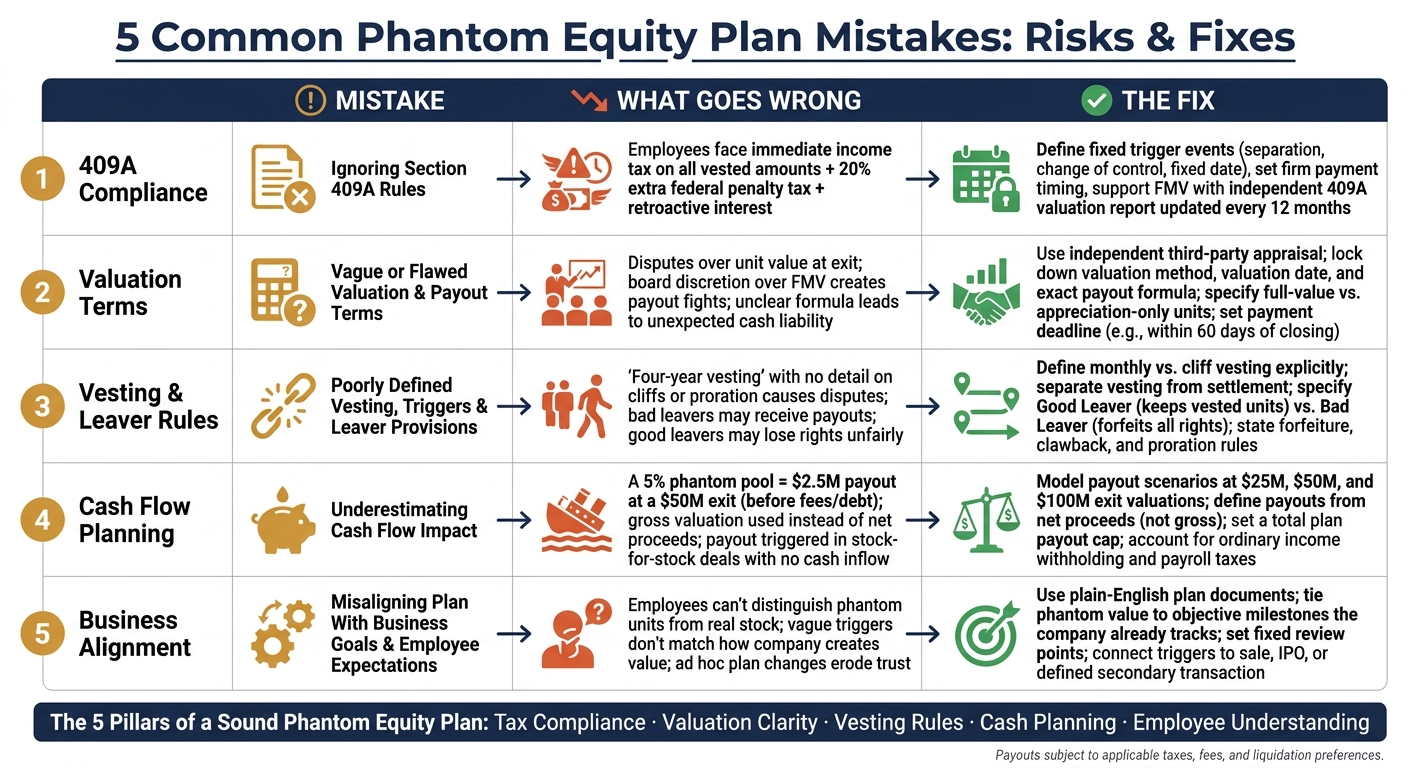
5 Phantom Equity Mistakes: Risks & Fixes at a Glance
Phantom Equity: Its Advantages and Disadvantages for Incentivizing Employees
sbb-itb-17e8ec9
Quick Comparison
| Mistake | What goes wrong | What I’d put in the plan |
|---|---|---|
| 409A rules ignored | Tax penalties, bad payout timing, deal friction | Fixed trigger events, fixed payment timing, FMV support |
| Valuation terms are vague | Disputes over unit value and payout formula | Third-party valuation, set dates, exact formula |
| Vesting and leaver terms are loose | Fights after termination or sale | Clear vesting, good/bad leaver rules, forfeiture terms |
| Cash needs are underestimated | Company owes cash it may not have | Scenario model at $25 million, $50 million, and $100 million |
| Plan does not match company goals | Confusion, weak retention, false expectations | Plain language, milestone fit, review points |
If you’re setting up phantom equity, I’d focus on five things from day one: tax compliance, valuation, payout triggers, cash planning, and employee understanding. That’s the whole article in one view.
How Phantom Equity Works in Startup Compensation
A phantom equity plan gives employees phantom units linked to the company’s value, not actual shares. In plain English, workers get the economic upside of equity without becoming stockholders.
Most plans use one of two setups:
- Appreciation-only units: these pay only the gain above a set base price
- Full-value units: these pay the full per-unit value when payout happens
Payout happens only if a trigger event listed in the plan document occurs. Vesting may be time-based, performance-based, or a mix of both. It can also help keep people on the team by pushing payout until they remain through the vesting period. Those terms shape the tax result and the cash planning founders need to think through.
Phantom equity is usually treated as nonqualified deferred compensation, which affects when tax applies.
Each unit you grant creates a future cash obligation. That’s the part many founders underestimate. Put the plan in writing, and have legal and tax professionals review it before rolling it out to employees. Those mechanics are where drafting mistakes tend to show up.
1. Ignoring Section 409A and Deferred Compensation Rules
The first mistake is treating phantom equity like an informal bonus instead of what it often is: 409A-covered deferred compensation. IRC Section 409A applies to these plans, and the cost of getting it wrong falls on employees first. They can face immediate income inclusion on all vested amounts, a 20% extra federal penalty tax, and interest going back to the year the compensation was first deferred. That’s why loose payout language causes so many problems.
Compliance Risk
Most Section 409A failures don’t look dramatic at first. They usually come from quiet drafting mistakes: payout triggers tied to vague liquidity events, board discretion over when payment happens, or no clear payment timing at all. Under 409A, payment events need to line up with permitted triggers - separation from service, disability, death, a defined change in control, a fixed date, or an unforeseeable emergency.
If the trigger works on paper but the valuation language is fuzzy, the plan can still run into trouble.
Valuation Clarity
Section 409A requires phantom equity to rest on a defensible fair market value (FMV). Plan language that gives the board total discretion over valuation does not satisfy that standard. A common approach is to connect payout calculations to an independent 409A valuation report and update that report at least every 12 months, and again after any material event, like a major financing.
The plan should spell out:
- the valuation method
- the valuation date
- the payout formula
If that formula is hard to pin down, employees can’t estimate what they may receive, and the company has a weak case if the payout is challenged.
Cash Liability Exposure
Meeting the rule is only part of the job. The other issue is having cash ready when payment comes due. If Section 409A issues come up close to an acquisition, buyers may push for a lower purchase price or ask for indemnities to cover the risk. Founders should accrue expected liabilities and model payout cases before the next financing round or a sale.
2. Using Vague or Flawed Valuation and Payout Terms
Even a compliant phantom equity plan can fall apart if the payout terms are fuzzy. Once the payout language gets loose, a retention tool can turn into a dispute. If the board can set fair market value whenever it wants, the company has too much wiggle room, and founders and employees may walk into an exit expecting very different numbers. The answer is simple: use exact valuation and payout language.
Valuation Clarity
The plan needs to pin down three things: what a unit is worth, when that value is measured, and how the company will pay it. Valuation should rely on an independent third-party appraisal updated at set intervals and after material events, not board discretion. The plan also needs to say whether grants are full-value or appreciation-only, because those two setups can lead to very different cash outcomes.
That level of detail matters. If people don't know the starting value, the measurement date, or the payment method, the whole plan gets shaky fast. And this same need for precision carries over to vesting and trigger terms.
Payout Timing and Triggers
This is where a lot of plans go off the rails. Vague trigger language often leads straight to payout fights. Undefined liquidity events are a common source of disputes.
The plan should spell out the exact events that trigger payment, such as:
- a change in control
- a fixed calendar date
- separation from service
It should also set a firm deadline for payment after the trigger happens, such as within 60 days of closing.
Cash Liability Exposure
Phantom equity is a cash-settled obligation. That means the company isn't handing over stock. It's taking on a cash payment duty. If the plan doesn't say whether payouts are calculated before or after transaction costs, liquidation preferences, or debt, the liability can come in much higher than founders expected.
Before the plan goes live, model payout scenarios using the plan's exact formula. On paper, a formula may look harmless. In a sale process, though, small wording gaps can change the check by a lot.
| Valuation approach | How it works | Main risk if poorly defined |
|---|---|---|
| Independent appraisal | Third-party FMV at set intervals or trigger events | Timing gaps if not updated after major financings |
| Formula-based (e.g., EBITDA multiple) | Calculated from defined financial inputs | Formula manipulation if inputs aren't locked down |
| Full-value phantom unit | Pays based on total share value at settlement | Disputes over base value or dividend treatment |
| Appreciation-only phantom unit | Pays only the gain from grant date to payout | Arguments over the grant-date valuation reference |
Clear valuation language matters, but the plan can still break down if vesting and departure rules are loose.
3. Poorly Defining Vesting, Triggers, and Leaver Provisions
A clear valuation formula helps, but it won’t save a plan if vesting and departure rules are fuzzy. That’s where phantom equity plans often go sideways.
For example, saying “four-year vesting” sounds fine on the surface. But what does that mean in practice? Monthly vesting? Annual cliffs? Proration for part of a year? If the plan doesn’t say, you’re leaving room for an argument later.
Compliance Risk
Vesting and settlement should be defined as separate things. If they blur together, the plan can create accidental deferred compensation.
Payout Timing and Triggers
Once vesting is set, the next issue is simple: when is cash actually owed?
Pick one objective trigger event. Then spell out exactly when payment happens:
- at signing
- at closing
- when proceeds are received
If you skip that detail, trouble starts fast. One person may think payment is due the day the deal is signed. Another may expect it only after cash lands in the company’s account.
Leaver Provisions
Leaver terms need to be blunt, not vague. A plan should say what happens in each departure case, especially for good leavers and bad leavers.
A bad leaver - for example, someone terminated for cause or misconduct - should generally lose all rights.
A good leaver - such as someone laid off without cause, disabled, or deceased - will often keep some or all vested units.
For any other type of exit, the plan should state:
- whether unvested units are forfeited
- whether vested units are kept or partly clawed back
- whether the person shares in a later exit
- when payout rights stop
That detail matters more than many founders expect. Without it, a startup could end up paying someone fired for serious misconduct. Or it could face a fight with a laid-off employee who thought they would still share in a later sale.
Run payout scenarios early so you can forecast cash needs before the plan goes live.
4. Underestimating Cash Flow Impact and Funding Needs
Phantom equity creates a future cash obligation. And that obligation has to compete with payroll, vendors, and day-to-day operating costs. A clean vesting schedule won't save you if the company can't cover the payout.
Cash Liability Exposure
A 5% phantom pool can turn into a $2.5 million payout at a $50 million exit, before debt, fees, and liquidation preferences cut into what shareholders actually receive.
That number can climb fast as the company's valuation goes up. So even before any payout trigger shows up, the liability can put pressure on the balance sheet.
One common mistake is looking at each grant on its own instead of adding up total exposure across the full plan. Another is using gross valuation to set payouts instead of net proceeds. That sounds small on paper, but it can leave the company owing far more than the cash it has when the bill comes due.
And here's where it gets messy: sometimes the trigger hits before the cash does.
Payout Timing and Triggers
If the plan says payment is due at the time of a sale, but doesn't connect that payment to actual cash proceeds, the company can end up with a liability in a stock-for-stock deal or another non-cash transaction, even if no cash comes in to fund the payout.
For early-stage startups, exit-based triggers are usually the safer route because the payout comes straight from the deal proceeds. Time-based cash payouts are a different story. They can strain the business fast unless the financial model shows a clear path to profitability. If you add a deadline, tie it to a financial threshold.
Funding the payout is only one side of the problem. Taxes can create another cash hit at the same moment.
Compliance Risk
Phantom payouts are generally taxed as ordinary income. That means the company has to withhold and remit payroll taxes when payment is made. If withholding happens late or gets handled the wrong way, penalties can follow, and officers may face personal liability.
A simple way to stay ahead of this is to build a scenario-based cash liability model. Map out what the company would owe at:
- $25 million
- $50 million
- $100 million
Include taxes in each case. Then set a clear cap on total plan payouts and define payouts from net proceeds, not gross valuation.
5. Misaligning the Plan With Business Goals and Employee Expectations
Phantom equity can fall flat when it feels more like a delayed bonus than an ownership-style incentive. That usually happens when founders build the plan around legal mechanics instead of business results. And even if the plan is legal and funded, it still misses the mark if employees can't tell what they're earning.
When the Benchmark Doesn't Match the Milestone
Vague valuation language can wear down trust fast. If the plan says value is based only on board discretion, employees have no clear benchmark.
A better setup ties phantom value to the same objective measure the company uses when it hits a real milestone. That way, employees are tracking the same number the business is tracking. No guesswork. No moving target.
When Triggers Don't Reflect How the Company Grows
Misaligned triggers create a gap between what employees expect and what the plan pays out. The plan should connect payouts to a sale, IPO, or a defined secondary transaction, with optional installment language to help protect cash flow while still honoring the economic deal.
That matters because growth doesn't always follow a neat path. If the trigger doesn't match how the company actually creates value, the plan can feel off even when the paperwork says otherwise.
When the Plan Creates Confusion Instead of Clarity
Ad hoc changes to plan terms - and language that suggests employees own actual shares instead of phantom units - can lead to false expectations and disputes. That's why the plan needs:
- Clear milestones
- Plain-language terms
- Fixed review points from day one
The next section shows how to build those guardrails into the plan from the start.
Fixes Founders Should Build Into the Plan From Day One
These five mistakes usually trace back to one core problem: the plan wasn't spelled out clearly enough at the start. The fix is simple in theory, but it takes discipline. Put the rules in writing before the plan goes live.
Lock down 409A-compliant payment timing by defining trigger events and settlement dates in writing.
Spell out the vesting schedule, change-in-control treatment, and valuation method.
Define good-leaver, bad-leaver, accelerated-vesting, and clawback rules.
Model payouts before launch. Set threshold, target, and maximum payout levels tied to clear financial metrics. Then test how those payout levels affect cash flow and runway across different outcomes. Lucid Financials can model payout, cash flow, and runway scenarios before an exit or financing event. Those same guardrails also make it easier to compare phantom equity with real equity.
Phantom Equity vs. Real Equity: A Side-by-Side Comparison
Once you’ve set the plan terms, the next step is simple: put phantom equity next to stock options and real equity and look at the tradeoffs. The big issues are ownership, tax treatment, and cash at payout. Those three points usually decide whether phantom equity makes sense.
This is where the drafting details start to matter. On paper, two plans might offer similar upside. In practice, they can lead to very different tax results, cash needs, and ownership outcomes. The table below lays out the six differences that matter most, so you can check whether phantom equity fits your company’s cash profile and incentive goals.
| Category | Phantom Equity | Stock Options (ISO/NSO) | Real Equity (Common Stock/RSUs) |
|---|---|---|---|
| Instrument type | Contractual promise to pay cash tied to company value or a liquidity event | Right to buy shares at a fixed exercise price | Actual ownership in shares |
| Ownership rights | None | None until exercised | Full ownership rights |
| Cap table dilution | No dilution | Dilutes on exercise | Dilutes immediately upon issuance |
| Employee tax treatment | Ordinary income at payout; no capital gains treatment | ISOs can qualify for favorable capital gains treatment if holding requirements are met; NSOs generally create ordinary income at exercise on the spread | Ordinary income at vesting for RSUs and unrestricted stock; capital gains on later appreciation if held long enough |
| Employer payroll & tax handling | Compensation expense; withholding and payroll taxes apply | Payroll tax rules vary by type; NSO exercises require withholding; ISOs generally do not trigger payroll taxes | Deduction available when the employee recognizes income; payroll tax rules differ by instrument |
| Cash required at settlement | Yes - the company must fund the cash payout when the trigger event occurs | No company cash required at grant or exercise; the employee pays the exercise price | Shares are issued; no cash required at grant, though buybacks or secondary transactions may need funding |
A few differences stand out right away.
- Phantom equity needs company cash at settlement. If the trigger event happens, the company has to pay.
- Phantom equity does not create ownership. The recipient gets economic upside, but not shares or stockholder rights.
- Phantom equity is often simpler, but usually less tax-efficient. Stock options and real equity can offer better tax results in the right setup.
That last point matters a lot when you’re choosing the right incentive for a given role. Phantom equity tends to work well when actual equity is hard to use in practice, such as for executives, contractors, or international hires.
Conclusion
Every phantom equity mistake starts in the same place: unclear terms or a weak read of the economics. The five issues covered here - compliance, valuation, vesting, cash planning, and alignment - usually point back to one problem. The plan wasn’t spelled out well enough before the first grant went out.
At the center of all five fixes is clarity. Build incentive design around measurable, controllable results tied to company success. Make sure participants understand the payout formula, the trigger event, and the timing. Explain the plan in plain English, and do it early.
If employees can’t see the link between their units and the payout, the plan won’t retain them. Spell out the payout formula, tie rewards to measurable results, and explain the plan before the first grant. If employees can’t understand the upside, the plan won’t hold them.
FAQs
Is phantom equity taxable before I get paid?
Yes. Federal and state income taxes are usually deferred until you receive your payout. But employment taxes, including FICA and FUTA, may come due when your phantom units vest.
That timing matters. If your units vest before a liquidity event, you could owe taxes before you receive any cash. In plain English: you might have a tax bill while your payout is still on paper.
It’s smart to check with your company about how those withholding obligations will be handled.
How should a startup value phantom units?
First, decide whether the plan is full-value or appreciation-only. Then use a reliable fair market value, ideally backed by a safe harbor valuation from a qualified independent appraiser.
To keep the value defensible and lower IRS scrutiny, get an independent 409A valuation each year and choose an IRS-approved method that fits your business needs.
What happens to phantom equity if I leave?
What happens next comes down to your written grant agreement. In most cases, phantom equity pays out ONLY when a trigger event named in the contract happens. That might be separation from service, death, disability, a change in control, or a set payout date.
The plan can also spell out what happens if you leave before full vesting. In some cases, unvested units are forfeited. In others, the agreement gives some protection if you meet the plan’s good leaver terms.