Phantom equity can stay off your cap table and still put a cash liability on your balance sheet. If you run this process by hand, small data gaps can turn into close issues, payroll mismatches, and board decks that don’t tie out.
Here’s the short answer: I’d keep phantom equity reporting under one close workflow built around one grant register, period-end valuation updates, liability rollforwards, and payroll/tax tie-outs. Then I’d use AI to check records across HR, payroll, legal docs, and the GL, draft entries, and prep board schedules.
What matters most:
- Phantom equity is usually cash-settled under U.S. GAAP, so it often needs expense recognition and liability remeasurement each reporting period.
- It does not dilute ownership, but it can affect cash planning, exit proceeds, and investor reporting.
- W-2, withholding, and FICA usually apply at payout.
- Section 409A can matter when payment is deferred.
- A clean process should track:
- grant terms
- vesting
- forfeitures
- valuation inputs
- payout timing
- journal entries
- current vs. long-term liability
- AI helps most with:
- document extraction
- cross-system checks
- liability math
- entry drafting
- plain-English reporting notes
A simple way to think about it: if your phantom equity file can’t answer what is owed, when it may be paid, and how the balance changed this period, your process needs work.
Compared with stock options or RSUs, phantom equity usually creates a cash payout obligation instead of share issuance. That one difference changes the accounting, tax reporting, and forecast impact.
| Area | Phantom equity | Stock options / RSUs |
|---|---|---|
| Shares issued | No | Yes, at exercise or settlement |
| Cap table effect | No ownership dilution | Dilution can occur |
| Main reporting issue | Liability and period remeasurement | Often equity treatment |
| Cash impact | Future cash payout | Varies by plan type |
I’d treat the article’s core point like this: build the reporting process once, connect it to close, and let AI handle the repeated checks that tend to cause errors as grant activity grows.
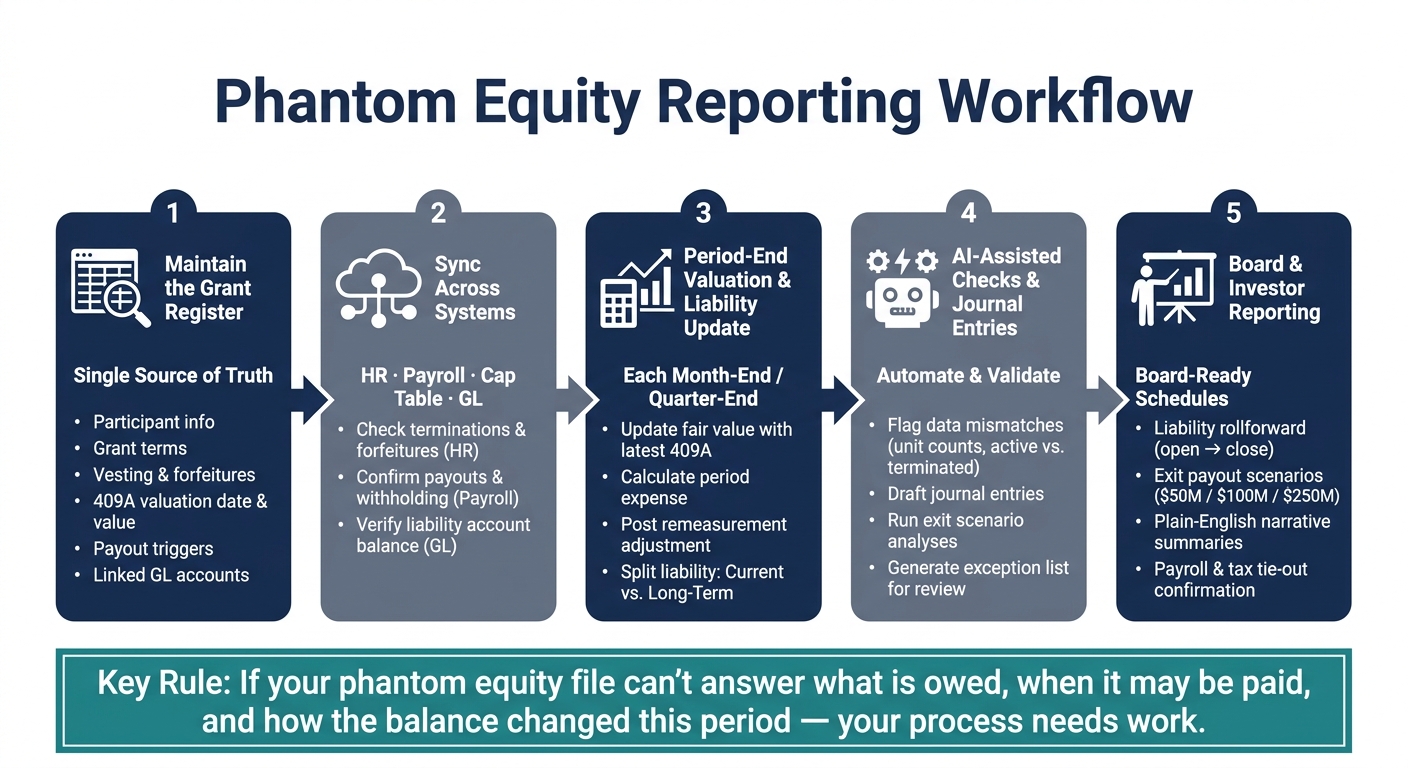
Phantom Equity Reporting Workflow: From Grant Register to Board-Ready Schedules
1. Understand what phantom equity means for your financials
Before you automate reporting, first map phantom equity to the financial statements it touches.
Phantom equity is a cash-settled compensation promise tied to a hypothetical share value. It does not give someone ownership, but it does create both a liability and compensation expense. It also does not show up on the cap table. For example, 1% phantom equity can track growth in company value without issuing any shares.
Where phantom equity fits in your compensation and capital structure
Phantom equity sits next to tools like stock options and RSUs, but it is not part of your legal ownership structure. It is a contractual pay obligation - a future cash liability that flows through your income statement and balance sheet, not your ownership percentages.
That difference matters in investor conversations. Investors need to know that phantom equity does not dilute their stake, yet it still creates a real cash obligation that can affect runway, exit proceeds, and financial projections. A clear disclosure that shows total liability at a few exit values helps them see the cash impact fast.
What triggers reporting under U.S. GAAP and payroll rules
Under U.S. GAAP, phantom equity is usually treated as a cash-settled compensation liability. You recognize the expense over the service period and remeasure the liability at each close.
Payouts are usually ordinary income reported on Form W-2, with withholding and FICA due at payment. If payment is deferred, Section 409A comes into play. If the plan does not comply, the participant can face current income inclusion, a 20% extra tax, and interest on unpaid taxes.
Here’s the short version of how phantom equity differs from stock options and RSUs:
| Phantom Equity | Stock Options / RSUs | |
|---|---|---|
| Issues actual shares | No | Yes, after exercise or settlement |
| Cap table impact | No dilution; cash obligation exists | Yes, affects dilution |
| Tax treatment | Ordinary income at payout; W-2 reporting | Varies by instrument and timing |
| Accounting focus | Liability and remeasurement at period-end | Often equity-classified |
So what does this mean in practice? Phantom equity changes compensation, liability, and payroll reporting, but not ownership percentages. The data your AI system needs to tie together includes grants, vesting schedules, fair value, and payout tax treatment. That makes phantom equity a strong use case for an automated reporting workflow.
With the instrument defined, the next step is building a repeatable workflow for grants, valuation, and close entries.
sbb-itb-17e8ec9
2. Build a repeatable phantom equity reporting workflow
Once phantom equity is tied to the financial statements, the next move is simple: make it part of the close.
Create a single phantom equity register and gather the right source documents
Use one phantom equity register as the master record. Each row should represent a grant. Each column should track the main details: participant information, grant terms, vesting, forfeitures or cancellations, valuation basis, most recent 409A date and value per unit, payout triggers, and linked GL accounts.
Keep that register in sync with HR, payroll, and the general ledger. In practice, that means:
- checking HR records each period to spot terminations and forfeitures
- confirming payouts and withholding through payroll
- verifying that the ending balance ties to the phantom equity liability account in the general ledger
All support should live in one organized, access-controlled location. That includes the signed plan document and any amendments, individual award agreements, board and compensation committee approvals, 409A valuation reports, cap table reports, HR records, payroll reports, and prior-period close workpapers. Every value in the register should tie back to one of those documents.
Record period-end valuations, expense, and liability updates
At each month-end or quarter-end close, update fair value using the latest valuation, calculate period expense, post the remeasurement adjustment, and split the liability between current and long-term balances based on expected payout timing.
A simple way to handle this is to tag each grant in the register with its expected payout timing. Then total the portion expected to settle within 12 months as current, and classify the rest as long-term. Update that split whenever there is a new financing, a shift in exit probability, or an amendment to plan terms.
Here’s how a structured workflow stacks up against a manual one across the five main close tasks:
| Task | Manual approach | Structured workflow |
|---|---|---|
| Fair value update | Ad hoc estimate in spreadsheets | Standard valuation input and documented review each close |
| Expense calculation | Separate formulas by employee or grant | Centralized schedule tied to vesting and reporting date |
| Journal entries | Hand-prepared entries with copy-paste risk | Recurring entry logic with review and approval |
| Liability classification | Updated only before audits or fundraising | Reviewed each period based on expected payout timing |
| Support for reporting | Files stored across email and folders | One reconciled package for close and due diligence |
Prepare investor-ready schedules for fundraising and exit scenarios
Use the same register to produce three core schedules for investors and acquirers: a unit-and-liability schedule, an exit payout scenario schedule that models cash payouts at hypothetical exit values such as $50,000,000, $100,000,000, and $250,000,000, and a proceeds schedule that shows phantom payouts alongside transaction costs and debt.
Keep those schedules in clean tables and state the assumptions clearly. That way, the package can be updated each period instead of rebuilt from scratch. When a deal starts moving fast, that saves a lot of time.
With the workflow standardized, AI can automate the checks and entries in the next step.
3. Use AI to automate valuation checks, journal entries, and reporting
How AI pulls together cap table, HR, payroll, and accounting data
Once the register and close process is set up, AI can reconcile the plan across systems before close.
This is where teams often lose time: one record says one thing, another system says something else, and now someone has to sort it out by hand. AI matches participants across the cap table, HRIS, payroll, and the GL using employee IDs or email addresses. Then it flags mismatches before close.
That includes:
- Unit-count mismatches
- Active-versus-terminated conflicts
- Grants tied to no underlying agreement
The output is a clean exception list your team can work through before locking any numbers.
How AI supports fair value updates and accounting entries
Once the data is clean, AI moves into the math.
It applies the plan's payout formula to current valuation inputs, runs scenario analyses across different exit outcomes, and recalculates the period-end liability for each grant. From there, it computes the period change, maps it to the chart of accounts, and drafts journal entries for review.
| AI capability | Phantom equity reporting need | Expected output |
|---|---|---|
| Data extraction | Pull grant terms, vesting data, and payout rules from source documents | Structured register |
| Reconciliation checks | Compare HR, payroll, cap table, and ledger records | Exception list |
| Liability modeling | Recalculate fair value and payout scenarios at each reporting date | Updated liability schedule |
| Journal entry drafting | Convert calculations into period-end entries | Draft entries |
| Reporting summaries | Explain changes in expense and liability in plain English | Narrative notes |
Controllers and CFOs still approve assumptions and entries before anything gets posted.
How AI improves board and investor reporting
Investors usually want three answers: how much is owed, when it is due, and what it means for runway.
A well-set-up AI reporting layer can produce a liability rollforward that ties the opening balance to the closing balance through vesting, forfeitures, settlements, and remeasurement. It can also add cash obligation scenarios under multiple exit values and combine those figures with current burn and runway projections.
Just as important, it can draft plain-English narrative summaries that explain what changed and why. Keep those writeups tight. One sentence tied to the actual driver of change is often enough.
These outputs can go straight into the monthly close and board package.
4. Put the workflow into practice with Lucid Financials

Set up phantom equity tracking inside your monthly close
Once the workflow is set, Lucid makes phantom equity part of the monthly close instead of a side spreadsheet that gets patched together later.
Lucid brings plan terms, vesting, and payout triggers into one register, then maps them to separate expense and liability accounts. That gives the team one place to track what matters and a cleaner path into the books.
At each month-end, Lucid pulls updated headcount, grant dates, vesting status, and plan amendments from connected systems. It also flags mismatches and drafts journal entries for review before posting.
There’s a practical upside here: founders can ask Slack for the current liability or changes in expense without digging through files. Lucid also flags material quarter-over-quarter increases and spots shifts from long-term liability to current liability.
Connect tax, payroll, and forecasting to the same reporting process
After the register and entries are up to date, payroll and tax treatment can tie back to the same source of truth. Lucid coordinates phantom equity payouts with payroll so withholding, FICA, and W-2 reporting reconcile to the liability rollforward. At the same time, tax specialists line up book and tax treatment with federal and state filings.
For CFO forecasting, Lucid rolls phantom equity expense into EBITDA, net income, runway, and hiring plans. It also builds investor-ready schedules across multiple growth and exit scenarios.
That means finance, payroll, and investor reporting stay in sync without having to rebuild the analysis every month.
Conclusion: Keep phantom equity accurate, current, and investor-ready
Phantom equity doesn't show up on the cap table, but under U.S. GAAP it does create a balance sheet liability. That's why the close process is the moment that matters most.
Strong reporting comes down to four things: a complete grant register, scheduled valuation updates, monthly liability rollforwards, and payroll treatment that lines up with accounting. Get that workflow in place, and AI can help keep it current without all the spreadsheet chasing.
AI can automate data intake, flag errors, and draft journal entries. That cuts much of the manual work that tends to slow the close.
Lucid Financials builds phantom equity tracking into the monthly close, keeps payroll and tax in sync, and maintains board-ready schedules. The result is a process finance can trust month after month.
Build the process once, keep it current, and phantom equity stays ready for every close, round, and diligence request.
FAQs
How is phantom equity valued each reporting period?
Under ASC 718, phantom equity must be marked to market at each reporting period. Since it’s treated as a liability, the company has to revalue it based on the current fair market value.
That means the accounting can shift over time. If the valuation goes up, the related expense goes up too. So clean, accurate tracking matters. Using a fair market value from a qualified independent appraiser can help support compliance and keep the numbers on solid ground.
When does phantom equity become a current liability?
Phantom equity is recorded as a liability because it creates a future cash payment the company may have to make. And because those units are linked to the company’s valuation, they need to be marked to market in each reporting period under ASC 718.
That means when the company’s valuation moves up or down, the liability changes too. The related compensation expense has to be adjusted along with it, which can lead to swings in your financial statements.
What data should be in a phantom equity grant register?
A phantom equity grant register should serve as one reliable source of truth. It also needs backing from signed, legally enforceable documents.
For each participant, record:
- Contact information
- The number of phantom units granted
- The vesting schedule
- Payout trigger events, such as a change in control, separation from service, death, disability, or a fixed date
- The fair market value at the time of grant
That way, the register does more than track grants on paper. It shows who received what, when it vests, and what event leads to payment.