A 5% to 10% currency move can hit margin, cash flow, and budgets fast. If I run a startup with foreign revenue, overseas payroll, supplier invoices, or a non-U.S. entity, FX risk usually shows up long before I build a treasury team.
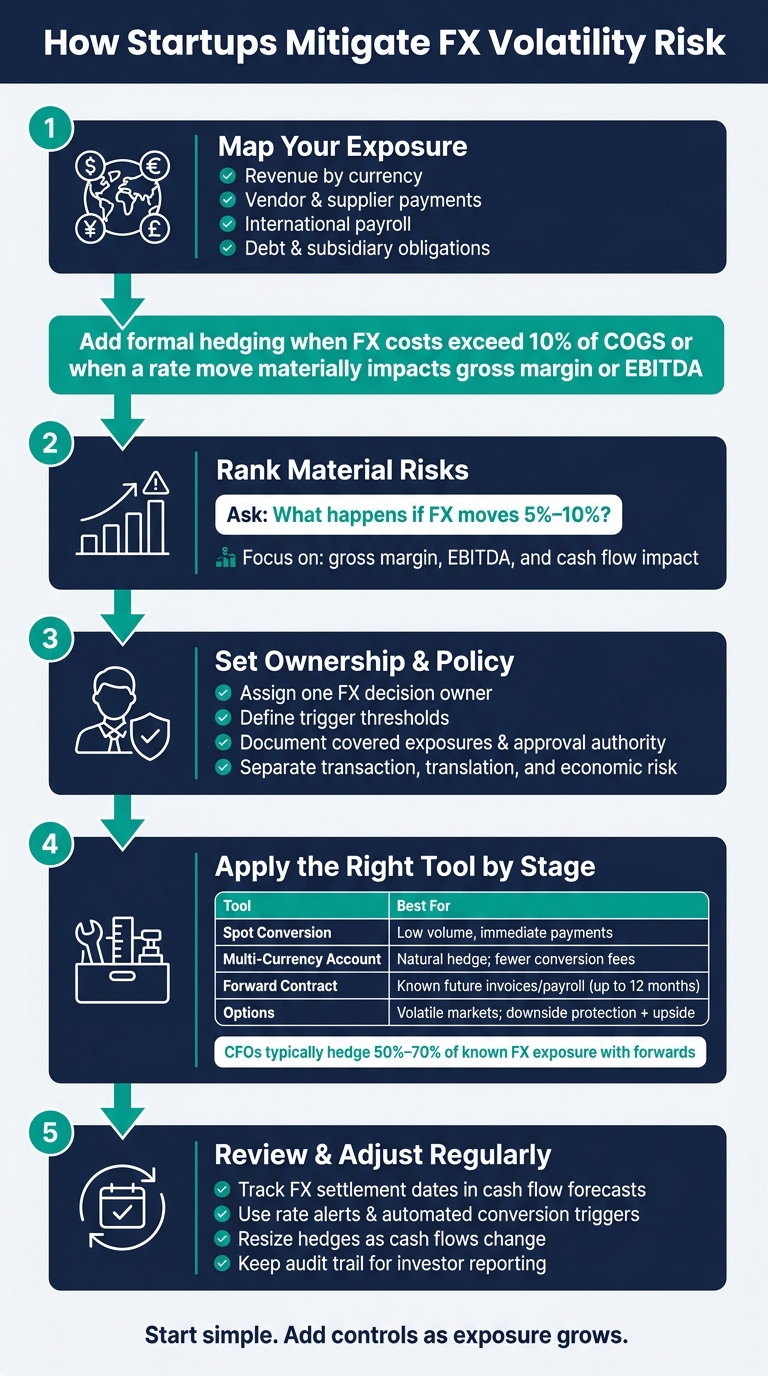
Here’s the short version: most startups start simple, then add controls as exposure grows. I’d usually begin by mapping where money comes in and goes out by currency, use multi-currency accounts to cut extra conversions, and then add forward contracts when future payments are known. If FX costs start to touch more than 10% of COGS, or if a rate move could change gross margin or EBITDA in a material way, teams often stop using ad hoc conversions and put a policy in place.
What I’d focus on first:
- Map exposure across revenue, vendors, payroll, debt, and subsidiaries
- Rank risk by asking: what happens if FX moves 5% to 10%?
- Assign one owner for FX decisions
- Use simple tools first: spot conversions and multi-currency accounts
- Add hedging for known future payments: mostly forwards, sometimes options
- Track settlement dates so conversions and hedges happen on time
- Keep records clean for reporting and investor updates
The main idea is simple: startups that deal with FX well don’t try to predict markets. They reduce avoidable conversions, hedge known exposure, and review cash flow often enough to keep surprises smaller.
Startup FX Risk Mitigation Framework: Step-by-Step Guide
Objectives of FX Hedging
sbb-itb-17e8ec9
What the Research Shows Startups Actually Do
When FX moves start to bite, most startups stop winging it.
Research shows that startups tend to ignore FX until volatility starts eating into margins. In smaller firms, currency risk is often handled as an ops task, not a finance policy, until a sharp rate move hits profit in a way the team can’t miss.
That’s usually the point where companies shift from ad hoc conversions to basic hedging. Startups often put more structure in place when foreign-currency costs rise above 10% of COGS or when foreign revenue becomes a meaningful part of the business. Before that, many teams stick with spot conversions and multi-currency accounts.
Why Some Startups Hedge and Others Do Not
In practice, hedging tends to follow two things: the size of the exposure and whether someone clearly owns the job.
For firms making fewer than 20 international payments per month, the usual informal setup is simple: spot conversions plus multi-currency accounts. It’s easy, it works, and for low volumes, it’s often enough.
As payment volume grows, the setup usually changes. More businesses start using forward contracts and automated conversion triggers, because manual handling gets harder to manage and the FX impact becomes harder to shrug off.
The Most Common FX Tools in Practice
Research points to a pretty clear path in how startups use FX tools.
Early on, multi-currency accounts are common because they let a company hold, receive, and pay in foreign currencies without converting every single transaction. That can cut repeated spread costs, which matters more than many founders expect at first.
Once exposures become more predictable, startups often turn to forward contracts. These let them lock exchange rates for known future payments for up to 12 months, which helps protect budgeted margins and adds more certainty to profit and loss. Many CFOs hedge 50% to 70% of known foreign-currency exposure with forwards and leave the rest unhedged, so they still have some upside if rates move in their favor.
Here’s how those tools usually show up in practice:
| Tool | Typical Usage Scenario | Primary Benefit |
|---|---|---|
| Spot Conversion | Immediate payments; low transaction volume | Simple; no lock-in |
| Multi-Currency Account | Receiving and paying in the same currency | Natural hedge; fewer conversion fees |
| Forward Contract | Known future supplier invoices or payroll | Budget certainty |
| Options | Volatile markets where upside potential matters | Downside protection with upside participation |
What keeps this from turning into guesswork is policy. Teams that handle FX well usually set thresholds, assign ownership, and follow a steady process.
The Main FX Risk Mitigation Methods and When They Fit
As FX exposure grows, startups usually move from natural offsets to formal hedges. The goal is simple: match the tool to the company’s stage and payment volume.
Financial Hedging: Forwards, Options, Swaps, and Loan Hedging
Use financial hedging when a currency move could hit margin or cash flow in a meaningful way.
For many growing startups, the first tool is a forward contract. It locks in today’s exchange rate for a known future payment, often for supplier invoices or international payroll. Companies commonly use forwards for obligations up to 12 months out.
Options cost more because they come with a premium. But they give downside protection while still letting you gain if rates move your way. Later-stage companies often use a mix of forwards and options.
Currency swaps are a better fit for recurring, multi-period exposures. And foreign-currency borrowing can act as a natural hedge when debt service lines up with the currency of revenue.
Here’s how these tools usually fit by stage:
| Tool | Best Startup Stage | Startup Use Case | Risk Reduction | Cost & Complexity |
|---|---|---|---|---|
| Forward Contract | Series A / growth stage | Locking in rates for known future invoices or payroll | High | Moderate; may require credit line or deposit |
| Options | Later stages / volatile markets | Downside protection with upside potential | High | Higher; premium cost |
| Swap | Later stages / recurring exposures | Managing multi-period currency obligations | High | Moderate to high; requires counterparty agreement |
| Loan Hedging | Growth / later stages | Matching debt service to revenue currency | Medium to high | Varies; tied to financing structure |
Operational Hedging: Matching Currency Inflows and Outflows
Before using financial instruments, many startups can cut FX risk just by avoiding extra conversions. If a startup earns revenue in euros and pays a European supplier in euros, holding those funds in a euro-denominated account creates a natural hedge.
A practical move is to net receipts and payments in the same currency before converting. That sounds straightforward, but in practice it only works when one person clearly owns the process.
FX Policy and Accounting Discipline
Startups that handle FX well usually have one clear owner and a short FX policy. That policy should spell out covered exposures, trigger points, and approval authority. It should also separate transaction risk, translation risk, and economic risk.
For later-stage startups, U.S. GAAP ASC 815 adds another layer. Proper documentation and hedge accounting matter because they help report gains and losses on hedging instruments in a way that lines up with the underlying exposure. That makes FX easier to manage and easier to explain to investors.
Once exposures and rules are set, the next step is tracking them in real time.
How AI and Real-Time Finance Systems Improve FX Risk Control
AI for Forecasting, Scenario Analysis, and Cash Flow Downside
Once policy and hedge tools are in place, the edge comes from making faster calls with live data. In FX risk control, timing matters just as much as setup.
Scenario modeling is a practical place to start. Finance teams can model the P&L impact of a 10% adverse currency move to see whether an exposure is large enough to hedge. It also helps to stress-test cash flow before rates shift, so teams have time to respond instead of scrambling after the fact.
Cash flow forecasts should include FX settlement dates, so hedges and conversions happen before exposure grows. When forecasts track foreign-currency settlement dates, startups can schedule large conversions with more care and use trigger thresholds instead of watching the market by hand. Rate alerts can also help finance teams adjust hedges as cash flows change.
Those same forecasts shouldn't stop at hedge timing. They should feed directly into bookkeeping and reporting too.
Using Integrated Finance Operations to Stay Investor-Ready
Real-time visibility matters most when it carries through to accounting and treasury reporting. Integrated multi-currency accounts let teams keep local-currency balances in place and maintain a clean audit trail. That makes it easier to keep hedge support, cash balances, and FX gains and losses lined up for reporting.
If a startup doesn't have a full in-house treasury team, an outsourced FX desk can help fill the gap. It can provide proactive hedging strategies and profit-and-loss impact modeling without the overhead of building that function internally. Lucid Financials combines bookkeeping, tax, and CFO support with real-time reporting, so FX decisions stay current.
When bookkeeping, forecasting, and FX decisions all run on the same data, startups can spot concentration risk earlier, resize hedges faster, and keep investor reporting up to date.
Conclusion: A Practical FX Risk Framework for Growing Startups
Startups deal with FX risk best when they treat it as a steady process, not a one-off fix. In practice, a simple operating framework works better than ad hoc reactions.
Use this sequence: Map exposures across revenue, vendor payments, international payroll, and debt. Rank material risks by focusing on currency pairs where a 5% to 10% move would have a meaningful effect on gross margin, EBITDA, or cash flow. Set ownership and thresholds with a short FX policy that defines who makes the calls. Use simple controls first - multi-currency accounts and spot conversions - before adding forward contracts or automated rate triggers as volumes grow. Review regularly, adjusting hedging strategies as cash flows change.
That cadence is what keeps FX risk manageable as startups grow.
FAQs
When should a startup start hedging FX risk?
Consider hedging FX risk once currency swings start to hit your business’s financial health or make results harder to predict.
A few signals tend to make the need pretty clear:
- A 5% to 10% exchange-rate move has a material effect on gross margin, EBITDA, or cash flow forecasts
- Foreign currency costs make up more than 10% of cost of goods sold
- Your business has meaningful foreign revenue
- Your board or investors expect you to manage currency risk rather than speculate on it
At that point, hedging stops being a nice-to-have and starts looking more like basic financial discipline.
What FX exposures should we track first?
Start with transaction exposure: open receivables, payables, and cash transfers, with special attention to the FX gap between the invoice date and settlement for each currency pair.
Then track cash balances by currency, expected inflows and outflows, and any hedge coverage and maturity dates. Include each currency you use, along with the timing and amount of revenue, supplier costs, payroll, and foreign-held debt or investments.
How much of our FX exposure should we hedge?
Hedge the part of your FX exposure that could throw off your plan in a big way. A common rule of thumb: if a 5%–10% currency move would have a meaningful effect on gross margin, EBITDA, or cash-flow forecasts, it’s worth hedging.
In practice, many CFOs hedge about 50%–70% of known exposures with forwards. That leaves part of the position open in case the market moves in their favor. The right hedge ratio comes down to two things: how predictable your cash flow is, and the size and timing of the exposure.