A 5% FX move can wipe out a quarter’s margin. If I send, receive, or hold money in more than one currency, I need a simple process: map exposure, cut extra conversions, hedge known cash flows, and record each trade the right way.
Here’s the short version:
- FX risk hits margin, cash flow, and runway
- Transaction, settlement, and rate markup risk show up in daily payments
- I should track revenue, costs, payables, and cash balances by currency
- A 5% to 10% stress test shows how much pain a rate move could cause
- Natural hedges and multi-currency accounts can cut double conversion costs
- Forwards fit known payments; options fit uncertain cash flows; swaps fit repeated long-term needs
- Clean accounting, approvals, and audit trails matter just as much as the trade itself
If I have foreign-currency costs above 10% of COGS, or I collect a meaningful share of revenue in another currency, I should stop treating FX as a one-off finance task. I should treat it like part of my payment process.
Foreign Exchange Risk Management: How to Get Paid in Foreign Currencies
sbb-itb-17e8ec9
Quick Comparison
| Area | What I’m Looking At | What I’d Usually Do |
|---|---|---|
| Exposure | Foreign revenue, payroll, vendors, cash balances | Map by currency and due date |
| Daily payments | Extra conversions between receipt and payout | Use natural hedges and multi-currency accounts |
| Known cash flows | Fixed invoices or payroll amounts | Use forward contracts |
| Uncertain cash flows | Deals or payments that may change | Use FX options |
| Long-term repeated needs | Repeated currency funding over time | Use swaps |
| Reporting | Rates, spreads, fees, approvals | Keep full records and month-end checks |
This guide is about making FX less random and more predictable, using plain rules that I can apply before exchange-rate moves turn into a cash problem.
Identify and Measure Your FX Exposure
Start by mapping every place currency risk shows up in the business. That means foreign revenue, overseas supplier payments, overseas payroll, foreign-currency SaaS subscriptions, planned capital moves, and cash balances in multi-currency accounts.
It helps to split exposure into two buckets: near-term exposure and future exposure. Near-term items are easier to act on now. Future exposure matters too, but it often needs a different level of planning.
If foreign-currency costs are more than 10% of COGS, or you bring in meaningful foreign-currency revenue, you should track exposure in a formal way.
| Exposure Type | What to Map | Typical Management Tool |
|---|---|---|
| Revenue | Foreign sales, dollar value | Invoice and receive in the customer's currency |
| Operating Expenses | Overseas payroll, foreign SaaS subscriptions | Forward contracts |
| Cash Balances | Multi-currency cash held in separate accounts | Multi-currency accounts |
| Payables | Supplier invoices, payment dates | Payment calendar |
| Capital Movements | M&A tranches, equipment purchases | Phased conversions |
Stress-Test Runway and Margins Against Exchange-Rate Moves
Once the exposure map is in place, put numbers on it. A currency swing may look small on paper, but it can chip away at margin and shorten runway fast.
Model a 5% to 10% adverse move in your main currencies and measure the effect on gross margin, EBITDA, and cash flow. This gives you a clearer view of where the pain would show up first and which exposures need attention now.
Write a Basic FX Policy Before Problems Scale
After that, write down the rules before the exposure gets harder to control. For most early-stage startups, a simple one-page policy is enough to cover the basics:
- Purpose: What the policy is there to protect - margin, runway, and cash flow
- Currencies in scope: Which currency pairs the policy covers based on your exposure map
- Coverage target: What share of known exposure you plan to hedge
- Approval and execution limits: Who can approve and carry out FX transactions, and at what dollar thresholds
- Review cadence: How often the exposure view is updated, plus extra reviews after material rate moves, central bank decisions, or changes in hedging strategy
Review the policy before major collections, payments, financing events, or material rate moves.
With exposure mapped and policy in place, the next step is cutting down forced conversions in payment operations.
Reduce FX Risk Through Payment Operations
Once you know which currencies drive your exposure, start with the simple fix: cut extra conversions in daily payments. For most startups, that means changing how they collect, hold, and send money.
Use Natural Hedges and Multi-Currency Accounts to Limit Forced Conversions
A natural hedge means lining up revenue and costs in the same currency. If you earn euros from European customers and pay a European contractor in euros, send that money straight through instead of converting it twice. Every extra conversion costs you.
Local currency receiving accounts make this much easier. You can collect foreign currency, hold it, and pay it out without pushing it back into USD first. That also makes reconciliation easier.
Then comes timing. You need clear rules for when to invoice, when to convert, and when to change prices.
Set Rules for Invoicing Currency, Conversion Timing, and Price Updates
The currency you use for invoices decides where the FX risk sits. If you invoice in USD, the customer carries that risk. If you invoice in local currency, you carry the risk until you collect the payment and convert it.
For large one-off payments, use rate alerts or scheduled conversions. That way, you can convert when the market hits a target level instead of converting the moment an invoice is paid. You should also update foreign-currency prices when exchange-rate moves pass a preset threshold.
FX Tactics by Startup Stage: A Comparison
| Tactic | How It Works | Advantages | Drawbacks | Best Fit |
|---|---|---|---|---|
| Natural Hedging | Match same-currency revenue and expenses | No extra conversion cost; simple to understand | Hard to get a perfect match; limited by the business model | Early-stage startups with global customers and vendors |
| Multi-Currency Accounts | Hold foreign currency in local currency receiving accounts | Avoids forced conversions; makes reconciliation easier | Can tie up liquidity in foreign currencies | All stages; a must once cross-border volume starts |
If these payment rules still leave material exposure, the next step is formal hedging.
Choose the Right Hedging Tools for Known and Uncertain Cash Flows
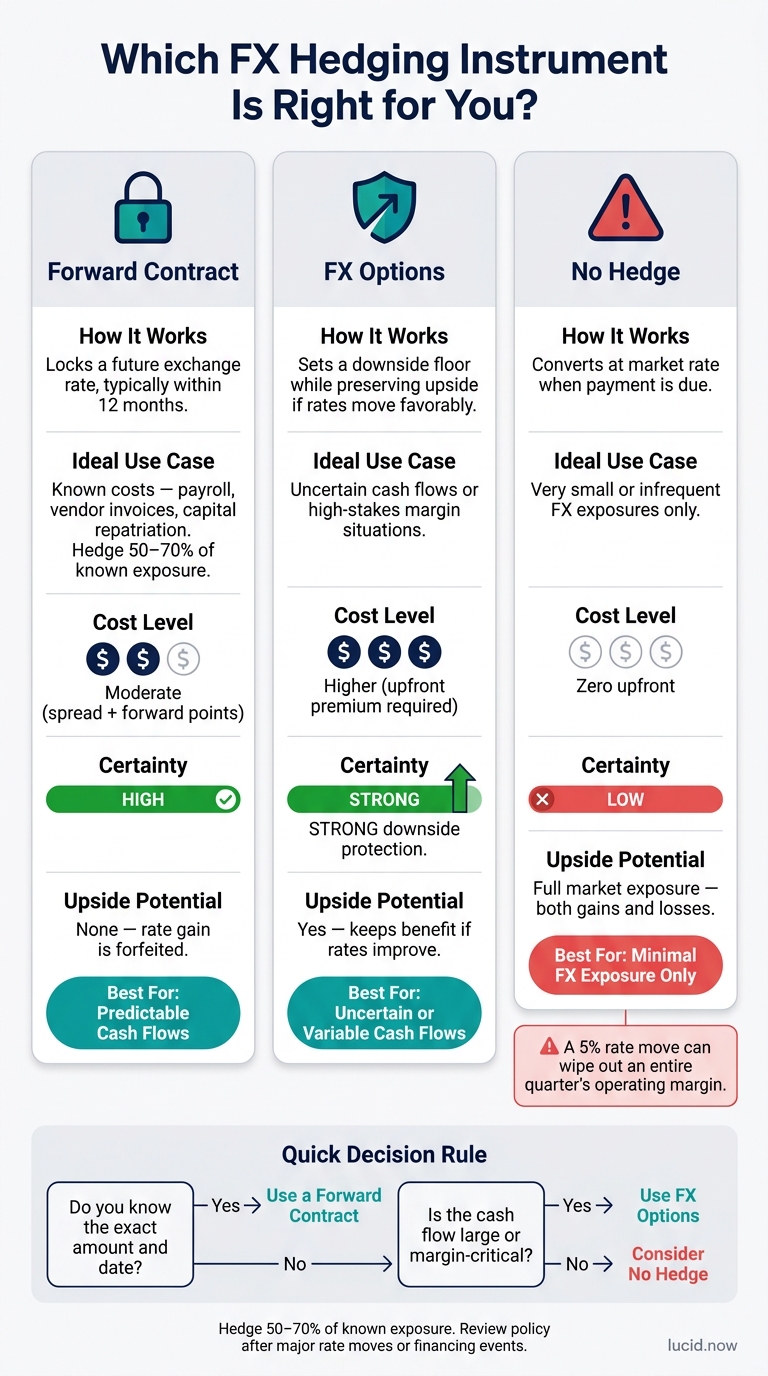
FX Hedging Instruments Compared: Forwards vs Options vs No Hedge
If payment operations still leave material exposure, hedging can lock down the risk that’s left. But don’t hedge every small FX movement. Use hedging when the exposure is big enough to hit budgeted margin or shorten runway.
When Forwards, Options, and Swaps Are Relevant
Once payment operations have done what they can, the next step is simple: match the hedge to the type of cash flow.
A forward locks today’s exchange rate for a future payment, usually within 12 months. It works well for known payments like supplier invoices, overseas payroll, or capital repatriation. If you already know the amount and timing, a forward is often the cleanest fit.
An option gives you a floor on the downside while letting you keep the upside if rates move your way. Put plainly, it protects against bad moves without taking away the chance to benefit from good ones. That flexibility comes with an upfront premium, so options make the most sense when cash flows are uncertain or when you’re protecting margin on a deal that matters a lot.
A swap is a better fit for longer-term, repeated currency needs.
Costs, Constraints, and Cash-Flow Tradeoffs Founders Should Know
After you pick the instrument, the hard part becomes cost versus flexibility.
Hedging isn’t free. Banks often build in wider spreads. Forwards may include forward points. Options require an upfront premium. And there’s a tradeoff that catches many teams off guard: if rates move in your favor after you lock a forward, you don’t get that gain. You gave it up in exchange for budget certainty.
Hedging Instruments vs. No Hedge: A Comparison
| Instrument | How It Works | Ideal Use Case | Cost Level | Certainty |
|---|---|---|---|---|
| Forward Contract | Locks a future rate, typically within 12 months. | Known costs: payroll, vendor invoices, capital repatriation. Hedge 50%–70% of known exposure. | Moderate (spread + forward points) | High - no upside if rates improve. |
| FX Options | Sets a downside floor; preserves upside. | Uncertain cash flows or high-stakes margin situations. | Higher (upfront premium) | Strong downside protection with upside potential. |
| No hedge | Converts at market rate when payment is due. | Very small or infrequent exposures. | Zero upfront | Low - a 5% move can wipe out an entire quarter's operating margin. |
Once you choose a hedge, the last step is making sure it is recorded and reported correctly.
Accounting, Compliance, and Reporting for US Startups
Once execution is done, accounting and compliance move right into the FX workflow. At that point, the job isn't over. You still need clean records so month-end close, board decks, and investor reporting stay right.
Record FX Gains and Losses Correctly Under US Reporting Rules
Start with the basics: document each trade's rate, spread, and fees so your books show the true cost. Keep real-time confirmations and a full audit trail so month-end close and investor reporting can check each FX decision without guesswork.
Practical step: Before closing each month, compare the interbank rate with the rate your provider used, and document both.
This matters more than it may seem. A small gap in rate data or missing fee detail can throw off reporting fast. The cleanest setup is to treat booking and compliance as one flow, not two separate tasks. Every FX payment should clear, settle, and post using the same source data.
Build Compliance Checks Into Cross-Border Payment Workflows
Your payment process should also include basic compliance gates. Use regulated multi-currency accounts, segregate safeguarded funds from operating cash, and keep dedicated IBANs by currency for cleaner tracking. For larger transfers, keep government ID, proof of address, and source-of-funds documents ready so payments don't get stuck at the worst time.
Just as important, maintain a full audit trail for every transfer. That means rate confirmations, counterparty details, approvals, and settlement records should be easy to verify during month-end close and reporting.
Conclusion: A Simple Startup Playbook for FX Risk Management
Map exposure, cut forced conversions, hedge what remains, and reconcile every payment. If you want AI-backed multi-currency bookkeeping and investor-ready reporting built around that workflow, Lucid Financials is built for startups managing multi-currency complexity.
FAQs
How much FX exposure is too much to ignore?
FX exposure is hard to brush off when exchange-rate moves can hit your gross margin, EBITDA, or cash flow forecast in a meaningful way. A simple gut check helps: if a 5% to 10% move would put real pressure on financial stability, this needs attention.
Active management should move up the list when foreign-currency costs make up more than 10% of COGS, when a meaningful share of revenue comes in foreign currencies, or when your board and investors want steadier cost expectations. And if your spreadsheets have stopped giving you a clear view, that’s a sign too.
When should I use a forward instead of an option?
Use a forward contract when you know the exact amount you need to pay or receive and want cost certainty. It locks in an exchange rate for a set date in the future, which helps shield your budget from market swings.
Use an option when you want a safety net against bad rate moves but still want the chance to gain if the market goes your way.
How often should I review my FX policy and hedges?
Review your FX policy and hedging activity monthly or quarterly. That gives you a clear view of working capital, helps with regulatory filings, and keeps your approach tied to your business goals.
Regular check-ins also make it easier to track risk and adjust course when needed, so you can help protect margins as your company grows.