I use AI to estimate startup valuation ranges - not to set a final price. Before trusting an estimate, I check whether the model predicts pre-money or post-money value, uses only data available at that date, and reports errors in dollars.
A reported 74.33% balanced accuracy may sound useful. But that result measured startup success - not valuation. Predicting an exit and pricing a funding round are different tasks.
Here’s how I assess an AI estimate:
- Check the research: Separate valuation studies from funding and success predictions.
- Test the model: Look for tests on later dates and unseen companies, data leakage, and errors across stages and markets.
- Compare the range: Cross-check against similar deals, cash-flow scenarios, investor return targets, and expert judgment.
- Keep records current: Use dated financials, financing terms, and downside, base, and upside assumptions.
My rule: <u>use AI to guide screening and diligence, not replace them.</u> Clean records help, but customer checks, IP reviews, and deal terms still matter.
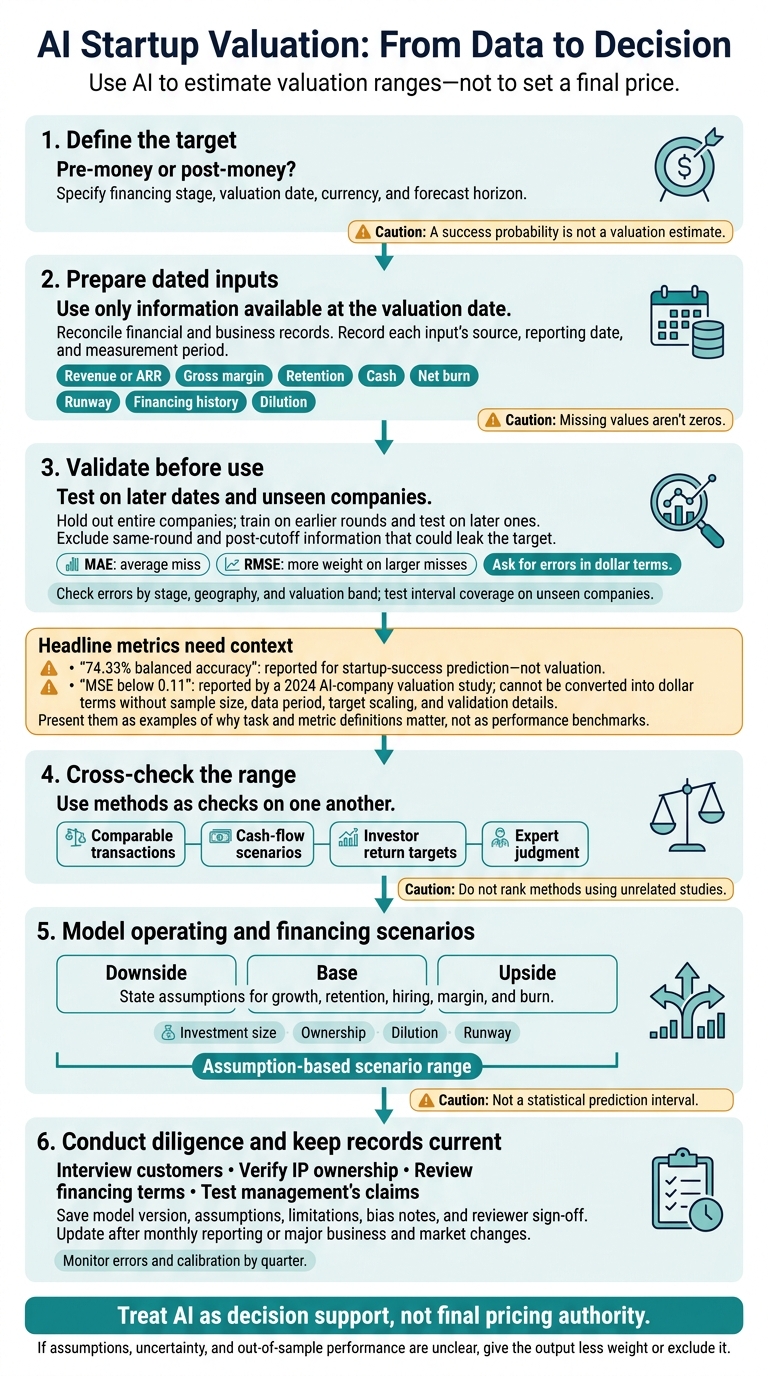
AI Startup Valuation: From Data to Decision
What Startup Valuation Research Shows
Structured Data and Company Descriptions
Saghafian’s 2020 study used Crunchbase data from 2009–2018 to estimate post-money valuation across regions, sectors, and funding stages. It paired funding amount, investor count, and company characteristics with topics drawn from company descriptions using latent Dirichlet allocation (LDA). The study reported strong holdout performance, but the excerpt does not explain the metric well enough to convert it into valuation error.
Funding amount and investor count were the two strongest predictors. But timing matters. If those inputs come from the financing event being valued, the model may be reconstructing that round’s valuation - not predicting it in advance. Check when features became available, exclude same-round fields, and keep companies and financing dates separate during testing.
That leaves a question: do network and text signals add information beyond deal terms?
Investor Networks and Neural Networks
Another line of research looks at investor relationships rather than deal-level features.
Kühn et al. used Crunchbase descriptions, company details, funding histories, and investor identities to predict funding rounds. Word2Vec-based text features represented startup competition. Graph-based models, including graph convolutional networks, represented investor relationships. Competition was more closely linked to early-stage fundraising, while network features were linked to growth-stage fundraising. However, the excerpts lack enough detail to judge performance on later time periods.
Network position may reflect access to capital or investor selection rather than company value. For investors, these features are screening signals, not price estimates.
Hybrid Models and LLM Signals
Recent research also uses text and LLM-derived signals alongside structured inputs.
A 2024 LLM paper on startup success found that company self-descriptions helped predict success, but it did not test valuation. The excerpt leaves out the data period, label, architecture, and benchmarks. When assessing these screening signals, investors should require descriptions dated before the outcome being predicted.
Valuation of AI Companies: Leveraging Large-Language Models and Deep Learning Approaches (2024) combines a numerical model with an LLM-based rating of company capabilities. It reports mean squared error (MSE) below 0.11. But without the sample size, data period, target scaling, and validation details, that MSE cannot be converted into dollar terms.
The study focuses on AI companies, so its findings should not be extended beyond the sample. Before using the approach, require reproducible prompts, dated inputs, and out-of-sample testing.
sbb-itb-17e8ec9
Assess Model Accuracy and Investor Use
Validation, Error Metrics, and Data Leakage
Reported gains can come from data leakage. That makes evaluation design more important than headline accuracy.
Define the target before testing: pre-money or post-money valuation, financing stage, valuation date, currency, forecast horizon, and whether the label represents a transaction value or an analyst estimate. Hold out entire companies so no startup appears in both training and test sets. Also split by time: train on earlier rounds and test on later ones.
Document data snapshots, feature cutoff dates, duplicate handling, missing-value rules, software versions, and model settings. Exclude later rounds, post-round syndicates, updated records, and any fields recorded after the cutoff date that could leak the target.
Ask for errors in dollar terms. MAE measures the average miss; RMSE puts more weight on larger misses. Use MSE only when squared-error penalties matter. For skewed valuations, report errors by stage, geography, and valuation band - even if the model trains on log valuations.
For success classifiers, precision measures how often flagged companies qualify, while recall measures how many qualifying companies the model finds. Balanced accuracy averages recall across classes. Check probability calibration, too, and test whether valuation prediction intervals meet their stated coverage on unseen companies.
AI Models vs. Other Valuation Methods
For investors, the right method depends on the task: screening, benchmarking, or negotiation. Do not rank methods using unrelated studies. Early-stage uncertainty affects every approach. Limited financial history weakens forecasts, while missing, biased, or outdated records distort benchmarks.
Once validation passes leakage checks, compare AI outputs with other valuation methods based on their data needs and intended use. Treat them as checks on one another, not as a universal ranking.
| Method | Data needs | Interpretability | Strengths | Limitations | Appropriate investor use |
|---|---|---|---|---|---|
| Structured-data models | Financial, funding, founder, market, and company variables | Moderate to high | Fast screening; repeatable benchmarks | Missing, biased, or outdated records; limited qualitative context | Screening and benchmark ranges |
| NLP/LLM models | Dated company text and diligence materials | Variable | Diligence questions; qualitative signals | Can reproduce language, geographic, sector, and pitch-style bias; stale or promotional text | Target diligence; supplement structured data |
| Deep-learning hybrids | Large structured and unstructured datasets; computing resources | Low to moderate | Nonlinear relationships; multiple data types | Audit difficulty; overfitting; unrepresentative data | Portfolio ranking with validation |
| Discounted cash flow | Operating forecasts, capital needs, and discount rates | High in principle | Explicit assumptions; cash-flow based | Forecast sensitivity; weak for pre-revenue companies | Scenarios with well-supported forecasts |
| Venture capital method | Exit value, ownership, dilution, investment, and target return | Moderate to high | Investor return requirements | Exit and return sensitivity; simplified risk | Negotiation and return thresholds |
| Comparable-company analysis | Relevant companies and transaction multiples | Moderate to high | Market anchoring | Scarce comparables; incomplete private data | Cross-check AI outputs and valuation ranges |
| Expert judgment | Industry, founder, product-market, and deal context | Variable; explainable if documented | Qualitative factors; novel situations | Subjectivity; optimism and network bias | Interpret outputs; challenge assumptions; diligence |
Studies illustrate why results must remain contextual. One early-stage valuation study reported better results than its baselines; another entrepreneurial-firm valuation study identified investor-syndicate size and social capital as important features. A separate LLM study reported balanced accuracy up to 74.33% for startup-success prediction - not valuation.
These results cannot be compared directly because they measure different targets and tasks. The next step is deciding how each output can support diligence.
Screening Uses, Bias, and Market Shifts
Published performance matters only if it holds up under time splits, leakage checks, and subgroup tests. Use outputs to prioritize review, flag unusual valuation assumptions, and focus diligence on retention, margins, customer concentration, and financing risk.
Feature importance shows correlation, not causation. Test whether influential variables act as proxies for stage, geography, or network access. Run sensitivity analysis on growth, burn, dilution, and exit assumptions. Then check whether the findings hold when questionable proxies are removed.
Check errors across stages, sectors, geographies, and levels of network access. Survivorship bias favors companies that remained visible. Selection bias can leave out bootstrapped startups or those with fewer network connections. Unequal investor access can improve a company's score without stronger fundamentals.
Monitor errors and calibration by quarter, and retest after changes in interest rates or funding conditions. Strong test scores do not establish reliable investment returns.
Build a Startup Valuation Workflow
Once the model passes validation, turn the research results into a dated, auditable workflow.
Prepare Financial and Business Data
Reliable AI estimates start with dated inputs that reconcile with your records. Build a data pack from accounting, bank, payroll, billing, cap table, and tax records. Include revenue or ARR, gross margin, retention, customer concentration, cash, net burn, runway, hiring plans, debt, financing history, dilution, and tax liabilities or credits.
For pre-revenue startups, add validated milestones, product progress, market evidence, IP, team experience, and investor commitments.
For each input, record its source, reporting date, measurement period, and whether it was available at the valuation date. Include supporting history, currency, adjustments, missing values, and a data-quality confidence score. Missing values aren't zeros, and estimates should stay separate from reconciled figures.
Match benchmarks by sector, business model, geography, stage, scale, round, and transaction date. Keep source dates and distinguish closed financing prices from asking prices.
Estimate Valuation Ranges and Funding Scenarios
Use the clean inputs to build valuation and funding scenarios for investor screening and scenario analysis.
First, define what you're estimating: pre-money value, post-money value, per-share price, acquisition value, an internal planning range, or a screening score. Compare the estimate with relevant private-market transactions.
Document the security type, liquidation preferences, fully diluted ownership, option-pool treatment, and SAFE or convertible-note terms. Model financing separately from operating performance, showing investment size, ownership, dilution, and runway.
Build downside, base, and upside cases with explicit assumptions for growth, retention, hiring, margin, and burn. Show how delays in revenue, financing, or tax-credit receipts change the runway end date. Label the output an assumption-based scenario range, not a statistical prediction interval.
Save the model version, assumptions, missing inputs, limitations, bias notes, and reviewer sign-off. Update the model after monthly reporting or major changes in customers, hiring, financing, or market conditions.
Maintain Financial Data With Lucid Financials
The workflow depends on clean, current financial records.
Lucid Financials brings bookkeeping, tax filings, tax-credit support, CFO forecasting, cash-flow tracking, and scenario modeling into one place. Its Slack-based support and investor-ready reporting help keep the input package current.
Keep reconciled results separate from forecasts and unapproved tax credits. Cleaner records make inputs easier to trace, but they don't remove valuation uncertainty.
Conclusion: Validate AI Estimates and Conduct Diligence
Once you’ve built a valuation workflow, validate the model and conduct diligence. A success probability is not a valuation estimate. Startup valuation models can help screen opportunities, but they can’t replace deal judgment. Before interpreting an output, check the model’s target, forecast horizon, and financing stage.
A model needs clean data, out-of-sample testing, time splits, and clearly stated uncertainty. Read the full study - not just the headline metric - and ask for evidence that it fits the startup, financing round, and market you’re assessing.
If the model passes those checks, treat it as one input. Cross-check its estimates against transaction benchmarks and transparent scenarios. Neither gives you pricing certainty. Then do the diligence AI can’t replace: interview customers, verify IP ownership, review financing terms, and test management’s claims. These checks put the model’s output in context; they don’t replace judgment.
Treat AI as decision support, not final pricing authority. If a model can’t explain its assumptions, quantify uncertainty, and show out-of-sample performance, give its output less weight or exclude it from the decision.
FAQs
Can AI value my startup without funding history?
Yes, AI can help value your startup even without a long funding history by focusing on its future potential. Models assess founder background, team expertise, intellectual property, market trends, and how difficult the technology is to copy. The Berkus and Scorecard methods help turn these qualitative strengths into valuation estimates.
Lucid Financials supports this process with real-time financial data, including burn rate and unit economics. It pairs AI analysis with expert oversight to help produce well-supported, investor-ready valuations.
What should I do when valuation estimates disagree?
Start with clean, reconciled, and standardized financial data. Use a single source of truth for key metrics, such as monthly recurring revenue (MRR).
Pair AI estimates with professional judgment to assess qualitative factors and business logic. Use Lucid Financials for investor-ready documentation and expert oversight.
Test your assumptions with sensitivity and scenario modeling. Show investors the base, downside, and upside outcomes.
How much valuation error is acceptable?
Investors want discipline and accuracy, not perfect startup valuations. AI tools can cut manual errors by 20–50%. But overlooking technical risks or business-model details can cause valuation errors of 3–5x.
Inaccurate data or flawed assumptions can lead to 15–30% valuation penalties. Reduce guesswork by using clean, reconciled financial data and testing base, downside, and upside scenarios. This helps build trust when markets are volatile.