If I use AI in lending, I need to be able to explain every credit decision, test for bias, log each result, and keep people in the loop. That is the core point.
Here’s the short version:
- I can’t judge a lending model by approval speed or score accuracy alone.
- I need to check where bias enters, especially through old lending data and proxy inputs like ZIP code or device data.
- I still have to follow U.S. fair lending rules, including specific adverse action reasons for denials.
- I should put controls in place before launch: data review, feature limits, group testing, human review, and written sign-off.
- After launch, I need monthly and quarterly checks so the model does not drift or start giving weak denial reasons.
A few facts stand out. The article points to the CFPB’s 2022-03 guidance on adverse action notices and a 2021 Federal Reserve comment on testing data sources and model outputs. Put simply: AI does not lower the bar for credit decisions.
What I take from this is simple: if I can’t explain, log, and defend a model decision, I should not use that model in production.
The rest of the piece turns that idea into a clear workflow for founders building or buying AI for lending.
Fair Lending, Bias Mitigation & Responsible AI | Build Trustworthy AI in Financial Services | Uplatz
sbb-itb-17e8ec9
What makes AI in lending ethically risky
AI lending models can post strong scores and still lead to unfair results if they chase prediction alone. For founders, the harder question is simple: can you defend the model, explain its decisions, and keep watch over it once it’s live? That’s where things get serious, and it starts with the data.
Founders need to build around five things: fair treatment, transparency, accountability, privacy, and human review. Those are the main risk areas. Miss even one, and you can end up with regulatory trouble and damage to your name.
| Traditional Underwriting Assumptions | AI-Driven Lending Risks | Common Ethical Failure Points |
|---|---|---|
| Static, rules-based eligibility criteria | Opaque machine-learning models | Opaque decisioning; inability to explain rejections |
| Explicit exclusion of protected traits | Proxy discrimination (e.g., using geography or habits as proxies) | Indirect discrimination |
| Manual review of edge cases and appeals | Automated decisions with no human review | Lack of oversight for edge cases and vulnerable applicants |
| Periodic policy and risk reviews | Real-time model drift and algorithmic degradation | Bias amplification at scale without monitoring |
In day-to-day use, the most common failure point is biased training data.
How bias enters the model
Most of the time, bias slips in through the dataset itself. If your training data reflects years of lending decisions shaped by discriminatory practices - redlining, income-based exclusions, geographic restrictions - the model can pick up those patterns and repeat them. And it can do that even if you never include a protected trait directly.
The trickier issue is proxy discrimination. A model may rely on zip code or spending habits as input features. On paper, those aren’t protected traits. But they can line up closely with ethnicity or socioeconomic status. The model isn’t making a moral judgment; it’s following the pattern it learned. That’s why disparate impact analysis matters. You have to test outcomes across protected groups, not just look at top-line accuracy.
Approval history can make this worse. If your past data includes more approvals for certain borrower profiles, the model may lean toward those profiles in future decisions. Not because those borrowers are plainly lower risk, but because the historical record is uneven.
And even if you clean up the dataset, that doesn’t fix the disclosure issue.
Why explainability matters in credit decisions
In credit decisions, a model must produce adverse action notices that point to the reasons behind a denial and support internal review. That’s not just paperwork. It’s part of being able to stand behind the decision.
Explainability also ties directly to accountability. If a model leads to a bad outcome and no one can trace how it got there, responsibility starts to spread out and disappear.
Fair lending rules that apply to AI models
Once a model can explain a denial, the next step is making sure its decisions stand up under fair lending rules. There are two main checks here: clear denial reasons and outcome testing before and after launch. In practice, that means building models that can point to specific reasons for a denial, such as debt-to-income ratio or payment history. Black-box outputs don't work well for adverse action notices or audit review.
Adverse action notices and model explainability
If a model helps drive a denial, the notice should tell the applicant why in plain language. The reasons need to be specific, not vague or generic. If the system can't do that yet, it's not ready to go live.
Shared responsibility across the company
Fairness checks can't live with just one team. Product, data science, legal, and leadership each own part of the same system, and the work only holds together if all of them stay involved.
| Function | Pre-launch responsibilities | Post-launch responsibilities |
|---|---|---|
| Product | Define target borrowers, risk thresholds, and applicant communication checks. | Run incident response simulations and human review of applicant communications. |
| Data Science | Remove proxy features, track fairness metrics, and document data lineage. | Monitor model drift with ongoing monitoring and recalibrate when needed. |
| Legal / Compliance | Validate the model, test disparate impact, and draft adverse action templates. | Conduct regular fairness audits and regulatory reporting. |
| Leadership | Set risk appetite, approve governance, and review incidents. | Review incident logs and oversee steps taken to maintain compliance. |
Disparate impact testing should happen before deployment and keep going during live operations. Any feature that might act as a proxy for protected traits should be flagged and tested again in live monitoring. These controls shouldn't sit off to the side. They belong in the same workflow that scores, approves, and reviews applications.
How to build an ethical AI credit workflow
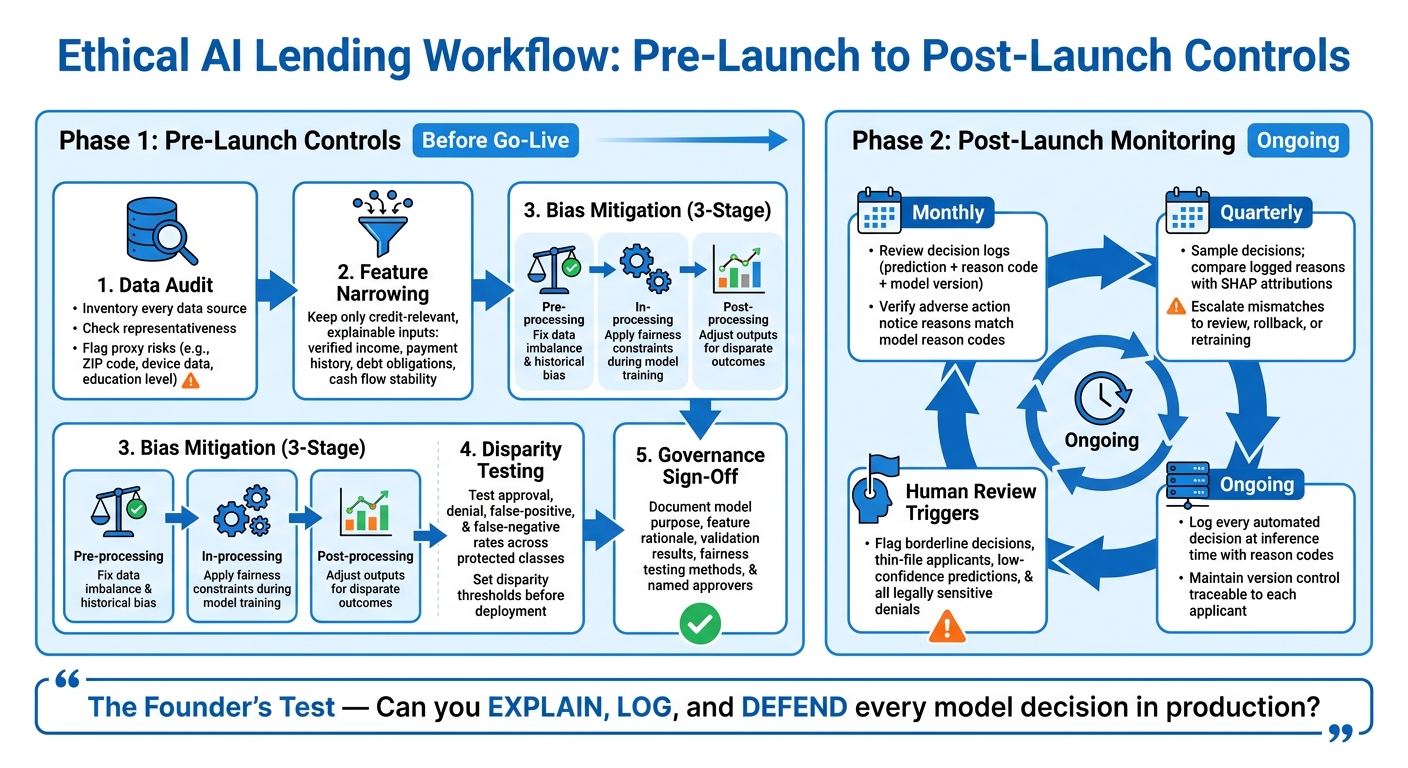
Ethical AI Lending Workflow: Pre-Launch to Post-Launch Controls
Legal rules matter. But on their own, they don't change day-to-day lending decisions. The work starts when you turn those duties into controls before the first application gets scored.
A fair AI credit workflow begins upstream. That means checking the data, limiting risky features, testing for uneven outcomes, and making sure every decision can be explained in plain language to a borrower.
Data, features, and testing controls
Start with your data. Inventory every source, document where it came from, and check whether it matches the borrowers you serve. A 2021 Federal Reserve comment urged institutions to routinely evaluate data sources, including vendor data, and to test AI underwriting models so outputs are statistically sound and monitored for discrimination drift.
Then narrow your features. Keep only inputs that are tied to credit and can be explained. Inputs like zip code, device data, and education level can act as proxies, so they should be removed or tightly limited. Safer examples include verified income, payment history, debt obligations, and cash flow stability.
Before launch, test approval, denial, false-positive, and false-negative rates across permitted protected classes and key subsegments. Set disparity thresholds in advance. If gaps show up, don't deploy until those gaps are explained or reduced. And make sure the test results are written down before launch so governance teams can review them.
There's a simple rule here: if you can't turn a feature into a borrower-facing reason, it probably shouldn't be in the model. The CFPB's Circular 2022-03 makes clear that creditors using complex algorithms, including AI/ML, must still give applicants the specific principal reasons for an adverse action.
| Mitigation method | When it fits | Risk it addresses |
|---|---|---|
| Pre-processing | Before model training, when the data is imbalanced or reflects historic inequities | Data imbalance, historical bias, proxy leakage |
| In-processing | During model training, when fairness constraints can be built into the objective | Tradeoff between predictive accuracy and fairness; bias learned by the model |
| Post-processing | After training, when outputs can be adjusted without retraining | Disparate outcomes, threshold effects, group-level decision imbalance |
In practice, many lending teams use all three. Clean the data first. Apply fairness-aware training next. Then add review and override controls at the output stage. Think of it like quality control on an assembly line: you don't wait until the last minute to catch problems.
Documentation and decision governance
Documentation isn't busywork. It's proof of how the system was built, tested, and approved. Before launch, record the model's purpose, where the training data came from, why each feature stayed in, validation results, fairness testing methods, and who signed off on deployment.
Your governance record should also spell out the revalidation schedule, the triggers for retraining or rollback, and when the model must hand a case to a human reviewer. Human review should be mandatory for borderline decisions, unusual applicant profiles, low-confidence predictions, thin-file applicants, and all denials that need a legally defensible explanation. If a reviewer overrides the model, log it. Then audit those logs on a set schedule.
| Control area | What to document | Why it matters |
|---|---|---|
| Data selection | Source, date, representativeness, missingness, proxy risk | Helps detect historical bias and unsupported inputs |
| Feature review | Rationale, proxy screening, exclusions | Reduces discriminatory proxy use and improves explainability |
| Validation | Performance by group, calibration, reason-code accuracy | Shows the model is sound and fair before deployment |
| Governance | Approvers, override rights, escalation paths, review cadence | Clarifies accountability and human control |
| Consumer notice mapping | How model outputs become adverse-action reasons | Supports Regulation B and ECOA compliance |
Version control matters too. You should be able to trace which model version scored each applicant, what reason codes it produced, and who approved any override. If an auditor, regulator, or internal reviewer comes calling six months later, those records should tell the full story without guesswork.
Financial reporting support for lean startup teams
For founders running lean, governance can slip faster than most people expect. When there isn't a dedicated compliance officer or finance team, model documentation, exception logs, and approval records often end up scattered across inboxes, shared drives, and spreadsheets.
Keep model logs, exception records, and approval history in one audit-ready system; Lucid Financials can centralize bookkeeping, CFO support, and investor-ready reporting alongside those records.
Monitoring, auditing, and accountability after launch
Once governance is set, the next job is making sure the model still acts the way it was approved to act. Launch is NOT the finish line. When a lending model goes live, keep post-launch logs for every decision, the reason behind it, and the model version used. That way, you can respond to regulators and customers without scrambling.
What to review each month and quarter
Each month, review decision logs to make sure every automated action includes the prediction, reason code, and model version. Also check that adverse action reasons still match the model's reason codes.
Monthly logs help you spot operational gaps. Quarterly reviews are better for catching drift. Each quarter, sample recent decisions and compare the logged reasons with SHAP attributions. If the logged reasons and the model's behavior don't line up, send it to review, rollback, or retraining.
Independent review and escalation paths
Build the explanation step into inference so every decision is logged with its reason at the exact moment it happens. If explanations stop matching the model's current behavior, escalate at once.
Conclusion: The founder's operating checklist
| Checkpoint | Frequency | What to confirm |
|---|---|---|
| Decision and reason logging | Monthly | Prediction, reason code, and model version captured |
| Adverse action notice mapping | Monthly | Notice reasons match current reason codes |
| SHAP audit trail | Quarterly | Logged reasons align with SHAP attributions |
| Explanation pipeline review | Quarterly | Explanations generated at inference time |
Use this checklist as your baseline for accountability. In ethical lending, the test is simple: can you explain, log, and defend each decision in production?
FAQs
How can I spot proxy bias in my lending model?
Look for variables that aren’t protected characteristics but still line up with them, like geographic data or spending habits. Those fields can act as stand-ins, even if they seem harmless at first glance.
Use explainable AI tools like SHAP or LIME to see which features have the biggest effect on credit decisions. That gives you a clearer view of what the model is leaning on behind the scenes.
It also helps to run bias tests on a regular schedule. Common fairness checks include:
- Demographic parity
- Equal opportunity differences
- The 4/5ths rule
Reviewing how well your data reflects the people you're scoring, along with how much weight each feature carries, can help surface hidden bias.
When should a human review an AI credit decision?
Human review matters most in high-stakes cases and any time the AI returns a low-confidence decision.
It should also kick in when the system flags high-risk items or when regulations change. If someone overrides a decision, log the final decision and the reason in the audit trail. That record helps support compliance and transparency.
What records should I keep for AI lending compliance?
Keep an audit trail that shows how your AI works and how decisions get made. That means documenting the model architecture, decision logic, training data sources, parameters, and logs for model versions, features, and thresholds.
You should also keep records of:
- Data interactions
- System updates
- Testing and validation results
- Approvals
- A control inventory that links compliance frameworks to supporting evidence
That evidence can include configuration files, vulnerability scans, and human-in-the-loop review records.