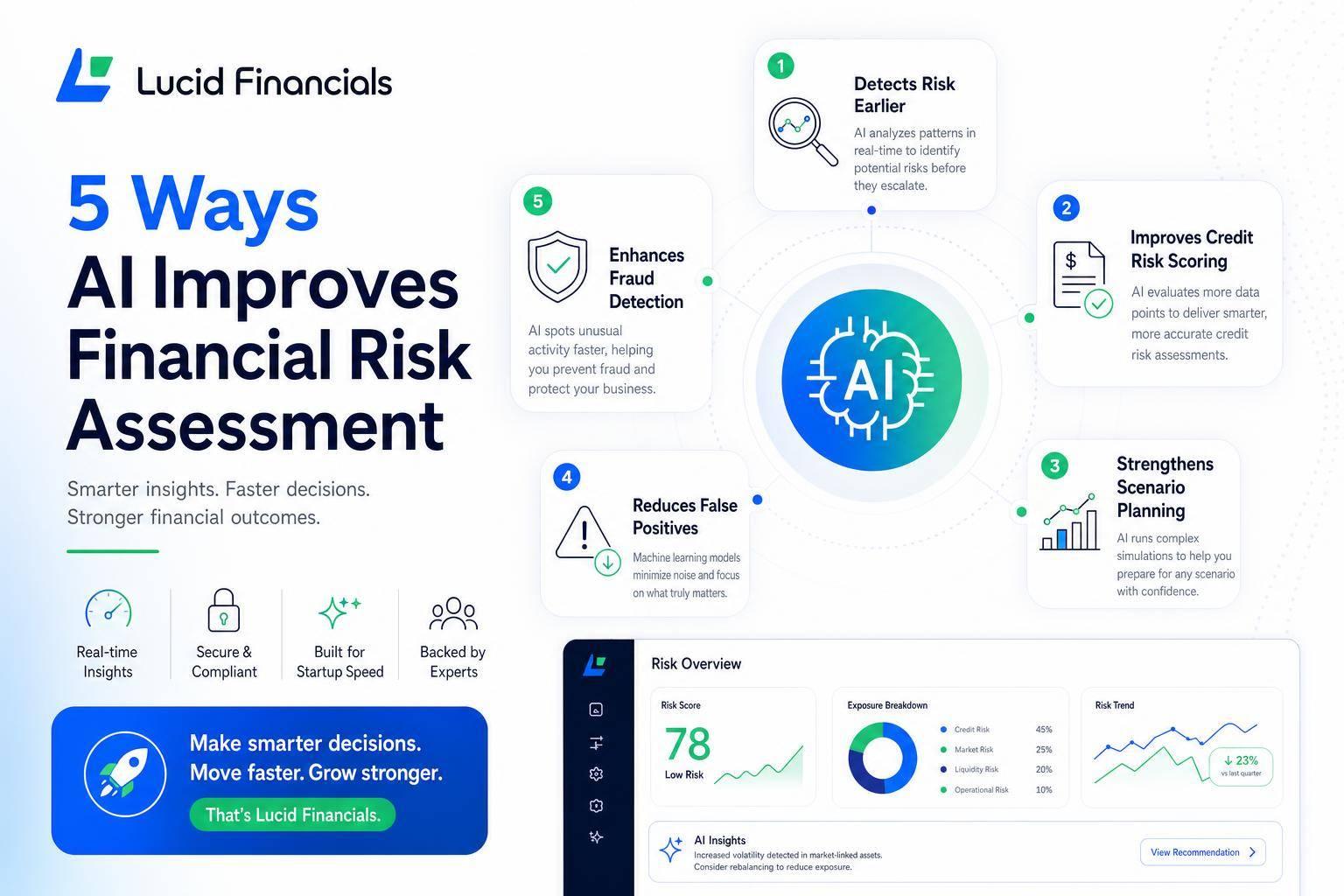
AI is transforming how startups in emerging markets predict revenue. By analyzing historical data and over 50 real-time indicators, it boosts accuracy from 45–65% to 82–94%. This helps businesses navigate volatile conditions like currency swings, seasonal changes, and regulatory uncertainty. Traditional methods struggle in these environments due to outdated data and rigid models.
Key Takeaways:
- Challenges in Emerging Markets: Poor data quality, economic instability, and policy unpredictability make forecasting difficult.
- AI Advantages: Real-time updates, scenario-based planning, and integration with tools like ERP systems improve decision-making.
- Example Tool: Platforms like Lucid Financials offer AI-driven insights, Slack integration for instant updates, and investor-ready reports, starting at $150/month.
AI-powered forecasting equips startups with the tools to manage cash flow effectively and stay ahead in dynamic markets.
AI-Driven Sales Forecasting and Market Intelligence Trends | Uplatz

sbb-itb-17e8ec9
Challenges of Revenue Forecasting in Emerging Markets
Emerging markets come with a unique set of challenges for revenue forecasting. From unreliable data to unpredictable economic and regulatory environments, these factors make accurate predictions incredibly complex.
Limited Data and Poor Data Quality
One of the biggest hurdles in forecasting for emerging markets is the lack of reliable data. Take West Africa, for example, where the informal economy accounts for about 80% of employment and 50% of GDP. Since so many transactions happen outside formal systems, they often don’t get recorded - leaving forecasting models without a complete picture.
On top of that, fragmented financial systems make things worse. Records are often kept on spreadsheets or even paper, leading to outdated or inaccurate economic data. A striking example of this occurred in April 2014, when Nigeria rebased its GDP and discovered its economy was nearly 90% larger than previously thought - jumping from $270 billion to $510 billion. Imagine the impact on businesses relying on outdated figures for their decisions.
"Reliable data is critical for informed decisions and business success, yet in many African markets, data accuracy challenges persist with profound implications for foreign direct investment (FDI) and market expansion."
These data issues lay the groundwork for even more challenges tied to economic and regulatory unpredictability.
Economic Instability and Currency Fluctuations
Economic instability in emerging markets can render traditional forecasting methods ineffective. Factors like rising oil prices, inflation, and higher borrowing costs can quickly lead to recessions. Archie Hart, Portfolio Manager at Ninety One UK Ltd, highlighted this uncertainty: "If the nascent ceasefire in the Gulf does not hold, renewed conflict could tip the world into recession in which case all earnings bets are effectively off".
Currency volatility adds another layer of complexity. In these markets, exchange rates can swing dramatically in a single day, wiping out profits in the blink of an eye. Standard forecasting tools, such as Mean Absolute Percentage Error (MAPE), often lose their reliability in such volatile conditions. Additionally, the non-linear nature of these economies - where small changes can have outsized impacts - makes classical econometric models less effective.
But the challenges don’t stop at economic metrics; regulatory unpredictability also plays a major role.
Regulatory and Policy Uncertainty
Frequent policy changes and political instability make long-term forecasting a daunting task. For instance, around 60% of emerging markets lack comprehensive data protection laws. This creates legal uncertainties that complicate how businesses collect and use data for forecasting. Political instability also drives talent out of these markets. Consider Turkey, where over 139,000 young professionals have recently left, or India, where 770,000 students chose to study abroad in 2022.
In response to these uncertainties, investors are moving away from a "growth-at-all-costs" mindset. Instead, they’re focusing on sustainable business models and clear paths to profitability. This shift forces startups in emerging markets to adopt real-time financial insights and more rigorous planning, even in environments where unpredictability is the norm.
Why Traditional Forecasting Models Fall Short
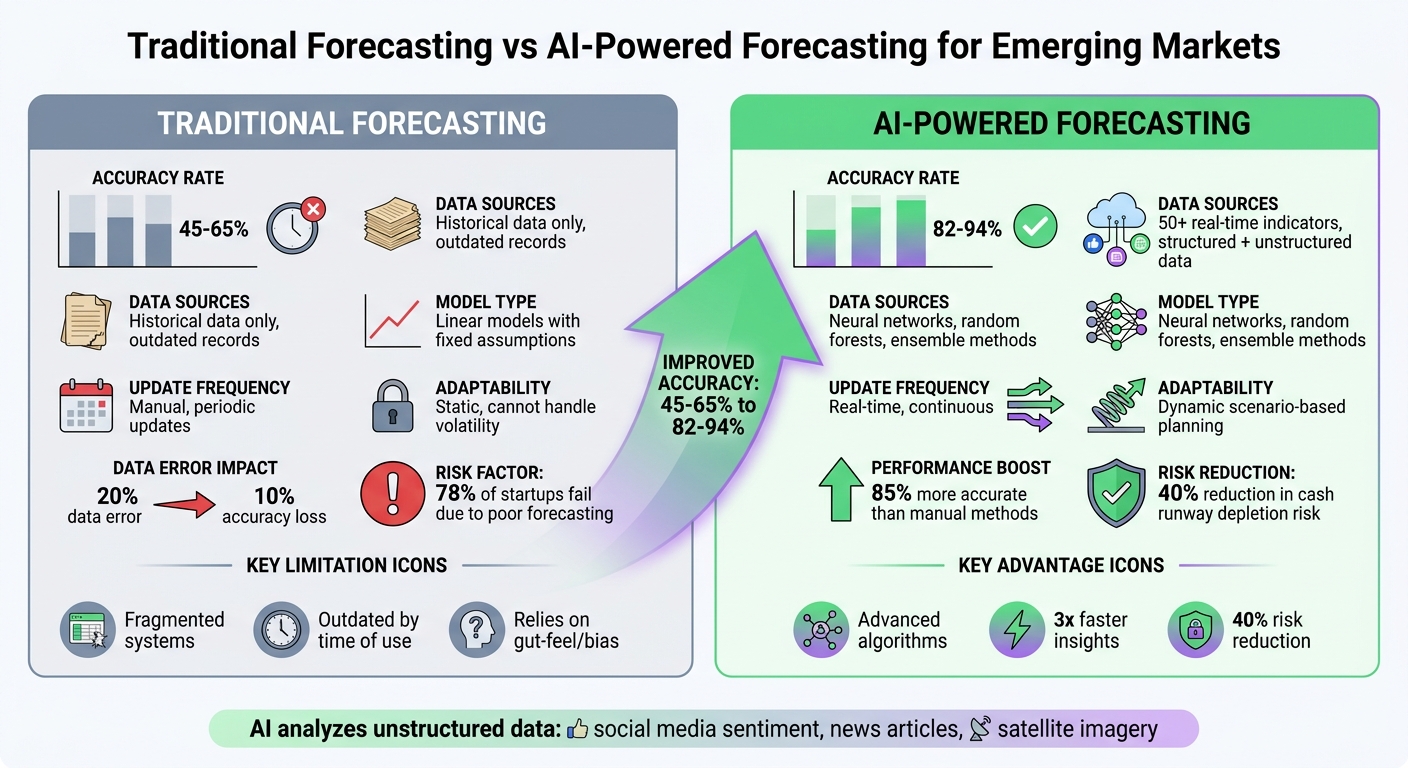
Traditional vs AI Revenue Forecasting: Accuracy and Performance Comparison
Traditional forecasting methods often struggle in volatile emerging markets. Designed for stable and predictable environments, these models simply can't handle the complexity and rapid changes that define emerging markets.
Inflexible Assumptions in Linear Models
Linear models operate on the assumption that relationships between variables are straightforward and consistent. But in emerging markets, this is rarely the case. These models rely on fixed assumptions and outdated historical data, making them ill-suited for capturing the unpredictable nature of such markets. As Perceptive Analytics explains: "Static models can't keep pace with real-world volatility".
For example, even a small data error - just 20% - can reduce a model's accuracy by as much as 10 percentage points. Emerging markets often deal with incomplete records and fragmented systems, which makes it even harder for linear regression models to account for non-linear dynamics. Additionally, traditional models overlook alternative data sources like news articles or social media, where early signs of market shifts frequently emerge. This rigidity limits their ability to support sound financial decisions in fast-changing environments, underscoring the need for more adaptable forecasting approaches.
Poor Performance Under Uncertainty
Traditional forecasting often leans heavily on historical metrics, such as closed deals or prior-quarter performance. While these metrics reflect past trends, they fall short in predicting future changes, particularly in volatile markets. By the time manual data compilations reach decision-makers, the information is often outdated and no longer relevant.
Another issue is the reliance on managerial intuition, or "gut-feel" adjustments, which can introduce bias and skew predictions. The consequences of these shortcomings are stark: 78% of startups fail due to poor market timing and inadequate demand forecasting, often because they depend on methods incapable of anticipating dynamic shifts. Static forecasts that offer fixed predictions instead of probability ranges leave businesses unprepared for unexpected changes. This gap highlights the growing need for AI-driven forecasting, which can adapt in real-time to reflect market realities.
AI Solutions for Revenue Forecasting
AI has completely changed the game for revenue forecasting. Instead of relying on educated guesses, businesses can now use AI to process vast amounts of data. This includes not only structured financial records but also unstructured sources like social media sentiment, news articles, and even satellite imagery. The result? AI uncovers subtle market trends that traditional methods might miss. As researchers László Vancsura, Tibor Tatay, and Tibor Bareith from the Hungarian University of Agriculture and Life Sciences explain:
"AI-based models are able to analyze large amounts of complex and unstructured data quickly and accurately, extracting information that would not be available to traditional models".
This approach lays the groundwork for forecasting methods that outperform older, manual techniques.
Advanced Predictive Models
AI takes forecasting to the next level with advanced predictive models. Using algorithms like neural networks, random forests, and ensemble methods, these models capture the complex, non-linear behavior of emerging markets. The impact is clear: AI-powered forecasting models are 85% more accurate than traditional manual methods. For startups in unpredictable markets, this level of accuracy can mean the difference between thriving and running out of cash. In fact, AI-driven financial forecasting has been shown to reduce the risk of cash runway depletion by 40%.
Scenario-Based Forecasting
One of AI's standout features is its ability to create scenario-based forecasts. Businesses can simulate multiple financial outcomes - best-case, worst-case, and base-case scenarios - allowing them to weigh strategic options in uncertain conditions. This is especially helpful when dealing with regulatory changes or sudden shifts in policy. By using natural language processing (NLP) to monitor diverse data sources, AI can identify early warning signs, enabling startups to adjust their strategies three times faster than manual research would allow. This agility lets businesses proactively tweak pricing, inventory, or market focus to stay ahead.
Real-Time Data Integration and Insights
AI also excels at integrating real-time data into forecasting processes. By connecting with ERP systems, e-commerce platforms, and CRMs, AI ensures revenue and cash flow models are continuously updated with transaction-level precision. Tools like Lucid Financials go a step further by integrating with platforms like Slack, providing instant financial insights directly within the app. Automated alerts for market changes turn forecasting into an ongoing strategy rather than a monthly task. Embedding AI into daily workflows gives startups a powerful advantage in fast-changing markets.
How Lucid Financials Supports AI Revenue Forecasting

Lucid Financials offers AI-driven forecasting tailored for startups in emerging markets. By harnessing advanced AI models, the platform processes millions of data points and updates forecasts automatically as market conditions shift. This means founders can adapt quickly without waiting for manual adjustments. Let’s explore the features that help startups navigate unpredictable markets with greater ease.
AI-Powered Forecasting Tools
Lucid's AI tools go beyond traditional forecasting by creating financial projections, staffing plans, and scenario models. Using natural language processing (NLP), the platform analyzes sources like news, social media, and market reports, enabling startups to react faster than they could with manual research. For founders grappling with currency fluctuations or regulatory changes, Lucid provides best-case, worst-case, and base-case scenarios, ensuring they’re prepared for a variety of outcomes. These features tackle the challenges of data volatility and uncertainty, which are often amplified in emerging markets. Starting at $150 per month, the CFO plan includes these AI tools, along with cash flow tracking and runway visibility - offering startups a way to make informed decisions without needing an in-house finance team.
Slack Integration for Real-Time Updates
Lucid Financials integrates seamlessly with Slack, transforming it into a financial hub. Founders can ask real-time questions about runway, spending, or performance and get instant, AI-driven answers. For more in-depth discussions, the finance team can join the same Slack thread, making collaboration faster and more efficient. This eliminates the need for lengthy email exchanges and ensures financial insights are always accessible, allowing startups to quickly adjust pricing, inventory, or market strategies as needed.
Investor-Ready Financial Reporting
Lucid also simplifies investor relations by automating financial reporting. The platform creates board-ready reports and investor-grade forecasts automatically, ensuring your financial statements are always up-to-date and accurate. This means you’re prepared for fundraising discussions or due diligence at a moment’s notice. With automated monthly closes and consistently clean books, Lucid builds the kind of financial transparency and reliability that investors look for in emerging markets.
Conclusion
This discussion has highlighted how AI is reshaping revenue forecasting, especially in unpredictable markets. By addressing the challenges of traditional methods, AI introduces a new level of financial flexibility and precision.
AI-powered forecasting provides startups with accurate insights, even in rapidly changing environments. With advanced predictive models, AI vs. traditional scenario planning, and real-time data integration, businesses can make quicker, more informed decisions when faced with market volatility.
"AI doesn't just forecast revenue - it empowers startups to thrive in chaos." (McKinsey AI Finance Report, 2023) [Source: McKinsey]
Say goodbye to outdated spreadsheets and create investor-ready forecasts in just 60 seconds. Companies using AI-driven forecasting tools report managing cash flow 15–30% more effectively. For startups in emerging markets, this is more than just a performance upgrade - it’s a lifeline for growth and survival.
Lucid Financials combines these benefits into one seamless platform. From delivering clean books in just seven days to providing real-time insights via Slack and AI-powered forecasts that adjust to market changes, Lucid Financials equips you with everything you need. Whether you're gearing up for a funding round or analyzing your runway, you can gain the clarity necessary to move forward - starting at just $150 per month.
Take the first step with Lucid Financials. Sign up for a free trial at https://lucid.now, and within seven days, access clean books, real-time insights, and forecasts designed to help you scale confidently. Turn uncertainty into opportunity today.
FAQs
What data do I need to start AI revenue forecasting?
To kick off AI-powered revenue forecasting, start by collecting clean and standardized data from your business operations. The most important data points include:
- Historical financial metrics such as monthly recurring revenue (MRR) and annual recurring revenue (ARR).
- Customer acquisition costs (CAC) to understand how much you're spending to bring in new customers.
- Churn rates, which indicate how many customers you're losing over time.
- Expansion revenue, reflecting additional income from existing customers.
For the best results, aim to gather at least 12 months of accurate data. Additionally, integrating data from billing systems, CRM platforms, and product analytics tools can provide AI systems with a richer dataset. This comprehensive approach allows for more precise trend analysis and forecasting.
How does AI handle currency swings and inflation in forecasts?
AI enhances the precision of forecasts by processing real-time data, adapting predictions on the fly, and incorporating economic factors such as market volatility and inflation. This approach helps forecasts stay accurate and applicable, even when currency values shift or prices climb.
How quickly can I get investor-ready forecasts with Lucid Financials?
With Lucid Financials, you can get forecasts ready for investors in just seven days. This platform simplifies the process by combining AI-driven tools with professional support, delivering precise and timely results. That way, you can spend less time on forecasting and more time growing your business.