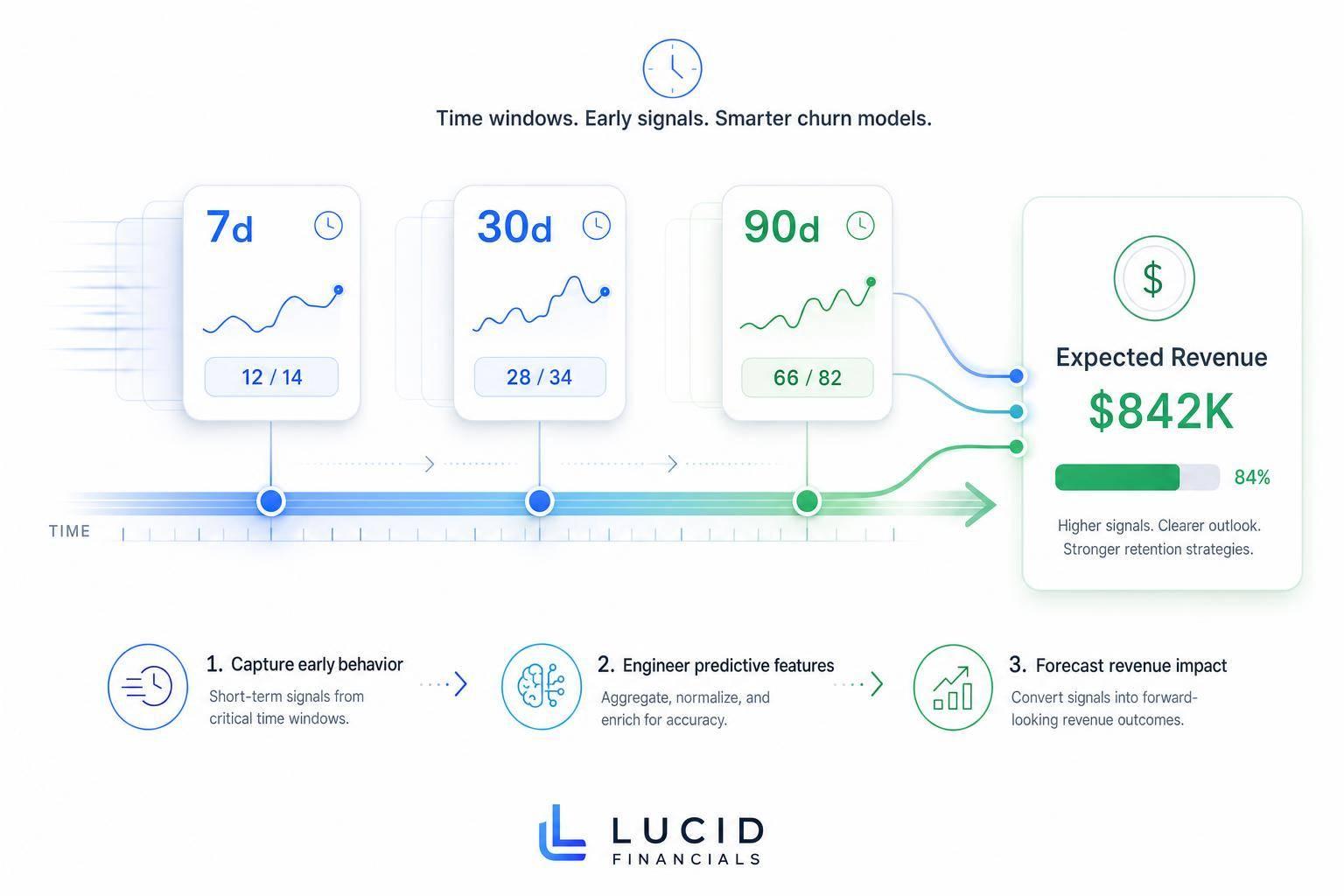
AI helps startups spot financial risk sooner, test more downside cases, track cash in near real time, use more than credit scores, and explain why a risk score changed.
If I had to sum up the article in plain English, it comes down to this: old risk reviews often rely on stale reports, while AI can update signals as bank activity, invoices, payroll, and market data change. That helps me make better calls on runway, hiring, spending, credit, and fundraising before a cash problem gets worse.
Here are the five core ways AI improves risk assessment:
- Better prediction for credit and cash flow risk
- Deeper stress testing across many inputs at once
- Near real-time monitoring for early warning signs
- More complete risk profiles using alternative data
- Clearer model explanations with audit trails and review steps
A few numbers stand out:
- 60% of critical forecasting errors come from manual data entry
- AI fraud monitoring reported 91.3% detection rates and 58.7% fewer false positives in the cited example
- Adding bank and accounting data improved some small-business risk forecasts by 20% to 40%
- A review of 27 studies found AI beat older scorecards on prediction and early warning detection
Leveraging Generative AI for Risk Assessments | Course Module
sbb-itb-17e8ec9
Quick Comparison
| Area | Older methods | AI-based methods |
|---|---|---|
| Risk updates | Monthly or quarterly | Daily or near real time |
| Data used | Financial statements and bank data | Financials, operating data, and outside signals |
| Scenario testing | A few fixed cases | Many changing cases |
| Risk detection | After reports are finished | As signals change |
| Decision support | Static snapshots | Live inputs for finance decisions |
| Oversight needs | Lower model complexity | More review, logs, and controls |
The main point is simple: AI does not remove risk. It helps me see it earlier and act with more context. But it still needs human review, clean data, and documented controls.
Why Standard Risk Assessment Falls Short
Most old-school risk processes have the same basic problem: they look in the rearview mirror instead of through the windshield. Legacy models give you a static snapshot, and that snapshot can get old fast. Since these systems react after the fact, they often spot risk only once conditions have already changed.
You can see this most clearly in cash management. A U.S. startup may get a monthly cash flow report that shows a healthy month-end balance, yet miss a mid-month dip when payroll and vendor payments put pressure on liquidity. Manual data entry causes 60% of critical forecasting errors, and static reporting can leave decision-makers weeks or even months behind what’s happening.
Scenario analysis has a similar weakness. Under older methods, most stress tests use a small set of fixed scenarios and don’t assign probabilities to outcomes. That sounds fine on paper. In a volatile market, though, it can fall apart fast. If interest rates jump or venture funding suddenly dries up, fixed-scenario models may miss extreme outcomes, feedback loops, and compounding effects that don’t fit a preset script. That’s why AI-powered scenario analysis is much more useful when markets get shaky.
Startups also run into a data problem. When information is spread across different systems, no one view shows the full risk picture. Teams end up stitching reports together by hand, and by the time the forecast is ready, it may already be stale. On top of that, sample-based audits can miss unusual payment patterns, duplicate entries, revenue recognition issues, and vendor behavior that looks off for months.
This is where AI makes a difference: it shifts risk review from static and reactive to continuous and forward-looking.
1. Better Predictive Modeling for Credit and Cash Flow Risk
AI helps by turning scattered startup data into forward-looking signals for credit and cash flow risk. Old-school credit scoring leans on a narrow set of inputs and tends to update slowly. AI looks at more variables at once, which helps teams spot credit and cash flow risk sooner. It can also pick up patterns across many data points, catching warning signs that a single score may miss.
What Data Inputs AI Analyzes
Strong AI models can pull together internal data like essential financial metrics including AR aging, AP cycles, MRR, churn, burn rate, gross margin, bank balances, payroll timing, and payment history. They can also factor in external signals like industry trends, macro data, shipping activity, and web traffic.
A 2025 FinRegLab report found that effective credit models often rely on a focused set of 10 to 20 features, including low-balance events, stability of cash inflows, balance trends, recent outflows, and debt-to-income proxies. In plain English, more data doesn’t always mean better results. The right data matters more.
How Fast AI Delivers Insights
AI can refresh risk predictions as new transactions, bank feeds, and invoices come in. That means it can flag liquidity pressure or weaker customer payment behavior earlier, instead of weeks later. For finance teams, that faster signal can make scenario analysis and stress testing more accurate and more useful.
Governance and Compliance
Speed alone isn’t enough. Faster predictions still need audit trails and clear thresholds so finance and compliance teams can explain why an account was flagged or why credit terms changed. Lucid Financials can connect bookkeeping, reporting, and CFO oversight in one workflow.
2. Deeper Scenario Analysis and Stress Testing
When predictive models point to rising risk, scenario analysis shows what that risk can do to cash and runway - and how fast it can happen.
AI helps finance teams test many variables at the same time. That makes it easier to see how shocks stack up instead of looking at each one in isolation. For example, a 20% drop in new bookings, a 15-day delay in receivables, and a 200-basis-point jump in interest costs can all hit cash flow and runway at once. For startups, that means looking at runway, hiring, and debt service together, not as separate planning exercises.
What Data Inputs AI Analyzes
AI does its best work when scenario models pull from both internal operating data and outside market signals.
Internal inputs often include:
- Burn rate
- AR aging
- Debt schedules
- Customer retention
- Payroll timing
External inputs can include benchmark interest rates, unemployment trends, and sector performance data.
That mix matters because stress often shows up first in customer behavior and cash timing, long before it appears in monthly reports.
How Fast AI Delivers Insights
When feeds are connected, AI can refresh stress-test results as receivables, bookings, or interest rates move. A manual stress test can take days or even weeks. That difference in timing matters a lot. Cash collections can slow down fast. Markets can tighten. Customer demand can change in a matter of days.
So instead of treating stress testing as a monthly exercise, teams can use it as a continuous decision tool. Founders get faster answers on whether they need to cut expenses, extend runway, or change hiring plans before the issue lands in end-of-month reporting. The point is simple: move faster on spending, hiring, and fundraising decisions.
Governance and Compliance
Speed helps, but speed without controls can create a mess.
AI-driven stress testing can improve accuracy, but it also brings model risk management needs with it. That includes scenario versioning, assumption tracking, and approval sign-off, so finance and compliance teams can explain how each result was produced. AI scenarios should be used as decision inputs, not as fixed predictions.
It also helps to add reverse stress testing and sensitivity testing on top of the main scenarios. That makes it easier to spot which assumptions have the biggest effect on outcomes. Better stress tests give startups a better shot at protecting runway before small shocks turn into funding gaps or payroll trouble.
Lucid Financials can turn those outputs into board-ready reports. Those same assumptions should also feed live alerts, so finance teams can respond as conditions change.
3. Real-Time Risk Monitoring and Early Warning Signals
Stress tests show what could go wrong. Real-time monitoring shows risk as it begins to show up. That’s why monitoring sits right after stress testing.
How AI Improves Risk Monitoring Decisions
AI tracks cash flow, fraud, payroll timing, and vendor payments as they change. It adds an early warning layer on top of existing controls, so teams can spot new risks sooner without removing human oversight.
What Data Inputs AI Analyzes
AI risk systems take in live transactions and external feeds, then turn that data into alerts and dashboards. They can look at transaction activity, payment flows, and outside data feeds at the same time. For finance teams, that means a better view of cash flow, fraud, vendor risk, and payroll timing than a periodic close can provide on its own.
How Fast AI Delivers Insights
One of the clearest gains is speed. Instead of waiting on manual review, teams can move to insights in hours or even minutes. AI transaction monitoring has reported 91.3% fraud detection rates and 58.7% fewer false positives than conventional systems.
For startups, that faster signal matters when runway, receivables, payroll, and customer payments are all moving at once. And the picture gets better when alerts pull from more than accounting data.
Governance and Compliance
Faster alerts bring a new job with them: making sure those alerts are dependable and that decisions are documented. AI governance programs are more often tracking drift, bias, and data quality in real time, while keeping human review in the loop for high-stakes decisions.
A few basics make a big difference:
- Clear thresholds
- Escalation rules
- Human review for higher-risk calls
Those guardrails can cut alert fatigue and keep the system useful. It also helps to map these practices to frameworks like the NIST AI Risk Management Framework, which can help startups stay audit-ready and better prepared for board-level oversight.
Lucid Financials keeps books current, so the data behind your risk signals stays current too.
4. Using Alternative Data for a More Complete Risk Profile
Real-time alerts only work if the data behind them is solid. That’s where alternative data helps. It fills gaps that credit scores and financial statements often miss.
How AI Improves Risk Profiling Decisions
Early-stage startups are hard to score with old-school credit methods because their credit files are often thin. In practice, that means looking beyond limited credit history and using day-to-day operating signals instead.
Startups may not have deep credit records, but they produce a lot of operating data every day through Stripe, payroll systems, subscription metrics, and accounting platforms. Models like gradient boosting and random forests can spot patterns across large, mixed datasets. They can look at things like MRR stability, cash-flow volatility, and revenue concentration, then flag risk sooner. That gives founders more time to adjust credit terms, spending, or runway.
In industry case studies, adding bank transaction data and real-time accounting feeds can improve the forecast accuracy of small-business risk models by 20% to 40% compared with old scorecards alone.
What Data Inputs AI Analyzes
The most useful alternative data for startup risk profiling tends to fall into three buckets:
- Cash collection: bank transactions, invoices, payroll, and accounting records
- Customer retention: subscription metrics, churn, and refund rates
- Operating performance: delivery performance and support volume
A 2024 survey found that 43% of lenders already use alternative data to improve underwriting models, and 90% say more alternative data would help them approve more creditworthy borrowers.
How Fast AI Delivers Insights
Once data pipelines are set up, AI can refresh risk scores within hours and send Slack or email alerts when burn goes up, a large expense lands, or a customer payment slips.
That kind of speed is useful. But it only works when the inputs are clear and the scoring can be explained.
Governance and Compliance
More data can improve coverage, but it also brings more model-risk demands. Regulators expect strong controls, including a clear data inventory, bias and fairness checks, and human review for major credit or cash-flow decisions.
Explainability matters here too. Tools like SHAP values can show which features are driving a risk score. That makes it easier to document decisions and support internal review, so teams can trust the score before acting on it.
Lucid Financials keeps books clean and current, which helps keep model inputs organized.
5. Clearer Explainability and Model Risk Management
More data helps only when the output is traceable and defensible. A risk score matters only if you can explain it. Many AI models can be highly accurate, but they can also feel opaque. Explainability closes that gap by showing why a model made a decision, not just what it predicted.
How AI Improves Explainability
Tools like SHAP (Shapley Additive Explanations) and LIME (Local Interpretable Model-agnostic Explanations) show which inputs pushed a prediction in one direction or another. That makes a big difference in finance, where a score without a reason is hard to trust.
For example, a credit risk model might show that a startup's declining MRR, rising burn rate, and shrinking cash runway each played a part in a "high risk" classification. Instead of a black-box score, founders and lenders get a clear story they can review and defend.
In one study of more than 30,000 customer records, SHAP values identified the main causes of default risk at both the portfolio level and the individual borrower level. That gave banks a direct way to produce clear justifications for model predictions.
What Data Inputs AI Analyzes
For model risk management, AI can monitor both model behavior and the underlying business inputs feeding the model.
That usually includes:
- Drift
- Error rates
- Feature shifts
- Backtests
- Reconciled inputs such as the general ledger, payroll, invoices, MRR, and churn
If one of those inputs starts to move in an unusual way, the system can flag it before the model output becomes hard to defend.
How Fast AI Delivers Insights
Model validation often happens monthly or quarterly. That's slow. AI-based systems can cut that down to near real-time, often within minutes or hours, as new data comes in or outputs shift.
Say a large expense lands or a revenue metric changes. The system can re-score risk, surface updated explanations, and send alerts through Slack or email. So the finance team doesn't just see that risk went up. They also see which variables caused the change.
Governance and Compliance
U.S. supervisory guidance, especially SR 11-7, expects models used in financial decisions to be validated, documented, and reviewed independently. For startups using AI in cash-flow forecasting or lending decisions, that means keeping change logs and building review steps into the process as models change over time.
It also means adverse action notices must point to specific, model-driven reasons. That's required under both the Fair Credit Reporting Act (FCRA) and the Equal Credit Opportunity Act (ECOA).
AI explainability tools make that paper trail much easier to produce and defend. You get a record that shows what changed, why the model responded the way it did, and how that decision can be reviewed later.
With the model explainable and documented, startups can use it more confidently in forecasting, lending, and runway planning.
How U.S. Startups Can Apply These 5 Improvements
For U.S. startups, these five improvements line up with the finance calls teams make every week. The goal isn’t more analysis. It’s faster decisions.
Predictive modeling helps teams see which expense cuts would extend runway the most. Instead of staring at a downside case and guessing where to trim, finance can turn it into a ranked action list.
Scenario analysis is useful when the main risk is timing, not demand. Finance teams can use AI to compare funding, hiring, and milestone plans across a few core timelines, then bring a base case and downside case to the board.
Real-time monitoring works best when each alert points to the next move. That might mean speeding up collections or pausing noncritical spend, especially when cash covers only two payroll cycles before the team needs to act.
Alternative data matters when internal records don’t tell the whole story. Pulling in vendor terms, contract data, and service performance can help teams spot exceptions sooner.
Explainability still matters with every alert and forecast. Teams need a reason they can stand behind. Plain-English explanations make it easier for the board, lender, and finance team to see why a score changed.
Lucid Financials keeps books clean and current so the data behind each of these decisions stays reliable.
AI vs. Standard Risk Assessment: A Side-by-Side Look
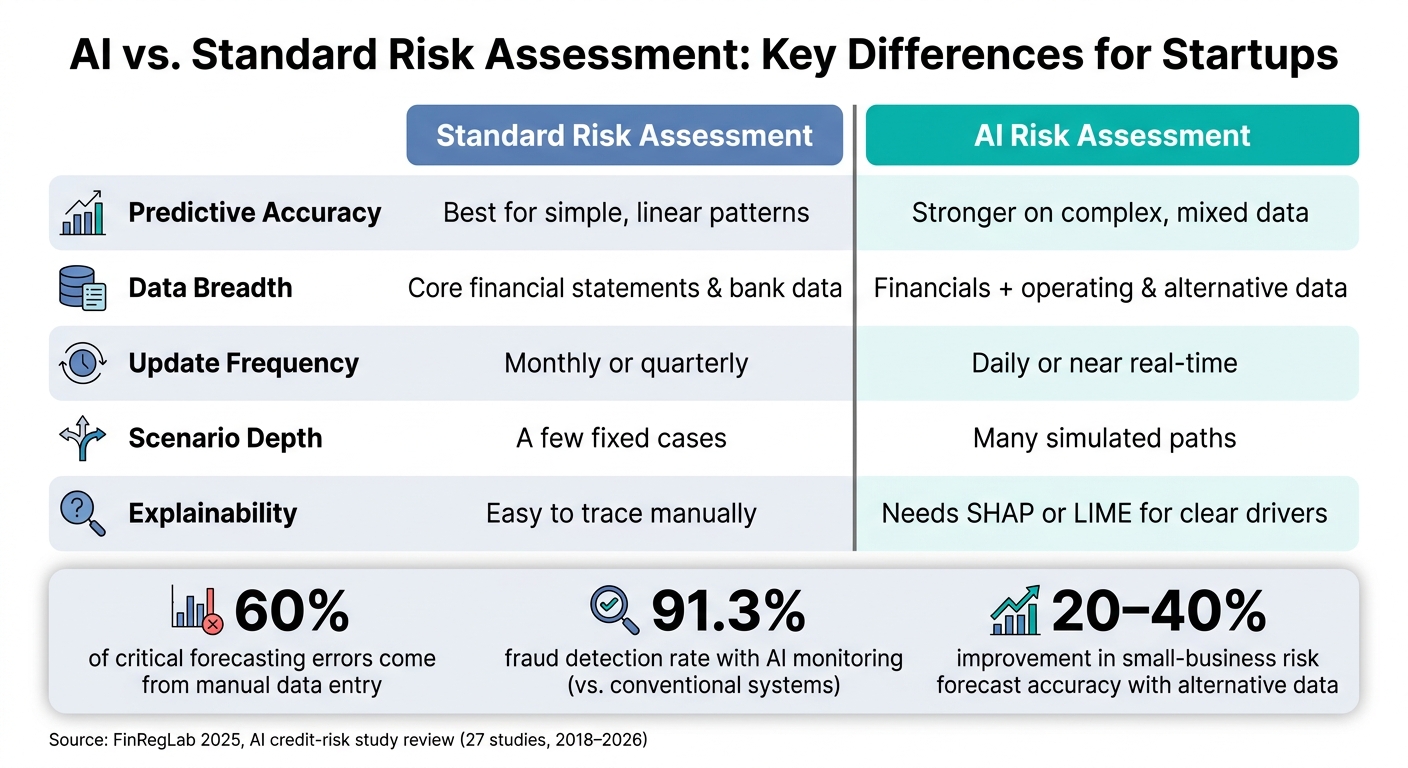
AI vs. Standard Risk Assessment: Key Differences for Startups
Here’s the short version: standard methods are simpler. AI spots startup risk sooner and with more accuracy.
The table below pulls the five main differences into one side-by-side view.
| Dimension | Standard Risk Assessment | AI Risk Assessment |
|---|---|---|
| Predictive accuracy | Best for simple, linear patterns | Stronger on complex, mixed data |
| Data breadth | Core financial statements and bank data | Financials plus operating and alternative data |
| Update frequency | Monthly or quarterly | Daily or near real-time |
| Scenario depth | A few fixed cases | Many simulated paths |
| Explainability | Easy to trace | Needs SHAP or LIME for clear drivers |
In day-to-day use, this changes a lot. Standard reviews often wait for month-end or quarter-end data. AI, by contrast, can keep updating default risk and runway risk as new signals come in.
That said, there’s a tradeoff. Governance matters more with AI. Teams need clear driver analysis, approvals, and audit trails so people can see what shaped the output and why.
Key Risks to Watch When Using AI in Risk Assessment
AI can improve speed and coverage. But it also brings a new set of ways things can go wrong.
That matters because adoption is already common, while AI-specific model risk frameworks are still rare. For finance teams, the big trouble spots are model drift, data quality, regulatory exposure, and bias.
Model drift shows up when a model keeps running, but the world around it changes. Market conditions shift, yet the model's outputs no longer line up with reality. On paper, everything may look fine. In practice, the model is off. The fix is pretty plain: run regular backtesting and give the CFO clear authority to override outputs when conditions change in a material way.
Data quality affects every result that comes after it. Bad inputs can lead to bad credit limits, missed covenant breaches, and false alerts. It's the old "garbage in, garbage out" problem. A single governed source of truth, paired with clear data lineage, helps keep that from snowballing.
Regulatory exposure is a serious issue for U.S. companies. Black-box outputs do not excuse weak adverse-action explanations under ECOA. And if AI outputs feed into GAAP reporting, board materials, or investor communications, those outputs need documented controls, independent review, and audit trails.
Bias risks can appear when some inputs push risk scores in unfair directions. Alternative data, for example, can skew scores against creditworthy businesses even when no protected characteristic is directly included in the model. That’s why finance teams should run fairness testing across regions, industries, and business sizes, and require human review before any adverse decision is finalized.
These risks don’t erase the upside. They show where control points need to be if finance teams want AI to be safe to use.
Conclusion
These five upgrades work together to close the gaps in legacy risk assessment. Taken together, they move risk review from periodic reporting to live decision support.
For founders, that means faster calls on hiring, spend, fundraising, and debt. In a cash-tight market, that forward-looking stance can give you an edge.
A review of 27 AI credit-risk studies from 2018 to 2026 found AI outperformed traditional scorecards on prediction and early-warning detection.
The controls matter just as much as the capability. Model drift, data quality gaps, and regulatory exposure are real risks. That’s why AI works best with human judgment, documented processes, and clear accountability. Lucid Financials combines AI automation with CFO support to keep books current, reporting investor-ready, and risk signals visible in real time.
AI doesn’t eliminate risk. It helps surface it earlier, while there’s still time to act.
FAQs
How much data does AI need to assess risk well?
AI doesn’t need a long history to judge risk well. What it does need is high-quality, clean, and consistent data.
For startups, accuracy depends less on how much data you have and more on whether that data is reliable, consistent, and easy to access. That usually means keeping a stable chart of accounts, tracking core metrics like payroll and revenue, and making sure data flows across your platforms instead of sitting in separate silos.
What should startups monitor first with AI risk tools?
Start with cash flow and burn forecasting. Before you build complex models, get the basics right: make sure your data on accounts receivable, vendor payment history, and bank activity is clean, consistent, and labeled correctly.
Then zero in on one expensive risk, like cash flow gaps or customer churn, and set clear alert thresholds. That makes it easier to catch shortfalls or cost overruns early, and it gives you a solid base for more advanced risk management.
How can teams keep AI risk scores explainable and compliant?
Teams should put transparency first. That often means using simpler, easier-to-read models when they can, plus explainable AI tools that show which inputs are shaping each outcome.
It also helps to use a hybrid setup. AI can spot patterns, but people still need to review those outputs. Human oversight and expert judgment add a reality check and help confirm that the model’s suggestions make sense.
Teams also need a steady review process around the model itself. Regular data audits, performance tracking, clear documentation, and compliance input throughout development help keep models in line with regulatory standards and business goals.