If a fraud model can’t tell you why it blocked a payment, it creates risk even when the score is right.
I’d sum it up like this: explainable AI helps fraud teams cut false positives, speed up reviews, answer customer questions, and keep a clear audit trail. In payment systems, that matters because even a small error rate can lead to more declines, more support tickets, and more lost sales.
Here’s the short version:
- Black-box models create friction. Teams see the score, but not the reason.
- False positives cost money. Good payments get blocked, and revenue drops.
- Analysts need context. Feature-level drivers help them review cases with less guesswork.
- Compliance pressure is growing. Teams need logs, model versions, and clear reason codes.
- Tools like SHAP and LIME help. They turn model output into plain-language reasons.
- Finance teams need the same visibility. A blocked payment can affect reconciliation and reporting, not just fraud review.
One example from the article makes the point fast: if a $5,400.00 payment is blocked on August 1, 2026, that event needs to be visible in both fraud review and finance records. If not, your team can end up with a bad cash view and messy month-end work.
I also noticed one stat that stands out: firms using explainable AI in financial crime systems have reported up to 60% lower false positives in AML work. The message is simple: reasons matter almost as much as scores.
Bottom line: I see explainable AI as the link between model output and human action. It helps people review, defend, and log each payment decision in a way that holds up with customers, analysts, and auditors.
VeriScore - Real-Time Fraud Detection with Explainable AI | Finspark Hackathon 2026
sbb-itb-17e8ec9
The problem: black-box fraud models create risk beyond missed fraud
At payment scale, even low fraud rates and false-positive rates can create a lot of operational strain. Once automated models take over, the top-performing systems are often the toughest to explain. And at that volume, every unexplained decline adds to support tickets and customer frustration.
Fraud is rare in payment data, which leads to severe class imbalance. When fraud patterns shift, teams have to update the model. But without clear explanations, they can't see why performance is slipping or which signals no longer help. That's why explainability matters for governance, trust, and faster review.
How opacity drives up false positives, analyst workload, and customer friction
When a fraud model returns a risk score with no reason behind it, analysts start from scratch. Reviews take longer. Queues pile up. The team has to do more work just to reach the same answer.
At the same time, legitimate transactions can get blocked with no clear explanation. That chips away at customer trust and can eat into revenue.
The business impact founders and operators need to understand
Unexplained holds slow teams down and weaken trust in the system. When those decisions aren't documented, the business pays for it in time, confidence, and auditability.
Explainability helps lower false positives, reduce manual review, and cut customer friction. The goal is simple: make each fraud decision traceable.
Why explainability matters: trust, compliance, and better fraud outcomes
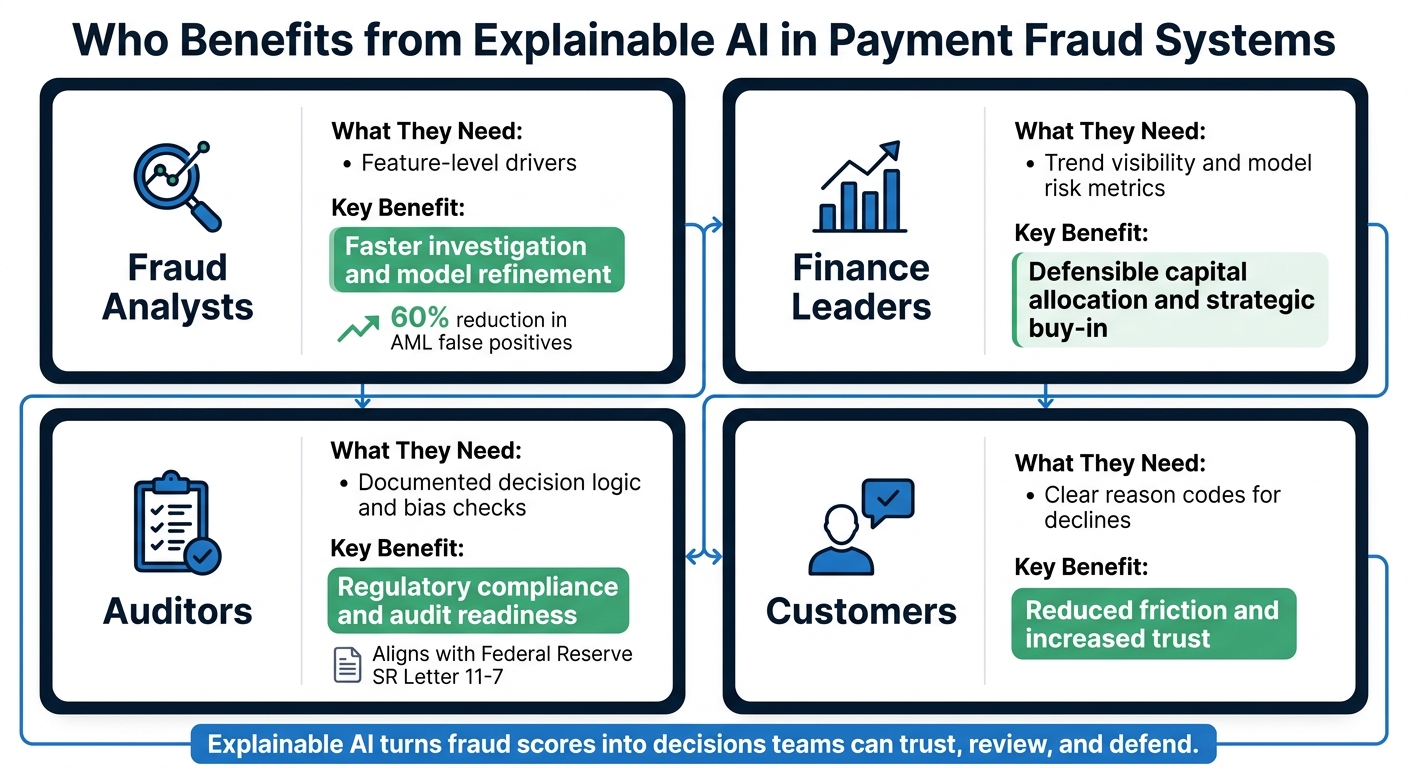
Explainable AI vs. Black-Box Fraud Models: Key Stakeholder Benefits
When a fraud score affects a payment, the conversation changes. It’s no longer just about accuracy. It’s about accountability.
In payment fraud, explainability turns a score into a decision people can act on and defend. Fraud analysts need to see why a transaction was flagged. Finance leaders need a clear business case for AI spend. Auditors need logic they can review step by step. And when a declined payment leads to a dispute, a clear reason code is what makes that decision auditable.
U.S. agencies are already asking banks to document AI risk management, so explainability isn’t just a nice feature. It’s a governance requirement.
How explainability supports model governance and audit readiness
U.S. model risk management guidance, including the Federal Reserve's SR Letter 11-7, requires financial institutions to understand and control their models. That gets much harder when a score comes out of a black box with no traceable logic.
Audit logs should record the data, features, model version, and reason behind each decision. That paper trail lets teams explain what happened, challenge it when needed, and reproduce the decision later. Without that record, review becomes slow, messy, and hard to defend.
How clear reasons build trust across teams and customer touchpoints
Explainability also helps fraud teams move faster in day-to-day work. Feature-level drivers show which inputs pushed a payment into the high-risk bucket, so analysts don’t have to start from zero every time. They can get to the point faster.
That same context helps finance leaders see model performance and risk trends more clearly. Instead of staring at raw scores, they can connect outputs to business impact.
| Stakeholder | What They Need | Key Benefit |
|---|---|---|
| Fraud Analysts | Feature-level drivers | Faster investigation and model refinement |
| Finance Leaders | Trend visibility and model risk metrics | Defensible capital allocation and strategic buy-in |
| Auditors | Documented decision logic and bias checks | Regulatory compliance and audit readiness |
| Customers | Clear reason codes for declines | Reduced friction and increased trust |
Financial institutions using explainable AI have reported a 60% reduction in AML false positives, with analysts working faster when they have feature-level context instead of just a raw score. That’s the part that matters in fraud operations: explanations need to help people do the job, not just decorate the model output.
Those needs point directly to the explanation methods that fit payment fraud systems best.
The solution: explainable AI methods that work in payment fraud systems
The next step is picking the explanation method that fits your fraud stack. You do not need to swap out your model. You need to add an explanation layer so each score can be reviewed. That matters in fraud because teams often have to approve, block, or send payments to review fast - and they need a clear basis for that call.
Interpretable models versus high-performance models with explanation layers
There are two main paths.
The first path uses models that are easier to read, like decision trees or logistic regression. With these, the decision rule is exposed more directly.
The second path uses high-performance models like XGBoost, gradient boosting, or neural networks. These models can catch more fraud, but they need after-the-fact explanation tools to show why a transaction got its score.
A lot of teams end up with a hybrid setup: a high-performance model for detection, plus explanation tools that turn model output into reason codes analysts can use. Decision trees and logistic regression work well for compliance-heavy decisions. Ensemble models and neural networks fit high-volume scoring, where the explanation layer fills the transparency gap.
SHAP, LIME, and reason codes for transaction-level decisions

SHAP gives each feature a score that shows how much it pushed fraud risk up or down. LIME explains one transaction at a time by testing small input changes and measuring how the score moves. That produces a case-specific explanation.
On their own, those outputs can feel too technical for day-to-day fraud work. They become much more useful when you turn them into reason codes - plain-language summaries that analysts and customer support teams can act on right away. Here’s what that looks like in practice:
| Feature | SHAP Value | Impact on Risk Score | Reason Code |
|---|---|---|---|
| Transaction Amount | +0.32 | Increases risk | Amount 5x higher than customer average |
| Geographic Location | +0.21 | Increases risk | International transaction from unusual country |
| Timestamp | +0.15 | Increases risk | Transaction occurred at 3 AM local time |
| Device ID | -0.05 | Decreases risk | Recognized trusted device |
Log the top drivers and reason codes for each transaction so analysts can review decisions fast. Once those explanations are in the log, teams can build a steady review workflow around them.
How to put explainable fraud AI to work in startup finance systems
Once a model can explain its score, the next move is simple: put those explanations inside the finance workflow.
Explainability doesn't matter much on its own. It matters when people use it during daily fraud checks, reconciliation, and reporting. For startup teams, that means linking fraud decisions directly to bookkeeping, reporting, and cash management.
What to log and review for every fraud decision
Every fraud decision should leave a clear audit trail.
For each decision, log:
- Timestamp
- Transaction amount in USD
- Model version
- Primary and secondary drivers with their SHAP values
- Action taken
- Whether a human override happened
This gives teams a record they can review later. It also helps them spot feature drift, false positives, and stale rules before those issues pile up.
Those records matter even more when they feed straight into bookkeeping and close processes.
Where Lucid Financials fits into a broader finance and controls workflow

A blocked transaction can create a reconciliation gap just as fast as it creates a fraud event.
Say a $5,400.00 payment is blocked on Aug. 1, 2026. If that block doesn't show up the right way in your records until month-end close, your cash position is off and your reporting is off too. Lucid Financials links fraud events to bookkeeping and reporting through Slack, so teams can keep records current and review exceptions fast. That link keeps fraud decisions visible inside the finance workflow.
When fraud decisions stay visible in finance systems, teams can trust the model and the books.
Conclusion: explainable AI makes payment fraud systems more reliable
Explainable AI turns fraud scores into decisions teams can trust, review, and defend. If a model can't explain why it made a call, teams have a hard time spotting weak performance, answering customer questions, or earning trust from people inside the business.
That kind of transparency helps analysts move faster. It also gives finance teams a clear audit trail they can stand behind. Reason codes, SHAP values, and decision logs connect straight to the review workflows and bookkeeping visibility covered earlier in this article. Put simply, opaque models are harder to tune, defend, and improve.
For startups, explainable fraud decisions can mean fewer unexplained declines, better audit readiness, and a more reliable finance workflow. In payment fraud systems, explainability is what makes automation trustworthy at scale.
FAQs
How does explainable AI reduce false positives?
Explainable AI can cut false positives because it shows why a transaction was flagged. That gives fraud teams a clearer basis for adjusting risk thresholds with more precision.
Instead of leaning only on rigid rules that may sweep up legitimate activity, tools like SHAP point to the factors behind a flag, such as unusual transaction times or high-risk locations. In plain English, analysts can see what pushed the model toward suspicion.
That matters because it helps teams separate actual fraud from normal customer behavior. And when they can do that more consistently, they can reduce the same false alarms from popping up again and again.
What should teams log for each fraud decision?
Teams should keep a tamper-evident audit trail for every AI-driven fraud decision. That means saving the full picture, not just the final alert: the input data, the logic used to reach the decision, and the output itself.
The log should also show who reviewed the case, when it happened, and the reason codes behind each alert. For example, that might include unusual velocity or new device activity.
When should a payment team use SHAP or LIME?
Payment teams should use SHAP and LIME when they need clear explanations for compliance work and faster fraud reviews.
SHAP shows why a specific transaction was flagged, which helps during audits. LIME gives fast, local explanations for single transactions in real time. Used together, they help teams make sense of automated decisions, cut false positives, and support compliance with rules like the Fair Credit Reporting Act.