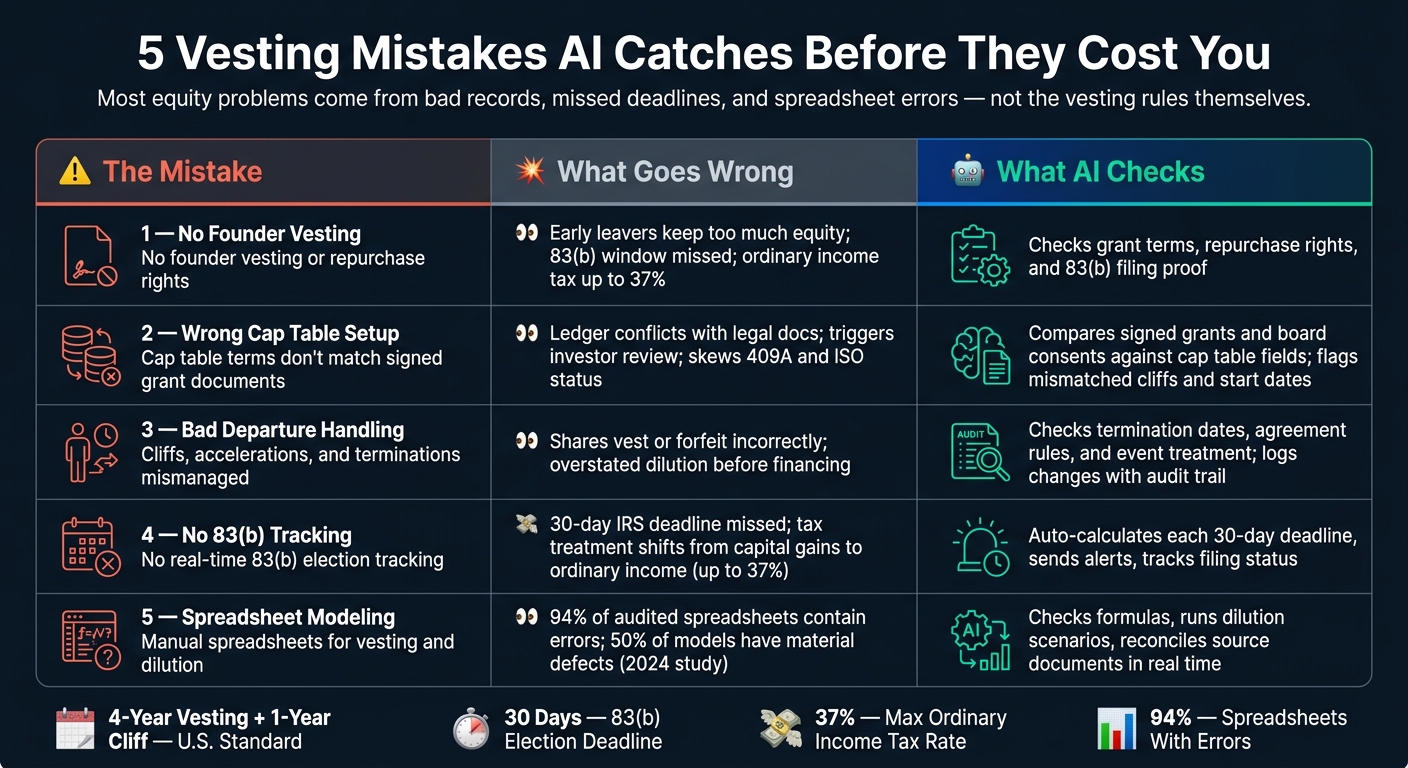
Most vesting problems come from bad records, missed tax deadlines, and spreadsheet errors - not from the vesting rules themselves. If I had to sum up the article in one line, it’s this: AI helps catch equity mistakes before they turn into tax issues, cap table errors, or financing delays.
Here’s the short version:
- Founder stock without vesting or repurchase rights can leave too much equity with early leavers.
- Cap table terms that don’t match signed grants can create legal and tax problems.
- Cliffs, acceleration, and termination handling often break when HR, legal, and finance records don’t match.
- Missed 83(b) elections can lead to ordinary income tax instead of capital gains treatment.
- Manual spreadsheets often fail once grants, departures, and new rounds stack up.
A few numbers make the risk plain:
- 4 years with a 1-year cliff is the standard U.S. vesting setup.
- 25% usually vests at month 12.
- 30 days is the deadline to file an 83(b) election.
- U.S. ordinary income tax rates can reach 37%.
- 94% of audited business spreadsheets contain errors, and 50% of spreadsheet models in a 2024 study had material defects.
Manual vs. AI-Managed Vesting: 5 Common Startup Mistakes Fixed
equity mistakes that kill startups
sbb-itb-17e8ec9
Quick Comparison
| Mistake | What goes wrong | What AI checks |
|---|---|---|
| No founder vesting | Early leavers keep too much stock | Grant terms, repurchase rights, 83(b) proof |
| Wrong cap table setup | Ledger doesn’t match signed docs | Start dates, cliffs, schedules, acceleration terms |
| Bad departure handling | Shares vest or forfeit the wrong way | Termination dates, agreement rules, event treatment |
| No real-time 83(b) tracking | Filing window gets missed | Deadline calculation, alerts, filing status |
| Spreadsheet-based modeling | Dilution and vesting math breaks | Formula checks, scenario runs, record matching |
If you’re running a U.S. startup, the main takeaway is simple: equity data needs one clean workflow. When grants, departures, tax filings, and cap table records drift apart, diligence gets harder and cleanup gets more expensive.
That’s the lens I’d use for the rest of the piece.
Why Vesting Errors Get Costly Fast for U.S. Startups
Vesting data usually lives in too many places at once: legal files, HR, payroll, finance, stock purchase agreements, option grant agreements, equity incentive plans, the cap table or stock ledger, and your HRIS. The problem is simple. Each system gets updated on its own timeline, so the records start to drift apart. Once that happens, the five mistakes below tend to show up.
Here’s a common mess: HR logs a termination, but the cap table doesn’t catch up. On paper, shares may keep vesting anyway. That can overstate dilution and stock-based compensation right before a financing.
During due diligence, investors' counsel doesn’t just glance at one file and move on. They compare grant agreements, board consents, and the stock ledger line by line. If those records don’t match, a round can slow down, and deal terms can shift. The same issue can hit the board. Directors approve grants based on equity tables they expect to match the legal record. If the records are off, they can end up approving more dilution than they meant to.
Bad vesting records also throw off stock-based compensation. And if an 83(b) filing gets missed, the tax hit can change from capital-gains treatment to ordinary income tax. These are often the first failures AI spots.
1. No Founder Vesting or Repurchase Rights
The first mistake is structural: founder equity with no vesting or repurchase rights.
When teams skip founder vesting, early leavers can walk away with too much equity. That’s a problem fast. Investors often expect founder stock to follow a 4-year vesting schedule with a 1-year cliff, usually through upfront issuance with company repurchase rights over unvested shares. If that setup isn’t in place, investors may ask for a cleanup grant or a new vesting arrangement before closing. Missing repurchase rights can also slow diligence and push back closing dates.
There’s also a tax angle, and it’s a big one. Founders who get restricted stock subject to vesting must file an 83(b) election within 30 days of transfer. Miss that window, and future vesting can be taxed as ordinary income, with U.S. ordinary income rates reaching 37%. If the transfer date isn’t clearly tied to a written vesting structure, it gets harder to pin down when that 30-day clock starts.
The cap table needs to spell out the basics in plain terms:
- vesting start date
- cliff
- vesting cadence
- repurchase terms
If those details are missing, the cap table can overstate founder ownership. Clean records should also show what happens if a founder leaves by choice versus being forced out, including how that changes the repurchase price tied to that founder’s shares.
AI can spot these gaps by checking founder grant agreements against cap table records and the stock ledger. It can flag missing repurchase language, absent 83(b) filing proof, and mismatches between signed documents and the equity ledger. Lucid Financials helps keep ownership records and founder tax data lined up so teams can work from one source of truth.
Once founder terms are cleaned up, the next issues usually show up in cap table setup and grant records.
2. Inconsistent or Misconfigured Cap Table Vesting Terms
Once founder terms are set, the next place things tend to go wrong is the grant record itself.
Even when founder vesting is set up the right way, cap table entries can drift away from the signed grant documents. A common example: a 3-year grant with no cliff gets entered as 4 years with a 1-year cliff. Or an advisor grant gets set up with standard employee terms instead of a 2-year schedule. These mismatches happen a lot, especially when manual data entry gets copied into later grants. And one bad entry doesn’t stay small for long. It can spill into diligence, tax reporting, and dilution models.
That creates friction fast. Buyers, investors, and counsel often spot the mismatch during diligence, then ask for cleanup. That can weaken the file, lead to cleanup conditions, and push back closing.
Grant dates and vesting terms matter for tax reasons too. If they’re wrong, they can misstate 409A inputs and ISO status, which opens the door to avoidable tax exposure. Bad vesting inputs can also throw off tax reporting.
Cliffs, cancellations, and forfeitures have the same problem. If those fields are off, fully diluted ownership can look wrong, and option-pool planning can get skewed.
AI helps by checking the source documents against the live cap table. It can compare signed grants and board consents with cap table fields, then flag mismatched vesting start dates, cliffs, schedules, and acceleration terms. That matters because it checks the legal source of truth against the cap table before mistakes pile up. Lucid Financials keeps equity records aligned across books and tax filings.
3. Mismanaged Cliffs, Accelerations, and Departure Scenarios
Cliffs, accelerations, and departures are usually where vesting mistakes show up first. The reason is simple: the rules often live in separate places across legal, HR, payroll, and finance. No one team usually has the whole story. That’s exactly where automated reconciliation does its best work.
Under a 4-year, 1-year-cliff grant, month 8 = 0%, month 12 = 25%, and month 18 = 37.5%. If the cliff is applied the wrong way, the company can vest equity that should have been forfeited, or forfeit equity that should have vested.
Departures make things even more time-sensitive. As soon as someone leaves, the cap table needs to reflect vested, unvested, forfeited, and accelerated shares, plus any repurchase rights. Investors expect a clean, auditable record after every cliff, acceleration, or departure event. If acceleration is handled the wrong way, ownership can be overstated, closing can get delayed, and disputes can spill out after the deal is done.
Departure timing also runs into Section 83 of the tax code. In practice, resignation date, last day worked, and HR processing date often don’t match. That gap can cause trouble fast. Vesting records need to follow the governing agreement, not a payroll date or offboarding entry that happens to be sitting in the system.
AI helps by checking grant documents, employment records, and cap table data against each other. It can flag inconsistent dates, missing termination records, and acceleration clauses that need review before they turn into investor-facing errors. When a departure is logged, an AI-assisted workflow can:
- identify the event type
- check the governing agreement
- apply the right vesting treatment
- log the change with an audit trail
That same event log should also feed real-time vesting and 83(b) tracking.
4. Not Tracking Vesting and 83(b) Elections in Real Time
As soon as a departure or new grant hits the system, the 83(b) clock starts ticking. That’s why real-time tracking matters. It keeps vesting, tax deadlines, and diligence files lined up instead of drifting apart.
The fix isn’t complicated: track every grant and every vesting event as it happens.
Tax and Deadline Risk
The 30-day 83(b) deadline is strict, and the IRS counts calendar days from the grant date. If the filing is missed, the election is generally lost.
That miss can get expensive fast. As the company’s value goes up, the tax bill can grow with it. AI helps by calculating the deadline at the time of grant, tracking filing status, and sending alerts to finance and the recipient before the window closes.
Investor-Readiness Impact
Investors expect a complete 83(b) filing log. If records are missing, it signals weak equity controls and can slow a deal.
Cap Table Accuracy
Every vesting event that goes unlogged creates a gap between the cap table and what’s actually true. Unvested shares can end up treated as fully owned. Forfeited shares can also remain on the books.
That kind of mismatch may look small at first. Then diligence starts, and suddenly every missing update turns into extra work.
AI Automation Opportunity
For startups, AI can auto-calculate deadlines, send alerts, and update vesting records in real time. Lucid Financials keeps vesting data, grant dates, and filing status synchronized across equity records and accounting.
Put simply, startups need AI tools that can handle vesting, dilution, and recordkeeping in one workflow.
5. Using Manual Spreadsheets for Vesting and Dilution Modeling
Even if your team tracks equity in real time, things can still go off the rails when vesting is modeled in spreadsheets.
Spreadsheets are fine at first. But once grants, employee departures, and financing rounds start piling up, one bad formula can throw off the entire cap table.
The data here is hard to ignore: 94% of audited business spreadsheets contain errors, and a 2024 study found that 50% of spreadsheet models used by mid-sized and large businesses contain material defects. Those mistakes aren’t minor. They lead to wrong share counts and off-base dilution forecasts.
Cap Table Accuracy
Manual modeling tends to crack under pressure. It gets messy fast with termination types, acceleration rules, partial-month vesting, milestone grants, and new financing rounds. Then the errors stack on top of each other.
Most of the time, teams don’t spot the problem early. It shows up later during diligence or a board review, when people start asking hard questions and the numbers don’t line up. And when the model is messy, board updates take longer too, because no one can trace dilution without digging through tabs and formulas.
AI Automation Opportunity
This is where AI can help in a very practical way.
AI tools can check vesting rules, reconcile source documents, and run dilution scenarios across funding rounds and option-pool changes. They can also flag mismatched cliff dates, broken formulas, and missing departure adjustments before those issues hit reporting. Lucid Financials brings bookkeeping, tax services, and CFO support into one AI-powered platform to keep equity records and financial reporting aligned.
That’s where AI does its best work here: it turns static models into live equity forecasts.
Where AI Adds the Most Value in Vesting Administration
Across these five failure points, AI helps most when it parses documents, checks records, tracks deadlines, and runs scenario models. Vesting mistakes tend to follow the same patterns. That’s good news, because repeatable errors are easier to fix. In practice, the biggest gains show up in four workflows.
Document parsing is the best place to start. AI can pull cliff dates, acceleration triggers, and repurchase rights straight from source documents into the cap table. That cuts manual entry mistakes at the point where they usually begin.
Cap table reconciliation can shift from an occasional cleanup task to a steady process. AI compares each grant’s terms with live cap table data, spots mismatches like the wrong vesting start date or a missing cliff, and flags grant fields that don’t match the underlying documents. As cap tables get larger, mistakes tend to pile up, and AI can catch them early. Once the records are clean, deadline tracking becomes the next layer of control.
83(b) deadline tracking is another area where AI can do a lot without much setup. It calculates each deadline, sends alerts, and keeps filing status up to date so deadlines don’t quietly pass.
Scenario modeling gives founders and CFOs a much easier way to test outcomes without rebuilding spreadsheets by hand. AI can simulate acquisitions, departures, down rounds, and new financing in seconds while applying vesting, acceleration, and liquidation rules on its own. You see the gap fast when you compare that with a manual process.
Manual vs. AI-Managed Vesting Workflows: A Side-by-Side Look
Those five mistakes tend to show up in the day-to-day work. And that’s where the gap between manual processes and AI-managed workflows becomes hard to ignore.
The table below shows how each setup handles the same vesting tasks and where things usually go wrong.
| Workflow Area | Manual Failure Mode | Startup Consequence | AI Safeguard | Diligence Outcome |
|---|---|---|---|---|
| Grant Setup | Wrong vesting start date or missing cliff entered by hand from email or PDF | Cap table mismatches legal documents; triggers legal review during financing | Extracts grant terms and flags mismatches | Clean cap table with matching source docs |
| Cliff Tracking | Static spreadsheet formulas don't account for terminations, amendments, or custom cliffs | Wrong vested balances; overstated dilution | Continuously syncs employment status; auto-recalculates cliff dates and forfeitures | Accurate, time-stamped vesting histories with no cliff-related ownership disputes |
| 83(b) Reminders | Calendar reminders missed in a high-growth environment; no central proof of filing | Missed 83(b) filings can trigger ordinary income tax | Calculates each 30-day deadline, sends alerts, and prompts upload of filing evidence | Documented, compliant 83(b) elections and quantified tax exposure ready for diligence |
| Departure Modeling | A generic rule ignores termination type, notice, and acceleration | Options not canceled after the post-termination window; repurchase rights ignored | Parses plan documents into rule-based engines; auto-updates cap table on status change | Rule-consistent vesting and repurchase outcomes with clear audit trails |
| Dilution Forecasting | SAFEs and convertible notes modeled with outdated assumptions; formulas break on new rounds | Founders misrepresent ownership to employees and investors; numbers conflict across decks | Syncs instruments with the cap table and runs scenarios fast | Scenario-based ownership projections that match legal instruments and financial models |
This is why workflow control matters more than one-off fixes. If the system breaks at the point of entry, the error spreads everywhere: the cap table, tax records, board materials, and financing prep.
Lucid Financials keeps vesting data, ASC 718 inputs, and dilution projections aligned in one financial stack.
Conclusion
Most vesting mistakes don’t happen because teams misunderstand how vesting works. They happen because the process breaks down: bad data gets entered, deadlines slip, and shaky workflows let small errors turn into bigger ones.
That’s why automation matters. AI pulls those moving parts into one auditable workflow, so teams can catch issues before they show up in tax filings, cap table records, or financing prep.
As a company grows, the upside gets bigger. So does the risk. More employees and more financing activity mean more chances for something to fall out of sync.
For teams that want that kind of control in one system, Lucid Financials can help. Lucid Financials keeps vesting, tax, and dilution data aligned in bookkeeping and CFO reporting, with Slack-based access for fast questions.
FAQs
Do all founders need vesting?
Yes. Vesting schedules protect the company, support long-term commitment, and lower the chance of equity disputes if a founder leaves early.
The standard setup is a four-year schedule with a one-year cliff. In most cases, that's the best-practice approach.
What happens if an 83(b) election is missed?
Missing the 83(b) election deadline can lead to a big, unexpected tax bill. The IRS gives you a strict 30-day window to file, and there are no extensions or exceptions.
If that window closes, you lose the chance to pay tax on the equity’s value at the time of grant. Instead, you’ll pay taxes as the shares vest, based on the fair market value on each vesting date. And if the company’s value climbs over time, that tax bill can get a lot more expensive.
When should a startup stop using spreadsheets?
Ideally, make the switch before you start a fundraising round.
Once your company starts growing, cap table management gets messy fast. Multiple share classes, convertible securities, and option grants can turn a spreadsheet into a headache.
And that’s where trouble starts. Spreadsheets can lead to calculation mistakes, leave gaps in your audit trail, and slow things down during investor due diligence. Those delays can get expensive.
Using an AI-powered platform like Lucid Financials helps you keep your cap table accurate, up to date in real time, and ready for investors.