A small churn error can distort your SaaS numbers fast. If I use the wrong churn formula, I can misread LTV, CAC payback, MRR forecasts, and even board reports.
Here’s the short version:
- Customer churn tells me how many accounts I lost.
- Revenue churn tells me how much recurring revenue I lost.
- I should calculate churn from the start-of-period base, not the end.
- For SaaS, I need clear rules for downgrades, upgrades, reactivations, annual plans, trials, and failed payments.
- I should track gross MRR churn and net MRR churn side by side, because a strong upsell motion can hide a retention problem.
- A 5% monthly churn rate does not mean a 60% yearly loss. It comes out closer to 46%.
- Failed payments can drive 20% to 40% of churn, and recovery flows can win back 10% to 26% of those losses.
If I want churn data I can trust, I need to do three things: pick the right formula, clean the input data, and treat edge cases the same way every time.
A quick side-by-side view:
| Metric | What it measures | Best for |
|---|---|---|
| Customer churn | Lost accounts | Onboarding, fit, account retention |
| Gross MRR churn | Lost revenue before upsells | Revenue leakage |
| Net MRR churn | Lost revenue after upsells and win-backs | Forecasting, planning, investor reporting |
Bottom line: I should not look for one churn number. I should use the churn view that matches the billing model, customer mix, and question I’m trying to answer.
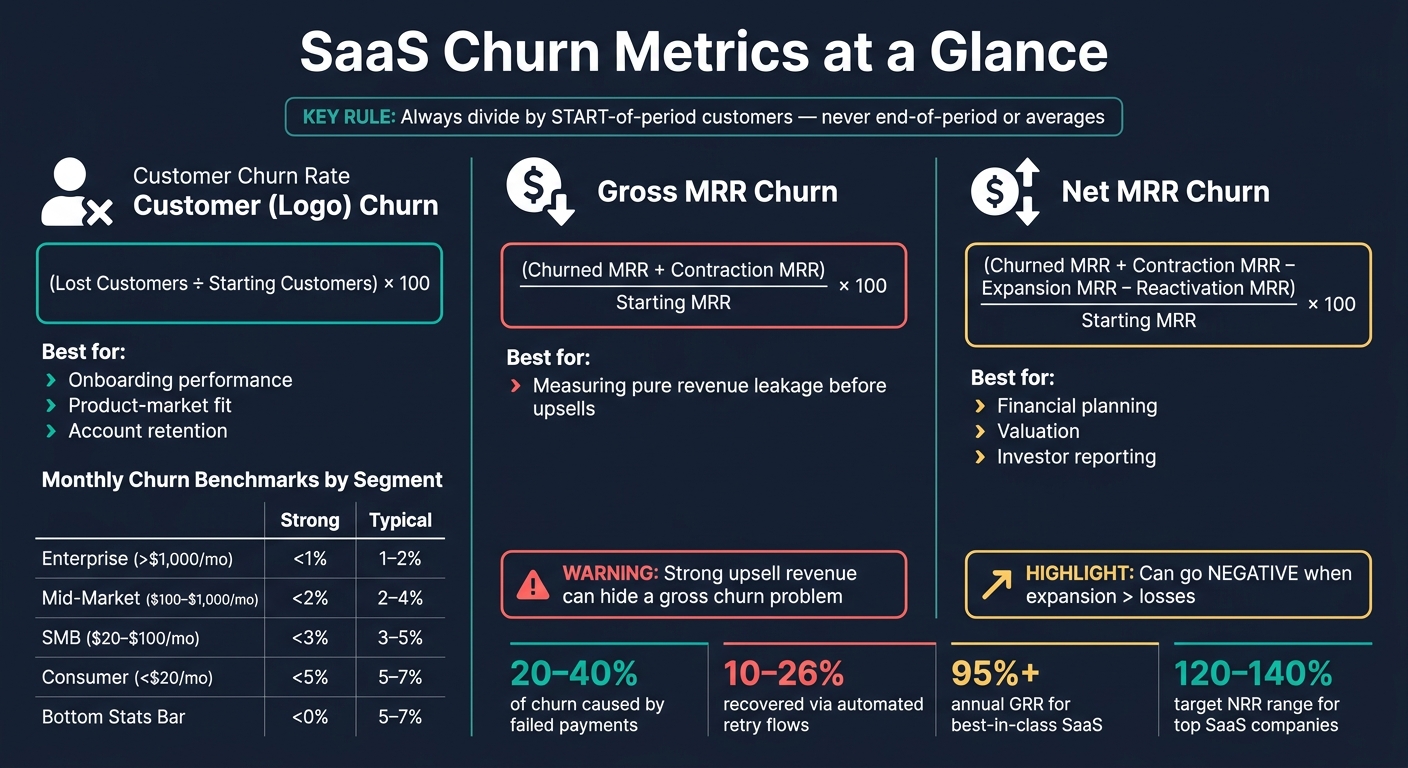
SaaS Churn Metrics Compared: Customer, Gross MRR & Net MRR Churn
How to Calculate Churn Rate for SaaS
sbb-itb-17e8ec9
Choose the Right Churn Formula for Your SaaS Model
Use the churn metric that fits the decision in front of you: customer loss, revenue loss, or total revenue impact. Put simply, use the formula that matches the report you’re trying to build.
Customer Churn Rate Formula for Monthly and Annual Subscriptions
The standard customer churn formula is simple:
Customer Churn Rate = (Customers Lost During Period ÷ Customers at Start of Period) × 100
Include paid cancellations, non-renewals, and paid-to-free downgrades. Then divide by start-of-period customers only.
For annual plans, don’t measure churn by calendar month. Measure it by renewal cohort instead, since renewals tend to bunch up around renewal dates.
If dollars matter more than customer count, move to MRR-based churn.
Gross MRR Churn and Net MRR Churn Formulas
Customer churn counts people. MRR churn tracks revenue. That difference matters a lot when you’re planning the business.
- Gross MRR Churn = (Churned MRR + Contraction MRR) ÷ Starting MRR × 100
- Net MRR Churn = (Churned MRR + Contraction MRR − Expansion MRR − Reactivation MRR) ÷ Starting MRR × 100
Gross MRR churn shows revenue leaking out before expansion makes up for any of it. Net MRR churn subtracts expansion and reactivation revenue from those losses. If expansion grows faster than losses, net MRR churn can go negative, which means expansion revenue is higher than the revenue you lost.
Even if net churn looks good, keep a close eye on gross MRR churn. Strong expansion revenue can hide a bad retention issue underneath the surface.
Use gross churn to find the leak. Then use logo churn to trace where it begins.
| Metric | Formula | Inputs | Best Use Case |
|---|---|---|---|
| Customer (Logo) Churn | (Lost Customers ÷ Starting Customers) × 100 | Cancellations, non-renewals | Product-market fit, onboarding performance |
| Gross MRR Churn | (Churned MRR + Contraction MRR) ÷ Starting MRR × 100 | Cancellations, downgrades, discounts | Measuring pure revenue leakage |
| Net MRR Churn | (Churned MRR + Contraction MRR − Expansion MRR − Reactivation MRR) ÷ Starting MRR × 100 | Upsells, cross-sells, seat adds, win-backs | Financial planning, valuation, growth sustainability |
Logo Churn vs. Revenue Churn: When to Use Each
Use logo churn to watch adoption. Use revenue churn to track the dollar impact.
Logo churn is the better view for product-market fit and onboarding performance. Revenue churn matters more for financial planning, valuation, and forecasting because it gives each loss the weight of its actual dollar amount. That gap gets bigger when a small number of large accounts bring in most of your revenue. In that setup, you can lose a few big customers, see logo churn stay low, and still watch revenue churn climb.
For context, top-quartile enterprise B2B SaaS companies keep monthly logo churn below 0.3%. If you’re in that segment and logo churn looks low while revenue churn keeps moving up, start with your largest accounts.
Next, clean your customer and MRR data so the formula uses the same active base. Before you calculate anything, standardize your customer counts and MRR fields.
Prepare Clean SaaS Data Before Calculating Churn
The formula is only as reliable as the data behind it. Before you calculate churn, your customer counts, subscription records, and MRR fields need clear, steady definitions. If they don't, you're not measuring retention. You're measuring noise.
Define Active Customers, Start-of-Period Counts, and MRR Fields
Use the Day 1 customer count as the denominator. Do not use end-of-period counts or averages. Stick to the start-of-period base.
Track these MRR fields each period:
| MRR Field | What It Captures |
|---|---|
| Starting MRR | Total recurring revenue on Day 1 of the period |
| Churned MRR | Revenue lost from full cancellations |
| Contraction MRR | Revenue lost from downgrades or price cuts |
| Expansion MRR | Revenue gained from upgrades or seat additions |
| Reactivation MRR | Revenue from former customers who returned |
Count only active paid billing accounts with MRR above $0. Treat paused accounts as active until cancellation. Exclude free trials from active accounts. For annual contracts, count churn at renewal or contract end, not at notice.
Once the base is fixed, split churn by plan, term, and customer size. That's how you find where retention starts to slip.
Segment Churn by Plan, Contract Term, and Customer Size
Blended churn can hide the real issue. A high churn rate might come from pricing, weak onboarding, or support strain. Segmentation helps you see which is doing the damage.
Start by separating monthly and annual subscribers. Annual customers are only at risk at renewal, so count them as at risk only in the month their contract expires.
Then break churn down by customer size. Benchmarks shift a lot by segment:
| Segment | Strong Monthly Churn | Typical Monthly Churn |
|---|---|---|
| Enterprise (>$1,000/mo) | <1% | 1–2% |
| Mid-Market ($100–$1,000/mo) | <2% | 2–4% |
| SMB ($20–$100/mo) | <3% | 3–5% |
| Consumer (<$20/mo) | <5% | 5–7% |
After that, separate involuntary churn so billing failures don't get lumped in with product loss.
Separate Voluntary Churn from Involuntary Churn
Treat failed payments as their own category so churn reflects retention, not billing friction. Voluntary churn happens when a customer chooses to cancel. That points to product value, pricing, or fit. Involuntary churn happens when a payment fails because of an expired card or bank decline, even though the customer did not mean to leave.
Failed payments and credit card issues account for 20% to 40% of total churn in most subscription businesses. Automated retries and reminders can recover 10% to 26% of failed payments.
Each churn type points to a different fix. Voluntary churn calls for product changes. Involuntary churn calls for billing recovery. Mix them together, and you'll end up working on the wrong problem.
With clean segments in place, you can handle upgrades, reactivations, and annual contracts without distorting churn.
Handle SaaS-Specific Edge Cases Without Distorting Churn
Clean data wipes out a lot of mistakes. Even so, SaaS edge cases still need clear rules.
How to Treat Upgrades, Downgrades, and Reactivations
Treat upgrades as Expansion MRR, downgrades as Contraction MRR, and reactivations as Reactivation MRR. If a customer comes back, log that revenue as Reactivation MRR, not new business.
| Event | Customer (Logo) Churn | Gross Revenue Churn | Net Revenue Churn |
|---|---|---|---|
| Upgrade | No impact | No impact | Offsets losses |
| Downgrade | No impact | Counts as Contraction MRR | Counts as Contraction MRR |
| Pause | Exclude | Exclude | Exclude |
| Reactivation | No impact | No impact | Offsets losses |
That split matters more than it may seem. An upgrade should not look like a save, and a returning customer should not look like a brand-new win. If you blur those lines, your churn numbers start telling the wrong story.
How to Account for Annual Contracts, Trials, and Discounts
For annual contracts, record non-renewals in the contract-end month, not on the date you got the cancellation notice. That keeps the churn signal steady instead of creating lumpy quarterly or annual spikes.
Exclude trial users from churn calculations altogether.
Discounts need a written policy. If you give an existing customer a deeper discount, treat the added discount as Contraction MRR. If a temporary discount ends and the price returns to normal, treat the restored price as Expansion MRR. Pick one policy and stick with it from one period to the next.
The same discipline shows up when churn runs across products or legal entities.
How to Calculate Churn Across Multiple Products or Entities
Watch out for double-counting. If a customer has two products and cancels one, that may be churn at the product level, but not at the full customer-relationship level.
Before you calculate anything, decide what level you’re reporting on:
- Product-level churn: Canceling any one product counts as churn for that product line.
- Consolidated churn: Count churn only when the customer cancels all active products.
Neither method is wrong, but mixing them will skew the result. If your company has multiple legal entities or subsidiaries that share the same customer base, use the same rule set across each entity. Then consolidate with care so shared subscription revenue is not counted twice.
Use Churn Metrics in Forecasting and Board Reporting
Turn Churn Data into Forecasts, Retention Goals, and Investor Updates
Once you define churn the same way every time, you can use it for forecasting, runway planning, and board updates.
Churn puts a hard limit on sustainable growth. That’s why it should feed directly into your MRR forecasts, runway model, and retention targets. One simple formula makes the point fast: Maximum Sustainable MRR = New MRR ÷ Monthly Churn Rate. If you add $10,000 in new MRR, that works out to $200,000 at 5% churn and $500,000 at 2% churn. Same sales input, very different outcome.
Churn also sits at the center of your LTV calculation: LTV = ARPU ÷ Churn Rate. When churn drops, LTV goes up, and CAC payback improves.
For board reporting, don’t show churn in isolation. Pair it with retention metrics so the picture is harder to misread. Use Gross Revenue Retention (GRR) to show the revenue floor, meaning what you keep without any expansion. Use Net Revenue Retention (NRR) to show the ceiling, or how much the current customer base grows on its own.
Best-in-class SaaS companies report annual GRR above 95% and aim for NRR between 120% and 140%. If you report ONLY NRR and leave out GRR, you can mask a high gross churn rate that expansion revenue is offsetting for the moment.
A fixed reporting cadence helps keep all of this clean and comparable:
- Review involuntary churn and failed payments weekly.
- Calculate logo churn, gross revenue churn, and net revenue churn monthly.
- Run cohort and segment deep-divives quarterly.
Just as important, standardize the meaning of "active customer", "churned," and "contraction" across reporting periods.
FAQs
Which churn metric should I track first?
Track both customer churn and revenue churn.
Customer churn tells you how many accounts you lose, but it gives every customer the same weight.
Revenue churn shows the money impact of cancellations and downgrades. That matters even more when you lose high-value accounts.
When you track both, you get a clearer picture of what’s going on and can spot trends that a single metric might miss.
How do annual plans affect churn calculation?
Annual plans can mask retention problems that show up much sooner. If you have both monthly and annual contracts, look at them in separate groups. People buy them for different reasons, and they cancel them differently too.
To keep your reporting consistent, convert annual contracts into monthly equivalents. And if you're turning monthly churn into annual churn, don't just multiply by 12. Use this formula instead:
Annual Churn = 1 − (1 − Monthly Churn)^12
Should failed payments count as churn?
Yes, but as involuntary churn.
Unlike voluntary churn, where a customer chooses to leave, involuntary churn happens when a subscription ends because of billing problems like expired cards or insufficient funds.
Track it on its own. That way, you can see if the issue points to the product, pricing, or your payment recovery process.
Most businesses count it as churn only after the final recovery window ends.