Your seed round is not just about valuation. It sets dilution, board control, investor rights, and the paperwork that can help - or hurt - your Series A.
If I had to boil this down, I’d say this: pick the right funding tool, watch option pool math, avoid giving up board control early, and keep your cap table clean from day one. Even a small miss between the term sheet and closing docs can create cap table errors, approval delays, or tougher terms in the next round.
Here’s the short version of what matters most:
- Term sheet terms drive the deal: valuation, round size, option pool treatment, board seats, veto rights, and liquidation preference
- Binding clauses start right away: no-shop, confidentiality, and who pays legal fees
- Your funding tool changes the whole setup:
- SAFE: simple, priced later
- Convertible note: debt that converts later, with interest and maturity risk
- Priced round: stock issued at close, with full investor rights
- Priced rounds often take 2–4 months
- Cap table errors slow diligence: every share, option, SAFE, and note must match the records behind it
- Closing is more than signatures: board approval, stockholder approval, charter updates, Form D, and state filings may all be part of it
- Post-close work matters too: update the stock ledger, archive signed docs, and keep investor reporting current
How to Raise Seed Funding for Your Startup: Convertible Notes and SAFEs
sbb-itb-17e8ec9
Quick Comparison
| Funding tool | When valuation is set | Investor rights at signing | Main risk | Best for |
|---|---|---|---|---|
| SAFE | Later, at conversion | Light | Hidden dilution if many stack up | Small early seed rounds |
| Convertible Note | Later, at conversion | Light | Debt pressure from interest and maturity date | Small rounds where note terms fit |
| Priced Round | At close | Full preferred stock rights | More time, more legal work, more cost | Larger seed rounds, often around $3 million+ |
A clean seed round usually comes down to four things: clear economics, tight control terms, clean records, and correct closing documents. That’s what this guide covers from start to finish.
Term Sheet Basics and Key Deal Terms
A term sheet is a mostly non-binding outline of a seed round. It gives lawyers the frame for the final deal documents. Once signed, confidentiality, exclusivity, and sometimes expense allocation are binding right away. The rest usually is not.
The next job is simple: separate the big money terms from the control terms.
Economics: Valuation, Round Size, Ownership, and Dilution
Start with economics, because this is where the round’s actual cost shows up. These terms drive dilution, and dilution is where a lot of founders get tripped up.
One of the most common pain points is option pool expansion. If the employee option pool is included in the pre-money valuation, founders get diluted before the investor’s cash even lands on the cap table. That can change the math more than people expect.
Here’s the basic split:
- Pre-money valuation is the company’s value before new money comes in
- Post-money valuation includes the new capital
That sounds simple on paper. In practice, the key question is where the option pool sits. Founders should check that point carefully so they know their actual dilution, not just the headline number.
Once the dilution picture is clear, the focus shifts from price to power.
Control Terms: Board Seats, Protective Provisions, and Investor Rights
Control terms can matter more in later rounds than the headline valuation. A high price sounds great. But if the control setup is off, that can come back to bite you.
Board makeup is the clearest example. Who sits on the board gets a say in major calls, from financing plans to big strategic moves. At the seed stage, founders should avoid giving investors board control.
Protective provisions, often called veto rights, give investors approval power over certain actions. That can include selling the company or changing the charter. The fine print that matters most is the threshold: what percentage of preferred shares is needed to use those rights? If the threshold is low, a small group of investors may be able to block major decisions.
Other investor rights also deserve a close read. These include pro-rata rights, information rights, and liquidation preference.
A common seed default is 1x non-participating liquidation preference. That means investors get their original investment back before common stockholders get paid in a sale. A participating preference goes further. It lets investors first recover their money and then also share in the remaining proceeds. For founders and employees, that can cut down exit payouts in a very real way.
| Control Term | What It Means | Founder Watch-Out |
|---|---|---|
| Board Seats | Who holds voting power on the board | Avoid giving investors majority control early |
| Protective Provisions | Investor veto over major decisions | Check the trigger threshold percentage |
| Pro-Rata Rights | Right to invest in future rounds | Can complicate later rounds if too broad |
| Liquidation Preference | Payout priority in a sale | Push for 1x non-participating as the standard |
Binding Provisions and Closing Conditions
Most of the term sheet is non-binding. But the binding parts matter right away: confidentiality, exclusivity, and expense allocation can create immediate duties.
A no-shop clause is the big one to watch. It stops you from taking the deal around to other investors while diligence is happening. In plain English, once you sign, you may be off the market for that period.
Closing conditions are the last checklist before money moves. These usually include completion of formal diligence, signing all definitive documents, and getting the needed board and stockholder approvals. The definitive documents handle the remaining details.
After the term sheet, the next choice is the financing instrument: SAFE, note, or priced equity.
Choosing the Right Financing Instrument
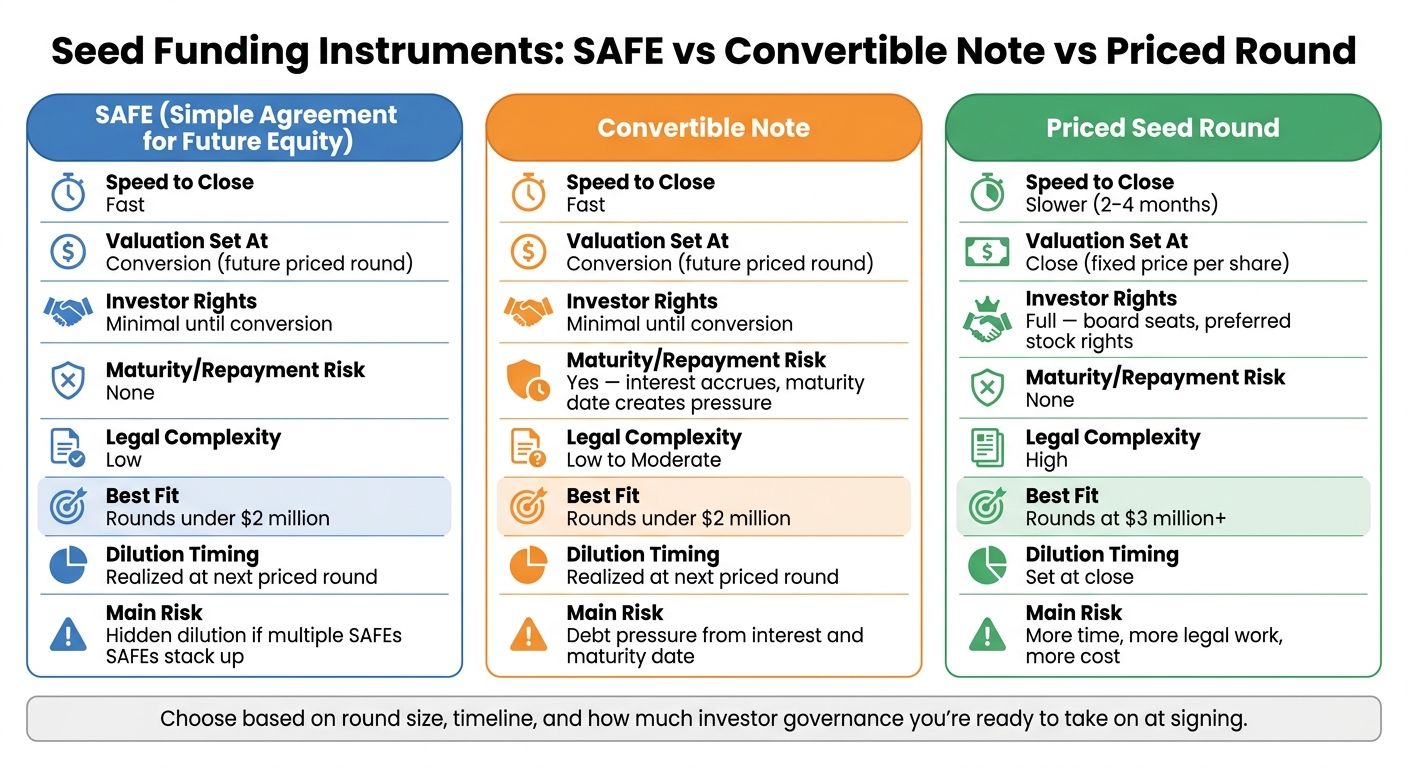
SAFE vs Convertible Note vs Priced Round: Seed Funding Comparison
Once the term sheet locks in price and control, founders need to make one more big call: issue equity now or push it to later.
That choice shapes when ownership is set, what rights investors get, and how much legal work the round will take. At the seed stage, most founders end up picking from SAFEs, convertible notes, and priced equity rounds. Same goal, different mechanics.
SAFE: Speed and Simplicity with Delayed Pricing
A SAFE, short for Simple Agreement for Future Equity, lets a company bring in money now without issuing stock right away. There’s no interest, no maturity date, and no shares at signing. Instead, the investor gets the right to convert into stock later, most often in the next priced round, based on a valuation cap or discount rate.
The appeal is obvious: it’s fast and light on paperwork.
But there’s a catch. Dilution can sneak up on you. If a company stacks several SAFEs, the later ownership shift can be bigger than it looks at first glance. That’s why founders should model dilution before signing each SAFE, not after the pile gets bigger.
Convertible Notes: Debt Terms That Can Reshape the Round
Convertible notes also delay equity issuance, but they do it through debt. A note has an interest rate and a maturity date, and it usually converts into equity at the next priced round using a valuation cap or discount.
That debt piece matters. If the company doesn’t close a priced round before the maturity date, repayment terms can add pressure at the worst time. What looks simple on day one can turn into a tense negotiation later.
Convertible notes often make sense for investors who want debt-style terms while still waiting to price the company.
Priced Seed Rounds: Clearer Ownership and Full Investor Rights
A priced round works differently. The company sets a fixed price per share at closing, and investors receive preferred stock at close. They also get governance rights right away, including board seats and protective provisions.
That means there’s no waiting around for a future conversion event. Everyone knows exactly what they own on day one, which can make the cap table much easier to read.
The downside is time and cost. A priced seed round usually takes 2–4 months to close, and it calls for a full priced-round document set.
| Feature | SAFE | Convertible Note | Priced Seed Round |
|---|---|---|---|
| Speed to Close | Fast | Fast | Slower (2–4 months) |
| Valuation Set At | Conversion (future round) | Conversion (future round) | Close (fixed price per share) |
| Investor Rights | Minimal until conversion | Minimal until conversion | Full (board seats, preferred stock) |
| Maturity/Repayment Risk | None | Yes | None |
| Legal Complexity | Low | Low to moderate | High |
| Best Fit | Rounds under $2 million | Rounds under $2 million | Rounds at $3 million+ |
| Typical Founder Dilution | Realized at next priced round | Realized at next priced round | Dilution is set at close |
Once the instrument is picked, the focus shifts to the closing package, approvals, and compliance filings.
Closing Documents, Approvals, and Securities Compliance
Once pricing is locked in, closing turns into a paperwork and approval process. At this stage, the main job is simple: make sure every document lines up with the deal terms already negotiated. The financing instrument sets the framework. The closing documents make the round legally effective.
Core Closing Documents and What Each One Controls
A priced seed round closes only when the definitive documents are signed.
| Document | What It Controls | Parties |
|---|---|---|
| Stock Purchase Agreement (SPA) | Sale of shares, reps and warranties, and the conditions that must be satisfied before issuance. | Company and investors |
| Amended and Restated Certificate of Incorporation | Preferred stock rights: liquidation preference, conversion, and voting. | Company (filed with the state, typically Delaware) |
| Investors' Rights Agreement (IRA) | Information rights, pro rata rights, and registration rights. | Company and investors |
| Voting Agreement | Board seats and director elections. | Company, founders, and investors |
| ROFR & Co-Sale Agreement | Limits transfers of founder shares. | Company, founders, and investors |
Each document handles a different part of the deal. The SPA covers the sale itself. The charter sets the rights tied to the preferred stock. The IRA spells out what investors can receive and do after the round. The Voting Agreement deals with control around board elections, and the ROFR & Co-Sale Agreement puts limits on transfers of founder stock.
Once those documents are in draft form, the next step is formal approval.
Board and Stockholder Approvals
The board needs to approve the financing, the new preferred stock class, and the final documents through board resolutions. Stockholders also need to approve the charter amendment that authorizes the preferred stock before it can be issued.
Founders should also expect to sign a CEO certificate of compliance at closing - a formal declaration that the deal documents' representations are accurate and current as of the closing date.
After the internal approvals are done, attention shifts to securities-law compliance.
Federal and State Securities Compliance
Seed stock sales must comply with federal and state securities laws. That usually means confirming accredited-investor status where required, filing Form D, and submitting any needed state notices on time.
Cap Table Readiness, Diligence, and Post-Close Recordkeeping
Pre-Close Cap Table and Diligence Checklist
Once approvals and compliance are set, the deal still comes down to two things: a clean cap table and a complete diligence file.
Before diligence starts, reconcile every outstanding security. Each cap table entry should match the documents behind the final financing. That means lining up records for every share, option, warrant, SAFE, and convertible note.
Messy records drag out diligence and make investors uneasy. A clean VDR helps move things along. Put the main diligence materials in one place, and make sure every IP assignment is signed before closing.
| Diligence Category | Key Materials to Organize |
|---|---|
| Corporate/Legal | Formation documents, board/stockholder consents, charter amendments, securities filings |
| Intellectual Property | IP assignments, patent filings, trademark registrations, founder invention agreements |
| Finance & Tax | Financial statements, tax returns, 83(b) election filings, burn rate projections |
| Cap Table | Records of common/preferred stock, options, warrants, SAFEs, convertible notes |
| Operational | Key customer contracts, vendor agreements, technical stack documentation |
After the round closes, those same files need to be updated so they match the final issuance. No guesswork. No loose ends.
Post-Close Records and Finance Handoff
Post-close recordkeeping starts right away. The first job is simple: organize signed copies of every closing document. That includes the Stock Purchase Agreement (SPA), Investors' Rights Agreement, Voting Agreement, and Right of First Refusal and Co-Sale Agreement. Then file the charter, update the stock ledger, and archive the executed documents.
The cap table also needs one more post-close reconciliation. This pass should reflect actual dilution across all existing shareholders. That matters for future ownership clarity and for Series A diligence. Matthew Wilson of Allied Venture Partners puts it plainly:
"A clean cap table is paramount for Series A investors who will use it to understand ownership structures and potential dilution."
The next round might be far off, so records can’t sit untouched in the meantime. Keep them current. Board minutes, quarterly shareholder communications required by the Investors' Rights Agreement, and up-to-date financial reporting all support that readiness. Keep the books reconciled, board minutes current, and investor reports ready for the next financing.
Conclusion: The Legal Structure Decisions That Shape Your Seed Round
A clean cap table before closing, and accurate records after the money hits the bank, are what make the earlier legal and financing choices stick. What founders decide at the seed stage shapes what they can negotiate, offer, and control at Series A and after that. Those records become the baseline for the next financing.
FAQs
How do I choose between a SAFE, note, and priced round?
It comes down to your budget, your company’s stage, and what you care about most in the deal.
SAFEs and convertible notes are usually the faster, cheaper path because they push valuation to a later round. That can make early fundraising feel a lot less heavy.
SAFEs are the simpler of the two. They don’t have a maturity date or interest, so there’s less pressure built into the paperwork.
Convertible notes work differently. They’re debt, which means they come with interest, a maturity deadline, and repayment rights.
Priced rounds take more time and usually cost more to paper up - often $20,000 to $150,000. But in return, you get clear ownership terms and preferred stock rights.
How do I calculate the real dilution from an option pool increase?
First, figure out whether the option pool goes up pre-money or post-money. That detail matters a lot.
If the increase happens pre-money, the dilution lands entirely on existing stockholders. In plain English, that means your pre-money valuation takes a hit.
To work out ownership, divide your total shares by the fully diluted share count. That count should include:
- Issued shares
- Warrants
- Convertible notes
- SAFEs
- All shares in the option pool
It also helps to model both scenarios against your financials so you can see the effect before you agree to terms.
What cap table mistakes can delay my Series A?
Cap table mistakes can slow a Series A by 4 to 8 weeks and can cut valuation by 12%. That’s not a small paperwork problem. It can turn into a deal problem fast.
The most common issues are pretty simple on the surface, but painful during diligence:
- Missing or unsigned stock option agreements
- Undocumented equity promises
- Unrecorded SAFEs or convertible notes
Other red flags show up when the records don’t line up. That includes missed 83(b) filings and gaps between the cap table and legal documents, like missing board minutes or IP assignment papers.