Investors trust businesses with clear, accurate cap tables. Here’s why it matters:
- First Impressions Count: Investors often review your cap table before your product or financials. A clean cap table shows you're organized.
- Mistakes Are Costly: Common errors - like unsigned agreements, miscalculated dilution, or missed 83(b) filings - can delay funding by 4-8 weeks, increase legal costs (up to $85,000), and even lower your valuation by 12%.
- Transparency Builds Confidence: Investors value cap tables that are up-to-date, accurate, and backed by legal documents.
Want to avoid these pitfalls? Use a centralized system, reconcile records quarterly, and integrate financial data for accuracy. A transparent cap table isn’t just about compliance - it’s a tool to secure funding and build long-term investor relationships.
A Guide to Cap Tables for Startup Founders: What to Include & How to Maintain One
sbb-itb-17e8ec9
The Problem: How Disorganized Cap Tables Damage Investor Confidence
Cap Table Mistakes: The Hidden Cost to Startup Fundraising
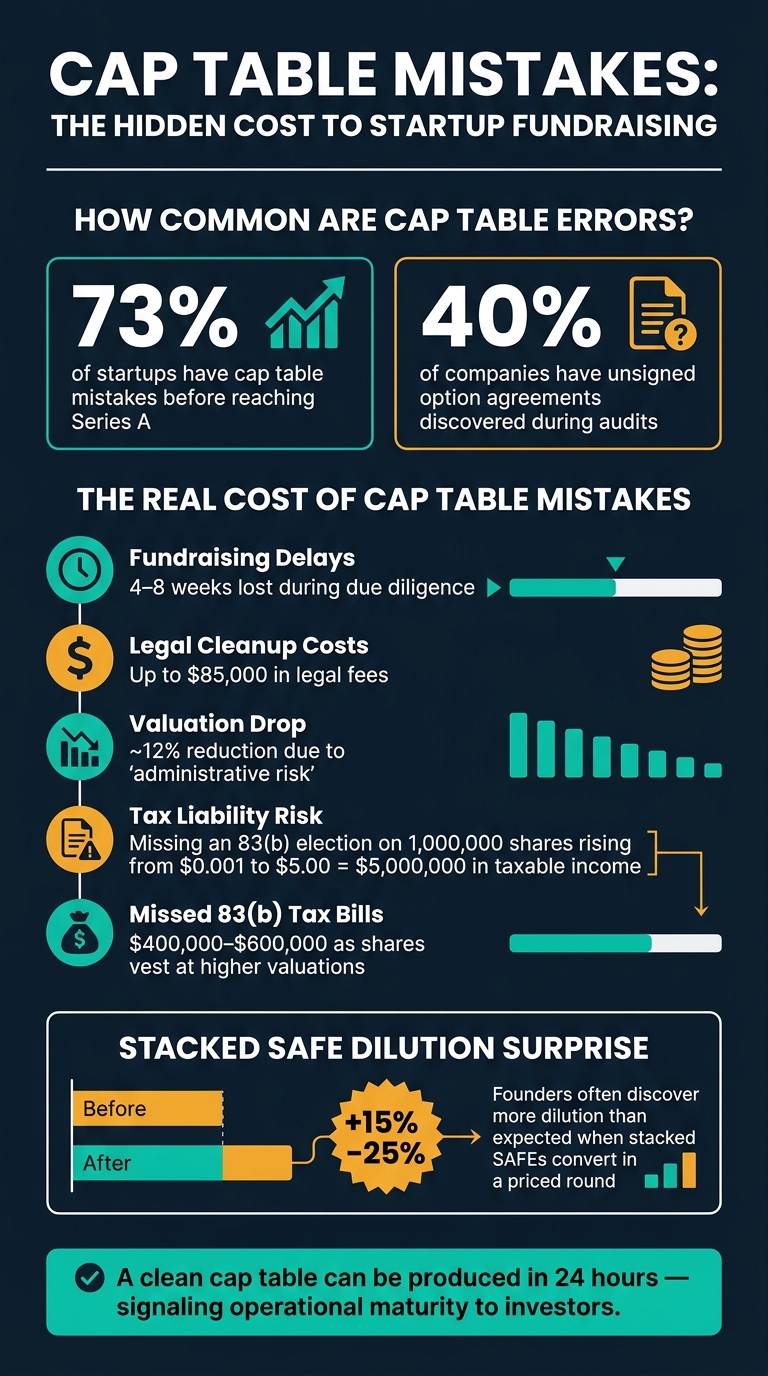
A messy cap table doesn't just slow things down - it can completely derail your fundraising efforts. Mistakes uncovered during due diligence can set your timeline back by 4 to 8 weeks. In a fast-moving funding round, that kind of delay can kill your momentum. Let’s break down the common errors that can make investors lose faith in your business.
Common Cap Table Mistakes That Concern Investors
The most harmful errors often start as small oversights but snowball into major issues. For example, unsigned option agreements show up in about 40% of companies during audits. Founders frequently promise equity informally - through emails or verbal agreements - without proper board approval or documentation. These "phantom equity" promises don’t show up clearly on the cap table but create legal risks when investors dig deeper.
Another frequent issue is stacked SAFEs. Raising multiple SAFE rounds with different valuation caps can make dilution calculations far more complicated than expected. Many founders only realize during a priced round that their ownership has dropped by 15% to 25% more than they anticipated. Then there’s the problem of missing or late 83(b) elections. This IRS filing, which must be submitted within 30 days with no extensions, can lead to massive tax liabilities if overlooked. For instance, failing to file an 83(b) on 1,000,000 shares that increase in value from $0.001 to $5.00 means a founder faces $5,000,000 in taxable income - without seeing any liquidity.
"When the cap table and the paper diverge, the 'ownership' you're showing investors may be incomplete or wrong." - Promise Legal
These kinds of mistakes don’t just carry legal and financial risks - they also undermine the trust investors need to feel confident in your business.
Why Investors Prioritize Clean Cap Tables
Errors on your cap table do more than just cost money - they suggest deeper problems with how your company is run. Investors aren’t just looking for accurate numbers; they want to see that you have strong operational discipline. A cap table full of mistakes signals poor internal controls, which raises red flags beyond just equity management.
"A cap table error discovered during due diligence doesn't just delay the deal - it raises a fundamental question about whether your company is well-managed. If you can't track ownership accurately, what else are you getting wrong?" - Stuart Wilson, ACMA CGMA, Fractional CFO, BlackpeakCFO
The financial fallout can be severe. Cleaning up a messy cap table can rack up legal fees of over $85,000. Take the case of a founder working with Northstar Financial Advisory in January 2026. Just six weeks before closing a Series A round, due diligence uncovered 14 discrepancies, including unapproved option grants and SAFEs with incorrect valuation caps. The result? $85,000 in legal fees, a seven-week delay, and a 12% drop in the company’s valuation due to "administrative risk".
These kinds of setbacks also bring attention to "dead equity" - shares held by former co-founders or employees who no longer contribute. This not only wastes equity that could be used to attract active talent but also signals to investors that the founding team might lack the motivation to push through long-term challenges.
The bottom line: a clean, well-managed cap table isn’t just a nice-to-have - it’s essential if you want to secure investor trust and successfully close funding rounds.
The Solution: How Transparency Strengthens Investor Relationships
Cap table issues can be avoided entirely with the right approach. A transparent cap table doesn’t just fix mistakes - it builds trust, encouraging investors to back your venture repeatedly.
What a Transparent Cap Table Looks Like
A transparent cap table serves as a single, reliable source of truth. It’s a centralized, digital record where every entry is supported by signed legal documents, board approvals, or stock purchase agreements. Unlike a static spreadsheet sent before a pitch, it’s a dynamic, up-to-date system that stays accurate between funding rounds.
Here’s what investors expect to see:
| Element | What It Covers | Why Investors Need It |
|---|---|---|
| Shareholder Ledger | Names, contact info, and share counts | Identifies who holds voting rights and control |
| Share Classes | Common vs. Preferred stock distinctions | Clarifies liquidation preferences and rights |
| Vesting Schedules | Typically a 4-year schedule with a 1-year cliff | Ensures key talent is incentivized to stay |
| Convertible Instruments | SAFEs, notes, and warrants | Helps calculate future dilution in new rounds |
| ESOP Pool | Unallocated vs. granted options | Confirms capacity to hire essential talent |
| Transaction History | Purchase prices and dates | Supports tax compliance and audit readiness |
In addition, compliance records like proof of 409A valuations, filed 83(b) elections, and board-approved equity workflows show that your cap table reflects actual ownership - not just intentions.
"Your cap table is a credibility document - not an internal worksheet. Investors evaluate your operational maturity through your equity management practices." - Tania Huzieran, Senior Manager, Fidelity Private Shares
This transparency doesn’t just confirm ownership details - it also creates real advantages for investors.
How Transparency Benefits Investors
Real-time access to a clean cap table eliminates guesswork. Investors can verify assumptions, model exit scenarios, and understand their position in the liquidation waterfall without chasing documents or waiting for manual updates.
Today, real-time access is becoming the norm. Instead of outdated PDFs, investors prefer logging in to view current data. Offering tiered access - detailed views for lead investors and summarized views for early-stage investors - balances openness with privacy. Platforms like Lucid Financials make this easier by integrating financial management with cap tables, ensuring accurate, investor-ready reports.
Demonstrating operational discipline is key. A founder who can produce a clean, reconciled cap table within 24 hours signals strong organizational skills.
"Companies that can produce a clean, reconciled cap table in 24 hours signal to investors that they run a tight ship." - Stuart Wilson, ACMA CGMA, BlackpeakCFO
This efficiency reduces friction during fundraising, minimizes due diligence delays, and lowers the risk of deal fatigue or re-pricing.
"If you keep your investors engaged with honest updates, they will reward you by participating in future rounds." - Jason Calacanis, Investor
Steps to Build and Maintain a Transparent Cap Table
Setting Up a Reliable Cap Table System
Start by creating a centralized system that ties directly to key documents like articles of incorporation, stock purchase agreements, board resolutions, and financing paperwork. Every entry in the cap table should connect to a signed, legally enforceable document.
From the very beginning, track fully diluted ownership. This means accounting for issued shares, unexercised options, warrants, and unconverted SAFEs or notes. Investors pay close attention to fully diluted ownership because it provides a complete picture of equity distribution.
"The gap between outstanding and fully diluted is where a lot of founder wealth gets quietly destroyed." - Trace Cohen, 3x Founder and Builder, Value Add VC
If you're still using spreadsheets, it's time to upgrade. Spreadsheets can lead to calculation errors and audit trail gaps. Today, over 50,000 companies manage more than $3.0 trillion in equity using dedicated platforms. These tools are increasingly the standard for cap table management.
Finally, make sure your cap table aligns seamlessly with your financial operations. This connection is critical for maintaining accuracy and avoiding costly mistakes.
Connecting Financial Operations with Cap Table Management
Once you've established a reliable system, the next step is to integrate your cap table with your financial records. A cap table that operates in isolation can create blind spots, which may lead to issues during due diligence.
To avoid these problems, sync your cap table updates with your financial close cycle. For example, reconcile equity records against signed agreements and bank statements on a regular (monthly or quarterly) basis. This "quarterly cap table close" approach ensures your equity data is as accurate and up-to-date as your income statement.
"Treating the cap table as documentation rather than a planning tool is a decision you make by default." - Aleksandar Stojanovic, CEO & Founder, Fiscallion
This alignment can also protect founders from unexpected dilution. Take the "option pool shuffle", for example. When investors require a new option pool to be created pre-money, the dilution often hits existing shareholders rather than the incoming investor . By modeling this scenario against your financials before signing a term sheet, you can negotiate a pool size that matches your actual hiring plan for the next 12–24 months, rather than accepting a percentage dictated by the investor.
To further enhance accuracy and efficiency, consider leveraging advanced technology.
Using AI to Keep Cap Tables Accurate
Manual reconciliation is prone to errors. AI tools can automate tasks like dilution calculations, convertible note modeling, vesting schedules, and error detection. These tools not only reduce mistakes but also demonstrate strong operational discipline to investors.
Platforms like Lucid Financials take this a step further. By combining AI-driven bookkeeping with CFO-level reporting, Lucid ensures your equity data and accounting records stay perfectly aligned in real time. This eliminates gaps that could arise during fundraising.
Modern AI tools also offer live, audit-ready models. Instead of sending static PDFs, these tools provide formula-linked models where changes - like a new funding amount - automatically update the entire ownership structure. This level of traceability is crucial: 8 out of 9 venture investors surveyed identified cap tables, preference-stack waterfalls, and derived models as their most time-intensive spreadsheet tasks.
Long-Term Practices That Keep Investors Confident
Regular Updates and Investor Communication
Keeping your cap table accurate isn't a one-and-done task - it requires ongoing attention. The companies that earn the most trust from investors aren't just those who start with clean cap tables; they're the ones who maintain them consistently through every funding round.
Treat your cap table like your income statement - review it regularly. Scheduling quarterly reviews of your equity records helps ensure your data stays up-to-date, preventing small mistakes from snowballing into bigger issues. Alongside this, maintain a steady rhythm of investor communication. Sharing quarterly "as of" ownership snapshots builds confidence and keeps everyone aligned.
"If you keep your investors engaged with honest updates, they will reward you by participating in future rounds." - Jason Calacanis
Institutional investors often base their decisions to reinvest on how clearly they understand their current ownership and the company's dilution history. By staying proactive and transparent, you demonstrate that your company is well-managed and trustworthy.
| Practice | Frequency | Purpose |
|---|---|---|
| Transaction Logging | Immediate | Record equity events as they happen |
| Legal Reconciliation | Quarterly | Match records with signed board consents and legal documents |
| Investor Reporting | Quarterly | Provide "as of" ownership snapshots to keep investors informed |
| Full Health Check | Annually | Audit equity records before major financing rounds |
While keeping investors informed helps maintain trust, strong internal systems ensure that your cap table stays accurate and error-free.
Governance and Internal Controls
Transparency with investors starts with having solid internal controls in place. Even a well-maintained cap table can develop issues if governance isn't up to par. Errors often surface at the worst times - like during a fundraising round - so it's critical to establish clear processes early on.
Assign a single person, such as your CFO or legal head, to oversee all equity transactions. This avoids the confusion and inconsistencies that can occur when multiple people handle updates independently. Require that every equity event is backed by board approvals and signed documentation before it's recorded.
Access control is another essential piece. Use a least-privilege approach, where most stakeholders have view-only access, and only a few administrators can make edits.
Two often-overlooked compliance areas are 409A valuations and 83(b) elections. Never grant options without a current 409A valuation, which should be updated yearly or after any major event. Failing to do so could trigger a 20% federal tax penalty under Section 409A. For restricted stock, recipients have just 30 days from the transfer date to file an 83(b) election with the IRS. Missing this deadline can lead to massive tax bills - ranging from $400,000 to $600,000 - as shares vest at higher valuations.
"The cheapest time to fix your cap table is before you issue anything. Once you're mid‑fundraise, 'cleanup' often means delays, renegotiation, and expensive ratifications." - Promise Legal
Mistakes uncovered during due diligence can delay fundraising by 4 to 8 weeks on average. Building strong governance practices early on ensures your cap table becomes an asset, not a liability.
Tools like Lucid Financials can simplify the process by automating updates and generating investor-friendly reports. This ensures that your cap table is always accurate, transparent, and ready for any funding round.
Conclusion: How Cap Table Transparency Supports Fundraising Success
Transparent cap table management goes beyond meeting due diligence requirements - it demonstrates that your company operates with discipline and precision. As Tania Huzieran, Senior Manager of Private Market Marketing at Fidelity Private Shares, explains:
"Your cap table is a credibility document - not an internal worksheet. Investors evaluate your operational maturity through your equity management practices."
The numbers paint a clear picture: cap table mistakes impact 73% of startups before they even reach Series A. When these errors are uncovered during due diligence, they can delay funding rounds by 4 to 8 weeks, reduce valuations by around 12%, and lead to hefty legal costs. These setbacks not only drain resources but also shake investor confidence. It's no surprise that efficient cap table management plays a direct role in speeding up the fundraising process.
Interestingly, the startups that navigate fundraising the fastest aren’t always the ones with the flashiest pitch decks. Instead, they’re the ones who can provide investors with a fully reconciled cap table within 24 hours, avoiding drawn-out legal reviews. This level of readiness can speak volumes about a company’s operational maturity.
"Pitch decks open doors, but cap tables determine how quickly startups can walk through them." - Garrison Gowens, Community & Partnerships, Cake Equity
To maintain a cap table that’s always investor-ready, consistent practices are key. This means recording every equity transaction in real time, reconciling records quarterly, assigning clear accountability, and conducting audits at least 90 days before starting a new fundraising round. Advanced platforms like Lucid Financials make this process even smoother by offering real-time, investor-ready reporting. By leveraging such tools, startups can transform their cap tables from potential liabilities into strategic assets. A dynamic, well-maintained cap table not only reassures investors but also creates a competitive edge, signaling operational excellence and readiness to scale.
FAQs
What documents should back every line on my cap table?
Every entry on your cap table needs to have a clear, chronological paper trail backed by signed legal documents. This means including board consents, stockholder approvals, and finalized agreements for equity transactions like stock purchases, option grants, warrants, SAFEs, or convertible notes. For actions like transfers, repurchases, or cancellations, make sure all related notices and agreements are properly documented. Lucid Financials simplifies this process, keeping your records organized and ready for investors.
How do I calculate fully diluted ownership the way investors do?
To figure out fully diluted ownership, you need to calculate your company’s total share count as if every equity right has been exercised or converted. This includes:
- Issued common shares
- Shares from both granted and ungranted option pools
- Warrants
- Convertible instruments, like SAFEs and convertible notes
Once you have the fully diluted total, divide an individual’s total shares by this number. The result is their ownership percentage. This method provides clarity when it comes to valuation and planning for exits.
When should I do a cap table cleanup before fundraising?
Start tidying up your cap table as soon as you can - preferably long before you kick off a fundraising round. If you wait until due diligence, you risk facing expensive delays or even putting deals at risk. Take the time to organize your equity structure early, ensure you have one precise and up-to-date cap table, and, if necessary, perform an equity audit. This will help you address any ownership or documentation issues before presenting everything to potential investors.