Equity dilution reduces your ownership percentage when new shares are issued. While this can grow a company's value, it impacts your control and financial exit. Manual forecasting with spreadsheets often leads to errors, especially with complex instruments like SAFEs or anti-dilution clauses. AI tools solve this by automating calculations, modeling scenarios, and providing real-time insights.
Key Takeaways:
- Common dilution sources: Funding rounds, option pools, SAFEs, and warrants.
- Manual issues: Errors in spreadsheets, compounding miscalculations, and missed details like option pool timing.
- AI advantages: Precise math, scenario modeling, and instant reporting for smarter decisions.
- Example tool: Lucid Financials integrates AI for accurate forecasting, Slack updates, and investor-ready reports.
AI tools ensure accurate ownership tracking, helping founders retain control and maximize exit value while avoiding common errors in equity management.
Benefits of AI Tools for Equity Dilution Forecasting
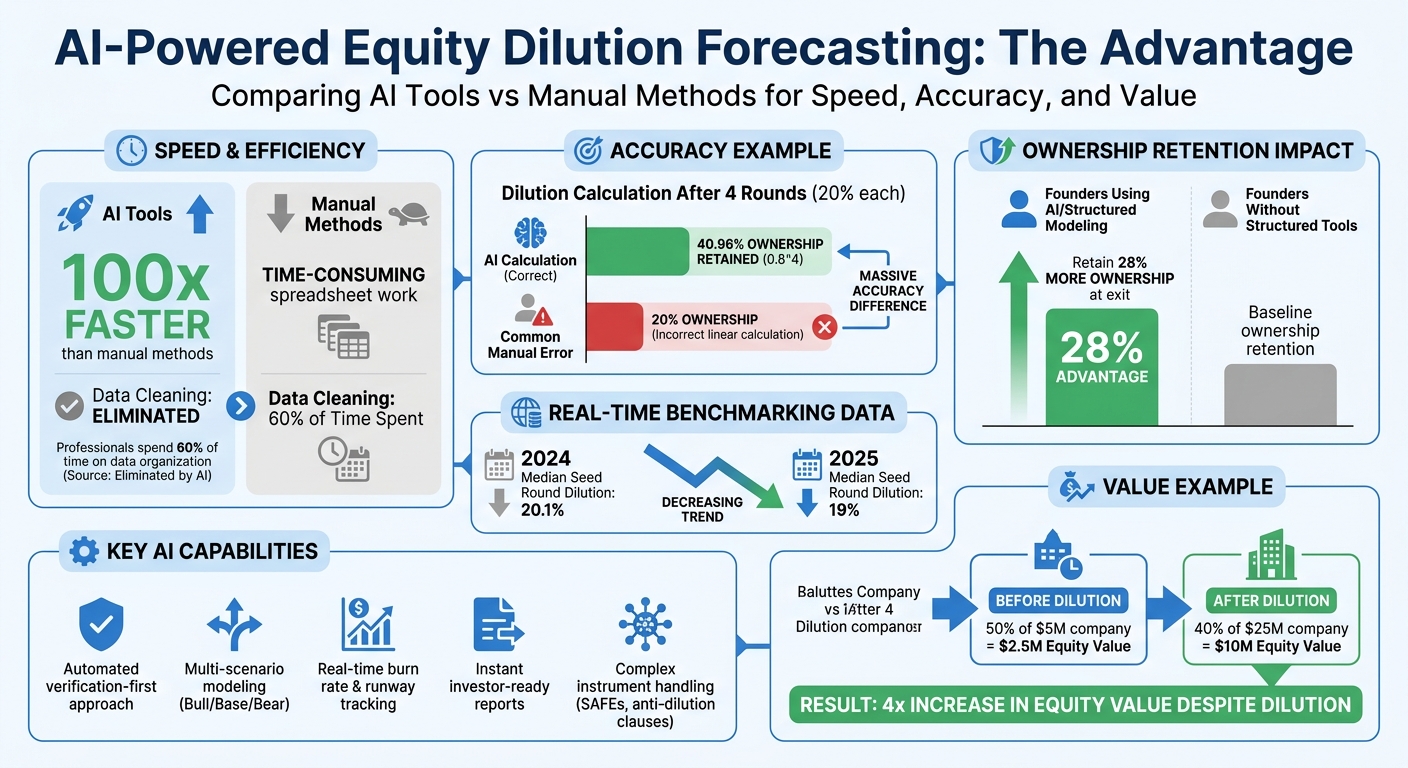
AI vs Manual Equity Dilution Forecasting: Key Benefits and Statistics
Better Accuracy and Fewer Errors
AI tools take the guesswork out of equity dilution calculations by automating the complex math that often leads to mistakes in manual spreadsheets. Instead of leaving gaps for critical details like vesting cliffs or liquidation preferences, advanced platforms use a verification-first approach. They ask targeted questions to fill in missing information before generating forecasts, ensuring your cap table is accurate and ready for investor scrutiny. This approach helps avoid the kind of errors that could derail your due diligence process.
These tools also speed up dilution forecasting - up to 100 times faster than traditional manual methods. More importantly, they handle the compounding nature of dilution with precision. For example, after four funding rounds with 20% dilution each, a founder retains 40.96% of their original stake (calculated as 0.8^4), not 20% as some manual methods might mistakenly assume. This accuracy is critical for laying a solid foundation for dynamic scenario planning.
Scenario Modeling and What-If Analysis
AI platforms excel at modeling various scenarios to help you understand how changes in valuation, funding amounts, or timing can impact your ownership. They allow you to simulate multiple funding rounds and even reverse-engineer from a target exit ownership percentage to determine acceptable dilution at each stage. For instance, if you want to maintain at least 15% ownership through Series C, these tools can calculate the dilution limits for earlier funding rounds.
They also present best-, worst-, and realistic-case scenarios side by side, offering a clear picture of potential outcomes. This insight directly informs decisions about funding strategies and equity retention. Additionally, AI tools handle complex terms like anti-dilution clauses and employee option pool sizing automatically, ensuring that your hiring plans won’t lead to unexpected dilution down the line. As Aswath Damodaran, a professor at NYU Stern, aptly puts it:
The best valuations are not just a collection of numbers, but a story connected to numbers.
Real-Time Data and Reporting
AI tools go beyond accurate forecasts and scenario models by offering real-time insights through instant reporting. They generate investor-ready reports, saving founders hours typically spent preparing board updates. Metrics like burn rate and runway are updated in real time, showing how spending and dilution impact your company’s longevity. This kind of visibility allows for smarter decisions about hiring and spending.
Real-time benchmarking is another game-changer, especially during negotiations. For example, the median dilution for seed rounds in 2025 dropped to approximately 19%, down from 20.1% in 2024. With AI, you can instantly access these benchmarks to assess whether a term sheet is reasonable or overly aggressive. Plus, since professionals often spend about 60% of their time cleaning and organizing data, automating these tasks frees up time for more strategic decision-making, leaving tedious spreadsheet work behind.
sbb-itb-17e8ec9
Lucid Financials: AI-Powered Equity Dilution Forecasting

Lucid Financials offers a tailored platform for startups, combining AI-driven financial tools with expert insights to help founders avoid dilution missteps and make smarter decisions. Designed specifically for fast-growing companies, it handles everything from bookkeeping and taxes to CFO-level forecasting, including equity dilution analysis. With real-time updates and seamless Slack integration, Lucid provides a single intelligent system to streamline financial management.
Key Features for Equity Dilution
Lucid Financials goes beyond basic cap table tracking, offering AI-powered valuation tools like Customer Lifetime Value (CLV) analysis to help determine your company’s worth during funding talks. It also generates customized, board-ready financial reports, ensuring you have professional and current equity data for investor presentations.
The "Compare Scenarios" tool allows you to model the impact of different funding strategies on your cap table in real time. You can evaluate best-case, worst-case, and realistic outcomes side by side, giving you a clearer picture of potential scenarios. Additionally, the platform supports specialized equity structures, such as phantom equity and other non-equity compensation plans, while providing built-in resources to educate your team on equity-related topics.
Slack Integration for Real-Time Financial Insights
Lucid’s Slack integration simplifies financial management by delivering instant answers to questions about dilution forecasts, runway, or spending - without the need to log into separate dashboards. The AI-powered system, supported by experts when necessary, ensures you get quick, actionable insights.
This integration also keeps financial conversations organized across Slack channels, so important updates or investor interactions don’t get lost. Founders can run what-if scenarios directly in Slack, testing the effects of raising specific amounts at various valuations without disrupting their workflow.
Investor-Ready Reporting
Lucid makes preparing for investor meetings effortless with its ability to create instant board and investor updates. The platform’s "Raise Capital" feature helps founders craft effective fundraising strategies, while tracking burn rate and runway in real time to guide decisions on when and how much to raise. It also provides real-time valuation benchmarks and competitor insights, giving you a strong, data-backed foundation for equity dilution discussions.
"Lucid has made it incredibly easy to track spending, plan ahead, and handle our growth. It's straightforward and effective."
- Aviv Farhi, Founder and CEO of Showcase
With SOC 2 compliance and robust security measures, Lucid ensures sensitive cap table data remains secure while staying accessible for investor needs. Starting at just $150/month, this platform delivers professional-grade financial management at a price that works for early-stage startups.
How to Use AI Tools for Equity Dilution Forecasting
To get the most out of AI tools for equity dilution forecasting, start by ensuring your cap table is in perfect order. This document, which lists shareholder names, share types (common or preferred), vesting schedules, and any outstanding options, warrants, or convertible securities like SAFEs, must be accurate and up to date. Mistakes here can derail deals and create unnecessary complications.
Keep Your Data Clean and Accurate
AI tools work best when they’re synced with your legal, HR, and payroll systems. This integration ensures ownership stakes are updated in real time, minimizing manual errors and creating an immutable audit trail - a key expectation during investor due diligence. Automate alerts for vesting milestones and employee terminations to avoid over-vesting issues.
It’s also essential to cross-check external data sources like LinkedIn, Crunchbase, and AngelList with your internal cap table. AI-powered tools can flag discrepancies immediately, saving you from potential headaches. Lastly, prioritize platforms that are SOC 2 compliant to protect your sensitive equity data with industry-standard security measures.
Model Multiple Funding Rounds
Once your cap table is clean, you can start modeling future funding rounds. Aim to project ownership changes across at least four funding rounds to understand long-term impacts. Founders who use structured dilution modeling tend to retain 28% more ownership at exit compared to those who negotiate on the fly.
To get a full view, model three scenarios - Bull, Base, and Bear - to see how different funding amounts and valuation changes could affect ownership. This kind of scenario planning helps you prepare for a range of outcomes and make better decisions about future funding.
Connect Dilution to Valuation and Growth
The real power of dilution models comes when you connect them to your company’s revenue and growth projections. By integrating dilution forecasts with revenue growth and valuation multiples, you can see the bigger financial picture. For example, cutting a 50% stake in a $5M company to 40% in a $25M firm results in a 4x increase in equity value, even though ownership decreases.
AI tools can also help with exit waterfall analyses, allowing you to evaluate outcomes for different exit scenarios - like $50 million, $100 million, or $500 million - while factoring in liquidation preferences. Additionally, consider how expanding your employee stock option pool (ESOP) impacts current shareholders. Instead of using arbitrary percentages, size your ESOP based on actual hiring needs over the next 12–18 months. This thoughtful approach ensures that funding rounds add meaningful long-term value rather than just injecting capital without proportional benefits.
Conclusion
AI tools are reshaping the way founders approach equity dilution forecasting. Gone are the days of relying on outdated, error-prone spreadsheets that leave room for costly mistakes and missed opportunities. With AI-powered platforms, you gain real-time accuracy, instant scenario modeling, and investor-ready reporting - helping you maintain control over your cap table and make informed decisions about your company's future.
Take Lucid Financials, for example. This platform combines AI-driven scenario planning and instant reporting, giving you clear insights into how each funding round impacts your ownership. Whether you're comparing best-case, worst-case, or actual funding outcomes, you can evaluate every scenario side-by-side before committing to a term sheet. Plus, its seamless integration into your workflow ensures you're always prepared for due diligence, with built-in CFO-level support to guide you.
The benefits are hard to ignore. AI-powered financial tools complete tasks up to 100 times faster than traditional methods. Even more compelling, founders who use structured dilution modeling retain an average of 28% more ownership at exit compared to those who negotiate without preparation. And with CFO services starting at just $150 per month, there's no reason to face funding negotiations unprepared.
Using tools like Lucid Financials, you can forecast funding rounds with precision, safeguard your ownership, and drive your business toward sustained growth.
FAQs
What inputs do I need for an accurate dilution forecast?
To calculate a precise dilution forecast, you'll need a few critical pieces of information: the current number of shares outstanding, the percentage ownership of existing stakeholders, and the number of new shares that will be issued to investors. These inputs allow you to determine how ownership percentages will shift once the new shares are introduced.
How do SAFEs and option pools change dilution across rounds?
SAFEs and option pools both play a role in dilution by increasing the total share count. SAFEs (Simple Agreements for Future Equity) convert into equity during funding rounds, which reduces the ownership percentages of existing shareholders. On the other hand, option pools set aside shares for employees, and when those options are exercised, they further dilute ownership for founders and early investors. While both are essential for supporting company growth - by attracting investors and incentivizing employees - they inevitably affect ownership stakes as more shares are issued.
Can AI tools model exit outcomes with liquidation preferences?
AI tools make it possible to model exit outcomes with liquidation preferences by simulating how proceeds are distributed among different share classes and preference terms. These tools consider critical factors like participation rights, conversion options, and varying exit values. This approach offers a detailed view of potential scenarios, helping stakeholders understand the financial implications of various terms.