I keep investor reports ready by tracking spending, unpaid commitments, and cash - then checking the numbers against the books before sharing them. For example, $235,000 in payroll against a $220,000 budget means a $15,000 overrun, or 6.8%.
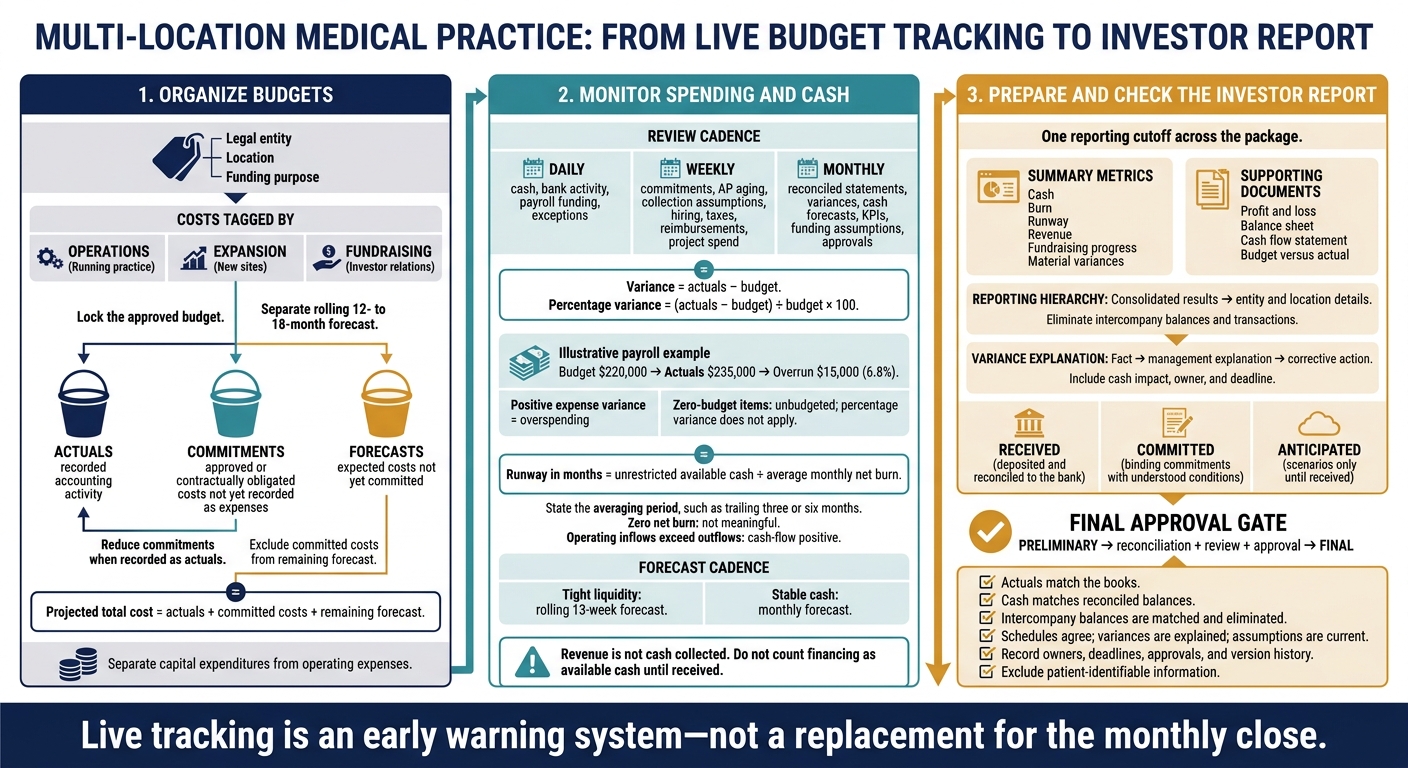
For a multi-location medical practice, I focus on three steps:
- Organize budgets: Separate costs by entity, location, and purpose. Keep the approved budget fixed and track actuals, commitments, and forecasts without counting costs twice.
- Monitor cash: Check cash daily, update payment and collection assumptions weekly, and review results monthly. Keep revenue separate from cash collected, and exclude expected financing from available cash.
- Check the investor report: Use one reporting cutoff, explain material variances, reconcile balances, and assign owners and deadlines. Keep patient-identifiable information out.
<u>Live tracking is an early warning system - not a replacement for the monthly close.</u> I label reports preliminary until reconciliation and review are complete.
Real-Time Budget Tracking for Investor Reporting
Step 1: Organize Budgets by Location, Entity, and Funding Purpose
Divide budgets into operations, expansion, and fundraising views. Make every cost traceable to its legal entity and location so investor variance reports use the same rollups and stay aligned with the general ledger and financing plan.
Allocate shared costs using a documented basis, such as headcount or square footage, and use the same monthly periods across entities. Lock the approved budget and keep a separate rolling 12- to 18-month forecast.
Separate Actuals, Commitments, and Forecasts
Track actuals as recorded accounting activity, commitments as approved or contractually obligated costs not yet recorded as expenses, and forecasts as expected costs not yet committed.
As committed costs become actuals, reduce the commitments so the same purchase doesn’t appear twice. Replace closed-period estimates with actuals and update future assumptions - not the original budget.
Each budget line should include its owner, vendor, funding source, approval status, approved amount, actual amount, committed amount, forecast amount, and remaining budget. Keep invoice or contract references. Track the expense-recognition period separately from invoice and payment dates to avoid counting an unpaid invoice twice.
Split Practice, Expansion, and Fundraising Costs
Keep payroll, benefits, medical supplies, leases, utilities, insurance, and maintenance in the recurring practice budget. Give each expansion project a separate budget for deposits, build-out, equipment, recruiting, training, permits, and launch marketing.
Separate capital expenditures from operating expenses. Let accounting determine capitalization, depreciation, and expense treatment rather than treating every cash payment as an immediate expense.
Create a dedicated fundraising cost center for legal fees, accounting, data-room preparation, diligence, travel, contractors, and financing fees. Link each cost to the financing round or instrument. Accounting should decide whether to expense it, defer it, net it against proceeds, or amortize it so fundraising costs don’t distort operating burn.
Treat expected funding dates and proceeds as scenario assumptions. Exclude uncommitted financing from the base case, show it separately in a financing scenario, and don’t count it as available cash until it’s received.
sbb-itb-17e8ec9
Step 2: Update Financial Data and Monitor Cash
Once budgets are set, feed live data into them to keep variances and runway current.
Connect all operating feeds and the general ledger in one controlled workflow. Map each transaction to the codes used in Step 1, and record its source, owner, status, and last-updated timestamp. Tag receipts and disbursements consistently so the cash forecast matches the ledger.
Use a documented reporting cutoff. Before sending reports to investors, route missing invoices, duplicate bills, uncategorized transactions, unreconciled bank items, and unusual payments to an exceptions queue.
Set Daily, Weekly, and Monthly Reviews
- Daily: Check cash, bank activity, payroll funding, and exceptions.
- Weekly: Update commitments, AP aging, collection assumptions, hiring, taxes, reimbursements, and project spend.
- Monthly: Review reconciled statements, variances, cash forecasts, KPIs, funding assumptions, and approvals.
These weekly and monthly checks keep investor assumptions current. Once the live data is up to date, use it to calculate variances and project costs.
Calculate Budget Variances and Projected Costs
Variance = actuals − budget.
Percentage variance = (actuals − budget) ÷ budget × 100.
Positive expense variances mean overspending. Label zero-budget items unbudgeted; percentage variance does not apply. Compare matching periods with the same accounting basis, entity scope, currency, and cutoff.
For material variances, require the amount, percentage, cause, whether the issue is temporary or recurring, expected cash impact, corrective action, owner, and target resolution date. Set materiality thresholds, with tighter limits for payroll, taxes, or restricted cash.
Projected total cost = actuals + committed costs + remaining forecast.
Avoid double-counting: include only commitments not already recorded in actuals and forecast costs not yet committed. Subtract the budget from projected total cost to calculate projected variance.
Use these projections to update liquidity and runway.
Track Cash, Burn, and Runway
Track unrestricted available cash, revenue collected, operating cash inflows and outflows, gross and net burn, committed but unpaid obligations, and the remaining fundraising budget.
Keep definitions consistent. Disclose whether they include taxes, capital expenditures, one-time costs, fundraising expenses, and customer deposits. Exclude financing proceeds and transfers between company-owned accounts from net burn.
Runway in months = unrestricted available cash ÷ average monthly net burn.
State the averaging period, such as the trailing three or six months, along with any exclusions. When net burn is zero, mark runway not meaningful. When operating inflows exceed outflows, use cash-flow positive instead. Sharp spending changes, seasonal collections, or large payments due soon can also make the formula misleading.
Use a rolling 13-week forecast when liquidity is tight and a monthly forecast when cash is stable. Include payroll settlement dates, taxes, debt service, capital spending, and other material receipts and disbursements. Each week, reconcile the forecast to bank activity and roll it forward 12 weeks.
These updates feed the investor report in Step 3.
Step 3: Prepare and Check the Investor Report
Build the investor package using the latest cash, variance, and runway data. Apply one data cutoff to the live tracking data throughout the report.
Use a consistent package that includes a cover page, reporting period, data cutoff, report status, executive summary, financial statements, KPIs, budget-versus-actual analysis, funding update, variance explanations, and required actions. Show consolidated results first, then entity- and location-level details. Eliminate intercompany balances and transactions, and keep a schedule of the source accounts and elimination entries.
Present Financial Statements, KPIs, and Variances
Start with cash balance, burn, runway, revenue, fundraising progress, and material variances. Back up the summary with the profit and loss statement, balance sheet, cash flow statement, and budget-versus-actual schedule. Use the same KPI definitions across reports and compare matching periods.
Illustrative example only.
Line item Budget Actuals Dollar variance Percentage variance Revenue $500,000 $470,000 $(30,000) -6.0% Payroll expense $220,000 $235,000 $15,000 6.8% Software expense $40,000 $34,000 $(6,000) -15.0% Net cash burn $180,000 $205,000 $25,000 13.9%
Lower spending doesn't always mean savings. It may mean an initiative has been delayed. Break each variance into the fact, management’s explanation, and the corrective action. For every material issue, include the cash impact, action owner, and deadline.
Follow operating results with a clear view of how financing affects liquidity.
Update Funding Assumptions and Report Status
Keep received, committed, and anticipated funding separate:
- Received: Include only funds deposited and reconciled to the bank.
- Committed: Include signed financing, executed subscription documents, or other binding commitments with understood conditions.
- Anticipated: Keep this funding in scenarios only until it is received.
For each financing source, show the expected closing date, gross proceeds, fees, net proceeds, conditions, and liquidity impact.
Assign owners and deadlines for the close, forecast update, variance explanations, review, and approval. Label each package preliminary until the close and review are complete, then mark it final. Include the reporting period, data cutoff, owner, preparer, reviewer, approval date, and version.
Approve Budget Changes and Reconcile Reports
Lock the baseline budget. Record each revision’s amount, reason, effective date, owner, and approval. Require approval for transfers and spending above the set threshold.
Before sharing tracked results with investors, check for duplicates, uncategorized transactions, unusual vendors, and manual journal entries. Confirm that actuals match the books, cash matches reconciled balances, intercompany balances are matched and eliminated, and schedules agree. Check that variances are explained and assumptions are current.
Keep source records, reconciliation dates, approvals, and version history. Limit access by role, and exclude patient-identifiable information from reports, exports, schedules, and file names.
Conclusion: Keep Investor Reporting on Schedule
Real-time budget tracking keeps investor reports up to date, backed by data, and on schedule. Reporting becomes a routine close instead of a last-minute scramble.
Before each reporting cycle, name one reporting owner and add cash review, close, and distribution dates to a shared calendar. Give each open item an owner and a deadline.
FAQs
How do I set material variance thresholds?
Review your financial metrics for changes that need attention, such as revenue shifts or expense spikes. Set alerts in your financial platform for preset limits, such as revenue deviations greater than 5% or specific percentage changes in order volume.
Review and update these thresholds quarterly to reflect your business model and growth stage. Lucid Financials monitors these metrics continuously and uses AI to flag major anomalies for review.
How should insurance reimbursement delays affect my cash forecast?
Factor insurance reimbursement delays into your dynamic cash flow forecast to avoid inaccurate reporting. Use AI-driven tools to pull in real-time transaction data and adjust projections automatically as cash inflows change.
Set budget triggers and automated alerts for revenue deviations so you can track how payment delays affect your runway. Keep scenario-based forecasts ready to discuss potential cash gaps with investors before shortfalls occur.
What should I do if reported numbers change after investor distribution?
Use your system’s audit trail to show what changed and keep the process transparent. Let automated variance commentary draft a plain-English explanation, then review and edit it. Keep one reconciled dataset as the source for every report to reduce discrepancies.
Lucid Financials provides clean, audit-ready data and fast answers so you can respond immediately and accurately when investors ask about burn rate or runway.