AI is transforming how startups calculate Customer Lifetime Value (CLV), making it more precise and actionable. By using AI-driven models, businesses can predict customer behavior with up to 92% accuracy, identify churn risks early, and optimize retention strategies. These insights directly impact profitability, investor confidence, and valuation.
Key Takeaways:
- CLV Defined: Total financial contribution a customer makes over their relationship with a business.
- AI Benefits: Tracks customer behavior in real-time, improving prediction accuracy by 20% over manual methods.
- Investor Impact: Healthy CLV-to-CAC ratios (3:1 to 5:1) and retention improvements can boost valuations significantly.
- Retention Insights: AI helps reduce churn by 15-25% and increase revenue by 20-35%.
- Tools in Action: Platforms like Lucid Financials provide dynamic CLV forecasts and investor-ready reports, helping startups secure higher valuation multiples.
AI-powered CLV isn’t just about better metrics - it’s a tool for smarter growth and stronger financial health.
Gen AI powered customer lifetime value | Gain deeper insights for smarter investments
sbb-itb-17e8ec9
How AI Improves CLV Predictions
AI transforms Customer Lifetime Value (CLV) from a static metric into a dynamic, real-time forecasting tool. Traditional models rely heavily on past spending patterns, offering a limited view. AI, on the other hand, identifies behavioral shifts - like reduced login activity or increased support requests - that signal potential churn. This allows businesses to spot at-risk customers 30 to 90 days before they leave, a critical window when intervention is 3 to 5 times more effective. By factoring in variables such as browsing habits and payment history, AI-driven models achieve an accuracy rate of 85%-92%, outperforming older methods by about 20%. These insights not only enhance customer retention strategies but also support more precise financial planning and valuation discussions.
AI's Impact on Retention and Revenue Growth
AI-powered CLV predictions do more than refine financial metrics - they directly influence retention strategies. By categorizing customers into risk levels - low, moderate, or critical - businesses can focus their efforts where they matter most. For instance:
- Critical-risk customers might receive personal attention from customer success teams.
- Moderate-risk customers could be targeted with automated emails or special offers.
The results speak for themselves. Companies leveraging AI-driven CLV models report revenue increases of 20% to 35%. Automated retention workflows alone can cut churn by 15% to 25%. Even a small 5% bump in retention rates can drive profit growth of 25% to 95%.
Predictive Analytics for High-Value Customers
AI also excels at pinpointing customers with the highest potential for future returns. By analyzing engagement trends, it identifies the perfect moments for upselling, leading to conversion rate improvements of 40%-60%.
Beyond upselling, AI enables detailed segmentation. Instead of relying on a single average CLV, it breaks forecasts down by acquisition channel, product type, and customer cohort. This granular approach is invaluable for optimizing marketing budgets and creating investor-ready financial models. Considering that roughly 80% of future revenue often comes from just 20% of current customers, this level of precision is indispensable for building a compelling growth strategy.
AI-Powered CLV Models and Methods
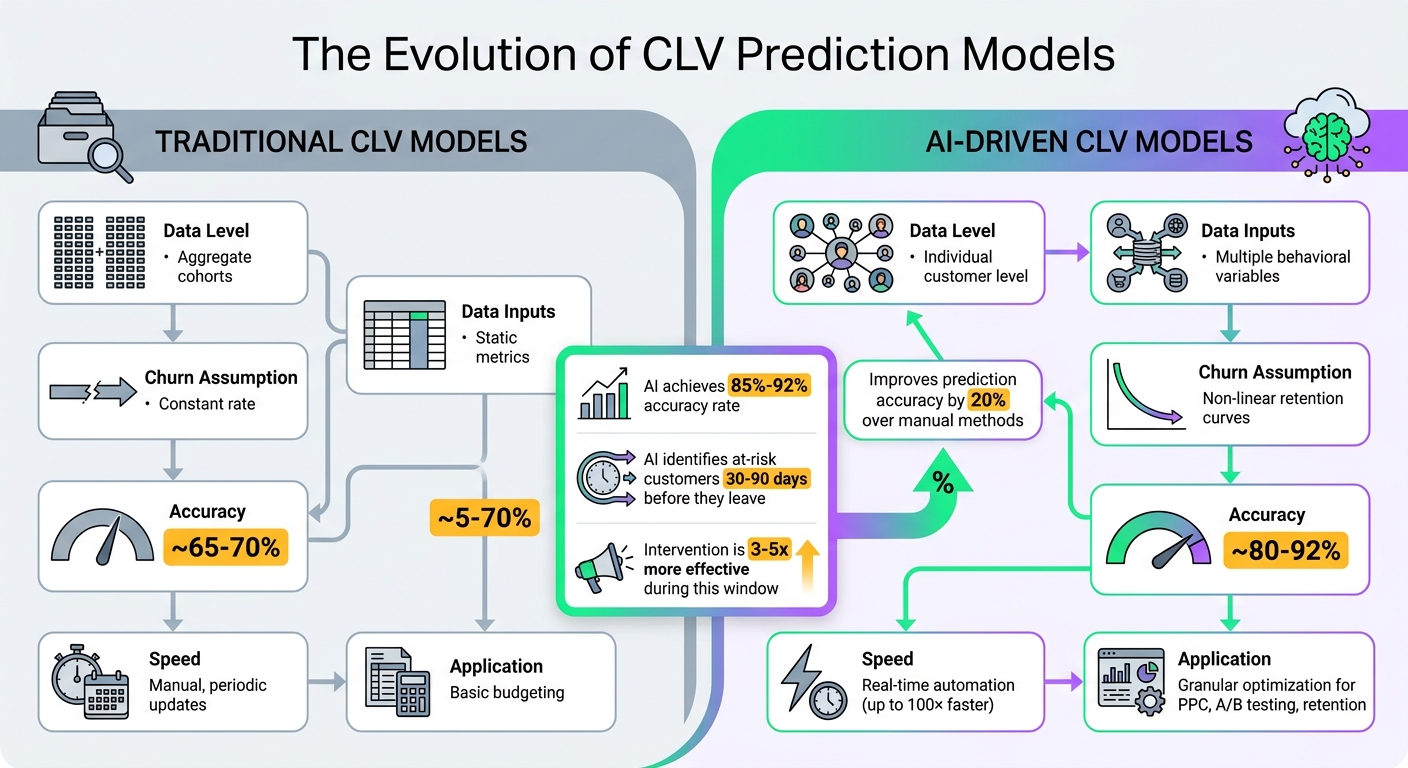
Traditional vs AI-Driven CLV Models: Accuracy and Performance Comparison
Machine Learning for CLV Predictions
Machine learning takes customer lifetime value (CLV) predictions to a new level by analyzing customer behavior in detail - something traditional methods often struggle to achieve. Instead of relying on broad averages across customer segments, AI models generate predictions tailored to individual customers or accounts based on their unique behaviors and patterns.
These models consider a wide range of factors, such as browsing habits, email engagement, support interactions, trial statuses, marketing channels, and even seasonal trends. Algorithms like Random Forest, Gradient Boosting, XGBoost, and LightGBM excel at uncovering intricate patterns in the data. They also handle missing values effectively and provide insights into which factors influence the predictions the most.
Many AI-driven CLV models are grounded in statistical methods. For instance, Gamma Generalized Linear Models (GLMs) with log link functions help manage revenue data that stays non-negative, while L2 regularization ensures the model doesn’t overfit. Subscription-based businesses benefit from additional transformations, like shifted inverse terms, which help capture the complex retention patterns often seen in annual billing cycles.
"Having LTV forecasts at a granular level allows us to understand and compare the value of different customer segments", explains Easton Huch, a data scientist at Lucid.
Probabilistic models, such as BG/NBD for predicting future transactions and Gamma-Gamma for estimating transaction value, complement these techniques. Survival analysis, on the other hand, uses actuarial methods to project how long customers will remain active. Building on these granular insights, methods like the Multi-Period Excess Earnings Method (MPEEM) turn customer behavior data into cash flow forecasts.
Multi-Period Excess Earnings Method (MPEEM)
AI-powered forecasts provide the foundation for advanced financial valuation techniques like MPEEM. This method links AI-enhanced CLV predictions to overall business valuation by treating customer relationships as assets that generate future cash flows. Instead of relying on simple revenue multiples, MPEEM uses AI predictions - such as churn probabilities and future spending habits - to create more precise financial valuations.
The method works by forecasting incremental CLV over a set time frame, capturing real-time changes in customer behavior and how they impact asset value. However, one key factor to account for is the "AI Tax" - the costs associated with computing, training, and running these models. These costs must be subtracted from projected earnings to ensure unit economics remain favorable as a business scales. Because of this level of rigor, investors are increasingly drawn to cash flow-based valuation methods like MPEEM over traditional revenue multiples.
"Revenue multiples were always a lazy substitute for the hard work of actual valuation: forecasting future cash flows and understanding what drives sustainable value creation", says Daniel Faloppa, CEO of Equidam.
Traditional vs AI-Driven CLV Models
Traditional CLV models often rely on static assumptions, such as uniform customer behavior and constant churn rates. These methods use simple averages for metrics like purchase frequency and value, which can lead to overly optimistic projections by ignoring nuanced customer behaviors. In contrast, AI-driven models adapt to dynamic trends, continuously refining their predictions as new data becomes available.
| Feature | Traditional Models | AI-Driven Models |
|---|---|---|
| Data Level | Aggregate cohorts | Individual customer level |
| Data Inputs | Static metrics | Multiple behavioral variables |
| Churn Assumption | Constant rate | Non-linear retention curves |
| Accuracy | ~65–70% | ~80–92% |
| Speed | Manual, periodic updates | Real-time automation (up to 100× faster) |
| Application | Basic budgeting | Granular optimization for PPC, A/B testing, retention |
This leap from static to adaptive models improves accuracy while also giving startups a more reliable way to model customer economics. For startups looking to attract investors, adopting AI-driven CLV models signals a deeper understanding of customer value and financial health. Lucid, for example, processes over $200 million in payments through its platform, using AI to provide real-time insights that inform both day-to-day decisions and high-stakes valuation discussions.
How Startups Use AI-Driven CLV
Startups are increasingly leveraging AI-driven customer lifetime value (CLV) tools to improve retention strategies and prepare for investor scrutiny. These tools provide actionable insights that help businesses make data-informed decisions and optimize their growth potential.
AI Tools for CLV and Retention
AI-powered platforms are becoming a go-to resource for startups aiming to refine their CLV calculations. By utilizing machine learning, these systems analyze user engagement data and integrate CRM information through APIs. The result? CLV forecasts that are up to 30% more accurate than traditional methods, thanks to the inclusion of behavioral signals.
Here’s how it works: customer data - such as purchase history, engagement metrics, and demographics - is aggregated and analyzed using algorithms like XGBoost or survival analysis. These models predict churn probabilities and future revenue, enabling startups to identify high-value customers. Once identified, these customers are targeted with personalized interventions, such as tailored email campaigns. The impact has been clear, with startups reporting retention rate increases of 5-10%, churn reductions of 15-25%, and CLV improvements of 20%.
AI-driven CLV models also excel in enhancing referral programs and onboarding processes. These improvements have led to retention gains of 15-30%, which directly boost unit economics and contribute to higher business valuations.
Lucid Financials: Investor-Ready CLV Insights

Lucid Financials has emerged as a standout platform, offering startups a robust tool for generating investor-ready CLV insights. This platform uses AI to provide dynamic CLV forecasting while integrating real-time bookkeeping and Slack notifications. It produces detailed reports that project CLV based on historical revenue, retention cohorts, and growth scenarios.
One of Lucid’s key features is its ability to automate valuations in compliance with MPEEM standards, delivering clean financial records in just seven days. Additionally, it offers scenario modeling, enabling founders to explore the impact of potential retention improvements. These tools help startups showcase 2-3x higher valuation multiples in their pitch decks.
"We pulled up the Lucid platform in a meeting with a VC and they were extremely impressed. His jaw just about dropped when he saw October was even up to date", says Giorgio Riccio, Founder of Lumino Technologies.
Lucid’s platform simplifies the process of creating investor and board reports, offering AI-driven scenario planning that compares best-case, worst-case, and actual outcomes. This helps founders strategically choose their growth paths. With over $200 million in payments processed through its system, Lucid provides real-time financial visibility that enhances CLV projections during due diligence.
Starting at $150 per month, Lucid’s CFO and fundraising plan includes AI-generated financial forecasts, cash flow and runway visibility, scenario modeling, and board-ready reports. These features are designed to clearly demonstrate how CLV ties into sustainable growth, making it an essential tool for startups looking to scale.
CLV, Valuation Multiples, and Investment Readiness
How CLV Impacts Startup Valuation Multiples
Let’s dive into how Customer Lifetime Value (CLV), bolstered by AI, plays a pivotal role in shaping startup valuations. Investors today are shifting their focus away from simple revenue multiples. Instead, they’re examining unit economics - particularly whether a startup's CLV can cover the actual costs of running an AI-driven business. The big question for investors? Whether the company’s growth is both profitable and sustainable.
A strong CLV reflects stable, production-grade revenue, which is essential for long-term success. This kind of revenue stands in contrast to income tied to temporary innovation budgets that can disappear when priorities change. The same AI precision that strengthens customer retention also supports a solid CLV, which is key to achieving higher valuation multiples.
In the SaaS world, healthy metrics typically include an LTV:CAC ratio of at least 3:1, with top-performing models hitting 5:1 or more. Add a CAC payback period of less than 12 months, and you’re looking at the kind of numbers that inspire investor confidence in sustainable value creation. Retention metrics further bolster this outlook: Gross Revenue Retention (GRR) above 90% indicates strong product-market fit in SMB SaaS, while Net Revenue Retention (NRR) over 100% shows growth fueled by existing customers rather than new acquisitions. The best-performing companies often achieve NRR of 120% or more, pushing valuation multiples into the mid-20s EV/Revenue range.
"AI has become what it should've been all along: an economic engine for software incumbents. Now, investors want to see the receipts", says Ben Murray, The SaaS CFO.
By “receipts,” Murray refers to verified financial data aligned with accrual accounting standards like ASC 606. Without this data, valuing a company becomes speculative. AI-driven platforms step in here, automating intricate calculations and offering the real-time financial transparency investors demand during due diligence.
Low vs High CLV Startups: A Comparison
The difference between startups with strong and weak CLV metrics is stark - and it directly influences valuation.
| Metric | High CLV Startup | Low CLV Startup |
|---|---|---|
| Valuation Multiple | Mid-20s EV/Revenue (Premium) | Discounted multiples |
| Revenue Quality | Stable, core revenue | Temporary, innovation-based revenue |
| LTV:CAC Ratio | 5:1 or higher | Below 3:1 |
| Net Revenue Retention | 120%+ | Below 100% |
| Monthly Churn Rate | Low, well-managed | 5–7% typical for early-stage |
| AI Adoption | Advanced, dynamic CLV models | Basic RFM segmentation |
| Gross Margin Trajectory | Targeting 65–75%+ | Struggling margins under load |
| Defensibility | High due to proprietary data and switching costs | At risk due to commoditization |
Retention is a major factor behind these valuation differences. Retaining customers is far more cost-effective than acquiring new ones - it’s estimated to be 5 to 7 times cheaper. Even a modest 5% improvement in retention can boost profits by anywhere from 25% to 95%. Furthermore, around 80% of future revenue often comes from just 20% of existing customers, underscoring the importance of CLV.
Switching from static segmentation to AI-powered dynamic CLV models can lead to a 20% to 35% increase in CLV-related revenue. AI models that incorporate behavioral signals achieve churn prediction accuracy rates of 85% to 92%, and the automated retention workflows they enable can cut churn by 15% to 25%.
"The gap between 'AI story' and 'AI asset' is increasingly determined by gross margin trajectory, retention quality, compute economics, and dependency risk, rather than brand narrative", notes ValuStrat.
Dynamic, AI-enhanced CLV metrics don’t just improve internal strategies - they’re also essential for building investor trust and scaling effectively. To succeed, startups must support their growth stories with verified financial data that proves sustainable unit economics. Platforms like Lucid Financials simplify this process by automating complex calculations, ensuring your CLV metrics are accurate, defensible, and ready for investor review when it counts most.
Conclusion
Throughout this analysis, we've explored how advanced AI-driven Customer Lifetime Value (CLV) models and real-time financial reporting are reshaping the way startups approach valuation. AI-powered CLV predictions have shifted the landscape from static, one-size-fits-all formulas to dynamic, behavior-driven models. These models achieve prediction accuracy rates of 80% to 92%, equipping founders with actionable insights to improve retention, reduce churn, and present sustainable unit economics to investors. This move from static metrics to real-time, data-backed forecasts is not just about numbers - it helps startups craft a compelling growth narrative grounded in real data.
The financial impact of these innovations is undeniable. For instance, improving customer retention by just 5% can increase profits by 25% to 95%. When paired with strong LTV:CAC ratios, these improvements directly influence valuation multiples, making startups more attractive to investors.
Real-time financial visibility has also become a key advantage during fundraising. Giorgio Riccio, Founder of Lumino Technologies, highlighted this during a VC meeting where updated financials boosted investor confidence and sped up the deal process. Tools like Lucid Financials simplify complex CLV calculations and provide always-on, investor-ready financial reports. This automation not only makes financial management 100x faster but also ensures transparency - helping startups scale efficiently while meeting investor expectations. Luka Mutinda, Founder and CEO of Dukapaq, emphasized this point:
"Lucid's CFO services give us the visibility we need, while their bookkeeping and tax support keep everything accurate and stress-free. It's been a game-changer for our operations".
Startups that integrate AI-enhanced CLV metrics with real-time financial reporting are leading the pack in securing investor attention. This combination signals a deep understanding of unit economics, the ability to scale profitably, and the infrastructure to sustain growth - key factors that drive valuation multiples and investor confidence.
FAQs
What data do I need to build an AI-based CLV model?
To create an AI-powered Customer Lifetime Value (CLV) model, you’ll need a mix of data that captures customer behavior, financial details, and external influences. Some key inputs include purchase frequency, average order value, recency of transactions, and customer demographics. Machine learning algorithms analyze this data to uncover patterns and forecast future revenue.
The accuracy of your CLV predictions - and the insights they generate - depends heavily on the quality and diversity of your data. High-quality, well-rounded datasets lead to more reliable and actionable results.
How do I prove AI-driven CLV numbers in investor due diligence?
When presenting AI-driven Customer Lifetime Value (CLV) figures to investors, the goal is to establish trust through transparency and accuracy. Here's how to approach it:
- Document Your Process: Provide detailed documentation on your data inputs, model validation methods, and performance metrics. This helps investors understand the foundation of your predictions.
- Show Historical Accuracy: Highlight concrete examples where past predictions closely aligned with actual outcomes. This track record can go a long way in demonstrating your model's reliability.
- Consider Third-Party Validation: Independent audits or reviews from reputable third parties can add an extra layer of credibility to your numbers.
By focusing on clear, evidence-backed data and validation, you can build the confidence investors need in your AI-driven CLV projections.
How often should I update CLV forecasts as my startup scales?
As your startup grows, it's important to regularly update your Customer Lifetime Value (CLV) forecasts. Why? Because customer behavior, retention rates, and revenue patterns can shift over time. By keeping these forecasts current, you'll ensure your predictions remain accurate and actionable. This helps you make smarter decisions and adapt effectively as your business evolves.