My takeaway: match your funding plan to recent investor checks - not green-tech promises. Start with investments made in the past 12 months, then check stage fit and investment sizes of $500,000 to $5 million+.
As of October 13, 2026, the research points to stronger support for utility-scale solar and battery storage. For EVs, industry, and carbon projects, I would focus on tested performance, paying customers, and margins that hold without subsidies.
Here’s what I would check before approaching investors:
- Sector fit: Solar and storage lead this research set; adaptation and resource efficiency lack enough funding data to rank.
- Project readiness: Match seed equity, growth funding, or project debt to your testing, customer contracts, permits, and repayment capacity.
- Cash needs: Budget tax-credit transfers at roughly $0.92 per $1 of credits, and track monthly cash burn, runway, and each entity’s obligations.
- Downside risk: Use a 3- to 5-year forecast to test funding delays, policy changes, tariffs, and supply costs.
My rule: <u>fund the next milestone, not just the next round</u> - and verify the source, date, and deal terms behind every funding claim.
Where Climate Capital Is Actually Flowing in 2026
sbb-itb-17e8ec9
Which Green-Tech Sectors Attract Investors?
Investor support differs sharply by sector. Utility-scale solar and battery storage draw the strongest support. Transportation, industrial decarbonization, and carbon management face a larger gap between investor interest and closed funding.
Clean Energy, Grids, Storage, and Data-Center Power
Section 6418 lets solar and battery projects transfer federal tax credits to corporate buyers for cash. Those credits have been trading at roughly $0.92 on the dollar.
The discount improves project economics, but it isn't full-price capital. How a project structures its financing matters as much as which sector it operates in.
Climate Adaptation and Resource Efficiency
This research set lacks enough sector-level funding data to rank adaptation or resource efficiency.
Transportation, Industry, and Carbon Management
Institutional investors have grown more cautious about transportation startups that depend on subsidies.
For industrial decarbonization, investors judge execution - not pledges. Only 7% of the world’s largest companies are on track to meet their 2030 net-zero targets.
Carbon credits trade from under $5 to over $100 per metric ton, depending on the methodology and registry. Registry approval alone doesn't guarantee project performance or offtake.
Investor Funding Priorities and Financing Gaps
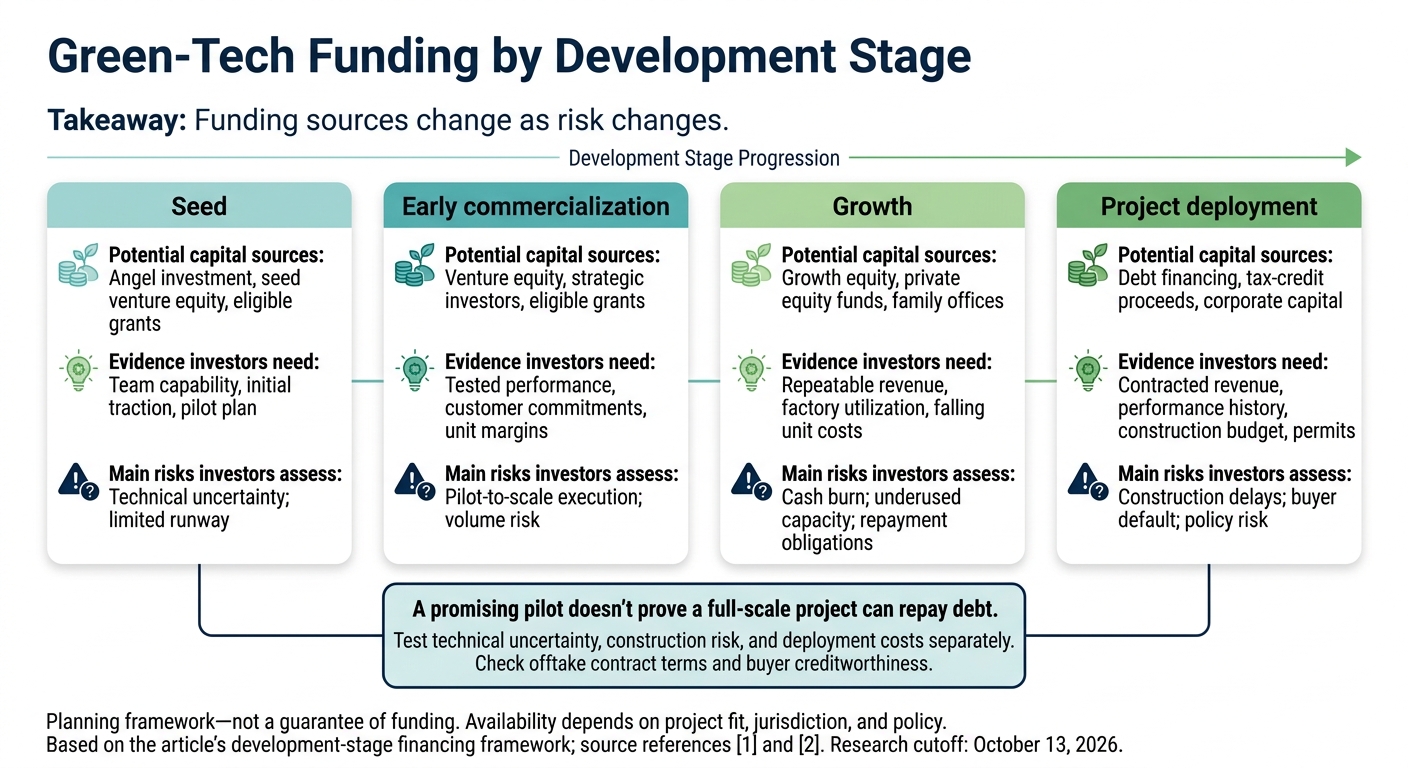
Green-Tech Funding by Development Stage
What Investors Need to See
Investor interest becomes funding only when the business case supports it.
Investors want proof of returns, not just demand forecasts. In 2026, that means identifiable buyers, unit margins, and scale economics: cash burn relative to production volume and lower unit costs as output grows. Tracked performance data carries more weight than manufacturer claims.
Back tested performance with contracted revenue and customer commitments. Show deployment costs, permitting status, policy risk, and the steps from pilot to commercial scale. Investors also want proof that demand and margins can hold without subsidies.
First-of-a-kind projects face a higher bar because operating data is still limited.
Financing First-of-a-Kind Projects
A promising pilot doesn't prove a full-scale project can repay debt. Pilots need to reduce both technical and repayment risk before a project can qualify for financing. Test technical uncertainty, construction risk, and deployment costs separately. Use offtake as evidence of buyer demand, then check contract terms and buyer creditworthiness.
With those risks better understood, funding can match the project's stage.
Capital Sources by Development Stage
Funding sources change as risk changes. Angels and seed VCs fund early uncertainty. Growth capital, family offices, and debt enter after the business gains traction.
| Development stage | Potential capital sources | Evidence investors need | Main risks investors assess |
|---|---|---|---|
| Seed | Angel investment, seed venture equity, eligible grants | Team capability, initial traction, pilot plan | Technical uncertainty; limited runway |
| Early commercialization | Venture equity, strategic investors, eligible grants | Tested performance, customer commitments, unit margins | Pilot-to-scale execution; volume risk |
| Growth | Growth equity, private equity funds, family offices | Repeatable revenue, factory utilization, falling unit costs | Cash burn; underused capacity; repayment obligations |
| Project deployment | Debt financing, tax-credit proceeds, corporate capital | Contracted revenue, performance history, construction budget, permits | Construction delays; buyer default; policy risk |
The table provides a planning framework, not a guarantee of funding. Availability depends on project fit, jurisdiction, and policy.
Capital Planning for Founders and Business Owners
Investor interest turns into funding when your cost structure, cash flow, and reporting fit the project’s stage. That means matching capital sources to the costs they can fund.
Match Financing to Project Costs
Each financing source covers different costs - and adds different risks. Map each project type to the funding investors are most likely to back.
| Project type | Costs to budget | Potential financing sources | Cash-flow risks to model |
|---|---|---|---|
| Software-enabled climate services | R&D, personnel | Equity; venture debt | Valuation swings; sentiment risk |
| Commercial solar/storage | Installation and equipment | Tax credit transfers (Section 6418); project finance | Policy-change risk; battery degradation |
| EV/hardware manufacturing | High fixed costs; factory capex | Equity (VC/growth); debt | Equity dilution; low utilization; incentive-expiration risk |
Budget to the next milestone, not the next funding round. For manufacturing, track unit gross margin and factory utilization; low output can hide fixed costs. If you use Section 6418 transfers, budget proceeds at about $0.92 per $1 of credits. Also model dilution if production falls behind.
Then use monthly checks to see whether the financing plan is working.
Track Cash Flow and Entity Obligations
Keep a monthly report covering cash burn, runway, R&D, unit gross margin, backlog, contracted revenue, and capital expenditures (capex). Pair it with a 3- to 5-year forecast that includes delayed-funding scenarios. Reconcile net income to operating cash flow: accounting losses alone don’t tell you how much cash the business is burning.
For businesses with multiple locations or entities, report location profitability, project cash flows, intercompany balances, debt payments, and guarantees separately. Combined totals can hide cash shortages or repayment obligations.
If reporting across projects or entities becomes hard to maintain, outside support can help keep the model current.
Financial Reporting Support
Lucid Financials provides bookkeeping, tax, tax-credit support, and CFO reporting for startups and multi-business owners. These services help keep books clean, forecasts current, and entity-level reporting ready for investors.
Conclusion: Key Findings and Research Limits
Recent investment favored utility-scale solar and battery-linked projects. EV capital went to companies with proven operating performance and durable unit economics.
Source quality and deal context matter when reading the data. As of the October 13, 2026 cutoff, link every quantitative claim to its source, date, geography, and measure. Distinguish ticket size from total deal size, and verify transactions that are unusually large, recent, or sensitive to changes in status.
For founders, interest rates, federal policy, tariffs, and supply chains remain material uncertainties that affect cash coverage and funding decisions. Strip out one-time gains so a smaller headline loss isn't mistaken for better operating performance.
FAQs
How can I verify an investor’s green-tech funding history?
Check Crunchbase, PitchBook, and SEC Form D filings for past funding rounds, portfolio companies, and sector focus. Look for deals from the past 3 to 6 months and a steady green-tech focus to gauge current funding activity and priorities [3][4]. AI-driven platforms can also help you find investors backing companies like yours [3].
Lucid Financials helps keep your financial data audit-ready and investor-ready for due diligence [3][5].
When is my green-tech project ready for debt financing?
Your green-tech project is ready for debt financing when its unit economics hold up with less policy-dependent subsidy support, its production scale can handle shifts in demand, and its cash reserves can cover losses until unit economics improve.
Before seeking debt, prepare 3 to 5 years of reconciled financial statements and evidence that per-unit costs fall as production scales. Your financial data should also be reliable, linked to source records, and verified through a controlled reporting process.
How do I stress-test cash flow without subsidies?
Put capital efficiency and disciplined operations first. Keep accurate, real-time financial records so you can track your burn rate and runway. Use AI-driven scenario modeling to forecast cash flow without subsidies under different conditions and spot risks early [3].
Connect your bank accounts and financial systems to create accurate, board-ready reports. These reports should show how well you manage capital, build investor confidence, and show that your business is “default alive” [4][3].