Energy bills can wreck a startup budget fast. U.S. electricity costs are up about 30% since 2021, and some grid capacity prices have jumped by 800% in a single year.
If I were running a startup, I’d keep the plan simple:
- Map every energy cost across offices, labs, warehouses, vehicles, and data centers
- Forecast usage first, then price
- Pick a hedge that fits cash and risk limits
- Cut peak-hour usage to lower charges that contracts may not cover
- Review contracts and bills every quarter
Here’s the core idea: I wouldn’t treat energy as a fixed overhead line. I’d treat it like a cost that can move hard and hit runway, margins, and hiring plans.
A few numbers show why this matters:
- Demand charges can make up 30% to 70% of a commercial power bill
- Fixed-price deals may include 5% to 15% in supplier premium
- Many contracts allow only ±10% to ±20% usage variance before penalties or spot pricing apply
- Billing errors show up in 25% to 35% of audited commercial accounts
For most startups, the goal is not to guess the market. It’s to make energy costs more predictable with a clear process and fewer surprises.
| Step | What I’d focus on | Why it matters |
|---|---|---|
| 1 | Cost map | Shows where price swings can hit |
| 2 | Usage + price forecast | Turns bills into a budget range |
| 3 | Hedge choice | Limits exposure to spikes |
| 4 | Load reduction | Cuts peak charges and open risk |
| 5 | Quarterly review | Catches drift, errors, and renewals |
Bottom line: if I know where energy spend sits, what part is exposed, and how much I can lock in, I have a much better shot at protecting cash.
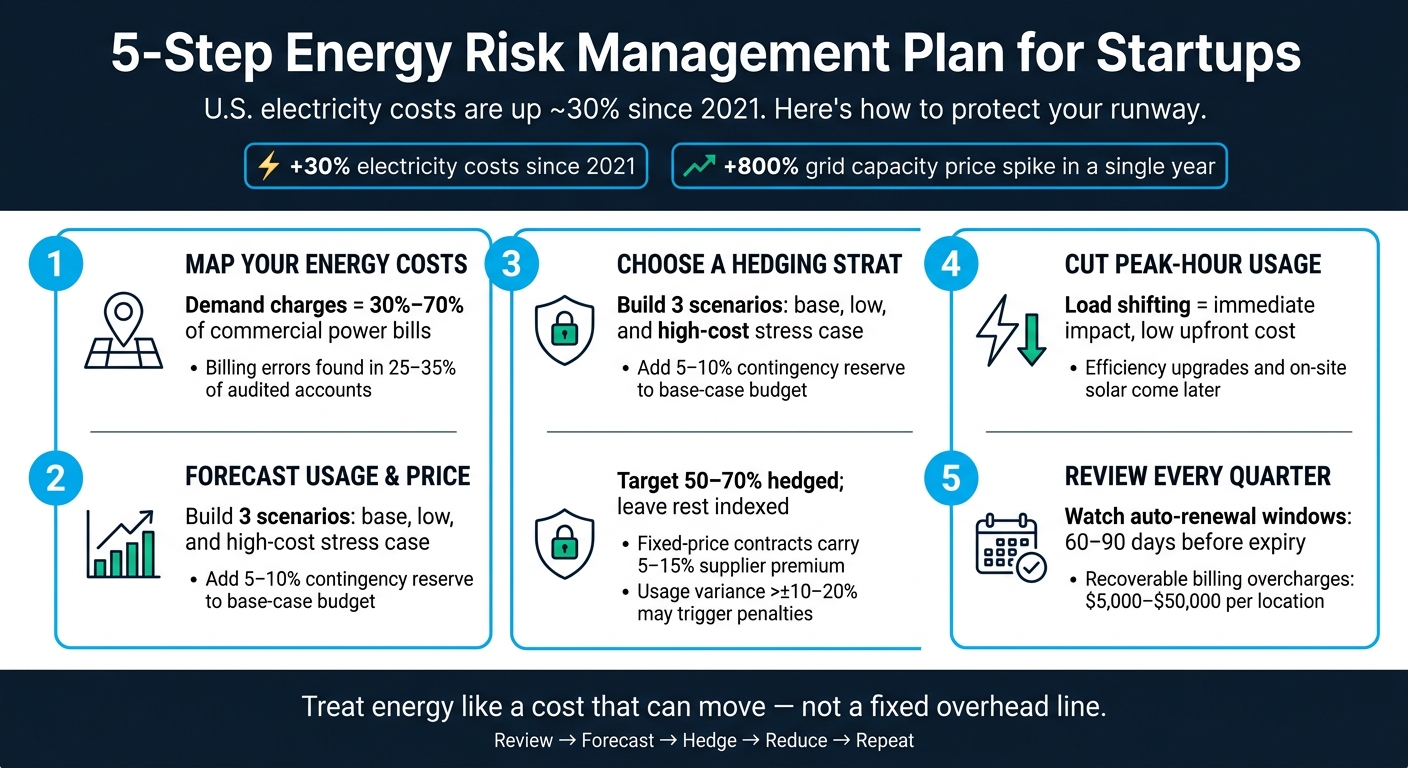
5-Step Energy Risk Management Plan for Startups
The Energy Risk Most Business Leaders Aren't Seeing
sbb-itb-17e8ec9
Step 1: Map Where Energy Costs Enter Your Business
Start with a full inventory of every utility account, meter, and energy-related cost. You need to see exactly where energy spend enters the business before you can control it. Once that map is in place, rank the costs most likely to shift your budget.
List Energy Costs by Location, Contract, and Use Case
List every site where your business uses energy: offices, warehouses, labs, retail locations, and data centers. For each location, note the rate type - fixed, indexed, variable, or hybrid - and the contract end date. Set renewal reminders well ahead of the auto-renewal window, which usually lands 60–90 days before expiration.
Also flag whether each site sits in a deregulated market, where you can negotiate supply, or a regulated market, where direct procurement choices are limited and the main levers are efficiency and on-site generation.
Then review the last 12 months of utility bills. This step matters more than most teams think. Billing errors and misclassified rates are common.
That inventory becomes the starting point for your usage and price forecast.
Measure Which Costs Are Most Exposed to Price Spikes
Once the inventory is done, sort costs by volatility, not just total spend. A big bill gets attention, sure. But the costs most likely to throw off your plan are the ones that can swing fast.
Focus on a few factors:
- Monthly spend
- Whether demand charges apply
- Whether usage spikes during high-cost hours
Demand charges can make up 30%–70% of a commercial electricity bill and usually sit outside fixed-rate supply contracts. So even if your supply rate stays flat, a spike in demand charges can still hit runway hard.
Put the most exposed costs at the top of your list for the next 3, 6, and 12 months. High-load operations like cold storage or manufacturing often carry the biggest risk. One useful metric here is energy cost as a percentage of operating expenses. It gives founders and investors a plain way to see the risk.
Use that ranking to decide what to forecast and hedge first.
Step 2: Forecast Usage and Price Before You Commit
Take the highest-risk cost items from Step 1 and turn them into a simple usage-and-price forecast.
Build a Simple Demand Forecast
Start with 12 months of utility bills and interval meter data. That gives you a baseline for energy use, repeat load patterns, and seasonality. Then adjust for what’s changing in the business: more staff, longer hours, new equipment, or higher production volume.
Seasonality matters a lot for U.S. operations. Summer cooling and winter heating can push monthly usage up fast, so relying on a flat annual average can make peak-month risk look smaller than it is.
A simple four-step process is enough for most early-stage companies:
- Set a baseline from 12 months of utility bills or meter data.
- Adjust for operating changes such as new hires, added shifts, more servers, or higher production.
- Apply seasonal factors based on prior-year monthly patterns for summer and winter demand.
- Build three scenarios: a base case, a low-usage case, and a high-usage/high-cost case.
Forecast kWh first, then dollars. In plain English, estimate how much electricity you expect to use based on your business drivers, then apply expected rates to that usage. Keeping usage and price separate makes the model much easier to update when one side changes.
Then price those loads against current market curves.
Track Market Prices and Plan Budget Scenarios
Usage forecasts show your exposure. Market prices show what that exposure may cost.
In deregulated markets, electricity supply prices are often linked to natural gas commodity prices traded on NYMEX futures. Forward curves in ERCOT, PJM West Hub, and ISO-NE Mass Hub can give you a sense of where prices may head.
Capacity charges need close attention. In PJM, capacity auction prices jumped from $28.92/MW-day to $269.92/MW-day in one year, then cleared at the $329.17/MW-day cap the next year. That’s a big move. And because capacity can make up a meaningful share of a commercial power bill, it belongs in the forecast.
Price each scenario using current forward curves, average weather, and a high-cost stress case that adds extreme weather, a regulatory shift, or a capacity spike. Then convert each case into annual dollar impact and runway impact. It also makes sense to add a 5%–10% contingency reserve on top of the base-case energy budget to help cover unhedged exposure, weather swings, or rule changes.
Review the forecast every quarter and after any major operating change.
Use that forecast range to decide how much price risk to lock in next.
Step 3: Choose a Hedging Strategy That Fits Your Risk Tolerance
Once you have a forecast range, the next step is figuring out how much exposure to lock in and which tool you can afford to use. That choice comes down to your usage forecast, cash runway, and how much price swing your budget can absorb. Use the range you built to decide what to fix now and what to leave open.
Compare Fixed-Price Contracts, Forwards, Futures, Swaps, and Options
A fixed-price contract is the most straightforward hedge. A retail supplier takes on market risk and gives you a flat rate in return. That gives you the most budget certainty, but there’s a tradeoff: suppliers often bake a 5–15% risk premium into the price, and you won’t gain anything if market prices drop. If you go this route, look closely at usage bands. Many contracts only allow about ±10% to ±20% usage variance before penalties kick in or spot pricing applies.
Forwards and futures both lock in a price for a later purchase. The main difference is that futures trade on an exchange, so pricing is transparent, but they often come with margin accounts and collateral needs. Swaps work a bit differently: you pay a fixed price and receive the market price in cash, which means your hedge can sit apart from your supply deal. Options, or price caps, put a ceiling on what you’ll pay while still letting you gain if prices fall. That flexibility costs money upfront. In volatile markets like ERCOT, a summer cap option can run $5–$15/MWh upfront.
Hedge to cap budget risk, not to predict market moves.
| Instrument | Certainty | Flexibility | Complexity | Best-Fit Use Case |
|---|---|---|---|---|
| Fixed-Price Contract | Maximum | Low | Minimal | Tight-margin startups needing absolute budget certainty |
| Forwards/Futures | High | Moderate | High | Buyers that want to lock in a future purchase price; futures require margin |
| Block-and-Index | Moderate | High | Moderate | Companies wanting to fix part of their load while leaving the rest exposed to the index |
| Swaps | High | High | High | Larger consumers wanting to separate supply from hedging |
| Options (Caps) | High (ceiling) | Maximum | High | Businesses wanting insurance against spikes while staying on index |
For most startups, fixed-price or block-and-index tends to be the better fit. You get enough fixed volume to steady the budget, while the rest stays indexed.
Use Layered Hedging Instead of Locking In All at Once
Layered hedging, sometimes called stacked procurement, spreads purchases across several transactions over a 12–24 month window before the delivery period. Instead of making one big call at one point in time, you buy in tranches. For example, you might buy three separate 20% blocks at 9, 6, and 3 months before your contract start date. That gives you a blended rate and lowers the odds of locking in all of your demand at a market high.
For many commercial and industrial buyers, a practical target is being 50% to 70% hedged, with the rest left indexed in case prices soften. For multi-year planning, it often makes sense to hedge more of the near term and less of the later years, when demand is still fuzzy. A common approach is:
- 80% to 100% near term
- 50% to 75% next year
- 25% to 50% in year three
Another smart move is to lock in only the baseload first, then hedge extra demand later as usage becomes more certain.
Set trigger prices before you start. Pick a maximum rate you can live with and a target rate you’d like to hit. That way, your hedging plan follows your budget instead of your nerves.
Once the hedge is in place, the next job is cutting the exposure that’s still left by reducing the load you use.
Step 4: Cut Energy Use to Lower Your Exposure
Hedging helps with price. It doesn't fix usage.
If you want less exposure no matter what the market does, you need to use less energy. That means cutting the part of your load that still sits outside your hedge. In plain English: after you lock in price risk, work on the demand that can still hit you during costly periods.
Shift Flexible Loads Away from Peak Hours
Peak demand can make up a big part of a commercial energy bill, which is why load shifting matters. Even if you have a contract in place, some peak-related costs may still come through. And one hot afternoon spike can push capacity costs up for the whole year.
The quickest move is often simple scheduling. Pre-cool your facility early in the morning before afternoon peak pricing kicks in. Move energy-heavy computing jobs, manufacturing runs, or batch processes to overnight or weekend hours. Smart controls can help too. They can automate thermostat setpoints, stop random manual changes, and keep HVAC systems from working too hard during costly hours.
Compare Efficiency Upgrades, Load Shifting, and On-Site Generation
Not every option works on the same timeline, so it helps to sort them by how fast they cut exposure.
Here’s a simple side-by-side view:
| Strategy | Speed of Impact | Upfront Cost | Effect on exposure |
|---|---|---|---|
| Load Shifting (reschedule operations) | Immediate | Low | High - directly cuts peak demand and capacity charges |
| Efficiency Upgrades (LED, HVAC, insulation) | Medium | Moderate to High | Permanent reduction in baseline exposure |
| On-Site Generation (solar + battery storage) | Slow | High | Maximum - reduces reliance on grid during peak windows |
For most early-stage startups, load shifting is usually the best first move. It works right away and goes straight after the capacity charges that fixed-rate contracts may not cover.
Efficiency upgrades make more sense once your operations settle down and you know where energy use is highest. On-site generation can have a big effect, but it usually comes later, not first.
Next, review supplier strength, contract terms, and policy changes so savings and hedges stay aligned.
Step 5: Monitor Contracts, Suppliers, and Results Over Time
Review energy contracts every quarter, not once a year. A hedge that looked fine a few months ago can drift out of step as usage shifts and market prices move. Use each review to update your forecast assumptions, hedge coverage, and load-reduction plans.
Review Supplier Strength, Contract Terms, and Policy Changes
Each quarter, break every variance into commodity, capacity, delivery, and other fees. Then find the top two or three drivers behind any budget gap. That makes it much easier to see what's actually going on. Is the change tied to the market? Weather? Or did something inside the business shift?
Next, check the contract terms that most often change cost.
- Bandwidth provisions: Many fixed-price contracts allow only a ±10% to ±20% swing from your forecasted volume. If usage lands outside that band, you may get hit with spot-rate or penalty pricing.
- Auto-renewal deadlines: Many contracts roll into costly month-to-month default service if you miss a 60–90 day cancellation window. Set a reminder 9–12 months before expiration so you have time to review renewal paths.
Billing accuracy matters too. Professional audits find billing errors or misapplied classifications in 25–35% of audited commercial accounts, with recoverable overcharges often falling between $5,000 and $50,000 per location. That’s not small change. Bill validation should be a routine control, not a one-off check.
You should also watch policy shifts and supplier health. Review how the contract passes through new regulatory costs. And keep an eye on supplier strength. The supplier market is getting more concentrated, which can shrink competitive options and increase counterparty risk.
Conclusion: A Simple Plan for More Predictable Energy Costs
Think of these five steps as a quarterly rhythm: map exposure, forecast usage, hedge selectively, cut load, and review results. No single move removes energy price risk on its own. But taken together, they can make costs far more predictable and cut down on budget surprises.
For startups, where every dollar of margin counts, that predictability is the point. A budget tied to actual cost drivers - not just last year's number - gives you more room to plan investments instead of scrambling after surprises. And each review gives you better input for the next round of forecasting and hedging, so your energy plan stays in step with where the business is now.
FAQs
How much of our energy use should we hedge first?
Most startups play it down the middle at first. They hedge 50% to 70% of expected energy use at fixed rates so monthly costs are easier to plan around. Then they leave the other 30% to 50% indexed, which gives them some room to benefit if market prices drop.
It also helps to avoid locking in your full volume in one shot. A lot of teams buy fixed blocks bit by bit over 12 to 24 months. That approach can smooth out pricing over time instead of tying everything to a single market moment.
The right split comes down to a few practical things: your risk tolerance, your margins, and how much flexibility your operation has.
What if actual usage misses our forecast?
If actual usage falls short of your forecast, don’t treat energy management like a box you check once a year. Treat it as an active business process that needs regular attention.
Review actual results against your scenario-based forecasts each quarter. That gives you time to adjust hedging or operations before the gap hits too hard. Lucid Financials can help with real-time, investor-ready reporting, so your numbers stay clear as usage shifts.
When should a startup choose load shifting over solar?
A startup should prioritize load shifting over solar when the main goal is to cut operating costs by avoiding peak demand charges, without taking on the long-term commitment or upfront capital that comes with physical infrastructure.
This works best for businesses that can move energy-heavy tasks to off-peak hours and want the freedom to react right away to price swings through operational controls, demand response, or curtailment during high-cost periods.