If you need investor reporting, the split is simple: one tool here is built around startup finance data, one is built for market research, and several others are only partly covered by the source material.
I’d sum it up like this:
- Lucid Financials focuses on startup accounting data, runway, scenario models, and board reporting.
- AlphaSense focuses on external research like filings, transcripts, and news.
- Kavout, TrendSpider, and Portfolio Visualizer are not verified enough in the source to judge fairly here.
- The comparison criteria are data connections, forecast output, reporting use, ease of use, and fit by team stage.
A few numbers stand out right away:
- 88% of spreadsheet-based models have at least 1% error rates
- Audit checks may flag 0.4% to 1.1% of total spend
- Audit-fee cuts may land around 30% to 50%
- Pricing in the article starts at $150/month for Lucid Financials, $950 to $1,950/month for Jirav, and $10,000/year for Cube
If I were reading this to make a short list, my takeaway would be simple: pick a tool based on the kind of data you need most. Internal books and runway planning are one job. External market research is another. And if a product is not backed by the source, I would not treat it as a safe choice in this comparison.
I Ranked The Best AI Tools For Investing
sbb-itb-17e8ec9
Quick Comparison
| Tool | Main Use | Data Source Type | Forecast/Model Output | Price in Article | Confidence Level |
|---|---|---|---|---|---|
| Lucid Financials | Startup finance reporting | Internal finance data | Runway, cash flow, scenario models, board reports | $150/month | High |
| AlphaSense | Market research | External documents and news | No direct forecast generation | Not listed | High |
| Kavout | Not confirmed | Not confirmed | Not confirmed | Not confirmed | Low |
| TrendSpider | Not confirmed | Not confirmed | Not confirmed | Not confirmed | Low |
| Portfolio Visualizer | Not confirmed | Not confirmed | Not confirmed | Not confirmed | Low |
Bottom line: this article points to a clear divide between finance-system tools and research tools, while also warning that some names in the list cannot be judged from the material provided.
1. Lucid Financials
Analytics Focus
Lucid Financials is built for U.S. startups that need to get their internal financial data into shape for investor-ready reporting. It pulls from the general ledger, bank feeds, and payroll to give founders a live view of business health.
For fundraising, that means cleaner books, better runway visibility, and reporting on unit economics and profitability that’s ready to share.
Data Depth
Lucid connects straight to bank accounts and corporate cards, including Mercury and Brex. It supports continuous transaction monitoring and reconciliation, which helps teams catch issues before they snowball.
Its audit-trail tools can flag discrepancies that usually land between 0.4% and 1.1% of total spend per audit cycle. The Slack integration adds another layer of day-to-day usability. Founders can get real-time exception alerts, ask financial questions, and review anomalies in under 10 minutes a day.
That data layer then feeds the forecasting engine.
Forecasting Output
Lucid turns live financial data into investor-ready projections, board reports, and scenario models. That’s a big deal when 88% of spreadsheet-based models contain at least 1% errors.
The scenario planning feature lets founders test the impact of a new hire or a marketing push before they commit budget. And for startups getting close to their first audit, Lucid’s continuous audit trail can reduce annual audit fees by 30% to 50%.
So this isn’t just about producing reports. It also helps with daily calls on spending, hiring, and planning.
Pricing and Fit
| Detail | Lucid Financials |
|---|---|
| Starting Price | $150/month; free basic reconciliation and audit-trail modules for startups under $1M ARR |
| Implementation Time | Same day |
| Core Workflow | Slack-based alerts and a native general ledger |
| Primary Focus | Bookkeeping, tax, and scenario planning |
Lucid fits pre-seed to Series C U.S. startups that want accounting, tax, and scenario planning in one platform. The free reconciliation and audit-trail module gives teams under $1M ARR a low-risk way to get started.
That matters because the next tools in the comparison are built for different kinds of investor analytics workflows.
2. AlphaSense
Analytics Focus
AlphaSense fits a different job. If your work leans more on outside research than internal financial reporting, this platform makes more sense.
It’s built for large-scale market research. Using NLP, AlphaSense searches filings, transcripts, and research so users can find relevant information fast.
Data Depth
AlphaSense covers SEC and SEDAR filings, earnings transcripts, global news, trade journals, and broker research for public-market workflows.
Forecasting Output
AlphaSense helps speed up research, but it does not generate forecasts or conclusions for the user. That makes it useful for research-heavy work, but not for building operating forecasts.
Fit
| Detail | AlphaSense |
|---|---|
| Core Workflow | NLP-powered document search and market intelligence |
| Primary Focus | Public-market research and analysis |
AlphaSense is a strong fit for public-market research teams. Its main value is faster research rather than portfolio modeling.
3. Kavout
Unlike the earlier tools, Kavout can't be assessed with confidence here based on the source material available.
4. TrendSpider
TrendSpider can't be assessed from the supplied sources.
The comparison moves on to Portfolio Visualizer.
5. Portfolio Visualizer
Portfolio Visualizer can't be assessed from the sources provided. That means its use case, data depth, forecast output, and pricing aren't confirmed here.
So, rather than guess, the next section looks at the platforms that are verified and compares them using the same investor analytics criteria.
How These Tools Stack Up Across Key Investor Analytics Criteria
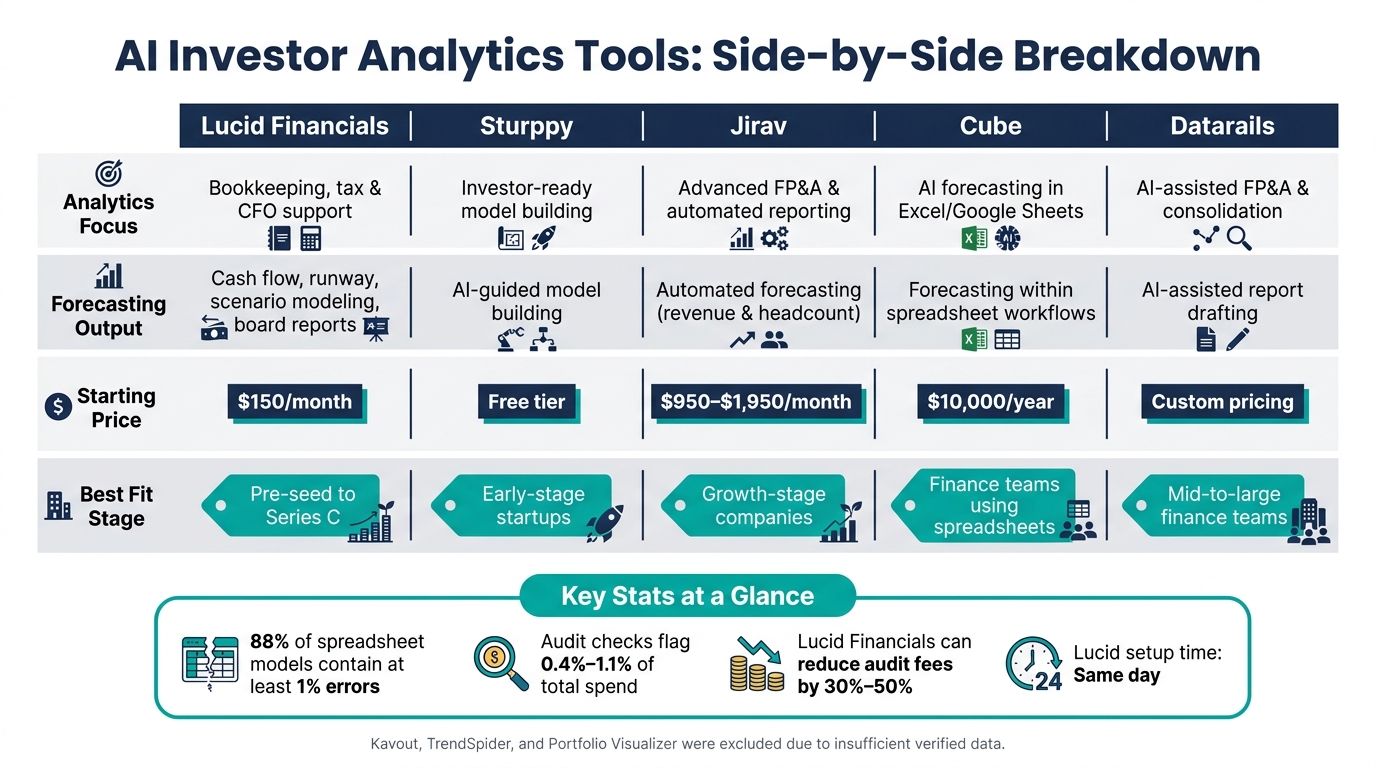
AI Investor Analytics Tools Compared: Pricing, Features & Fit
The table below shows the main investor-analytics differences across the verified platforms. It gives you a quick way to compare workflow depth, forecasting, and cost side by side.
| Criterion | Lucid Financials | Sturppy | Jirav | Cube | Datarails |
|---|---|---|---|---|---|
| Analytics Focus | Integrated bookkeeping, tax, and CFO support | Investor-ready model building | Advanced FP&A and automated reporting | AI forecasting in Excel/Google Sheets | AI-assisted FP&A reporting and consolidation |
| Forecasting Output | Cash flow, runway, scenario modeling, and board-ready reports | AI-guided model building | Automated forecasting based on historical revenue and headcount | Forecasting within spreadsheet workflows | AI-assisted report drafting |
| Starting Price | $150/month | Free tier | $950–$1,950/month | $10,000/year | Custom |
The big tradeoff here is scale. A tool that feels like a perfect fit at pre-seed can start to show cracks by Series B, especially when reporting needs to pull data from multiple teams and departments.
The next section breaks each platform into practical pros and cons.
Pros and Cons of Lucid Financials
Lucid Financials has some clear upsides, but there are a few limits startup finance teams should think through.
Here’s the main tradeoff: you’re getting bookkeeping, tax support, and CFO help in one place, along with live runway tracking and reporting. That can save time and cut down on the usual back-and-forth between different tools and service providers.
At the same time, there’s a catch. Lucid Financials works best when your books are clean and your transactions are categorized the same way every time. If your records are messy, the setup and day-to-day use can get harder. And the starting price of $150/month may feel steep for pre-revenue teams.
| Tool | Pros | Cons | Best For |
|---|---|---|---|
| Lucid Financials | Unified bookkeeping, tax, and CFO support with live runway and reporting | Requires clean, consistently categorized books; the $150/month starting price may be too expensive for pre-revenue teams | U.S. startups that need automated bookkeeping plus strategic CFO guidance |
That brings the decision back to one practical point: does your team need clean books and investor reporting in a single workflow?
Conclusion
No AI platform fits every investor analytics need. The right pick comes down to your stage, your data quality, and what you need from reporting. In this comparison, three things mattered most: data quality, forecast strength, and reporting speed.
Lucid Financials brings bookkeeping, tax support, real-time dashboards, and CFO-level forecasting into one platform, starting at $150 per month.
Across every platform, clean data still made the biggest difference. Human review also stayed central for strategic decisions and investor-facing materials. The best platform is the one that turns raw data into reliable, investor-ready reporting with the least manual work.
FAQs
How do I choose the right investor analytics tool?
Start by defining your startup’s stage and main goals. That could mean managing cash flow, getting ready for fundraising, or making board reporting easier. Once that’s clear, put tools first that connect with your accounting software and bank feeds. That helps improve accuracy and cuts down on manual entry.
Look for automation, reliability, real-time metrics like burn rate and runway, scenario modeling, and investor-ready reports. For early-stage and high-growth companies, Lucid Financials can be a strong fit.
What makes clean financial data so important?
Clean financial data matters because accuracy isn't optional when you're trying to earn investor trust. During due diligence, even small errors or mismatches can damage your credibility and set off red flags.
Clean, audit-ready records make it easy to trace every figure back to its source. They also support compliance with U.S. reporting standards and help you answer investor questions fast and with confidence.
When should a startup move beyond spreadsheets?
A startup should move past spreadsheets when manual work starts to slow growth or when auditability, real-time data, and governance become must-haves. Spreadsheet-based finance models also tend to create errors, and those mistakes can snowball fast.
The shift usually happens when you need always-on, investor-ready reporting, automated reconciliation, or scenario modeling that’s too complex to handle by hand with any confidence. Lucid Financials gives startups a simple path forward by bringing accounting, tax, and CFO support into one automated platform.