Healthtech funding in the U.S. is no longer story-first. It is proof-first. In 2025, healthcare became the top AI investment area, funding hit $1.5 billion, and 8 new unicorns were created. At the same time, the market got tighter: the top 10 AI companies took 78% of funding, and 95% of AI pilots failed to show P&L impact.
If I had to sum up the market in one line, it would be this: money is still there, but it goes to fewer teams that can show hard results.
Here’s the short version:
- Mid-to-late 2010s: digital health was easier to fund, and story often beat proof
- 2020–2021: COVID pushed a surge in telehealth, remote care, and mental health deals
- 2022–2023: the market cooled, and investors focused on unit economics and payback
- 2024–2026: AI became the center of the market, with more focus on workflow change and agentic AI
What changed most was not just sector focus. It was the bar founders had to clear before they could get funded:
- More concentration: fewer companies get most of the money
- More scrutiny: investors want ROI, data access, compliance, and workflow fit
- Tighter deal terms: more checkpoints, more controls, and less room for weak proof
- Higher burden on founders: clean reporting and live results now matter more than a polished pitch
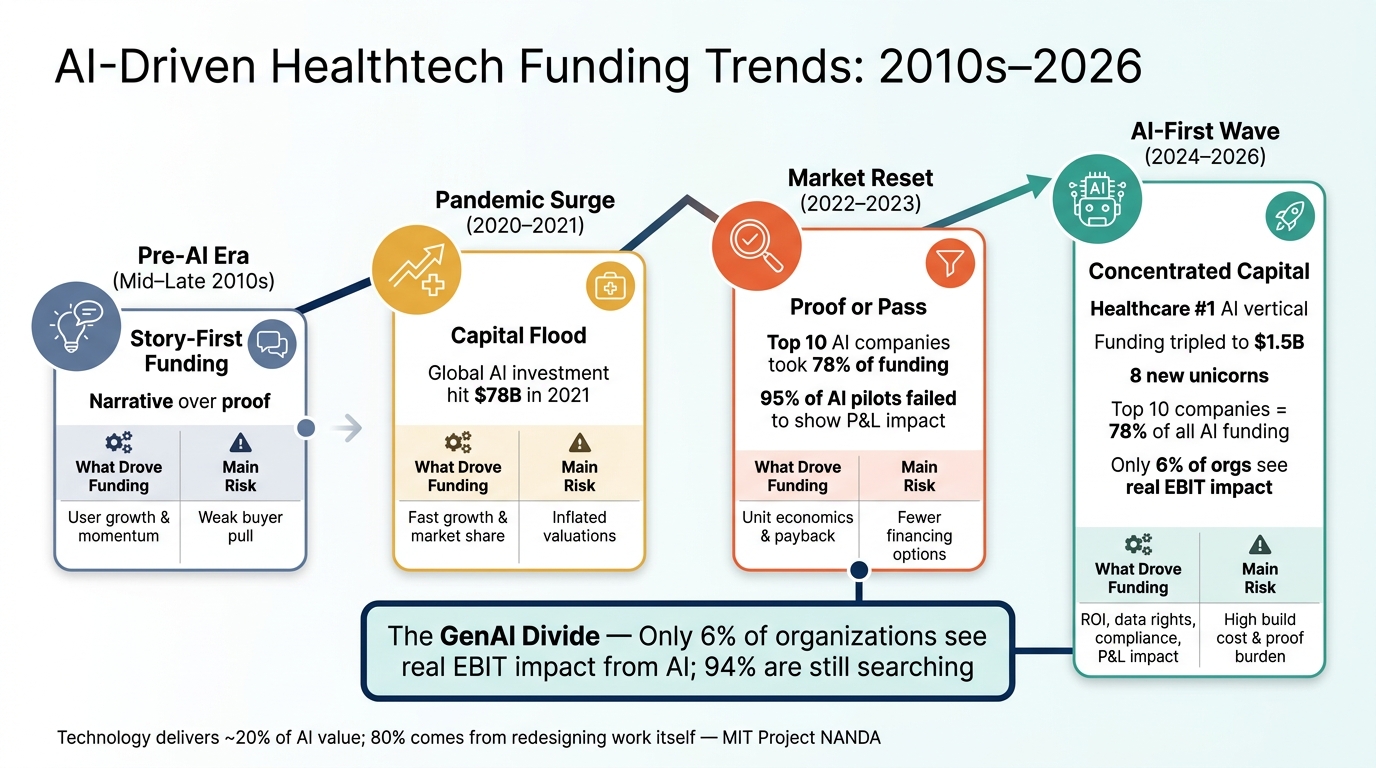
AI-Driven Healthtech Funding Trends: 2010s to 2026
Innovation in Healthcare: What AI Investors Are Backing in 2026
sbb-itb-17e8ec9
Quick Comparison
| Period | What drove funding | What investors wanted | Main risk for founders |
|---|---|---|---|
| Pre-AI (Mid–Late 2010s) | Growth story and market size | User growth and momentum | Weak buyer pull |
| Pandemic surge (2020–2021) | Virtual care demand | Fast growth and market share | Inflated valuations |
| Reset (2022–2023) | Pullback after overfunding | Unit economics and payback | Fewer financing options |
| AI-first wave (2024–2026) | AI tools tied to workflow change | ROI, data rights, compliance, P&L impact | High build cost and proof burden |
So if you are a founder reading this, the message is simple: you do not just need an AI product. You need data, deployment proof, and numbers that hold up in diligence.
1. Pre-AI Digital Health Funding Era (Mid-2010s to Late-2010s)
Before AI took center stage in healthtech funding, digital health was simply easier to fund. Startups could win investor interest with a strong growth story and the promise of scale, even without near-term proof that the business worked in practice.
Put plainly: the market put more weight on narrative than on hard operating proof.
That looks very different from today's AI-first market. Now, investors are much more selective, and funding tends to flow to companies that can show clear clinical and commercial proof.
That looser standard helped set the stage for the funding surge that came in 2020.
2. Pandemic-Era Healthtech Funding Surge (2020–2021)
COVID-19 sped up digital health adoption and drew investor money into the space as healthcare moved toward virtual care. That was a sharp shift from the more measured, story-led market that came before the AI boom.
The biggest attention went to telehealth, remote patient monitoring, mental health, and care navigation. The reason was simple: these areas made it possible to deliver care outside hospitals and clinics.
You could see that urgency in the deals themselves. Terms got looser. Diligence moved faster, and investors priced companies around growth while betting demand would stay high.
Global AI investment reached $78 billion in 2021. But the AI-first market today is much more concentrated, with the top 10 AI companies taking 78% of all funding. During the pandemic run-up, that mix of speed, optimism, and easy money created a market that moved fast but couldn’t last. Once demand started to normalize, the cracks showed.
That surge set the stage for the 2022–2023 correction, when investor discipline came back and easy capital dried up.
3. Market Correction and Selective Funding Period (2022–2023)
After the pandemic boom, the market cooled off. Funding went to fewer companies, and those companies had to look far more proven. Investors shifted away from big growth stories and focused on one thing: measurable economics.
Capital moved toward the clearest winners. Instead of placing bets across a long list of early-stage startups, investors backed a smaller group they believed could show hard results. During this stretch, the top 10 AI-related healthtech companies took 78% of all sector funding.
The scrutiny didn’t stop at topline growth or user activity. Investors wanted proof that a product could deliver in clinical or financial terms, not just attract attention. That change makes sense when you look at the numbers: 95% of AI pilots failed to produce financial returns.
Diligence got tougher too. Investors started pressing on data readiness - basically, whether a company had usable data outside old legacy systems. If the data was messy, trapped, or weak, the business was hard to finance.
The segments that still got funded tended to share the same traits:
- Clear ROI
- Tight workflow integration
- Lower implementation risk
Those companies could show a faster payback path and less rollout friction. In a tougher market, that’s what separated financeable businesses from the broader set of AI healthtech plays that fell out of favor.
4. Current AI-first healthtech funding wave (2024–2026)
After the 2022–2023 reset, today’s funding market looks more concentrated and a lot less forgiving. Money is still flowing, but investors want proof. Not a slick demo. Not a vague AI story. Proof that the product changes how care teams or ops teams work and that the change shows up in results.
Healthcare led every vertical in AI investment in 2025. Funding tripled to $1.5 billion and created eight new unicorns. But this isn’t a repeat of the pandemic-era boom. This wave is tighter, more selective, and much more proof-driven.
That concentration held into 2025. The top 10 AI companies took 78% of all AI funding. So the market didn’t just slow down and get picky. It bunched up around a small set of winners.
Researchers describe the result as the "GenAI Divide": a gap between the 6% of organizations seeing real EBIT impact and the 94% still trying to find it. That’s the heart of the market right now. Plenty of teams can pilot AI. Far fewer can turn it into bottom-line change.
"Technology delivers roughly 20% of AI value - the remaining 80% comes from redesigning work itself."
- MIT Project NANDA Study
Investors seem to have taken that point to heart. They’re backing companies that rethink clinical and operational workflows, not companies that just bolt AI onto old systems. In plain English: adding a chatbot to a broken process isn’t enough.
That helps explain why the move from generative AI to agentic AI matters so much. These systems don’t just draft or suggest. They can handle multi-step workflows. That shift is driving deals in clinical AI, workflow automation, and products that need heavy deployment work inside care settings. Founders who can show autonomous workflow impact are the ones pulling in capital.
The next section looks at how these changes reshaped investor priorities and deal terms.
How AI Changed Investor Priorities and Deal Terms
AI changed more than the list of healthtech winners. It changed how investors judged risk, priced deals, and decided when a company had earned the right to raise.
The biggest shift wasn't just where money went. It was how much proof investors wanted before sending a wire.
Here’s how that shift played out over time:
| Period | Capital Concentration | Sector Focus | Deal Structure | Diligence Standards |
|---|---|---|---|---|
| Pre-AI (Mid–Late 2010s) | Distributed across many seed/Series A startups | Broad digital health, telehealth, wellness | Standard priced rounds; user growth focus | User engagement, market momentum |
| Pandemic Surge (2020–2021) | Rapid funding across many sectors | Remote care, patient engagement, patient entry point | High valuations, founder-friendly terms, fast close | Growth metrics, rapid share gains |
| Market Reset (2022–2023) | Selective; flight to quality | Generative AI, administrative automation | Down rounds, bridge loans, and tighter investor protections | Path to profitability, cash burn relative to growth |
| AI-First Wave (2024–2026) | Extreme - top 10 companies captured 78% of all AI funding | Autonomous AI systems, clinical workflows, ROI-driven tools | Milestone-based tranches; high infrastructure costs baked in | Data rights, model performance, measurable profit-and-loss impact |
Capital concentration shifted toward fewer companies with stronger proof points
By 2025, the top 10 AI companies captured 78% of all AI funding. That tells the story pretty clearly: money didn't just get selective, it piled into a small group of companies. If you weren't in that circle, the climb got much steeper.
That also changed the investor mindset. Traction alone stopped being enough. Investors wanted to see harder proof in the business model, especially around unit economics.
Sector focus moved from broad access and convenience to workflow automation and clinical decision support
From 2024 to 2026, investor attention moved toward autonomous AI systems, clinical workflows, and tools with clear ROI. The focus was no longer just on helping patients get through the front door. It was on changing what happens once care teams are already inside the system and doing the work.
That shift mattered because workflow products carry a different kind of risk. A slick demo can get attention, but live deployment is where things get tested. Once the goal became workflow change, execution risk started to matter just as much as product vision.
Deal structures became more disciplined as AI costs and compliance needs rose
As capital got tighter, deal terms did too. Higher AI deployment costs, along with compliance demands, pushed investors toward a more guarded approach.
That showed up in a few ways:
- Milestone-based tranches instead of all-at-once funding
- Tighter governance
- Clearer regulatory requirements built into the deal
In plain English, investors wanted more checkpoints before putting in the next dollar.
Investor diligence now covers ROI, data rights, compliance, and deployment risk
As AI moved from pilot to production, diligence changed shape. Earlier rounds often leaned on growth metrics. Now investors ask a tougher set of questions: Does the product work inside live workflows? Does it fit how care teams operate? Can it produce measurable value?
The data behind that caution is hard to ignore: 95% of enterprise AI pilots failed to deliver measurable profit-and-loss impact.
So the bar is different now. Investors aren't just backing invention. They're underwriting implementation.
Pros and Cons for Founders in Each Funding Period
Each funding cycle rewarded a different kind of proof. For founders, that changed more than the amount of money in the market. It changed what investors wanted to see before they wrote a check.
The same market swing that moved funding levels also rewrote the founder playbook.
| Funding Period | Advantages | Disadvantages |
|---|---|---|
| Pre-AI Digital Health (Mid–Late 2010s) | Faster investor understanding; lower AI burden | Weak buyer urgency; limited appetite for deep tech |
| Pandemic Surge (2020–2021) | Fast capital; high valuations; strong remote-care demand | Inflated expectations; unrealistic growth targets; later valuation pressure |
| 2022–2023 Reset | Clear performance benchmarks; unit economics rewarded | Slow deal cycles; fewer follow-on options; intense cash pressure |
| 2024–2026 AI-First Wave | More capital for teams with proof points; healthcare AI funding tripled to $1.5B in 2025 | 95% of enterprise AI pilots failed to deliver measurable P&L impact; high build costs; heavy compliance burden |
Pre-AI digital health era: easier category formation, lower AI burden
In the pre-AI digital health period, category formation was often easier. Investors could get their heads around the story faster, and teams did not have to clear a heavy AI proof bar just to be taken seriously.
That said, the market had a drag built into it: buyer urgency was weak. Many teams could move on product and narrative, but demand from buyers was not always strong enough to pull deals through. Deep tech also had a harder time getting broad support.
Pandemic surge: faster fundraising, but inflated expectations
During the 2020–2021 surge, money moved fast. High valuations and strong remote-care demand made fundraising much easier for many founders.
But there was a catch. A lot of companies raised at the top of the market and got tied to inflated expectations and unrealistic growth targets. Later, when the market cooled, those same companies faced hard pressure on valuations and follow-on financing. In plain terms, the money was fast, but the hangover was rough.
2022–2023 reset: more discipline, fewer financing options
The 2022–2023 reset brought more discipline back into the market. Investors leaned harder on clear performance benchmarks, and companies with strong unit economics had a better shot.
Still, financing got tougher. Deal cycles slowed down, follow-on options narrowed, and cash pressure got intense. Efficient companies survived; weaker capital structures did not.
2024–2026 AI-first wave: larger upside for strong teams, higher proof burden
The 2024–2026 AI-first wave opened the door to more upside for teams that could show hard proof. More capital is available, and healthcare AI funding tripled to $1.5B in 2025.
At the same time, the burden is much heavier. Proof matters more than story alone, especially when 95% of enterprise AI pilots failed to deliver measurable P&L impact. Add high build costs and a heavy compliance load, and the message gets pretty clear: founders need clean, investor-ready reporting to hold up under ROI-focused diligence. In this market, proof - not pitch - drives fundraising.
Conclusion
U.S. healthtech funding has moved from big promises to hard proof. In 2025, the top 10 AI companies took 78% of all AI funding, while healthcare became the top vertical for AI investing, tripling to $1.5 billion and adding 8 new unicorns.
That changes the bar for founders. To get funded now, it’s not enough to tell a strong story. Investors want to see data access, workflow fit, governance readiness, and tight financial control before the fundraise starts.
So diligence now begins with evidence, not narrative. The GenAI gap is getting bigger, and investors are putting money behind companies that turn AI into measurable P&L results, not just pilot programs.
For founders, the takeaway is simple: fundraising strategy and evidence generation have to move in sync. Investor-grade reporting isn’t a back-office chore. It’s a fundraising asset. Lucid Financials helps founders keep clean books fast and stay ready for investor diligence.
FAQs
Why is healthtech now the top AI funding category?
Healthtech leads AI funding for a pretty simple reason: it lines up with government priorities and serves demand that’s easy to measure. That makes the space easier for buyers, founders, and investors to get behind.
There’s also a money angle that matters. Federal procurement and grant programs can give startups extra financial tailwinds and help extend runway without dilution.
Investors are leaning in for another reason too: healthtech plays a strong part in vertical AI. Funding in that area climbed to $1.5 billion. On top of that, healthtech often offers clearer compliance rules, better workflow efficiency, and more direct paths to profitability.
What proof do investors expect from AI healthtech startups?
Investors want clear, measurable proof that the business runs well and that the tech can hold up under scrutiny.
For healthtech startups, that usually means 3 to 5 years of reconciled financial statements along with core metrics like ARR, growth, churn, and LTV:CAC.
They also look for proof of strong IP, documented data ownership, readiness for GDPR and CCPA, and plain metrics for accuracy, inference speed, and scalability.
Why do most AI pilots fail to show financial impact?
Most AI pilots don’t show a clear financial return for three common reasons.
First, the data often isn’t ready. Legacy systems and siloed databases make it hard to give AI clean, usable inputs. Second, there are governance gaps around autonomous agents. That can create risk fast if no one sets clear rules, oversight, and limits. Third, the process itself is often too messy. In those cases, AI needs more than a software layer on top - it calls for workflow redesign.
A lot of teams also start without a sharp value proposition or the right controls in place. So the pilot gets through the proof-of-concept stage, then stalls out and gets dropped.
Lucid Financials helps startups steer clear of those problems by providing clean, audit-ready financial data and real-time reporting.