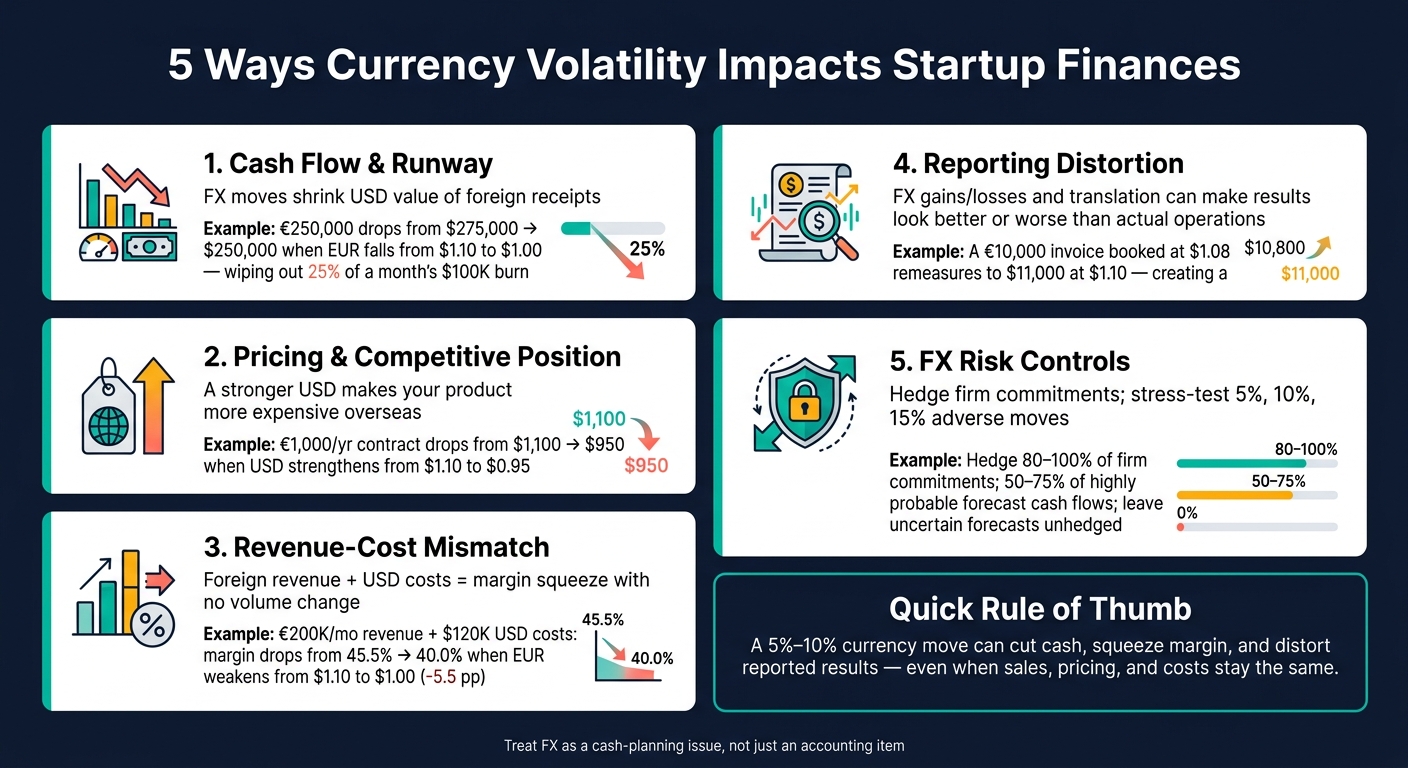
A 5% to 10% currency move can cut cash, squeeze margin, and skew reported results fast. If I bill in euros, pay in pounds, or keep cash in another currency, exchange rates can change my numbers even when sales, pricing, and costs stay the same.
Here’s the short version:
- Cash flow can shrink: A foreign invoice or cash balance may be worth fewer U.S. dollars by the time I get paid.
- Pricing gets harder: A stronger U.S. dollar can make my product look more expensive overseas.
- Margins can swing: If revenue is in one currency and costs are in another, profit can drop with no change in volume.
- Reporting can look off: FX gains, losses, and translation can make results look better or worse than the business itself.
- Controls matter: I need to track exposure by currency, test 5%, 10%, and 15% moves, and hedge only clear, forecastable amounts.
A simple example shows the problem fast: a €100,000 invoice worth $110,000 at $1.10/EUR drops to $105,000 at $1.05/EUR. Same sale. Same customer. But I’m short $5,000.
5 Ways Currency Volatility Impacts Startup Finances
Corporate Finance Explained | How Companies Manage Currency Risk
sbb-itb-17e8ec9
Quick Comparison
| Area | What changes | What it can do |
|---|---|---|
| Cash flow | Value of foreign receipts, payments, and cash | Shortens runway |
| Pricing | Local price vs. competitor price | Hurts conversion or retention |
| Margin | Revenue-cost currency mismatch | Lowers gross margin |
| Reporting | Remeasurement and translation | Distorts investor-facing numbers |
| Hedging | How much exposure I lock in | Cuts downside, but adds cost or limits upside |
If I want fewer surprises, I need to treat FX as a cash-planning issue first, not just an accounting item.
Where Startup FX Exposure Comes From
FX exposure comes in three forms. What separates them is when they hit: at settlement, in reporting, or over time.
Transaction exposure shows up first in day-to-day cash movement. A signed €50,000 invoice, a C$20,000 contractor bill due next month, or recurring U.K. payroll in pounds all fit here. The U.S. dollar value keeps moving until settlement.
Translation exposure shows up at the reporting level. Say you have a U.K. subsidiary whose functional currency is pounds sterling. Those pound-denominated accounts must be converted into U.S. dollars for consolidated financial statements. The business itself hasn't changed, but the reported numbers can shift enough to affect investor-facing metrics.
Economic exposure is the long-term effect of currency moves on future revenue, costs, and competitive position. If the euro weakens against the dollar, your SaaS pricing can start to look more expensive to European customers even though the product is the same. These three exposures drive the five startup impacts that follow.
Here's how they map to common startup situations:
| Exposure type | Startup example | What's at risk |
|---|---|---|
| Transaction | €80,000 monthly customer collections, C$25,000 contractor invoices, £40,000 U.K. payroll | Dollar value of each cash flow before settlement |
| Translation | U.K. subsidiary's GBP accounts consolidated into USD | Reported assets, liabilities, revenue, and equity |
| Economic | Euro-priced revenue against dollar-based costs | Future sales volume, pricing power, and gross margin |
Next, those exposures show up in cash flow, pricing, margins, reporting, and hedging.
One thing worth noting: exposure isn't limited to companies with overseas offices. A startup based fully in the U.S. can still face material FX risk if it invoices in euros, pays contractors in Canadian dollars, or holds funds in a foreign-currency bank account. The key is the startup's functional currency, not just where the transaction happens.
1. Cash Flow and Runway Uncertainty
The most immediate hit for a startup is cash flow. Exchange rates can change how long your runway lasts, even when nothing else in the business changes.
This kind of risk often starts with transaction exposure. Money you expect to receive or pay in another currency can end up being worth more or less in USD by the time it settles. Foreign-currency cash balances can shift in USD value too. Over a longer period, economic exposure can affect demand, pricing, supplier costs, and how well you stack up against competitors.
Impact on USD Cash and Margins
FX risk is easy to shrug off at first because the numbers can look minor on paper. Then it shows up in cash.
Here’s a simple example: if a startup holds €250,000 and the euro drops from $1.10 to $1.00, the USD value of that cash falls from $275,000 to $250,000. With a $100,000 monthly burn, that wipes out a quarter of a month of runway. For a small company, that can be the difference between making a hire now or waiting until after the next fundraise.
These moves can hurt from both directions. A weaker foreign currency cuts the USD value of foreign-currency collections. A stronger foreign currency pushes up the USD cost of foreign-currency expenses. The pressure gets worse when incoming and outgoing payments happen on different dates.
A useful cash forecast should show:
- The foreign-currency amount
- Its USD equivalent
- The budget rate used for the conversion
Operational Decisions Affected
When FX reduces available cash, leaders often have to make fast choices. That might mean delaying hires, cutting back on discretionary spending, renegotiating supplier terms, or going out to raise capital earlier than planned.
Your forecast should track expected foreign-currency inflows and outflows over the next 3 to 6 months by:
- Currency
- Amount
- Settlement date
That gives you a clearer view of where pressure may show up.
Mitigation Options
Start with natural hedging. In plain English, that means using foreign-currency revenue to pay foreign-currency expenses before converting what’s left into USD. It’s one of the simplest ways to cut exposure.
You can also lower risk by invoicing in USD, shortening payment terms, asking for deposits, lining up supplier pricing with your revenue currency, and holding only the foreign-currency cash you expect to use.
For fixed obligations, a forward contract can lock in the USD value ahead of time. If you need more room to react, an FX option gives you the right - but not the obligation - to transact at an agreed rate, though it usually comes with an upfront premium.
The key is not to hedge everything blindly. Hedge the exposure you can forecast. Use forwards for fixed obligations and options when you need flexibility.
The same currency move that changes runway can also change how customers react to your pricing.
2. Pricing, Demand, and Competitive Position
FX doesn’t just change what you collect. It also changes what customers are willing to pay.
Type of FX Exposure
Economic exposure affects how your price appears in local markets and how buyers react to it. This risk builds over time, not just when payment settles.
Impact on Revenue and Margins
Take a simple example. At €1,000 per year, a move from $1.10 to $0.95 cuts contract value from $1,100 to $950. Across hundreds of contracts, that gap adds up fast.
That’s where the trade-off shows up. You can pass the FX move through in your pricing and risk churn. Or you can hold prices steady and take the hit through margin compression.
Operational Decisions Affected
FX shifts your local price position. If the U.S. dollar gets stronger, your product can look more expensive to overseas buyers. That can reduce conversions, slow renewals, or push customers to a competitor. If the dollar gets weaker, your product becomes more affordable in local terms, but each sale converts into fewer U.S. dollars back home.
Some products can handle this better than others. Differentiated products usually have more room to absorb FX pressure. Standardized products tend to see demand fall faster when local prices move up.
Mitigation Options
A good starting point is to track performance in both local currency and USD. That helps you separate FX noise from actual demand changes.
For example:
- Stable euro bookings with lower USD revenue usually point to translation, not weaker demand.
- Falling euro bookings after a local price increase point to real demand pressure.
Those are two very different problems, and they call for different responses.
| Pricing response | Effect on customer demand | Effect on USD margins |
|---|---|---|
| Full pass-through | Higher risk of churn if the local price rises | Protects margins more directly |
| Partial pass-through | Moderates customer impact | Splits the burden between startup and customer |
| No immediate pass-through | Protects conversion and retention | Can meaningfully compress margins |
| Local-currency pricing | Improves price transparency | Startup retains more FX exposure |
It also helps to set a pricing corridor instead of reacting to every market move. In plain terms, don’t reprice every time FX twitches. Review local prices only when a currency moves 5% to 10% from plan or when gross margin drops below target.
These pricing choices flow straight into revenue and gross margin volatility.
3. Revenue, Costs, and Gross-Margin Volatility
Pricing shapes what you bring in. But exchange rates decide what that money is worth once it lands in U.S. dollars. If rates move against you, reported USD revenue can fall and gross margin can tighten fast.
Type of FX Exposure
This is the clearest case of the economic exposure mentioned earlier. Transaction exposure hits when cash is settled. Translation exposure appears when results are rolled up for reporting. Economic exposure runs deeper and affects pricing, demand, and repeat cost patterns.
Impact on USD Cash and Margins
The main risk is a mismatch between foreign-currency revenue and U.S.-dollar costs.
Say a startup collects €200,000 per month in subscription revenue and pays $120,000 in U.S.-dollar costs. At $1.10 per euro, that revenue translates to $220,000. Gross profit is $100,000, and gross margin is about 45.5%.
If the euro then weakens to $1.00, revenue drops to $200,000 while costs stay fixed at $120,000. Gross profit falls to $80,000, and gross margin declines to 40.0%.
That’s a 5.5 percentage point margin decline with no change in sales volume or pricing.
When revenue and costs are in the same currency, you get a natural hedge. The USD value may still move up or down, but the margin percentage tends to stay more stable.
Operational Decisions Affected
Margin swings caused by currency moves lead to very practical choices. A company may need to raise local prices, add a currency-adjustment clause, invoice in USD, switch suppliers, move production, shift more costs into the sales currency, or leave the market.
That same revenue-cost mismatch also helps determine whether a hedge makes sense or whether it’s better to change how the business operates.
Mitigation Options
If the currency mix is causing the problem, start there. Try to match revenue and costs in the same currency when you can. Multi-currency accounts can help too, since they let you hold receipts for planned expenses instead of converting every payment right away.
For committed and easy-to-forecast exposures, forward contracts can lock in a rate for a known future receipt or payment.
And one more thing: track the all-in conversion cost. That means the exchange rate, the spread, and bank fees. If you skip that step, your gross margin may look better on paper than it does in practice.
| Exposure pattern | Revenue currency | Cost currency | Typical margin effect |
|---|---|---|---|
| Foreign revenue, USD costs | EUR or other foreign currency | USD | Foreign-currency depreciation reduces USD revenue while costs stay fixed, compressing margin |
| USD revenue, foreign costs | USD | EUR or other foreign currency | Foreign-currency appreciation raises COGS in USD terms, reducing margin |
| Matched foreign revenue and costs | Same foreign currency | Same foreign currency | Natural hedge; USD cash value shifts, but net margin is less exposed |
| Foreign subsidiary translation | Foreign currency | Foreign currency | Local economics may be unchanged, but reported USD revenue and profit fluctuate |
4. Financial Reporting, Tax, and Investor Metrics
Even when day-to-day operations are fine, FX moves can make your numbers look worse - or better - than the business is actually doing. That gap causes problems when you close the books, file taxes, or walk investors through results. At that point, FX is no longer just a treasury issue. It starts changing the figures that investors, lenders, and tax authorities see.
Type of FX Exposure
This section focuses on how FX changes reported results. Transaction exposure affects booked receivables and payables. Translation exposure affects consolidated financial statements.
Under ASC 830, foreign-currency cash, receivables, payables, and debt are revalued at current rates. Transaction gains and losses run through earnings, while translation gains and losses bypass earnings and sit in equity until they are realized. That split matters. A weak quarter may reflect accounting translation, not an actual drop in business performance.
Impact on USD Cash and Margins
Foreign-currency receipts and payments can create taxable gains or losses when exchange rates move between booking and settlement. The booking rate and settlement rate decide whether you record an FX gain or loss.
Here’s the basic idea: if the euro drops from €1 = $1.10 to €1 = $1.05 before collection, the company records a $5,000 FX loss even though the customer paid the full invoice amount. Under IRC Section 988, that loss is generally treated as ordinary income or loss, not a capital item. For investors, that can make performance look weaker or stronger than operations actually are.
Those reporting swings feed straight into board decisions and fundraising narratives.
Operational Decisions Affected
Reported FX swings can push companies into the wrong calls at the wrong time - hiring freezes, fundraising, or pricing changes - even when demand in local currency is steady. That’s the trap. The business may be holding up, while the U.S. dollar view tells a rougher story.
Finance teams should model decisions in both local currency and U.S. dollars. It also helps to run base, favorable, and adverse rate scenarios. That way, decisions are tied to operating performance, not translation noise.
Mitigation Options
A few reporting controls can make a big difference:
- Track realized gains and losses separately from unrealized remeasurement and translation adjustments
- Report constant-currency results alongside GAAP results
- Keep a transaction-level FX schedule with booking rates, payment rates, and settlement dates
Those steps also make the next move - hedging - more precise.
5. FX Risk Controls and Hedging Decisions
After you’ve looked at cash flow, pricing, margin, and reporting, the last call is simple in theory and tricky in practice: how much FX risk will you live with, and how much will you hedge? Once you’ve mapped the exposure, sort it into three buckets: what you can match, what you should hedge, and what you can leave unhedged.
Type of FX Exposure
The control should fit the exposure. That means separating committed cash flows, forecast cash flows, balance-sheet items, and translation exposure.
It also helps to split economic exposure from accounting exposure. Economic exposure changes what the business actually collects or pays in cash. Accounting exposure changes reported numbers, even when cash doesn’t move.
Practical FX Controls and Hedge Tools
Start with natural hedging. If foreign-currency inflows and outflows offset each other, you only need to convert the net amount. That can cut risk before you ever touch a hedge product.
For exposure that still remains, there are three common responses:
| Instrument | Best For | Key Trade-Off |
|---|---|---|
| Immediate spot settlement | Small, immediate payments | Full exposure to rate movements |
| Forward contract | Firm invoices or committed payroll | Locks the rate; no upside if rates improve |
| FX option | Uncertain forecast cash flows | Preserves upside, but costs an upfront premium |
Operational Decisions Affected
Use operating changes first. Hedge only the exposure that stays material and predictable.
A few practical moves can reduce risk before any hedge is placed:
- Invoice in USD
- Shorten payment terms
- Source locally in the same currency as your revenue
- Use currency-specific accounts
Those steps can lower exposure, but they aren’t free. You still need to weigh spreads, fees, premiums, collateral, and any FX upside you give up.
Mitigation Options
A written FX policy should spell out the basics: currencies covered, materiality threshold, approved instruments, hedge limits, approval authority, and documentation.
A common framework is to hedge 80% to 100% of firm commitments, 50% to 75% of highly probable forecast cash flows, and leave uncertain long-range forecasts unhedged until they become more reliable. In plain English: lock down what’s firm, cover a share of what’s likely, and wait on the fuzzy stuff.
A simple decision flow looks like this:
- Match foreign-currency inflows and outflows
- Reduce exposure through pricing, invoicing, supplier, payroll, or financing choices
- Hedge the remaining material and sufficiently certain exposure
- Review hedge ratios and forecast accuracy on a regular basis
Stress-test the budget against 5%, 10%, and 15% adverse moves in each key currency. Also set a review trigger for moments when a single currency exposure rises above a set share of monthly operating cash, or when a 10% move would materially cut runway.
One rule matters more than it may seem: don’t speculate. The hedge amount, currency, and maturity should tie back to a clear business exposure. If you can’t trace it, that’s a red flag.
Have your accountant or CPA review hedge documentation before execution.
From there, day-to-day finance should carry the policy into invoicing, collections, payments, and cash forecasting.
Comparing Practical FX Responses
No single FX response works for every startup. The right move depends on where the exposure comes from and how easy it is to forecast. Once you’ve mapped that out, this comparison helps you weigh the main options by predictability, complexity, cost, and fit for an early-stage company.
| FX Response | Predictability | Implementation Complexity | Direct Cost or Premium | Fit for Early-Stage Startups |
|---|---|---|---|---|
| Natural hedge: match inflows and outflows in the same currency | Medium to high for the matched portion; does not cover the residual exposure | Low to medium; requires currency-level cash forecasting and possibly foreign-currency accounts | Low direct cost; may involve banking, supplier, or localization costs | Strong first step, especially when the startup already has recurring costs in the sales currency |
| Adjust prices or add an FX buffer | Medium; protects future unit economics but not necessarily existing receivables | Low to medium; requires pricing rules, customer communication, and monitoring | Low direct financial cost; possible demand or competitiveness impact | Good for new quotes and renewals, particularly where margins are thin and the startup can change prices |
| Add contractual currency clauses | Medium to high if the clause is clear and enforceable | Medium; requires careful drafting, reference-rate definitions, thresholds, and dispute procedures | Low drafting cost; may weaken pricing power or close rates | Useful when negotiating leverage exists; less suitable for standardized or highly competitive sales |
| Use forward contracts | High for the hedged amount and settlement date | Medium to high; requires forecasts, bank or provider onboarding, documentation, and settlement controls | No standard fixed fee; pricing is embedded in the forward rate | Appropriate for material, committed exposures, but usually not the first tool for small or uncertain exposures |
| Use currency options | High downside protection with continued upside participation, subject to the option terms | High; requires instrument selection, premium analysis, valuation, and accounting controls | Upfront premium plus transaction and admin burden | Selective use for large or uncertain exposures where flexibility justifies the premium |
A point that’s easy to miss: predictability doesn’t erase risk. A forward contract can lock in a future rate for a set amount and date. A natural hedge does something different. It cuts down how much money you need to convert in the first place.
Cost can be slippery too. Natural hedging may look cheap on paper, but it can mean opening foreign-currency accounts, changing suppliers, or doing localization work. Price changes don’t come with an instrument fee, but they can affect demand and make you less competitive.
For most startups, the practical path is pretty simple:
- Start with natural hedges where you can.
- Use pricing changes or contract terms to protect margin.
- Hedge only the exposure that still puts runway or reporting at risk.
That mix has to work in the day-to-day finance process, not just in a spreadsheet. It shows up in pricing, billing, cash management, and hedge review.
How to Manage FX Exposure in Day-to-Day Finance
Once you’ve mapped FX exposure, the work moves from analysis to real-time financial insights. At that point, FX management stops being a one-off project and becomes part of the weekly finance rhythm.
Start by mapping foreign-currency receivables, payables, and due dates. Then group cash flows by currency and maturity so the team can see what needs attention now versus later.
For example:
- EUR receipts in 30 days
- GBP payroll in 60 days
- JPY supplier payments in 90 days
That simple view makes it easier to spot pressure points for the current month.
It also helps to flag currencies that make up more than 10%–15% of revenue or expenses. From there, run a couple of stress tests using 5% and 10% adverse moves. A €100,000 payable, for instance, gets about 10% more expensive in USD terms if the euro weakens 10%.
Next, net offsets before you hedge anything left over. If euro receipts and euro contractor costs hit in the same month, only convert the net amount. That cuts extra FX activity and keeps things simpler.
Ownership matters too. Assign one person to oversee the process, review near-term positions weekly, and update longer-dated forecasts monthly.
The exposure map also needs updates when the business changes. New markets, contract changes, foreign debt, overseas hiring, or shifts in sales mix can all alter the picture. Once updated, feed that map into billing, payments, and the month-end close.
Accounting, Reporting, and Getting the Right Support
Once you've made hedging decisions, accounting decides how FX appears in the books.
Under U.S. GAAP ASC 830, the accounting treatment depends on the type of transaction, each entity’s functional currency, and the parent’s reporting currency. Remeasurement runs through earnings. Translation usually goes to accumulated other comprehensive income.
Your accounting system needs to keep a clear trail for each foreign-currency transaction, including:
- the original transaction currency and amount
- the transaction date
- the exchange rate used
- the U.S. dollar amount
- any realized or unrealized gain or loss
Here’s what that looks like in practice. If a U.S. parent records a €10,000 invoice at $1.08 per euro, the initial receivable is $10,800. If the invoice is still unpaid at month-end and the rate moves to $1.10, the receivable remeasures to $11,000. That creates a $200 FX gain, and your system needs to record it.
Your monthly management report should also make a clean distinction between operating performance and currency movement. That way, boards and investors can see what came from the business itself and what came from exchange-rate shifts.
A solid FX variance note might say:
"European revenue was €500,000, up 8% in euros, but translated U.S.-dollar revenue increased only 3% because the euro weakened against the dollar; the $24,000 translation impact reduced reported revenue growth."
Keep FX variance reporting in plain English. If the business grew, say that. If exchange rates reduced the reported U.S. dollar result, say that too. No one should have to dig through accounting language to figure out what happened.
Once reporting is clean, the next job is to make FX review part of the monthly finance close instead of treating it like a side issue.
If your startup has multiple entities or works in more than one currency, bring in CPA review for functional currency, rate policy, and FX variance reporting.
Conclusion
Currency volatility is an operating issue, not just an accounting one. Exchange-rate moves can cut the USD cash you collect from overseas sales and make runway planning harder to trust, even when the business itself hasn’t changed.
The next step is control: visibility, scenario planning, and disciplined reporting. Know your net exposure by currency. Model 5% to 10% moves against cash flow and runway. Then review local pricing after material FX shifts.
Clean reporting makes the rest much easier. Separate operating results from FX remeasurement gains and losses. Show constant-currency performance alongside reported U.S.-dollar figures. Keep reconciliations current across bank accounts, payment processors, and billing systems.
Use this checklist to keep FX exposure under control:
- Map cash by currency: Update currency exposure weekly, and reconcile bank, processor, billing, and ledger balances during each close.
- Stress-test 5%, 10%, and 15% moves: Model adverse rate cases against cash flow, gross margin, and runway. Review local pricing after material FX moves.
- Report constant-currency results and FX impacts separately: Show realized and unrealized FX effects alongside operating performance.
- Get treasury, tax, or CFO review before hedging: Escalate accounting, tax, and derivative decisions before changing your FX policy.
When you manage FX across cash flow, pricing, margins, reporting, and hedging as one system, currency volatility becomes a planning input instead of a surprise.
FAQs
When should a startup start managing FX risk?
Start managing FX risk as soon as your startup starts moving money in more than one currency. Exchange-rate shifts can hit cash flow, margins, and financial reporting fast.
This should move to the top of your list if currency swings make cash flow hard to predict, or if a 5% move could erase a month’s margin. Once your banking setup is in place, a clear approach helps limit extra financial exposure.
How do I know if I should hedge?
It comes down to two things: how steady your cash flow is and how much risk your startup can handle.
Natural hedging means matching revenue and expenses in the same currency. That can cut currency risk without adding extra fees, which makes it a simple option for many startups.
If your exposure is larger or easier to forecast, forward contracts can lock in exchange rates for future payments. You can also mix both methods based on your forecasts and the amount of risk you're willing to take.
What’s the difference between transaction, translation, and economic exposure?
- Transaction exposure: when exchange rates move before a payment is made or received, changing the value of a specific payable or receivable.
- Translation exposure: when exchange rates change the reported value of a foreign subsidiary’s financial statements during consolidation.
- Economic exposure: the long-term effect of currency swings on a company’s market value, future cash flow, and competitive position.