Treaty protection does not automatically give you a right to arbitration. I compare seven frameworks to help you check your nationality, investment, host country, and filing deadlines before relying on coverage.
These frameworks address government actions such as unlawful takings, discrimination, and blocked transfers - not ordinary business losses. This is a comparison, not a ranking: BITs are a treaty category, while ICSID provides a dispute process, not investment rights.
Quick Comparison
| Framework | Main scope | Arbitration access and limits |
|---|---|---|
| USMCA | North American investments | Limited U.S.–Mexico claims; broader access for certain government contracts. No general U.S.–Canada ISDS. |
| ECT | Energy investments | Check withdrawals, intra-EU barriers, and possible 20-year sunset protection. |
| ACIA | Investments within ASEAN | Access depends on investor eligibility, sector coverage, reservations, and filing rules. |
| CPTPP | Investments among its parties | Arbitration depends on the country pair, exclusions, and side letters. The United States is not a party. |
| CETA | Canada–EU investments | Provisional application does not activate its investment court system. |
| BITs | Investments between two treaty countries | Rights and dispute routes depend on the exact treaty. |
| ICSID Convention | Qualifying investor–state disputes | Requires separate written consent and jurisdiction; creates no investment rights. |
My starting point: <u>verify the treaty text and status as of October 22, 2026</u>. Then check eligibility, exceptions, consent, and deadlines. Keep ownership and loss records, and assess collection early - winning an award does not guarantee payment.
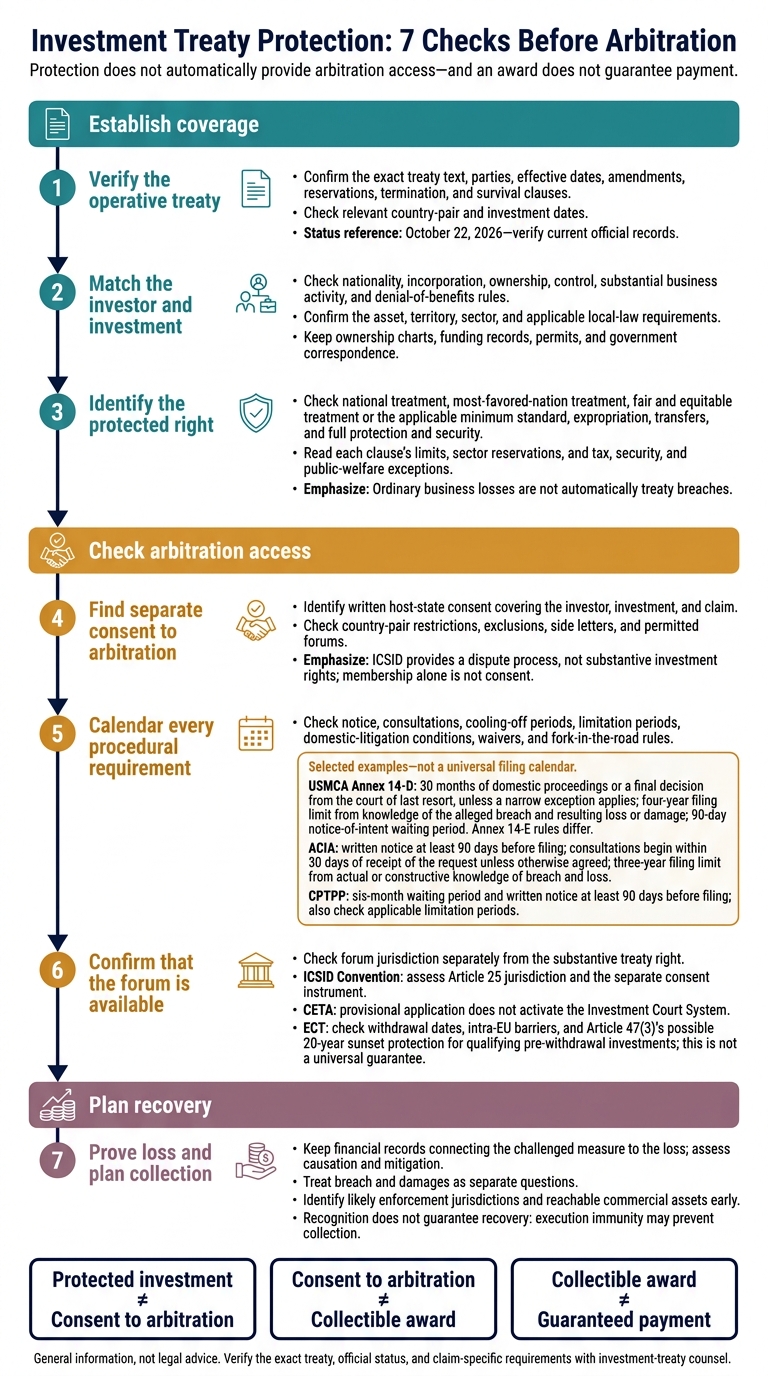
Investment Treaty Protection: 7 Checks Before Arbitration
"Investment Treaty" Arbitration, BIT, Introduction Future of ISDS, By Arvind P. Datar & ASGI
sbb-itb-17e8ec9
How to Assess Treaty Coverage
Start with the exact right the treaty grants, then check who can claim it. National treatment requires treatment no less favorable than domestic investors receive in like circumstances. Most-favored-nation (MFN) treatment compares treatment with investors from third countries. For each standard, check whether it covers entry, acquisition, or only post-establishment operations. Read sector reservations and exceptions for taxes, security, and regulation. Then move from market-access rules to the treaty protections that triggered the claim.
Fair and equitable treatment (FET) may cover arbitrary conduct, denial of justice, or serious procedural unfairness. The threshold depends on whether the treaty sets an independent standard or ties protection to customary international law. Expropriation protection addresses direct takings and, where covered, indirect measures that substantially deprive an investment of its use, value, or control. Neither standard promises that regulations will stay unchanged. Legitimate, nondiscriminatory public-welfare measures may fall outside indirect expropriation.
Free-transfer clauses commonly protect payments such as dividends, loan repayments, and sale proceeds. Exceptions may apply for bankruptcy, financial regulation, criminal enforcement, or monetary measures. Full protection and security usually requires reasonable protection against physical harm, violence, or unrest - not protection against every economic or regulatory loss. Pinpoint the blocked payment or alleged security failure, then check the clause’s limits.
Match the treaty’s definitions exactly. Confirm the parties, effective dates, and coverage of preexisting investments. Compare incorporation, nationality, ownership, control, and any substantial-business-activity requirements against corporate and ownership records. Check denial-of-benefits clauses, whether the asset qualifies as an investment, and whether it falls within the defined territory. Keep ownership charts, funding records, permits, and government correspondence. Only then check whether a dispute path exists.
Treaty coverage and access to dispute settlement are separate questions. Investor–state dispute settlement (ISDS) lets eligible investors bring specified claims directly against the host state in an agreed forum. Identify written consent separately from the protection allegedly breached. Calendar notice deadlines, cooling-off periods, and limitation periods. Check local-litigation or fork-in-the-road requirements, waivers, and forum-choice restrictions. For ICSID, assess Article 25 jurisdiction separately from the treaty right you are claiming.
7 Investment Treaty Frameworks Compared
These seven frameworks differ in who qualifies, what they protect, and whether investors can use arbitration.
| Framework | Countries or regions | Covered investments | Main protections | Dispute routes | Key limits |
|---|---|---|---|---|---|
| USMCA | United States, Mexico, Canada | Qualifying enterprises and covered assets, including equity, debt, loans, IP rights, and licenses | National treatment, most-favored-nation treatment, minimum standard of treatment, expropriation protection, and transfers | Limited ISDS for qualifying U.S.–Mexico claims | No general U.S.–Canada ISDS under USMCA. Eligibility depends on nationality, covered-contract status, sector, procedure, and time limits. Covered-contract sectors include oil and gas, power generation, telecommunications, transportation, and infrastructure. |
| Energy Charter Treaty (ECT) | ECT parties; membership is changing | Qualifying investments connected with energy activities | Fair and equitable treatment, expropriation protection, and transfers | Investor-state arbitration, subject to jurisdictional requirements | Check withdrawal and modernization status as of October 22, 2026; Article 47(3)’s 20-year sunset for qualifying pre-withdrawal investments; and applicable intra-EU rules and inter se arrangements. |
| ASEAN Comprehensive Investment Agreement (ACIA) | Participating ASEAN member states | Qualifying enterprises and assets; admission and establishment in specified sectors | National treatment, most-favored-nation treatment, fair and equitable treatment, full protection and security, expropriation protection, transfers, and senior-management provisions | Consultations, conditional ISDS, and state-to-state procedures | Sector reservations, local-law requirements, exclusions, and denial-of-benefits rules apply. Check each state’s commitments. |
| CPTPP | Asia-Pacific parties | Qualifying enterprises and a broad range of investment assets | National treatment, most-favored-nation treatment, minimum standard of treatment, expropriation protection, transfers, and restrictions on performance requirements | Investor-state arbitration for specified claims | Reservations, side letters, sector exclusions, and procedural conditions can restrict access. The United States is not a party. |
| CETA | Canada and the European Union | Qualifying investments between Canadian and EU investors and host states | Non-discrimination, fair and equitable treatment, expropriation protection, and transfers, subject to treaty limits | Permanent investment court and appeal mechanism, once operative | Check ratification and implementation as of October 22, 2026. Provisional application does not activate every investment-protection provision. Full application requires completed ratification, including by all EU member states. |
| Bilateral investment treaties (BITs) | The two countries named in each treaty | Treaty-specific assets and investor categories | May include national treatment, most-favored-nation treatment, fair and equitable treatment, full protection and security, expropriation compensation, and transfers | ICSID, UNCITRAL, another forum named in the treaty, or only state-to-state proceedings | Coverage varies. Check the exact treaty text, protocols, reservations, amendments, termination provisions, survival clause, and host-state consent. Also check whether the investor has qualifying nationality and a protected investment. |
| ICSID Convention | Contracting states and qualifying nationals of other contracting states | Procedural only: disputes under Article 25 | No independent substantive investment protections | Arbitration and conciliation; Convention rules address award recognition and enforcement | Membership alone does not create consent. A separate instrument must provide it. |
Eligibility still depends on nationality, ownership, and denial-of-benefits rules. Treaty protections and access to arbitration are separate questions - the next step is to distinguish them.
1. United States–Mexico–Canada Agreement (USMCA)
Investor and Investment Eligibility
USMCA is the main North American treaty, but its protections are narrower than its headline coverage suggests. Start by documenting nationality, ownership, control, and the investment’s location. Chapter 14 covers equity, debt, contracts, IP, property, and concessions when the asset involves committed capital, an expectation of profit, and risk.
Investment Protections
USMCA protects against discrimination, expropriation, transfer restrictions, and certain management controls. But Annex 14-D limits which claims can go to arbitration. The main constraint is who can use arbitration to enforce those protections.
Arbitration Access and Requirements
Annex 14-D permits only limited U.S.–Mexico claims: national treatment, MFN, and direct expropriation. Claimants must first pursue domestic proceedings for 30 months or obtain a final decision from the court of last resort, unless a narrow exception, such as futility, applies. They must also file within four years of learning of the alleged breach and resulting loss or damage, give notice of intent, wait 90 days, and waive overlapping proceedings.
Annex 14-E is the main exception for qualifying government contracts. It allows broader arbitration access in oil and gas, power generation, telecommunications, transportation, and infrastructure. Check the contract, counterparty, ownership chain, and sector, along with the annex’s modified procedural rules, forum-selection clauses, and waiver consequences.
Treaty Status and Exclusions
Canada is outside Annex 14-D and 14-E. The NAFTA legacy filing window closed on July 1, 2023, though cases filed on time may continue.
2. Energy Charter Treaty (ECT)
For energy assets, the ECT is a key treaty to check, but coverage depends heavily on treaty-party status and withdrawal dates.
Investor and Investment Eligibility
The ECT covers energy-related investments. Eligibility depends on whether the asset qualifies as an energy investment and whether both states were treaty parties on the relevant dates.
Investment Protections
The ECT addresses transfer restrictions and may protect government contract commitments. But an ordinary contract breach does not automatically amount to a treaty violation.
Arbitration Access and Requirements
The ECT provides investor–state arbitration and state-to-state dispute mechanisms. Access depends on consent, notice, deadlines, and limits on duplicate proceedings.
Intra-EU claims face major jurisdictional barriers. The EU’s position is that the ECT cannot provide a basis for arbitration between an EU investor and an EU member state.
Treaty status therefore needs a close check. The EU and Euratom withdrew effective June 28, 2025, and the United Kingdom withdrew effective April 27, 2025. Individual countries have separate withdrawal dates. Article 47(3) provides 20 years of sunset protection for qualifying investments made before withdrawal, but this is not a universal guarantee - particularly for intra-EU disputes.
| Issue | Advantage | Limitation |
|---|---|---|
| Sector coverage | Can cover conventional and renewable energy infrastructure. | Definitions, annexes, and reservations narrow coverage. |
| Jurisdiction | May provide direct investor–state arbitration. | Nationality, procedural rules, and intra-EU objections can block claims. |
| Changing participation | Sunset provisions may protect existing investments. | Withdrawal dates and applicable modernization rules require an investment-specific review. |
3. ASEAN Comprehensive Investment Agreement (ACIA)
ACIA has a narrower scope than the frameworks above and depends on its schedules. Coverage turns on ASEAN membership, reservations, and scheduled commitments.
Investor and Investment Eligibility
Claimants generally must be ASEAN nationals or permanent residents, or enterprises formed under an ASEAN member state’s laws that conduct real business there. Investments must meet ACIA’s definition and comply with host-state law.
Check incorporation, ownership, control, and actual business activity. A shell company is not enough.
Investment Protections
ACIA provides national treatment, MFN treatment, fair and equitable treatment, full protection and security, expropriation protection, transfers, and senior-management rights. Treaty terms, reservations, and exceptions limit these rights. MFN does not automatically bring in another treaty’s arbitration procedures.
Arbitration Access and Requirements
The state must receive written notice at least 90 days before filing. That notice must identify the breach, the provisions invoked, and the loss or damage.
Consultations must begin within 30 days of receipt of the request, unless otherwise agreed. The investor must file for arbitration within three years after it knew or should have known of the breach and loss.
Track each deadline separately: notice, consultations, and filing.
Treaty Status and Exclusions
ACIA covers manufacturing, agriculture, fishery, forestry, mining and quarrying, and related services. Its negative list limits coverage within those sectors.
Check current protocols and schedules for reservations that apply across sectors or to specific sectors, including ownership, licensing, and management restrictions. Taxation, prudential, public-interest, and security exceptions may also apply. If the investment falls outside ASEAN or is in a reserved sector, check CPTPP next.
| Coverage checklist | What to verify |
|---|---|
| Reservations | Applicable obligation, government level, investment date, and schedule version. |
| Denial of benefits | Whether ownership/control or insufficient business activity permits denial. |
| Remedies and waiver | Domestic-remedy conditions, written waiver, and consent to the chosen forum. |
4. Comprehensive and Progressive Agreement for Trans-Pacific Partnership (CPTPP)
ACIA focuses on ASEAN, while CPTPP protects investments across a larger Pacific group. It offers broader access to arbitration than USMCA, but eligibility and procedural rules still determine who can bring a claim.
Investor and Investment Eligibility
The United States is not a CPTPP party. A U.S.-based startup therefore does not qualify simply by selling into a CPTPP market. Chapter 9 can cover equity, debt, IP, licenses, money claims, and indirectly held investments.
Trace indirect holdings through each fund or subsidiary, and keep cap tables and supporting records. Restructuring after a dispute arises may draw abuse-of-process scrutiny.
Investment Protections
Chapter 9 provides national treatment and most-favored-nation treatment in like circumstances, along with a customary international-law minimum standard of treatment. It also protects against direct and indirect expropriation, permits free transfers, and restricts performance requirements.
These rules can limit discrimination, forced local-content or technology-transfer demands, and blocked distributions, though transfer exceptions apply.
Arbitration Access and Requirements
Before filing, confirm treaty coverage, side letters, and forum eligibility. Complete consultations, observe the six-month waiting period, and provide written notice at least 90 days before filing.
Also check limitation periods, waivers, prior proceedings, and eligibility for ICSID, the ICSID Additional Facility, or UNCITRAL arbitration. CPTPP suspends claims based solely on investment authorizations or investment agreements. A government contract dispute alone is therefore not enough.
Treaty Status and Exclusions
Check the entry-into-force date for the relevant party pair, as well as the investment date. New Zealand side letters with Australia, Brunei Darussalam, Chile, Malaysia, Peru, the United Kingdom, and Vietnam restrict mandatory ISDS.
Review reservations, approvals, and sector rules together with exceptions for taxation, procurement, subsidies, and security. Article 9.16 preserves legitimate public-welfare regulation; economic harm alone does not establish indirect expropriation.
The table compares CPTPP’s broader coverage with USMCA and shows how procedural rules limit access.
| Issue | CPTPP | USMCA |
|---|---|---|
| Parties | 12 parties; confirm the relevant entry-into-force date and any side letters. | United States, Mexico, and Canada; Canada does not participate in USMCA ISDS. |
| Claim eligibility | Broad Chapter 9 protections and arbitration access for qualifying investors and investments, subject to reservations, annexes, and side letters. | General U.S.–Mexico claims are primarily limited to national treatment, MFN, and direct expropriation; qualifying covered government contracts in listed sectors allow broader claims. |
| Procedural restrictions | Six-month waiting period, 90-day notice, limitation periods, waivers, and forum requirements. | General claims may require 30 months of local proceedings; covered-government-contract rules differ. |
5. EU–Canada Comprehensive Economic and Trade Agreement (CETA)
CETA is the EU–Canada counterpart to the North American and Pacific agreements above. Its dispute system, however, is not yet fully in place.
Investor and Investment Eligibility
CETA covers qualifying Canadian and EU investors and their covered investments. These include enterprises, equity, debt, IP, money claims, and contractual rights, subject to the agreement’s definitions and exclusions.
Check eligibility before choosing a dispute route: confirm nationality, ownership or control, and the investment’s location.
Investment Protections
CETA provides protections against discrimination, unfair treatment, expropriation, and transfer restrictions, subject to reservations and limits on interpretation.
But protections on paper are only part of the picture. Access to arbitration is the key issue.
Arbitration Access and Requirements
CETA’s proposed Investment Court System includes a Tribunal and an Appellate Tribunal, but it is not yet fully in effect. Provisional application does not make the court system available.
Once the system takes effect, claims will still require an eligible investor, a covered investment, consultations, and compliance with notice, filing, waiver, and parallel-proceeding rules.
Treaty Status and Exclusions
CETA has applied provisionally since September 21, 2017. Full entry into force still depends on all EU Member States completing their approvals. Check the current official ratification record - approval by the investment’s host country alone is not enough.
| Category | What businesses should verify |
|---|---|
| Protection standards | Investment protections and transfer guarantees are not fully in effect. Distinguish them from market-access commitments that apply provisionally. |
| Market access | Many commercial commitments already apply, but portfolio-investment market access awaits full entry into force. |
| Investor eligibility | Nationality, covered-asset status, and direct or indirect ownership or control must meet CETA’s definitions. |
| Forum access | Confirm that Chapter 8’s dispute provisions have entered into force before treating the proposed court as available. |
Review reservations, financial-services rules, taxes, procurement, subsidies, and establishment and operating rules against CETA’s wording and interpretive annexes.
6. Bilateral Investment Treaties (BITs)
BITs provide a treaty-by-treaty fallback when no regional agreement applies or multilateral coverage is limited. They are the least standardized framework in this list. Unlike USMCA, CPTPP, or CETA, BIT coverage depends on the exact treaty text.
Investor and Investment Eligibility
A BIT protects investments made by investors of one treaty party in the other, but the treaty sets the eligibility rules. Check nationality, incorporation, ownership, control, and any substantial business activity test. Some treaties also require investments to comply with host-state law when made. Keep ownership records and proof of business activity.
Investment Protections
Compare the treaty’s exact wording, annexes, protocols, and exceptions. Similar language does not always provide the same protection.
| Clause to compare | Country-pair difference to check | Potential effect |
|---|---|---|
| FET | Broad wording versus a customary-international-law standard | Changes the threshold for liability |
| Umbrella clause | Covers certain state commitments or is absent | May bring contractual obligations within treaty claims |
| Tax carve-out | Excludes taxes, allows limited claims, or requires tax-authority referral | May restrict jurisdiction, liability, or damages |
| Procedural limits | Fork-in-the-road rules, waivers, and cooling-off periods | Can bar arbitration or affect filing timing and admissibility |
Then check whether the BIT provides access to arbitration.
Arbitration Access and Requirements
Map out the dates for the measure, notice, negotiations, cooling-off period, filing deadline, and waiver. Verify written consent and eligibility for the chosen forum. ICSID also has separate nationality and jurisdictional requirements.
Before filing, confirm the notice recipients and delivery rules. Review any prior court or contract proceedings for fork-in-the-road risks.
Treaty Status and Exclusions
Confirm the parties, entry-into-force date, territorial scope, amendments, replacements, and whether the treaty remains in force. Check whether earlier investments qualify and whether pre-existing disputes are excluded. If the treaty has ended, determine which investments keep their protection and for how long.
Review security, public-health, environmental, and financial-services exceptions. Check sunset clauses, denial-of-benefits rules, and restructuring dates. Restructuring after a dispute arises can trigger an abuse-of-process objection.
If the treaty is in force, check whether its consent clause covers the dispute.
7. ICSID Convention
When a treaty names ICSID, the Convention provides the forum; the treaty still provides the right. The ICSID Convention is a procedural treaty that creates a forum for investor-state arbitration and conciliation. Access requires a separate instrument giving consent to use ICSID.
Investor and Investment Eligibility
ICSID jurisdiction requires both a qualifying investor and a valid consent path. Article 25 covers a legal dispute arising directly out of an investment between a Contracting State and a national of another Contracting State. Check nationality on the relevant dates, including any dual-nationality issues. A host-state company may qualify if the parties agree to treat it as foreign because of foreign control.
Arbitration Access and Requirements
The tribunal decides whether it has jurisdiction and issues the award. Under Article 26, ICSID generally becomes the exclusive forum once consent is given, unless the consent instrument provides otherwise. After an award, the Convention allows interpretation, revision, and annulment on specified grounds - not an appeal on the merits.
Contracting States must recognize awards as binding and enforce their monetary obligations as if they were final court judgments. But execution immunity can still prevent collection.
Treaty Status and Exclusions
Before relying on the Convention, check Contracting State status, the consent instrument, nationality, and whether the dispute meets the applicable investment definition. Once the investor and host state submit the dispute to ICSID, the investor’s home state generally cannot pursue diplomatic protection over that same dispute.
Investment Rights vs. Arbitration Access
A protected investment does not automatically give an investor access to arbitration.
The next question is not what the treaty promises, but whether the investor can enforce those promises.
Protection vs. Enforcement
A treaty can protect an investment on paper while still blocking arbitration in practice.
| Framework | Investment rights | Conditions for use | Dispute route |
|---|---|---|---|
| USMCA | Limited protections and narrow investor-state access. | Claims are limited, with a 90-day notice requirement and, in some cases, prior domestic proceedings. Annex 14-E permits broader access for qualifying covered government contracts. | Limited investor-state dispute settlement (ISDS). State-to-state proceedings do not give investors a direct claim. |
| ECT | Energy-investment protections; access depends on jurisdiction after withdrawal. | Check that jurisdiction remains after withdrawal and that the applicable procedural requirements are met. | Treaty arbitration where jurisdiction remains. State-to-state procedures may also apply. |
| ACIA | ASEAN investment protections, subject to reservations. | Protection alone does not establish ISDS eligibility. Consent and procedural conditions must also be met. | Conditional ISDS, alongside consultations and state-to-state procedures. |
| CPTPP | Broad Chapter 9 protections, but access varies by party. | Side letters, exclusions, and procedural requirements can restrict claims that would otherwise be covered. | ISDS where permitted for the relevant party pair and claim. |
| CETA | Investment protections paired with an investment court system. | Investors can use the system only once the relevant dispute provisions enter into force. | The investment court system is not available through provisional application. State-to-state procedures do not replace investor access. |
| BITs | Protections vary from treaty to treaty. | Read each BIT separately. The host state’s consent must cover the investor, investment, and claim. | Only the forums authorized by the applicable consent instrument. |
| ICSID Convention | No substantive rights; it provides only a forum. | Convention jurisdiction must be established separately. Additional Facility proceedings follow different rules. | Arbitration or conciliation - not an independent treaty claim. |
After checking rights and access, assess the investor’s specific facts: nationality, ownership, location, sector, dates, the measure at issue, and the remedy sought. Each can affect the claim.
Conclusion: Verify Coverage Before Relying on a Treaty
After comparing frameworks, turn to proof and enforcement. Read the exact treaty and protocol texts. Verify the operative text, amendments, termination date, and any survival clause. Treaty protection alone isn’t enough: confirm eligibility, consent, and filing deadlines.
Keep ownership records, permits, government communications, and financial data. These records help connect each challenged measure to the loss, rule out other causes, and assess mitigation. Treat breach and damages as separate questions.
Even a valid award can be hard to collect. Plan enforcement early by identifying likely enforcement jurisdictions and reachable commercial assets. ICSID Convention Article 55 preserves domestic execution-immunity rules for specific state assets, so recognition does not guarantee recovery.
Review corporate structures before a dispute becomes foreseeable. Late restructuring can trigger abuse-of-process objections. Consult investment-treaty counsel and valuation experts before relying on coverage or valuing a claim.
This article provides general information, not legal advice.
FAQs
What if multiple investment treaties cover my claim?
You may be able to use the most favorable provisions across those treaties. In some cases, Most Favored Nation clauses let investors draw on stronger protections from another treaty. Work with legal advisors to identify which treaties put you in the best position for your dispute.
Lucid Financials can help bring financial data together and model the financial impact of different treaty strategies. It can also support the documentation needed to use these protections effectively.
How much does investment treaty arbitration cost?
Investment treaty arbitration typically costs about $13 million for both parties combined. That total includes legal counsel fees, arbitrator fees, and expenses tied to lengthy proceedings.
Startups should weigh potential damages against these costs and assess whether the advantages of negotiation justify the investment. Some financial firms may fund these cases in exchange for a share of any future awards.
Can I fund a treaty claim through a third party?
Yes. International arbitration can be expensive. Some financial firms cover your legal costs for treaty claims in exchange for a share of any award you receive.
Lucid Financials can help with financial modeling and scenario planning so you can weigh potential damages against arbitration costs.