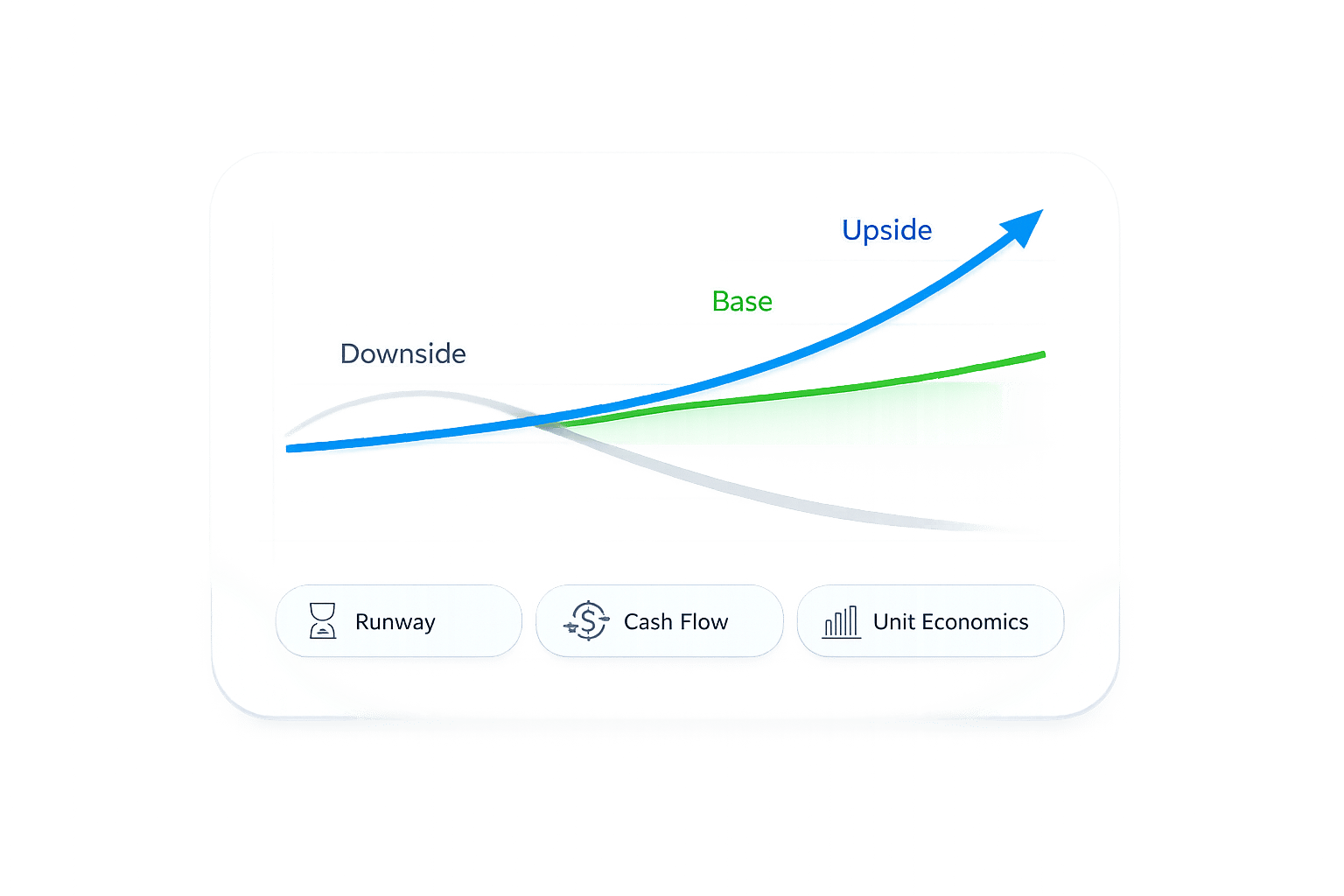
Most startup finance mistakes are not math mistakes. They are judgment mistakes. If I had to sum up this topic fast, here’s the point: hybrid models help me spot where bias is shaping runway, hiring, fundraising, and tax cash flow before those choices turn into cash problems.
Here’s the short version:
- Founders do not make money decisions on data alone. Stress, fear, confidence, and social pressure shape the call.
- Bias leaves signals in the numbers. I can see it in forecast gaps, delayed cost cuts, copycat spending, and old targets that no longer fit.
- Hybrid models mix tools. They combine machine learning with stats, rules, text analysis, and human review.
- That mix works better for startup finance because it can read both hard data and behavior signals.
- Good inputs matter. If books are late or messy, the output will be off.
- The goal is not to let AI decide. The goal is to give me a better way to test judgment, flag risk, and make cleaner calls.
A few facts from the article stand out:
- 86% of people say they feel more peace of mind when human judgment is part of financial decisions.
- 53% say emotional needs are the top part of trust in a financial relationship.
- Losses can feel about 2x to 3x stronger than equal gains.
- In finance text, about 75% of words marked negative by general dictionaries are neutral in a finance setting.
What does that mean in plain English?
I should not treat startup planning like a clean spreadsheet exercise. A founder may overhire after a round, delay layoffs too long, stick to an old valuation, or shift budget because everyone else is doing it. A hybrid setup can flag those patterns, test scenarios, and put guardrails around choices.
The article boils down to four use cases:
- Runway planning: test odds of keeping 12 months of cash
- Hiring timing: check if headcount plans are too aggressive
- Fundraising timing: avoid assuming today’s market will hold
- Tax cash flow: spot timing shifts before they hit liquidity
Bottom line: if I want better startup finance decisions, I need more than forecasts. I need forecasts tied to human behavior, clear rules, and clean books.
That’s what the rest of the article explains.
Behavioral Finance Fundamentals: Decision-Making Biases
sbb-itb-17e8ec9
Behavioral Biases and the Financial Signals Behind Them
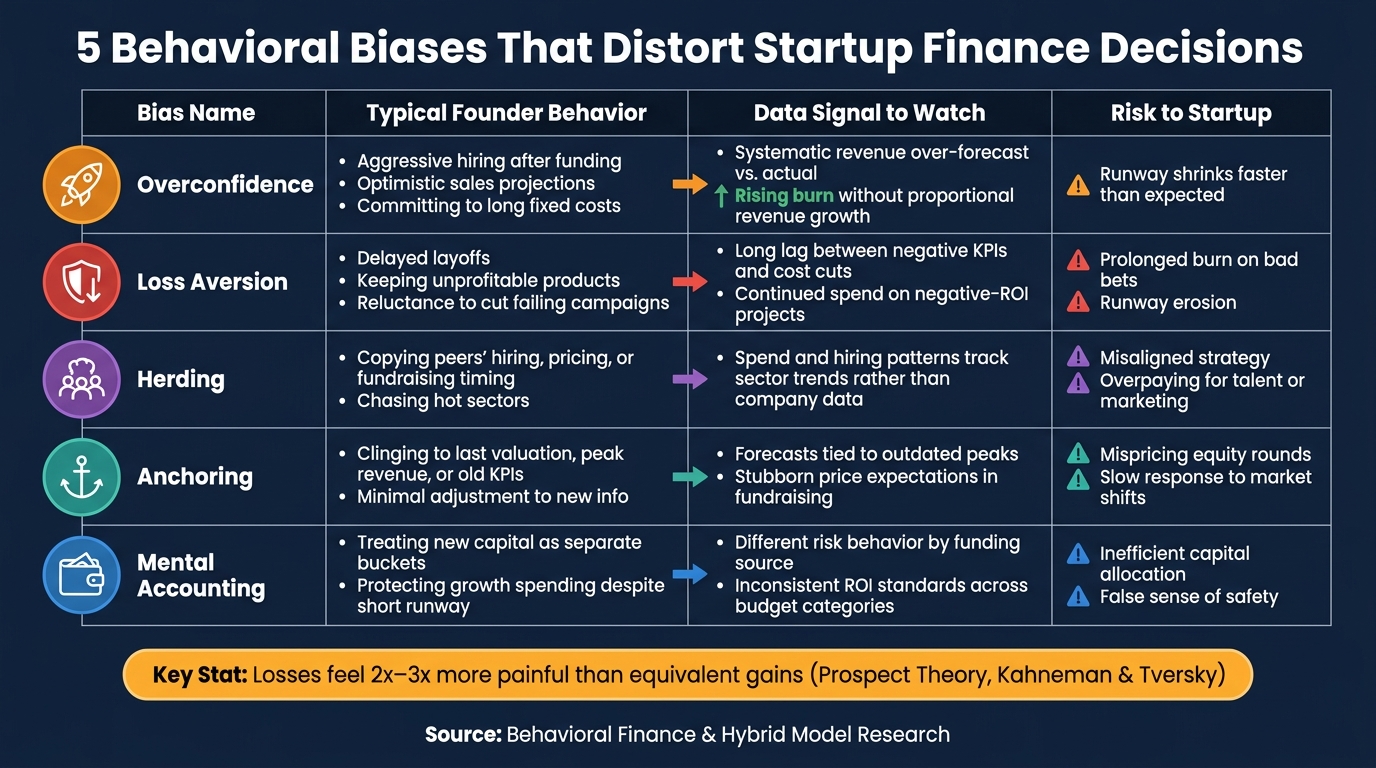
5 Behavioral Biases That Distort Startup Finance Decisions
Standard financial analysis tells you what happened. Hybrid models go a step further: they help explain why it happened. In startups, that usually shows up in runway, hiring, fundraising, and cash flow.
Biases That Affect Financial Choices
Five biases show up again and again in startup finance, and each one leaves a trail in the numbers.
Overconfidence is one of the most common. Founders often rate their odds of success too high, underestimate burn, and lock in fixed costs based on best-case plans. You can usually spot it in a forecast gap that keeps showing up quarter after quarter. Research also shows that overconfident CEOs tend to lean toward debt instead of equity because they discount downside risk.
Loss aversion plays out in a different way. Losses feel roughly two to three times more painful than equivalent gains. On the ground, that can mean waiting too long to make layoffs, keeping weak products alive, or continuing to fund negative-ROI campaigns long after the math says stop. The signal here is the lag between a negative KPI and an actual cost cut.
Herding appears when hiring sprees, fundraising timing, or budget changes follow the crowd instead of the company’s own data. Say a startup suddenly shifts 30% of its marketing budget into AI, but there’s no clear internal use case. That move may say more about peer pressure than business logic.
Anchoring keeps founders tied to old reference points, and mental accounting leads them to judge risk differently across budget buckets.
The table below shows how these biases tend to appear in startup data.
| Bias | Typical founder behavior | Common Data Signals | Risk for Startup Financial Planning |
|---|---|---|---|
| Overconfidence | Aggressive hiring after funding, optimistic sales projections, committing to long fixed costs | Systematic revenue over-forecast vs. actual; rising burn without proportional revenue growth | Runway shrinks faster than expected |
| Loss aversion | Delayed layoffs, keeping unprofitable products, reluctance to cut failing campaigns | Long decision lag between negative KPIs and cost cuts; continued spend on negative-ROI projects | Prolonged burn on bad bets; runway erosion |
| Herding | Copying peers' hiring, pricing, or fundraising timing; chasing hot sectors | Spend and hiring patterns closely track sector trends rather than company data | Misaligned strategy; overpaying for talent or marketing |
| Anchoring | Clinging to last valuation, peak revenue, or old KPIs; minimal adjustment to new information | Forecasts tied to outdated peaks; stubborn price expectations in fundraising | Mispricing equity rounds; slow response to market shifts |
| Mental accounting | Treating new capital as separate buckets; protecting growth spending despite short runway | Different risk behavior by funding source; inconsistent ROI standards across budget categories | Inefficient capital allocation; false sense of safety |
These patterns only matter if you can turn them into features, model inputs, and decision rules.
From Prospect Theory to Startup Planning
Prospect theory, developed by Kahneman and Tversky, gives a simple way to understand why founders make uneven bets. People judge outcomes against a reference point, not in absolute terms, and losses loom larger than gains. For founders, that reference point is often runway, ARR, or the last funding round.
Once that line is set, decisions often shift toward staying above it instead of maximizing total firm value. Founders who are above target tend to protect gains. Founders who fall below target often swing toward bigger risks to claw their way back. For example, with an extra $100,000 on hand, a founder might turn down a 60% chance to produce $250,000 in incremental ARR, even if the expected value is positive, because the possible loss feels too painful when runway is tight.
Hybrid models can encode moving reference points and flag cases where founder behavior drifts away from expected gain-loss patterns. The next step is to turn those signals into model-ready features and validation rules.
How Hybrid Models Turn Behavior Into Usable Financial Insights
Bias only starts to matter when you can turn it into a signal a model can use. And a signal only helps if it becomes a clean input for forecasting and decision-making.
Behavioral Data Sources and Feature Design
Hybrid models usually pull from three main input buckets: accounting data, operating data, and text.
Accounting data, like your general ledger and cash flow statements, shows spending swings and burn-rate patterns. Operating data, such as hiring pace and sales pipeline velocity, points to momentum changes and concentration risk. Text from board notes, Slack messages, or news coverage can bring out softer signals like sentiment changes, overconfidence, or herding behavior. That's what turns messy human behavior into something a model can actually use.
The table below links each data type to the model component and the behavioral signal it helps track.
| Data Type | Best-fit model | Behavioral Insight Target |
|---|---|---|
| General ledger and cash flow | Econometric + ML (e.g., ARIMA-LSTM) | Spending volatility, cash-buffer behavior, burn trajectory |
| Board Notes / Slack / News | Lexicon + Deep Learning | Sentiment shifts, concentration risk |
| Hiring Pace / Ops Data | Rule-based + Ensemble (Random Forest) | Overconfidence, reaction speed to revenue shifts |
| Survey / Sentiment Data | Statistical + NLP | Investor/founder alignment, prospect theory biases |
A few engineered features tend to matter a lot here: reaction speed (how fast operating expenses change after revenue moves), cash-buffer behavior (how much runway cushion the company keeps), and spending concentration (how tightly spending clusters across vendors, channels, or teams). If reaction speed is slow, that's often a sign of sunk-cost bias or status-quo bias.
One text-related point is easy to miss: don't use a general-purpose sentiment tool for internal finance communication. The Loughran-McDonald financial lexicon was built for this exact job; roughly 75% of words marked as negative by standard dictionaries are actually neutral in financial settings.
Hybrid Model Types That Work in Practice
Each model setup has its lane. Some are better for time-series drift. Some are better for operating behavior. Others are built for text sentiment.
Econometric-ML hybrids - like ARIMA paired with an artificial neural network - split the job in two. The econometric layer handles stable linear trends in the time series. The ML layer picks up the nonlinear residuals, which is often where behavioral noise shows up. Financial time series often contain both linear trend and nonlinear noise, which helps explain why hybrid models often beat single-algorithm methods on forecasting accuracy.
Ensemble and stacked models - such as Random Forest, XGBoost, or gradient boosting layered over rule-based outputs - fit operating data well, especially when relationships are messy but the data itself is fairly clean. They're useful for spotting herding in hiring or spending that doesn't line up with the company's own metrics.
Deep sentiment hybrids combine NLP with financial or communication data. These models help when you want to compare what leadership is saying in board notes, Slack, or news with what the numbers are showing. Put simply, they help answer a practical question: Do the words and the metrics tell the same story?
The table below compares these approaches on the factors startup finance teams tend to care about most.
| Feature | Pure Statistical | Pure ML | Hybrid |
|---|---|---|---|
| Interpretability | High | Low | Moderate to High |
| Forecast Strength | Moderate | High | Very High |
| Regime Handling | Poor | Moderate | High |
| Implementation Effort | Low | High | Moderate |
Validation Standards for Noisy Financial Data
Standard cross-validation is a bad fit for financial data because of non-stationarity. In plain English, the statistical behavior of the data changes over time. If you randomly mix time periods, you can create look-ahead bias, where the model quietly learns from the future.
Walk-forward testing fixes that problem by training only on past periods and testing on the next one, then repeating that process as time moves ahead. It takes more time to run, but it gives a much more honest read on how the model will perform for runway, hiring, or spending calls.
Prediction error alone isn't enough. What matters is decision impact. Decision metrics like "Did the model predict the runway shortage 3 months early?" tie model output to actual business results.
For early-stage startups, the lexicon layer helps steady the model when there isn't much historical data. That's what makes it workable for live startup decisions.
Where Hybrid Models Solve Real Behavioral Finance Problems
Once a model can handle messy financial data, the next step is simple: what does it change in day-to-day finance work? That’s where hybrid models start to matter. They turn behavioral signals into something teams can measure, explain, and use when making decisions.
Better Measurement, Explainability, and Control
Hybrid models work well because each layer has a clear job. One part can track cash flow. Another can read internal commentary. Another can group similar behavior periods. And rule-based logic can enforce hard limits, like minimum runway floors.
That setup matters because finance teams don’t just need a forecast. They need to understand why it moved. If projected runway gets shorter, the team has to know what caused it: a revenue downgrade, a hiring spike, or upbeat language in the last board update that doesn’t line up with the numbers. SHAP and LIME show which inputs drove the change, so the output becomes auditable instead of just another score.
For startup teams, the main tradeoffs come down to three things:
- Better accuracy because the model can pick up nonlinear behavior and qualitative signals
- Interpretability because rules and attribution tools show how outputs were produced
- Governance because hard constraints can be applied before a recommendation gets to a founder or board
Behavior-Aware Forecasting and Decision Systems
Hybrid models don’t stop at forecasting. They can also suggest actions. Behavior-aware RL can shift recommendations as funding conditions and pipeline quality change, moving between cash preservation and growth.
When runway is tight and markets are shrinking, the system leans toward conservative spending. When pipeline quality gets better and runway is strong, it can support faster hiring or bigger budget commitments.
Neuro-symbolic systems add another layer to this. The neural side detects patterns across time series, text, and transaction data. The symbolic side applies explicit financial rules. That might mean requiring human approval for large hiring changes when forecast confidence is low, or blocking any move that would push runway below a board-approved floor.
The end result is a recommendation engine that still respects runway, tax, and board limits, even when the underlying data is fragmented.
In startup finance, that affects runway, hiring, fundraising, and tax decisions in a direct way.
Applying Hybrid Behavioral Models to Startup Finance
Use Cases: Runway, Hiring, Fundraising, and Tax Cash Flow
Startup finance decisions often look rational on the surface. In practice, they’re full of gut calls, pressure, and bias. That’s where hybrid models help. They turn bias-shaped decisions into forecasts you can test, pressure-check, and update.
These signals become useful in four areas founders deal with all the time: runway, hiring, fundraising, and tax cash flow.
The table below shows how common startup finance decisions connect to model types, data inputs, and the bias each model helps correct:
| Startup Finance Use Case | Hybrid Model Type | Data Needed | Behavioral Bias Addressed |
|---|---|---|---|
| Runway Planning | Monte Carlo Simulation | Monthly burn, cash reserves, volatility | Loss aversion (fear-driven underinvestment) |
| Hiring Timing | Counterfactual Reasoning | Revenue per head, historical hiring lag | Overconfidence (aggressive headcount growth) |
| Fundraising Timing | Probabilistic Linear Ensembles | Market multiples, few reliable internal KPIs | Recency bias (assuming current trends persist) |
| Capital Allocation | Probabilistic capital allocation | Win/loss ratio of projects, ROI | Gambler's fallacy (doubling down on failing projects) |
| Burn Correction | Expense-overrun correction | Late transaction records, actual vs. forecast | Confirmation bias (ignoring expense overruns) |
Take runway planning. Monte Carlo simulation estimates the odds of keeping a 12-month runway across different burn paths and market conditions. That gives founders something better than a single neat spreadsheet case. It shows what could happen when things go right, when they go sideways, and when the market turns cold.
Tax cash flow is a timing issue too. And small timing changes can hit liquidity hard. Hybrid models can track earnings, deductions, payroll timing, nexus, and credits to flag likely shifts in tax obligations before those changes start squeezing cash.
Why Clean Financial Data Matters for Hybrid Models
Behavioral signals are only as good as the data underneath them. If transaction records are weeks late, categories are inconsistent, or key dates are missing, the model isn’t reading a clean pattern. It’s reading noise.
That matters even more here because hybrid probabilistic models are built to learn from small, noisy financial datasets and to measure uncertainty instead of covering it up.
"This generative ensemble learns continually from small and noisy financial datasets while seamlessly enabling probabilistic inference, retrodiction, prediction, and counterfactual reasoning." - Deepak K. Kanungo, CEO of Hedged Capital
So before behavioral modeling can help, the books need to be clean and current. Lucid Financials fits into that step by keeping books clean, current, and investor-ready, which gives the model inputs it can actually use.
Conclusion: What Founders Should Take Away
Bias shows up in nearly every forecast assumption. It shows up when a team gets too optimistic about revenue, freezes spending out of fear, or assumes fundraising conditions will keep moving the way they did last month. Hybrid models help because they combine quantitative rigor with founder knowledge, uncertainty-aware forecasting, and counterfactual reasoning.
Just as important, a forecast isn’t useful if no one can understand how it got there. Explainability and validation matter as much as forecast accuracy. If a model spits out a number without showing the logic behind it, it’s hard to trust and even harder to use. The best setups pair solid modeling with clean, current financial data, so when the model flags a bias pattern or shows that its assumptions no longer match the market, the team can check it, understand it, and act.
FAQs
How do hybrid models detect founder bias?
Hybrid models spot founder bias by combining machine learning with natural language processing. That lets them look at both the numbers and the words around a decision.
On the financial side, they scan transaction patterns and KPIs for anomalies. On the qualitative side, they review meeting notes, investor updates, and transcripts for language tied to biases like overconfidence or confirmation bias.
The result is simple: these models can flag moments when judgment may be driven more by emotion or cognitive bias than by objective data.
What data do startups need for these models?
Startups need inputs they can trust and check, such as:
- market microstructure data, like order-book depth, bid-ask spreads, and tick-by-tick trades
- historical and real-time price and volume series
- sentiment signals from financial news and social media
- company-specific context from internal financial records
The hard part isn't just getting the data. It's pulling these sources together in a clean, consistent way. For example, aligning timestamps to Eastern Time can cut down on noise and fill in gaps that would otherwise throw off the analysis.
When should human judgment override the model?
Human judgment should take the lead when reliability, risk, or fiduciary responsibility is on the line. That matters most when a model’s confidence drops, market conditions change out of nowhere, or the output needs a human check for anomalies and data bias.
The same goes for high-stakes decisions like runway planning or complex tax strategies. In those moments, context, values, and accountability still belong to people - not software.