Money decisions aren’t just about numbers - they’re shaped by how your brain reacts to risks and rewards. Neurofinance combines neuroscience, psychology, and finance to explain why emotions and biases often drive financial choices. For example, 95% of financial decisions are emotion-driven, costing global markets up to $2 trillion annually.
AI tools now analyze brain activity and behavior to improve decisions, from smarter startup budgeting to reducing risky investments. Systems like MCoRNNMCD-ANN and platforms like Lucid Financials are helping leaders identify biases like overconfidence or loss aversion, paving the way for more balanced, data-driven decisions.
Key insights:
- Brain regions involved: Prefrontal cortex (logic), amygdala (emotions), ventral striatum (rewards).
- Common biases: Loss aversion, herd behavior, overconfidence.
- AI solutions: Real-time emotional monitoring, predictive analytics, and streamlined financial tools.
AI-driven neurofinance offers practical tools to address cognitive traps, helping startups and investors make better financial decisions while minimizing costly mistakes.
Core Principles of Neurofinance
Key Cognitive and Emotional Drivers
The brain’s role in financial decision-making is shaped by specific regions, each contributing uniquely to how we process and act on financial information. Here’s a closer look at the three key areas involved:
| Brain Region | Primary Role in Finance |
|---|---|
| Prefrontal Cortex | Evaluates risks and handles complex investment decisions |
| Amygdala | Processes emotional reactions to financial uncertainty |
| Ventral Striatum | Manages reward perception and shapes financial preferences |
For example, imagine a startup founder deciding whether to accept a new round of funding. The prefrontal cortex evaluates risks and calculates potential outcomes, while the amygdala reacts to possible threats or uncertainties. At the same time, the ventral striatum amplifies the perception of rewards, ultimately influencing the balance between logic and emotion in the final decision.
These neural processes don’t just shape individual choices - they also underpin the broader patterns seen in group financial behavior.
Behavioral Insights in Financial Decisions
In group settings, shared emotional reactions to market signals can lead to herd behavior, where investors collectively follow trends. This is especially common during uncertain times, as heightened threat detection drives people to mirror others’ actions. Such behavior often plays a role in phenomena like market bubbles or sudden sell-offs.
Another factor at play is heuristics, or mental shortcuts that help the brain make decisions quickly. While useful in day-to-day situations, these shortcuts can lead to less rational choices during high-pressure moments, as stress pushes individuals to rely on pattern recognition rather than careful analysis.
Understanding these cognitive and emotional drivers is key for developing AI systems capable of interpreting and predicting financial behaviors with greater accuracy.
sbb-itb-17e8ec9
AI's Role in Neurofinance
How AI Analyzes Financial Behavior
AI has become a powerful tool for unraveling the complexities of financial decision-making, a process deeply influenced by emotions and behavioral biases. As researchers Christos Bormpotsis, Michael Nanos, and Asma Patel explain:
"Financial decision-making, a cornerstone of individual prosperity and global economic stability, is hard to comprehend because it is a complex cognitive process concerned with emotional state and behavioural bias."
Traditional financial models often fall short of capturing these intricate dynamics. This is where AI steps in, offering tools that can analyze these patterns with a level of detail that was previously unattainable.
One standout example is the MCoRNNMCD-ANN, a system introduced in April 2025 through research published in IEEE Transactions on Technology and Society. This model combines neuroscience with financial behavior analysis, relying on convolutional neural networks (CNNs) to process brain modeling data and identify patterns in decision-making. Additionally, sentiment analysis tools assess the emotional and cognitive biases that shape financial choices. Together, these components allow the system to not only predict decisions but also uncover the psychological factors driving them.
This bio-inspired approach is paving the way for real-time tools that support better decision-making in areas like trading and financial audits.
Real-Time AI Applications in Decision Science
AI's influence extends beyond research into practical, real-time applications. For instance, brain-state adaptive trading systems use biometric data, such as EEG signals, to monitor a trader’s emotional state. If the system detects that emotions - like stress or overconfidence - are heavily influencing decisions, it can send alerts before trades are executed, helping traders maintain objectivity.
For startup leaders, AI-powered neurofinance tools provide insights into internal financial decision-making. These tools can identify hidden cognitive tendencies, such as loss aversion or an overemphasis on recent data, which might lead teams to make less-than-ideal choices. The purpose here isn’t to replace human judgment but to enhance it by offering a clearer understanding of the psychological forces at play.
Neurofinance: The Secret Science Behind Your Money Decisions
Practical Uses of AI-Neurofinance for Startups
AI-Neurofinance: How AI Tackles Startup Cognitive Biases
AI Tools for Behavioral Finance Insights
Startups are increasingly turning to AI-neurofinance to improve financial decisions in areas like budgeting and hiring.
Behavioral finance platforms use advanced algorithms to analyze massive data sets, uncovering patterns that traditional tools often overlook. Take NeuroFin, for example. Their behavioral intelligence algorithms have processed over 500,000 data points and identified more than 10,000 unique behavioral patterns in financial decision-making. These insights are rooted in over a century of research in cognitive science and behavioral economics. This means startup founders can access high-level financial insights without needing a full-fledged research team.
"Advanced algorithms reveal behavioral patterns that traditional models miss." - NeuroFin
One practical use of these tools is addressing optimism bias, which often leads finance teams to underestimate burn rates. AI can flag such risks early, allowing startups to adjust before problems escalate.
Another advantage lies in consolidating financial tools into a single platform. This reduces cognitive fatigue, minimizes errors, and helps avoid biases. Platforms like Lucid Financials exemplify this streamlined approach.
Lucid Financials: AI for Smarter Financial Decisions

Recognizing the need for integrated financial tools, Lucid Financials provides an all-in-one AI-driven financial solution tailored to startups. It combines bookkeeping, tax services, R&D tax credits, and CFO-level support into a single platform, designed specifically for startups ranging from pre-seed to Series C.
What makes Lucid stand out is its ability to offer real-time insights. Founders can ask financial questions directly in Slack - whether it’s about runway, spending trends, or cash flow - and receive immediate answers from Lucid’s AI. For more complex queries, the finance team steps in, ensuring a seamless blend of automation and human expertise. This quick access to information helps counter recency bias, which can distort decision-making when critical data arrives too late.
Lucid also simplifies investor relations by generating investor-ready reports and financial forecasts with just one click. Founders no longer need to scramble during due diligence. With clean books delivered in as little as 7 days and continuously updated financials, Lucid empowers startup leaders to make faster, more informed decisions. Pricing starts at $150/month, with a transparent flat rate and no hidden fees or hourly charges.
Future Trends in AI and Neurofinance
Advances in AI-Neural Integration
AI is moving beyond simply observing financial behavior to actually modeling the cognitive processes driving those behaviors. This shift has the potential to reshape how startups and decision-makers approach financial strategies. Instead of just identifying patterns, AI will dive deeper into the "why" behind those patterns.
A groundbreaking example of this is "Centaur," an AI model introduced in July 2024 by Marcel Binz's team at the Helmholtz Institute. Trained on the Psych-101 dataset - a massive collection of over 10 million individual choices from 60,000 participants across 160 psychology experiments - Centaur achieved 64% prediction accuracy in scenarios, including ones it had never encountered during training.
"We've created a tool that allows us to predict human behavior in any situation described in natural language - like a virtual laboratory." - Marcel Binz, Research Scientist, Helmholtz Institute for Human-Centered AI
Further advancements, such as the MCoRNNMCD-ANN framework, are delving into the neural mechanisms behind financial decisions, factoring in emotional states and cognitive biases. Meanwhile, Large Language Models (LLMs) are stepping up to offer real-time, personalized financial advice. These models adapt to individual behavioral profiles, helping users identify and address their own biases as they make decisions.
As these technologies continue to evolve, the focus on ethical considerations becomes increasingly critical.
Ethics and Privacy in Neurofinance
The rise of AI models capable of simulating human financial behavior brings with it pressing ethical concerns, particularly around data use and potential manipulation. Neurofinance relies on analyzing deeply personal emotional and neural data, which raises questions about how this information might be used - or misused - in financial decision-making.
One of the biggest risks is manipulation. If AI can pinpoint the exact neural triggers for behaviors like risk-taking or impulsive spending, there’s a real danger that this knowledge could be exploited to the detriment of consumers. Researchers Bormpotsis, Nanos, and Patel highlight this concern:
"The societal implications of this research seek to encourage equitable, stable and informed financial systems while addressing challenges at the intersection of neurofinance and neuroscience-informed AI."
Policymakers have a critical role to play here. Insights from neurofinance can be used to craft consumer protection regulations and design environments that nudge individuals toward smarter financial choices. Educational initiatives based on neurofinance findings could also empower individuals to recognize and counteract their own cognitive biases. While the technology holds enormous potential, its long-term impact will depend on the ethical frameworks and safeguards put in place.
Conclusion: Using AI and Neurofinance for Better Decisions
AI and neurofinance are already making waves in how financial decisions are approached. By identifying cognitive biases and emotional triggers in real time, these tools provide a clearer path to sound financial choices. For instance, neuroscience-driven AI systems boast an average ROI of 9.8x compared to 7.9x achieved by traditional models.
The big takeaway? Human emotions and biases are at the heart of financial decision-making. Tools that address biases like loss aversion and overconfidence are not just boosting ROI - they’re fundamentally changing how decisions are made, catching hidden pitfalls before they turn into costly mistakes.
Key Takeaways for Startup Leaders
For startups, where 90% fail due to poor decision-making under uncertainty, the stakes couldn’t be higher. The good news is that AI-neurofinance tools are becoming more accessible, offering actionable solutions to common challenges.
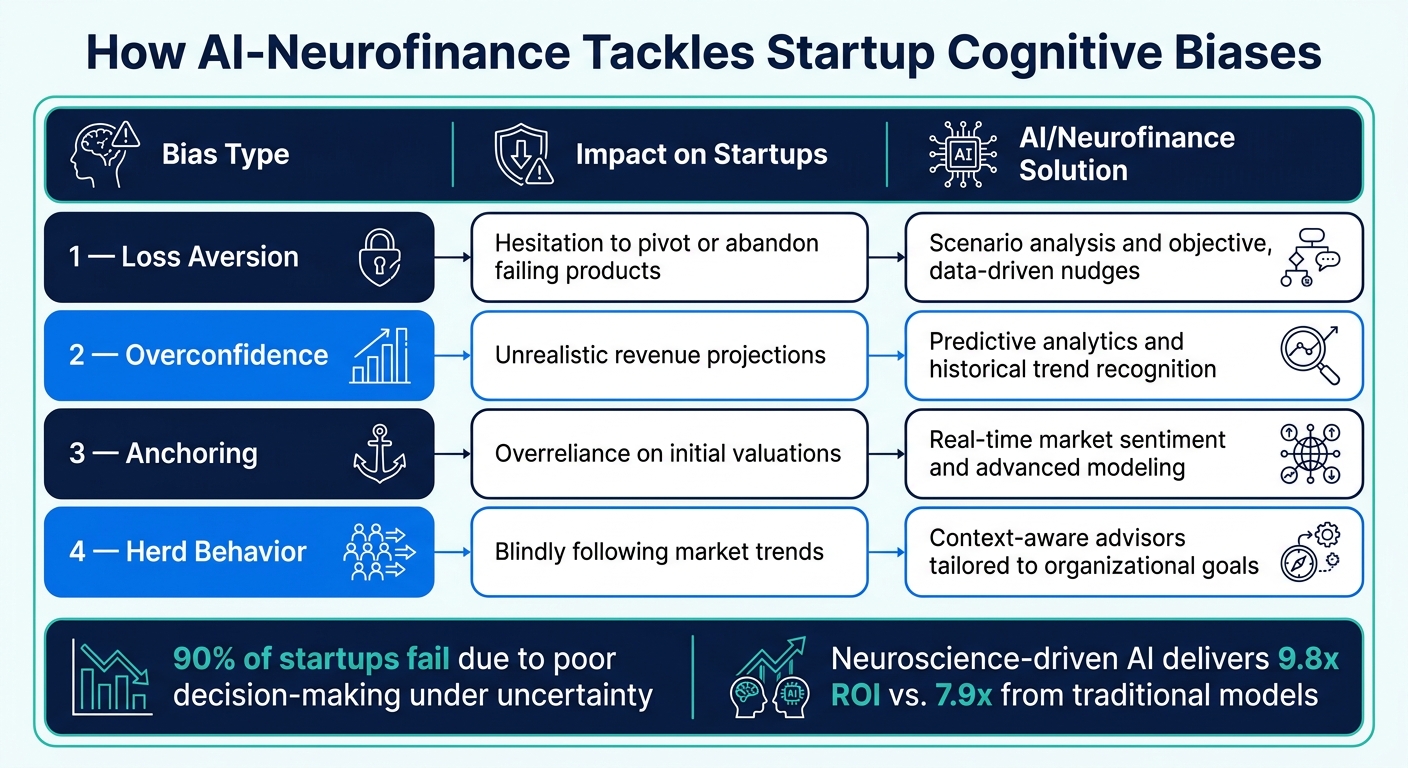
Here’s a quick look at how these tools tackle some of the most frequent cognitive traps faced by startup leaders:
| Bias Type | Impact on Startups | AI/Neurofinance Solution |
|---|---|---|
| Loss Aversion | Hesitation to pivot or abandon failing products | Scenario analysis and objective, data-driven nudges |
| Overconfidence | Unrealistic revenue projections | Predictive analytics and historical trend recognition |
| Anchoring | Overreliance on initial valuations | Real-time market sentiment and advanced modeling |
| Herd Behavior | Blindly following market trends | Context-aware advisors tailored to organizational goals |
Startup leaders can take proactive steps like conducting regular behavioral audits and running "what-if" scenario analyses that factor in both emotional and cognitive influences. Tools like Lucid Financials make this process easier by combining AI-powered analytics with real-time reporting. This helps founders generate clean, investor-ready data to back their decisions with confidence.
"Neuroscience-inspired AI is here, offering transformational returns for organizations that adopt it." - Dr. Jerry A. Smith, Frontier AI Executive
FAQs
How does AI detect financial biases like loss aversion or overconfidence?
AI pinpoints financial biases like loss aversion and overconfidence by examining patterns in trading behavior, market sentiment, and decision-making processes. By analyzing behavioral data, it can identify emotional and cognitive factors - such as panic selling during downturns or overconfidence during price surges - that influence these actions. Additionally, insights from neurofinance deepen AI's understanding of how emotions and brain activity shape these biases, helping refine detection and support better financial decisions.
Do I need brain data (like EEG) to use neurofinance tools?
Neurofinance tools don’t rely on brain data like EEG to function. Instead, many of these tools focus on behavioral data, market trends, and psychological factors to analyze and predict financial decisions. While incorporating neural data can offer additional layers of insight, most tools are designed to work effectively by integrating behavioral patterns and market information - no direct brain measurements required.
How can startups apply AI-neurofinance to improve budgeting and runway decisions?
Startups can tap into AI-neurofinance to make smarter budgeting and runway decisions. By analyzing behavioral patterns - like herding tendencies or shifts in sentiment - and using predictive analytics, startups gain insights that improve how they allocate capital, manage liquidity, and time their fundraising efforts.
AI tools, such as decision trees, play a key role here. They simulate various financial scenarios and forecast cash flows, helping startups craft flexible budgets. This data-driven approach not only extends a company's financial runway but also supports sustainable growth.