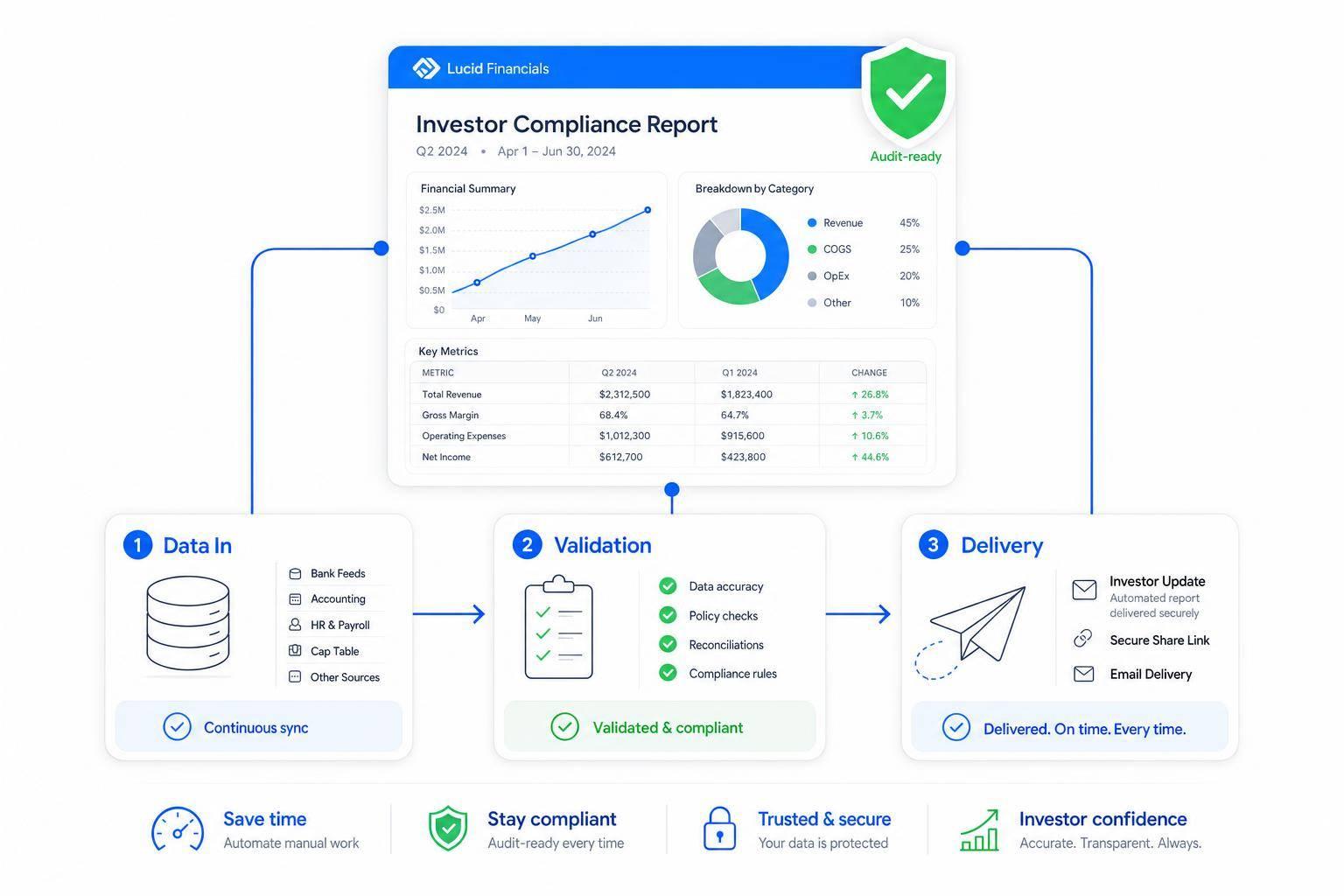
Managing early-stage startup portfolios is challenging due to inconsistent data, limited financial history, and unpredictable operations. Traditional tools like spreadsheets and quarterly reports often fail to provide timely insights, leaving investors and founders reactive instead of proactive. Predictive analytics changes this by using historical data, market trends, and real-time signals to forecast future performance.
Key takeaways:
- Challenges: Visibility gaps, messy data, and outdated manual monitoring methods.
- Solution: Predictive analytics tracks critical metrics like cash flow trends, burn rate, and runway to anticipate risks and opportunities.
- Benefits: Early detection of financial issues, improved decision-making, and better resource allocation.
- Tools: Platforms like Lucid Financials integrate real-time data and AI to deliver actionable forecasts and standardized reporting.
Predictive analytics empowers startups and investors to make informed decisions, addressing uncertainty before it escalates into major problems.
Challenges in Early-Stage Startup Portfolio Management
Managing early-stage startup portfolios is a whole different ballgame compared to overseeing mature companies. Startups often deal with immature processes, limited operational history, and rapid shifts in strategy. These unique traits introduce challenges that traditional portfolio management tools just aren’t built for. Let’s break down some of the key hurdles.
Visibility Gaps in Portfolio Performance
One of the biggest headaches for investors? Not knowing what’s really going on inside their portfolio companies until it’s too late. Many startups only provide updates during fundraising rounds, leaving investors in the dark for weeks - or even months - about critical metrics like cash burn, runway, or revenue growth.
Reports from startups are often delayed and inconsistent, leaving out essential details. By the time founders announce they need to raise capital, they might already be running on fumes - with less than six months of runway left. This not only slashes their negotiating power but also jeopardizes the company’s survival.
CB Insights backs this up: 38% of failed startups pointed to running out of cash or failing to secure new funding as a key reason for their downfall. Early visibility into financial health could help avoid these situations entirely.
Data Challenges in Early Stages
It’s not just about visibility - the data itself is often messy and unreliable. Startups frequently pivot their business models, making financial trends hard to track. And without a dedicated finance team, many don’t have robust monthly reporting in place. This leads to delayed financials and inconsistent accounting practices.
Even when data is available, comparing one startup to another can be nearly impossible. Definitions for key metrics vary wildly, making benchmarking unreliable. A survey by Sapphire Ventures highlighted this issue, with over half of respondents naming data quality and standardization as one of their top three challenges in portfolio monitoring.
Limitations of Manual Monitoring
The chaotic nature of startups makes manual monitoring a losing battle. Many investors still rely on Excel spreadsheets and manual data reconciliation. This approach not only slows updates but also increases the risk of errors - problems that only grow as portfolios scale.
A survey by Silicon Valley Bank found that more than 60% of venture capital firms still use Excel or basic spreadsheets as their main tool for portfolio monitoring. But when you’re managing 30, 50, or even 100+ startups, this method quickly becomes unmanageable and ineffective.
sbb-itb-17e8ec9
How Predictive Analytics Solves Key Portfolio Challenges
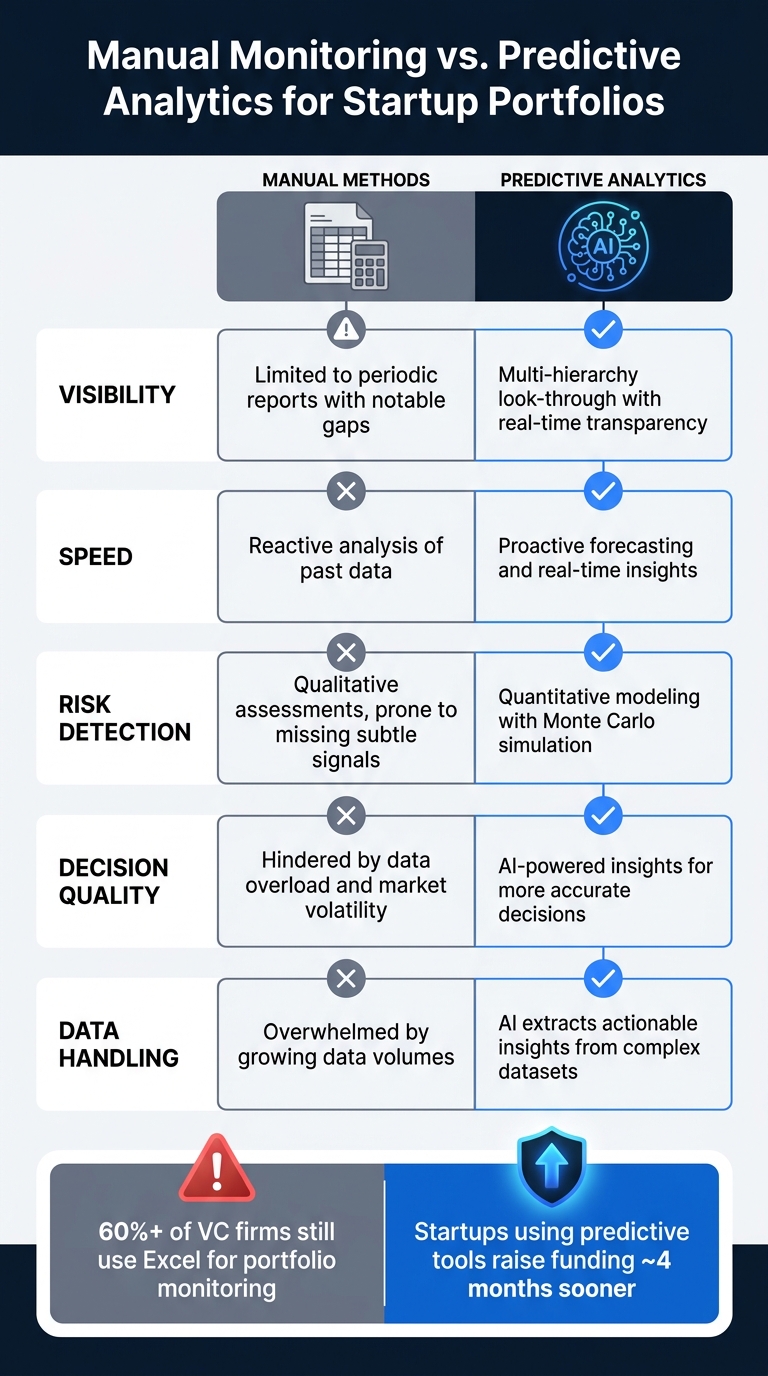
Manual Monitoring vs. Predictive Analytics for Startup Portfolios
Investors face significant risks when dealing with inconsistent data and slow insights, which can stall startup progress. Predictive analytics steps in by converting raw data into actionable signals, enabling smarter, faster decisions.
"Artificial Intelligence is reshaping how private capital investors operate across the entire investment lifecycle... AI offers a powerful solution to accelerate analysis, personalize insights, and enhance decision-making quality." - CEPRES
Key Predictive Signals to Track
Predictive analytics zeroes in on specific signals that consistently forecast how startups will perform. Not all data points are equally useful, so these models focus on key indicators that reveal future trends. For early-stage portfolios, critical signals include cash flow trends (like burn rate) and Net Asset Value (NAV) changes.
In addition to these financial markers, operational data - such as profit and loss statements, leverage effects, and fee projections - play a role. External factors, like regulatory filings and market sentiment, also feed into the analysis. By tracking these signals, investors can move beyond reacting to past outcomes and start anticipating what’s ahead.
These insights form the foundation of broader portfolio models, helping quantify risks and uncover opportunities.
Benefits of Portfolio-Wide Predictive Modeling
When applied across an entire portfolio, predictive analytics amplifies its advantages. Investors gain a "multi-hierarchy portfolio look-through", which provides visibility into intricate fund structures, right down to individual deal performance.
One standout technique is Monte Carlo simulation, which uses cash flow and operational data to create thousands of potential scenarios. This approach helps quantify risk and model future outcomes. By tapping into data from over 150,000 deals and $72 trillion in market value, AI-driven forecasts deliver unmatched precision in predicting forward IRR and cash distributions.
This level of insight allows investors to spot underperforming companies early, seize emerging opportunities, and allocate capital with greater confidence. It directly addresses the challenges of inconsistent data and delayed decision-making.
Manual Monitoring vs. Predictive Analytics: A Side-by-Side Comparison
| Dimension | Manual Methods | Predictive Analytics |
|---|---|---|
| Visibility | Limited to periodic reports with notable gaps in updates | Multi-hierarchy look-through with real-time transparency |
| Speed | Reactive analysis of past data | Proactive forecasting and real-time insights |
| Risk Detection | Relies on qualitative assessments, prone to missing subtle signals | Quantitative modeling with Monte Carlo simulation |
| Decision Quality | Hindered by data overload and market volatility | AI-powered insights for more accurate decisions |
| Data Handling | Overwhelmed by growing data volumes | AI extracts actionable insights from complex datasets |
Switching from manual methods to predictive analytics isn’t just about adopting new technology - it’s a complete shift in how risks are managed and opportunities are identified across startup portfolios. Predictive analytics transforms decision-making, giving investors the tools to stay ahead in a fast-changing market.
How to Implement Predictive Analytics in Early-Stage Portfolios
Tackling visibility gaps and data challenges in early-stage startups calls for a well-thought-out plan. With a structured approach, predictive analytics can provide actionable insights, even with a lean team and limited resources. Here's how to get started.
Steps to Build a Predictive Workflow
To create a solid predictive analytics workflow, focus on critical metrics like cash flow, burn rate, and customer acquisition costs (CAC). Here’s a step-by-step guide:
- Collect and standardize data: Pull information from financial systems, CRM platforms, and operational tools, ensuring uniformity for accurate outputs.
- Pilot predictive models: Test models on selected portfolio companies to build confidence while identifying any data gaps or inconsistencies.
- Train leadership: Help decision-makers understand model outputs and apply them to strategic planning.
- Regularly update models: Continuously refine models as new data becomes available to improve accuracy.
"Businesses using outsourced analytics expertise achieve 5x faster implementation timelines compared to internal development approaches." - Deloitte Center for Integrated Research
For startups with limited internal bandwidth, managed cloud machine learning platforms or third-party APIs can fast-track the process. Startups adopting these tools often secure their next funding rounds about 4 months sooner than those who don’t.
Strong data and governance practices are the backbone of successful predictive analytics.
Data and Governance Requirements
To make predictive analytics work, startups need to prioritize key metrics like monthly recurring revenue (MRR), churn rates, burn rates, CAC, and lifetime value (LTV). Complement internal data with external sources, such as macroeconomic trends and market sentiment. In cases where data is sparse, synthetic data can help fill the gaps.
Establishing solid data practices is non-negotiable. This includes:
- Implementing rigorous data collection protocols
- Standardizing reporting formats
- Conducting regular audits
- Ensuring algorithmic transparency
As Gartner highlights:
"Algorithmic transparency is now a top-three evaluation metric for enterprise clients purchasing software from early-stage vendors." - Gartner
Both investors and enterprise clients increasingly demand clarity on how models generate predictions, not just the predictions themselves.
Using Predictions as Decision Support, Not Guarantees
It’s essential to treat predictive analytics as a decision support tool, not as a crystal ball. Startups operate in highly dynamic environments where a single strategic move - like a new hire or a market pivot - can upend forecasts.
Instead of automating decisions, use predictions to:
- Identify early risks
- Test key assumptions
- Develop contingency plans
Shifting from instinct-driven to data-informed decision-making equips founders and managers with a competitive edge. By following these steps, startups can turn predictive analytics into a practical tool for navigating uncertainty and driving growth.
Lucid Financials: Investor-Ready Forecasting for Startups

Lucid Financials takes the raw data startups generate and turns it into actionable, real-time forecasts. By providing accurate and continuously updated financial information, it gives startups a strong edge in predictive analytics.
How Lucid Financials Supports Predictive Analytics
Lucid Financials is an AI-driven accounting platform tailored for startups and fast-growing businesses. It consolidates bookkeeping, tax services, R&D tax credits, and CFO-level support into a single system, eliminating the fragmented data sources that can disrupt predictive models.
What sets Lucid apart is its ability to integrate directly with financial systems, creating a real-time flow of data. It connects to bank accounts, payroll systems, and billing platforms, capturing cash inflows and outflows almost instantly. The platform then categorizes these transactions and generates updated cash flow forecasts, runway projections, and scenario models automatically.
Even with limited data - just 3–6 months of transaction history - Lucid’s AI can handle the messy, incomplete datasets common in early-stage startups. It produces probabilistic revenue and expense forecasts in USD, projecting cash balances weekly or monthly. These projections include key metrics like burn multiple and implied growth rates across base, best, and worst-case scenarios. Founders can even ask questions directly through Slack, such as, “What will my cash balance be on 12/31 if I hire two account executives in October?” Lucid responds instantly with charted projections.
This integration doesn’t just improve forecasting - it also provides clear, actionable insights for both startup founders and their investors.
Benefits for Startup Founders and Investors
Lucid simplifies operations for founders by automating financial reporting and ensuring data accuracy. Founders no longer need to manage bookkeeping, reconciliations, tax filings, or compliance themselves. Lucid handles it all, delivering investor-ready financials within just seven days for new clients.
For investors, Lucid offers a unified reporting system across their portfolio companies. This standardization makes it easier to analyze portfolio-wide metrics like revenue, burn rate, and runway. Investors can quickly spot startups nearing a 6-month runway, those that may require bridge funding, or those outperforming on unit economics. Since all data follows U.S. GAAP standards and is formatted in USD, it integrates seamlessly into fund-level cash flow models and capital planning without requiring manual cleanup.
Lucid also prioritizes transparency by combining AI with human oversight. While the AI handles tasks like transaction categorization, anomaly detection, and baseline forecasting, experienced controllers and CFOs review the results to ensure accuracy and flag potential issues. This approach ensures the forecasts are both reliable and timely.
Conclusion: Better Portfolio Decisions with Predictive Analytics
Managing an early-stage portfolio comes with its fair share of challenges - limited data, rapid shifts in circumstances, and infrequent financial updates can make small issues snowball into larger ones. Predictive analytics helps bridge this gap by moving the focus from analyzing past events to anticipating future trends. This transition from hindsight to foresight is the essence of predictive analytics.
The concept is simple: by consistently tracking indicators like burn multiple, runway, and net dollar retention, you can identify potential issues months before they show up in quarterly reports. That extra time - whether it’s for initiating a bridge conversation in October instead of scrambling for emergency funds in January - can make all the difference.
However, it’s important to remember that predictions inform decisions; they don’t guarantee outcomes. The best results come when founders and investors use predictive models alongside their own understanding of market conditions, team dynamics, and strategic priorities. For example, a forecast showing cash depletion in nine months isn’t a final sentence - it’s a call to take action.
This is where Lucid Financials steps in. By addressing the data challenges that often undermine predictive models, Lucid Financials makes it easier to take strategic, proactive steps in portfolio management. It simplifies the process by maintaining clean books, automating forecasts, and providing standardized reporting across portfolio companies. Founders gain constant insight into their financial health, while investors receive consistent, comparable metrics across their portfolios - eliminating the inconsistencies that can derail analytics.
And here’s the best part: this shift to predictive analytics isn’t just for large funds with dedicated data science teams. With the right tools and a solid financial foundation, any founder or investor can make quicker, more confident decisions. In the end, predictive analytics turns uncertainty into actionable insights, paving the way for better portfolio outcomes.
FAQs
What data do I need to start predictive analytics with limited history?
To begin predictive analytics with a limited history, the first step is creating a clean, centralized data foundation. Start by integrating essential systems - like accounting software, banking platforms, payroll tools, and CRMs - using APIs to enable real-time data sharing. Gather critical data points, including financial statements, transaction records, and metrics such as customer acquisition costs and churn rates. To address any gaps, consider incorporating external data, such as industry benchmarks. Tools like Lucid Financials can simplify bookkeeping and streamline these efforts.
Which metrics best predict runway risk for early-stage startups?
To get a clear picture of runway risk, keep a close eye on cash burn, cash runway, and revenue metrics like ARR (Annual Recurring Revenue) or MRR (Monthly Recurring Revenue). These numbers are essential for understanding your company’s financial stability.
You should also monitor other important metrics, such as CAC (Customer Acquisition Cost), churn rate, DSO (Days Sales Outstanding), and DPO (Days Payable Outstanding). Together, these help you gauge cash flow health. Tools like Lucid Financials simplify this process by offering real-time dashboards and AI-driven scenario modeling. This allows founders to spot potential funding gaps early and stay ahead in their financial planning.
How should investors use forecasts without overtrusting them?
Investors and founders need to base their forecasts on 12–24 months of clean, consistent historical data alongside real-time inputs. Forecasts shouldn't be static; instead, treat them as dynamic tools. Use scenario planning to explore best, worst, and base case outcomes, which helps in preparing for various possibilities.
To ensure accuracy and reliability, combine AI-driven insights with human expertise. This blend allows for validating outputs, fine-tuning models, and maintaining a well-rounded, risk-conscious approach when making strategic decisions.