I wouldn’t choose a portfolio by its AI label. I’d first check overlapping holdings, total fees, tax costs, and who approves trades - and ask whether a 30% decline would disrupt planned withdrawals.
AI can analyze holdings faster, but missing data can hide risk. Human advice can account for your personal circumstances, but fees and judgment errors still matter. A hybrid process combines both, without guaranteeing better returns.
Here’s how I compare the three approaches:
Quick Comparison
| Approach | Risk checks | Personal fit | Costs and taxes | Oversight |
|---|---|---|---|---|
| Human-led | Context-based review; may miss overlap | Direct discussion of goals and life changes | Adviser fees; human tax review | Investor or adviser controls decisions |
| AI-assisted | Fast screening; depends on data quality | Depends on current, complete inputs | Software and fund fees; automated tax checks may miss outside accounts | Trade approval or automation within agreed limits |
| Hybrid | AI checks plus human judgment | Account data plus personal context | Advice and technology fees; human review of tax-sensitive trades | Written approval rules and override rights |
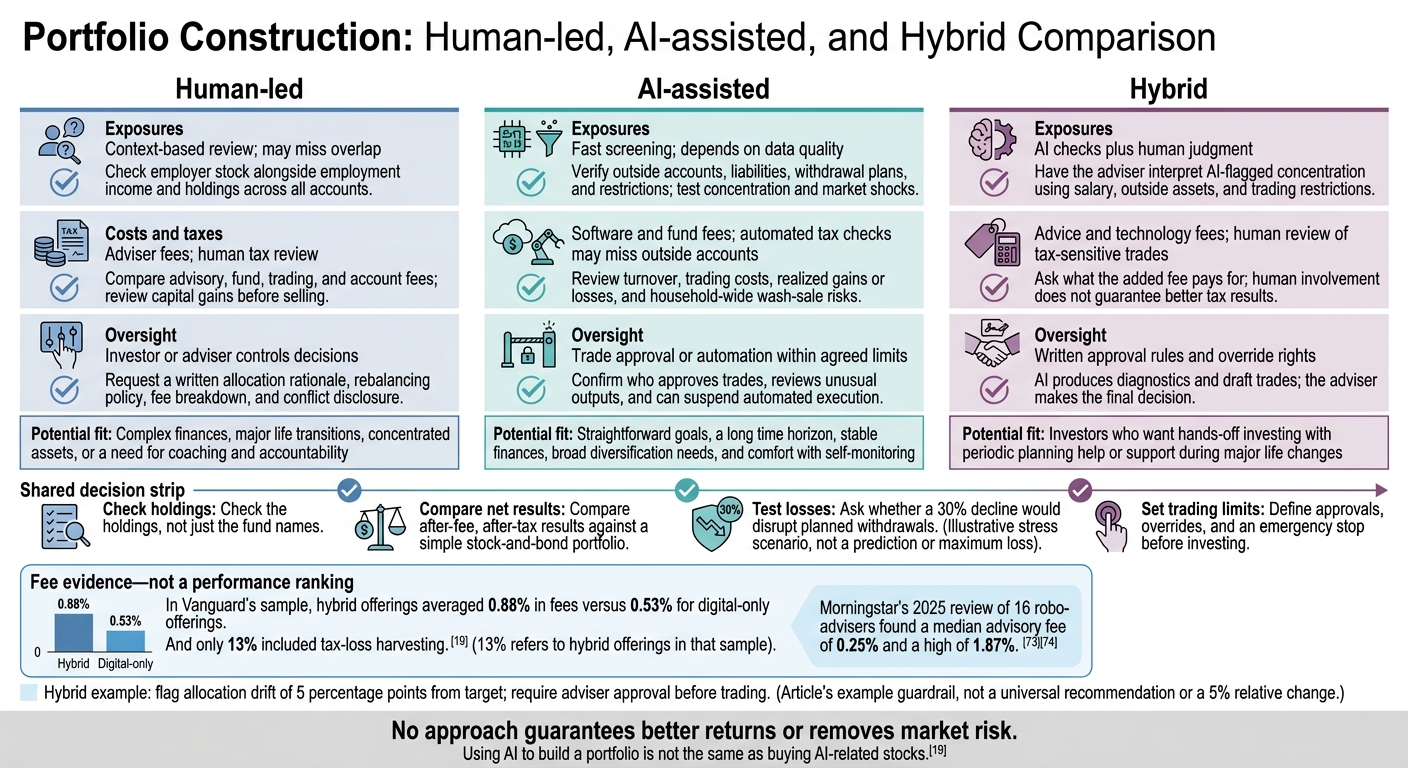
My bottom line: <u>check the holdings, not just the fund names</u>. Compare after-fee, after-tax results against a simple stock-and-bond portfolio, test losses and market shocks, and set trading limits before investing. Using AI to build a portfolio is not the same as buying AI-related stocks - and neither removes market risk.
AI Portfolio Diversification: Compare Three Approaches
Why Your Portfolio Might Be Redundant (And How AI Fixes It)
sbb-itb-17e8ec9
1. Human-Led Portfolio Construction
Human-led portfolio construction begins with the investor’s goals, then sets the asset mix - the baseline for this comparison. Before choosing asset-class targets, investors or advisers review the investor’s time horizon, income, liquidity needs, taxes, and existing holdings. The first risks to check are overlapping investments and concentration.
Risk and Concentration
Risk tolerance is not risk capacity: being comfortable with losses doesn’t mean you can afford them. Review employer stock alongside employment income, since both depend on the same company. Across all accounts, check for overlapping holdings and sector and geographic exposure. Separate intentional bets from concentration left over from past decisions. These exposures shift as the investor’s life changes.
Personalization and Portfolio Updates
Update the plan after major life changes, and set a quarterly or annual review schedule with rebalancing bands. Before selling holdings, use new contributions, dividends, and interest to top up underweight assets. This can reduce trading and tax costs.
Costs and Taxes
Compare after-tax, after-fee results, accounting for advisory, fund, trading, and account fees. Before selling investments that have gained value in a taxable account, check the potential capital gains tax and whether cash flows could restore the target allocation instead. Human advice is worth its cost only when tax coordination and behavioral support justify the fee. Then clarify who reviews and approves the decisions.
Transparency and Oversight
Ask for a written explanation of the allocation, a rebalancing policy, a fee breakdown, and a conflict disclosure. Review the adviser’s Form ADV, registration, and disciplinary history. Confirm whether the adviser is acting as a fiduciary. Human oversight doesn’t guarantee better performance, but it makes decisions easier to audit and can reveal bias or inconsistent execution. These manual checks set the baseline for the AI-assisted approach that follows.
2. AI-Assisted Portfolio Construction
Human-led portfolio construction relies on manual review. AI can run those same checks at scale - but only with the data it can see. Faster diversification checks help only when the system sees the full portfolio and the firm controls execution. Confirm whether AI recommends trades for human approval or executes them automatically within authorized limits. The firm still carries its regulatory duty.
Risk and Concentration
Models can spot overlap, yet steer several strategies toward the same names. Require concentration checks for single names, sectors, issuers, factors, and liquidity.
Add stress tests for rate shocks, tech selloffs, and marketwide volatility spikes.
FINRA warns that unusual market conditions can lead to unreliable predictions or undesirable trading behavior. Speed helps only when the model has the full financial picture.
Personalization and Portfolio Updates
Check that the model accounts for outside accounts, liabilities, withdrawal plans, and restrictions. An allocation may look tailored to you and still be wrong if inputs are missing. Set clear triggers for contacting you before trading, especially after a job change, retirement, or a major cash need. Monitoring shouldn't turn into churn.
Costs and Taxes
Ask to see turnover, trading costs, and realized gains or losses for every rebalance. Tax-loss harvesting doesn't guarantee savings. Replacement holdings may bring higher costs or tracking error, and wash-sale restrictions need attention across relevant accounts. Check whether future gains could offset projected tax savings. Cost and tax figures are useful only if the model can explain how it calculated them.
Transparency and Oversight
Request plain-language reasons for allocation changes, the data used, model limits, and an audit trail. Ask whether testing used out-of-sample data and accounted for taxes and trading costs. A strong backtest doesn't predict future returns. Identify who reviews unusual outputs and who can suspend automated execution when data or market conditions become unreliable.
3. Hybrid AI-and-Human Portfolio Construction
AI produces diagnostics and draft trades; the adviser makes the final decision. Put that division of work in the investment policy. The adviser sets objectives and approves, changes, or rejects material recommendations. Algorithm oversight does not require manual review of every account. This setup works when software can flag risk faster than a person can assess it.
Risk and Concentration
Have the adviser map AI-flagged concentration to salary, outside assets, and trading-window restrictions before approving any sale of employer stock. This tests whether AI surfaces hidden exposure the adviser can interpret in context.
Personalization and Portfolio Updates
Set an AI alert when an allocation drifts 5 percentage points from its target, but require adviser approval before any trade. Require explicit human sign-off for illiquid holdings, large tax consequences, or changes to goals.
Costs and Taxes
Hybrid oversight should deliver better tax judgment - not just a higher fee. Having a person involved does not guarantee better tax results.
In Vanguard’s sample, hybrid offerings averaged 0.88% in fees versus 0.53% for digital-only offerings, and only 13% included tax-loss harvesting.
Ask what the added fee pays for and who reviews tax-sensitive trades. Human review of AI-proposed trades must add measurable value through tax handling, trade approval, or risk control.
Transparency and Oversight
Spell out who reviews the account, how often, and which decisions can skip individual review. Keep an audit trail that records each material recommendation, its reviewer, the decision, and the outcome.
Reviewers must challenge the model, not rubber-stamp it. Give them authority to override recommendations and suspend the system.
FINRA highlights controls for model risk, data integrity, reliability, and accuracy.
Comparing Risks, Rewards, and Research
Use AI research to test claims - not assume a winner. Require the date range, asset universe, benchmark, costs, and a clear statement of whether results were live or simulated. AI-assisted portfolio construction is different from investing in AI-related companies. The test is whether AI improves diversification without masking concentration.
Check out-of-sample testing, look-ahead bias, survivorship bias, and multiple testing. Compare historical periods and stress scenarios rather than relying only on average returns or a Sharpe ratio.
The comparison below examines where each approach can fail under actual data, tax, and oversight constraints.
Risk and Concentration
Measure look-through exposure across all accounts, not just fund names. Owning more holdings does not guarantee protection during a crisis. Stale prices, changing correlations, illiquid assets, and missing delisted securities can skew the analysis. Even broad-market funds can concentrate exposure in large technology companies. Use holdings reports or factsheets dated close to the analysis date when assigning concentration figures.
| Approach | Risk-analysis capability | Failure mode | Evaluation metric | Control |
|---|---|---|---|---|
| Human-led | Risk judgment informed by context | Bias or missed correlations | Drawdown and concentration | Written limits and independent review |
| AI-assisted | Fast exposure and stress analysis | Data errors, overfitting, regime change | Out-of-sample drawdown and correlations during stress periods | Data validation and scenario testing |
| Hybrid | Monitoring plus judgment informed by context | Unclear responsibility or deference to the model | Error rate and override outcomes | Approval rights and audit logs |
Input quality also shapes how well an approach can tailor a portfolio to an investor.
Personalization and Portfolio Updates
Check whether the model uses current holdings, tax status, and restrictions. FINRA cautions that automated tools may rely on assumptions that do not fit an individual investor. Compare how each approach accounts for time horizon, liquidity needs, risk tolerance, account type, income, liabilities, and preferences.
| Approach | Personalization inputs | Response to changing conditions | Limitation | Validation check |
|---|---|---|---|---|
| Human-led | Goals and personal circumstances | Accounts for qualitative changes | Infrequent or inconsistent reviews | Written profile and scheduled review |
| AI-assisted | Structured investor and account data | Continuous monitoring and alerts | Missing or outdated inputs | Verify inputs and test recommendations |
| Hybrid | Account data plus human context | Monitoring with human escalation | Routine acceptance of model outputs | Override and changed-circumstance procedures |
Costs and Taxes
Compare net, after-tax returns. Include fees, spreads, turnover, realized gains, and taxable-account consequences - not just the headline return.
Tax-loss harvesting requires household-wide wash-sale checks. A loss may be disallowed if an investor buys a substantially identical security within the applicable window. A system that cannot see outside accounts may miss those purchases.
| Approach | Cost drivers | Tax considerations | Implementation risk | Metric |
|---|---|---|---|---|
| Human-led | Advisory, fund, and trading costs | Manual tax-lot and account-location coordination | Missed opportunities | After-tax return and turnover |
| AI-assisted | Software, fund, and trading costs | Automated harvesting with limited account visibility | Wash sales or unsuitable replacements | Net return and harvesting benefit |
| Hybrid | Advisory, technology, and fund costs | Human household-wide review | Conflicting instructions | After-tax risk-adjusted return and total cost |
Transparency and Oversight
Verify registration and accountability. SEC-registered robo-advisers remain subject to the Advisers Act and fiduciary obligations. FINRA also emphasizes supervision of suitability, conflicts, customer risk profiles, and rebalancing when firms use AI investment tools.
An AI label does not establish investor protection. Check disciplinary history, trading authorization, and who can suspend execution. Compare unusual allocations with the written mandate, and retest model changes.
| Approach | Decision visibility | Accountability | Warning indicator | Safeguard |
|---|---|---|---|---|
| Human-led | Direct discussion of the rationale | Named investor or adviser | Undocumented changes or conflicts | Written policy and independent review |
| AI-assisted | Metrics may lack explanation | Provider and approving person | Unexplained model updates | Change logs and approval controls |
| Hybrid | Human explanation plus evidence | Documented responsibilities | Rubber-stamped outputs | Override authority and exception review |
Before a trade proceeds, use the written mandate as the final check on whether the approach fits the investor’s process.
Trade-Offs and Investor Fit
Choose the process that fits your finances - not the technology label. Portfolio complexity, provider skill, and your circumstances matter more than whether the process is human-led, AI-assisted, or hybrid.
Compare each approach using the same three tests used earlier: exposures, costs, and oversight.
| Approach | Principal rewards | Principal risks | Investor circumstances where it may fit | Required safeguards |
|---|---|---|---|---|
| Human-led | Personalized judgment on taxes, estate issues, business interests, concentrated positions, and behavioral needs | Adviser bias; inconsistent decisions; conflicts; higher fees; limited capacity for analysis | Complex finances, major life transitions, concentrated assets, or a need for coaching and accountability | Fiduciary status; fee and conflict review; written process; exposure review |
| AI-assisted | Speed, consistency, analysis at scale, automated rebalancing, and potentially lower costs | Data or model errors; unclear reasoning; privacy and cybersecurity concerns; unsuitable outputs; weak performance in unusual conditions | Straightforward goals, a long time horizon, stable finances, broad diversification needs, and comfort with self-monitoring | Input validation; holdings and fee review; testing; security; support access |
| Hybrid | Automation combined with professional planning and human context | Higher fees than basic automation; unclear advice boundaries; too much reliance on the model and adviser | Investors who want hands-off investing with periodic planning help or support during major life changes | Human intervention rules; credentials; response times; total cost; governance; escalation |
Weigh complexity, the time needed to monitor your investments, and the services you need. Cost differences matter most when they reflect a different level of service - not just a different label.
Morningstar’s 2025 review of 16 robo-advisers found a median advisory fee of 0.25% and a high of 1.87%, showing how wide service costs can run.
For hybrid services, ask whether a qualified professional reviews your individual situation or mainly oversees the algorithm. Check whether human access means investment advice or only account support, how soon you can reach that person, and when they can override or suspend automated trading. For human-led services, ask who steps in when your adviser is unavailable. For AI-assisted services, find out what happens when your finances no longer fit the intake questionnaire.
Age and account size matter less than complexity, taxes, monitoring time, comfort with automation, and the need for coaching. No process removes market, inflation, interest-rate, or liquidity risk. The final checklist applies these trade-offs to exposures, costs, and oversight.
Conclusion: Check Exposures, Costs, and Oversight
Document the guardrails, no matter which process you use. Record your goal, time horizon, required return, income needs, tax situation, liquidity needs, and maximum acceptable drawdown.
Ask whether a 30% decline would disrupt planned withdrawals - not just whether your risk preference is “moderate.”
Check for overlapping holdings and indirect exposure through chips, cloud, power, cooling, and software. AI helps only if it makes overlap visible rather than hiding it.
Compare against a baseline. Use a simple stock-and-bond allocation with the same dates, cash flows, risk targets, and tax assumptions. Track after-fee and after-tax returns, drawdown, turnover, and tracking error. Stress-test equity declines, rate shocks, technology reversals, and liquidity shortages. A stress test does not cap losses.
Set limits before trading. Add up every cost: fees, expenses, spreads, commissions, and platform charges. Review realized gains, wash-sale risks, settlement timing, redemption restrictions, and cash needs. Define rebalancing thresholds, trading permissions, position and turnover caps, and an emergency stop. Require human approval for exceptions, illiquid holdings, and tax-sensitive transactions. If the rules aren't explicit, the process isn't ready to trade.
Audit and reassess. Request data-quality checks, model assumptions, validation results, version histories, and records of recommendations, approvals, and trades. Review suitability at least annually and after major financial or model changes. Hybrid review provides governance - not a return guarantee.
Use this final grid to compare the three approaches on the same tests: exposures, costs, and oversight.
| Approach | Exposures | Costs | Oversight and execution |
|---|---|---|---|
| Human-led | Slower monitoring; contextual judgment | Advisory, fund, and trading costs | Professional review; manual errors, delays, and bias |
| AI-assisted | Fast screening; data-dependent signals | Software, fund, and trading costs | Model, data, and vendor controls; automation risks |
| Hybrid review | Automated detection; human judgment | Advisory, technology, and fund costs | Documented approvals and overrides; execution risk reduced, not eliminated |
FAQs
How can I spot hidden overlap in my portfolio?
Use AI-powered look-through analysis to spot concentrated exposures across your holdings. These tools break down investments by sector, geography, market cap, and investment factors. They identify assets that move together - even when those assets seem different. Machine learning analyzes relationships and clusters across your accounts to flag holdings that behave like a single concentrated investment.
Lucid Financials helps you monitor these exposures with clean, real-time data and reporting.
How can I tell if AI's benefits justify its fees?
Focus on what AI does for your financial work, not just what it costs. Does it save time on manual tasks, reduce errors, or deliver real-time insights that help with planning and risk management?
Look for audit trails, explainable outputs, and expert human oversight, too. Fees make sense when these gains offset the costs and help you shift from manual reporting to anticipating and addressing financial needs.
What should I do if AI recommends a trade I don't understand?
Don’t act on an AI recommendation without checking it first. AI systems can be black boxes, so keep a human in the loop. Review the reasoning and check whether the trade fits your long-term financial goals, risk tolerance, and current life circumstances. Factor in potential tax effects and transaction costs, too.
If the logic is still unclear or the trade doesn’t fit your circumstances, override the recommendation. Expert judgment can help you check whether AI suggestions make sense in practice.