AI-powered portfolio tracking uses artificial intelligence to monitor and analyze financial investments in real time. Unlike static tools, it provides dynamic insights like risk exposure, asset correlations, and rebalancing suggestions. By integrating live data - pricing, news sentiment, and technical indicators - it helps users make informed decisions faster. This is especially useful for startup founders managing fluctuating finances or investors aiming to optimize returns.
Key Features:
- Real-Time Monitoring: Tracks portfolio performance continuously.
- Risk Analysis: Identifies hidden correlations and allocation drifts.
- Rebalancing Suggestions: Adjusts portfolios based on thresholds and tax considerations.
- Diversification Insights: Highlights concentration risks and optimizes holdings.
- Stress Testing: Simulates market shocks to evaluate portfolio resilience.
- Data Integration: Consolidates holdings from brokers and accounting tools.
Benefits:
- Saves time by automating tedious tasks.
- Improves decision-making with actionable insights.
- Enhances portfolio resilience through stress testing.
While AI offers powerful tools, its effectiveness relies on accurate data and human oversight to ensure accountability and adapt to unique circumstances.
AI for Investing Explained: Frameworks Used by Hedge Fund Analysts
sbb-itb-17e8ec9
How AI Changes Portfolio Management
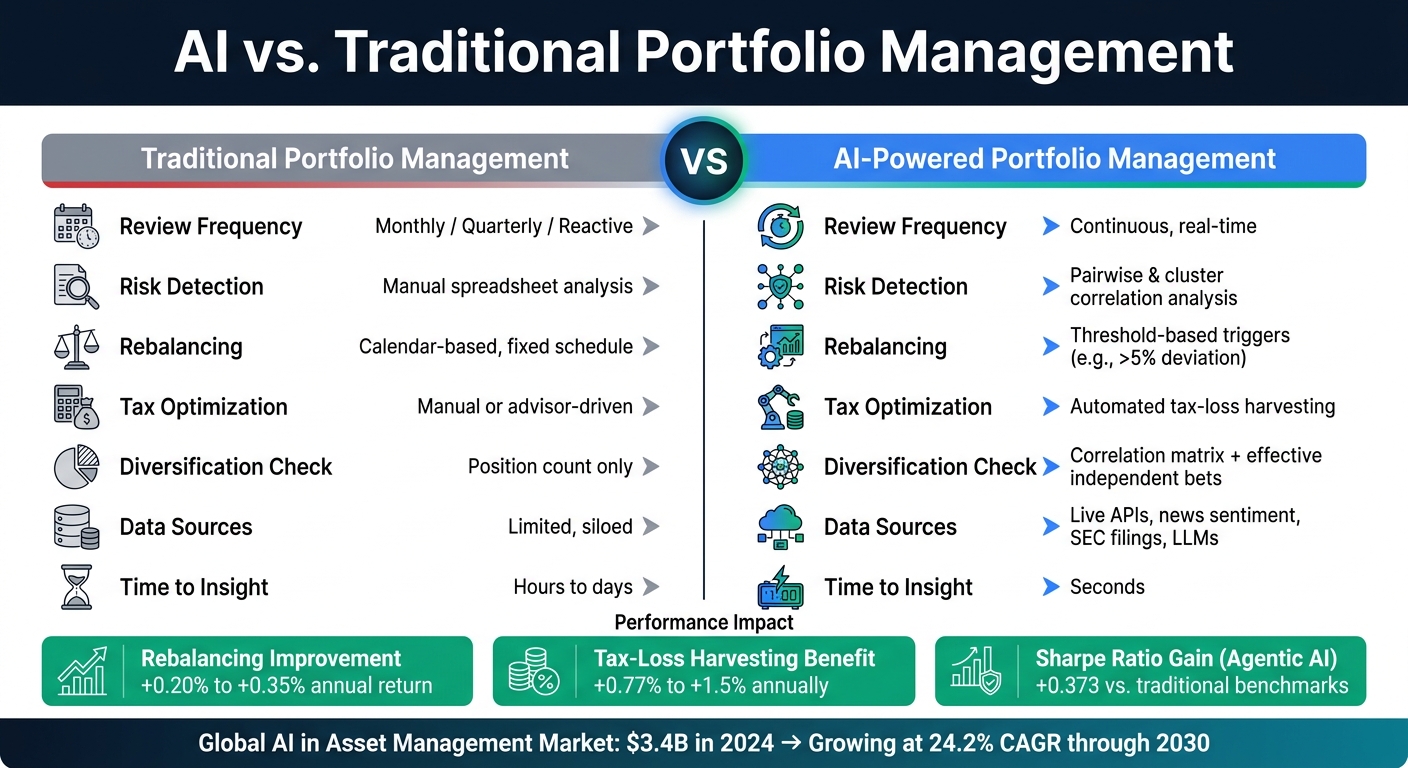
AI vs. Traditional Portfolio Management: Key Differences & Performance Gains
AI is reshaping portfolio management by automating complex tasks and providing deeper, more actionable insights. Traditional portfolio management often relies on spreadsheets, periodic reviews, and subjective decisions, all of which can lead to errors. AI changes the game by taking over the tedious work and uncovering insights that would otherwise take hours to discover. The global AI in asset management market was valued at $3.4 billion in 2024 and is expected to grow at a 24.2% CAGR through 2030, emphasizing the rapid adoption of this technology.
Real-Time Data Analysis
Traditional portfolio reviews tend to follow fixed schedules - monthly, quarterly, or only when a problem arises. AI, however, operates continuously. It integrates live data feeds, including pricing, financial fundamentals, and even news sentiment, through APIs. Technical indicators like RSI, MACD, and Bollinger Bands further enhance these insights, ensuring they reflect the latest market conditions. This immediacy is particularly valuable for founders juggling cash flow and investments simultaneously.
AI doesn’t stop at providing instant insights. It also helps protect your portfolio by constantly monitoring for potential risks.
Risk Monitoring
AI uses pairwise and cluster analysis to identify hidden relationships between assets. For instance, during periods of market stress, tech ETFs and individual tech stocks might behave like a single concentrated investment - a risk that could go unnoticed without AI. Continuous drift detection further ensures your portfolio stays aligned with its target allocation. This is crucial because, as Brinson, Hood, and Beebower found, "asset allocation explains over 90% of portfolio return variability over time". Early detection of allocation shifts can make a significant difference for both investors and founders managing their portfolios.
Rebalancing Suggestions
AI-driven rebalancing outperforms traditional calendar-based methods by using threshold-based triggers. For example, rebalancing when an asset class deviates by more than 5% can improve returns by 0.20% to 0.35% annually. AI also incorporates tax considerations before suggesting trades. Automated tax-loss harvesting identifies unrealized losses, potentially delivering annual tax benefits of 0.77% to 1.5%, all while staying within IRS regulations.
This combination of precision and tax efficiency provides a clear advantage. As Daniel Mercer, Senior Market Editor, explains:
"The best rebalancing systems do not try to predict the next move. They focus on preserving the right exposure after the move already happened."
AI-Driven Diversification Strategies
Holding a large number of stocks doesn’t automatically mean a portfolio is diversified. Correlated movements can still leave investors vulnerable during market turbulence. AI takes diversification to the next level by analyzing how a portfolio behaves under pressure, providing a more nuanced understanding of allocation and resilience.
Identifying Concentration Risks
AI dives deep into portfolio structures, breaking holdings down by sector, geography, market cap, and investment factors. It also uses correlation analysis to highlight assets that tend to move together, even if they appear distinct on the surface. For instance, Apple and Microsoft share a correlation of roughly 0.75, meaning owning both offers less diversification than it might seem.
A portfolio is generally considered well-diversified if its weighted average correlation falls below 0.6. On the other hand, correlations above 0.8 signal concentrated risk. AI also calculates the "effective number of independent bets" in a portfolio - providing a more meaningful diversification measure than simply counting positions. For example, in April 2026, Taiwan’s weight in the MSCI EM Index hit 24.8%, overtaking China’s 23.1% for the first time in nearly 20 years. This shift, driven by demand for AI semiconductors, left investors tracking emerging markets more exposed to the AI hardware cycle than they might have realized.
"AI doesn't kill diversification. It forces us to do it properly again." - Allianz Global Investors
Optimizing Portfolio Allocation
Once concentration risks are identified, AI can help rebalance portfolios. Advanced systems use tools like Hidden Markov Models to detect shifts between risk-on and risk-off market regimes, adjusting allocations accordingly. For example, during periods of heightened volatility, these systems can prioritize risk control over chasing returns.
AI also incorporates real-time sentiment data from financial news, thanks to large language models (LLMs). This forward-looking data feeds into risk and return estimates, improving decision-making. A 2026 study showed that portfolios managed with agentic AI using NSGA-3 multi-objective optimization algorithms achieved Sharpe ratio improvements of +0.373 compared to traditional benchmarks. One practical takeaway: new positions should be sized inversely to their correlation with existing holdings. A position with a 0.2 correlation might justify a 5% allocation, while one with an 0.8 correlation should be capped closer to 2%.
Stress Testing for Startup Portfolios
Stress testing is another area where AI proves its worth, especially for startup founders. AI systems can simulate hypothetical shocks - like tariff hikes or energy price spikes - and assess their impact on every position in real time. This granular analysis identifies vulnerabilities across asset classes, regions, and currencies.
Platforms such as swissQuant enable users to customize scenarios, like modeling a 20% energy price surge, to see how it would affect portfolio liquidity and valuation. This type of scenario modeling is invaluable for startups aiming to build portfolios that can weather downturns.
"When geopolitics moves, do portfolios follow? War in the Middle East. Tariff escalation. Energy shocks. These are hypothetical scenarios, but the transmission mechanics are real." - swissQuant
For startup founders, this level of stress testing provides a critical tool for creating resilient, investor-ready portfolios.
Data Integration and Setup
Getting started with AI portfolio tracking requires one critical element: clean and complete data. Without it, even the most advanced AI tools can produce unreliable or misleading recommendations.
Key Data Sources for AI Tracking
To function effectively, AI tracking systems rely on four main inputs: current holdings, full transaction history, cost basis, and tax documents. These tools can also pull data from a variety of investment types, such as traditional stocks, mutual funds, ETFs, and even cryptocurrency, to deliver a comprehensive financial overview.
One standout feature of AI tools is their ability to consolidate accounts seamlessly. For instance, importing holdings from major brokers like Fidelity or Charles Schwab usually takes less than 2 minutes. Here's a breakdown of broker integrations and the key data they provide:
| Broker | Integration Method | Key Data Extracted |
|---|---|---|
| Alpaca | API Integration | Real-time positions, trade execution, bot trading |
| Interactive Brokers | Flex Queries / CSV | Multi-currency, global markets, comprehensive history |
| Fidelity / Schwab | CSV Export | Positions, transaction history, cost basis, tax documents |
| Vanguard | CSV Export | Mutual funds, ETF positions, IRA/401k support |
| Robinhood | Data Export | Trading history, positions, crypto support |
| Generic/Other | AI Vision / Manual | Screenshots, text files, or manual ticker entry |
For startup founders, internal accounting data is just as important as brokerage information. Tools like Lucid Financials can reconcile and clean your books in as little as seven days, giving AI platforms the reliable data they need to generate precise insights and investor-ready reports.
"AI recommendations are only as good as the data they're based on. With your complete portfolio picture, our AI can provide truly personalized advice." - Portfolio Genius
Connecting AI Tools with Financial Workflows
Once you've identified your data sources, the next step is integration. API connections are often the preferred method, as they allow for real-time syncing of portfolio positions and, in some cases, automated trade execution based on AI-generated suggestions. For those without API access, AI vision technology offers a workaround by extracting data from screenshots or portfolio page uploads.
Beyond syncing brokerage accounts, workflow integration plays a key role. For example, Lucid Financials connects directly with Slack, enabling users to ask financial questions and receive instant answers without leaving their workspace. This kind of accessibility ensures that AI insights are always at your fingertips when needed.
No matter how data is imported - whether via CSV files or AI vision scans - it’s crucial to review the extracted information to catch and correct any errors before they cascade into larger issues.
Setup Timelines and Costs
After connecting your accounts and importing historical data, the setup process is generally quick. For most users, basic configurations can be completed in a single session. However, more complex setups, such as managing multi-currency portfolios through Interactive Brokers or handling multi-entity accounting, may take additional time for proper data mapping and verification.
When it comes to costs, entry-level AI tracking tools typically start at $10/month, covering features like daily AI reviews, trade suggestions, and management of up to three portfolios. Many platforms also offer free trials for seven days. For startups needing more comprehensive financial services - like bookkeeping, tax preparation, and forecasting - Lucid Financials provides plans starting at $150/month. Their flat-rate pricing combines the speed of AI with human expertise, ensuring accurate and efficient financial analysis without the uncertainty of hourly billing.
Benefits and Limitations of AI Portfolio Tracking
Key Benefits for Founders and Investors
AI portfolio tracking offers a major time-saving advantage by pulling together holdings, valuations, transaction histories, and risk exposures from various accounts into one constantly updated dashboard. Founders can quickly spot changes - like shifts in runway, new funding rounds, or allocations moving off target - without needing to dig through raw data. Instead, the system highlights what’s most important. As portfolios grow more complex, AI takes on the heavy lifting, simplifying the process. A global CFA Institute survey even found that over 70% of investment professionals already use AI and big data in their firms, primarily for research and risk management. This shows how much the industry has embraced these tools.
But while AI tracking brings clear advantages, it’s not without its challenges.
Limitations and Risks of AI Systems
The effectiveness of AI tracking depends heavily on the quality of the data it uses. If records are incomplete, categories are inconsistent, or errors creep in from accounting or cap table systems, the results may look precise but could actually be misleading. Regulators like the Federal Reserve and OCC have flagged erroneous or incomplete data as a leading cause of model failures in financial institutions. The same risks apply to startup portfolios.
Another issue is model transparency. Many AI systems function as "black boxes", providing recommendations without explaining the reasoning behind them. This can create problems when someone needs to understand why a specific holding was flagged as high-risk or why rebalancing was suggested. Beyond that, models trained on historical data can struggle when conditions change unexpectedly - whether it’s a sudden regulatory shift, a frozen funding environment, or an unprecedented market event.
Combining AI with Human Expertise
To overcome these challenges, human oversight is crucial. AI works best when paired with experienced professionals who can interpret the results, spot errors, and make nuanced decisions. For example, a finance expert might override an AI’s rebalancing suggestion if they’re aware of a pending acquisition or undisclosed revenue that shifts the risk profile. Humans also take responsibility for key decisions, like investor communications or strategic allocations, which require a broader context.
This approach mirrors the model used by Lucid Financials for accounting and financial reporting. Their system uses AI to handle data ingestion, bookkeeping, categorization, and real-time reporting through Slack, while CFOs and tax professionals ensure accuracy, provide strategic advice, and interpret the data. The same principle applies to portfolio tracking - AI accelerates the process, while humans ensure accountability. For founders managing complex structures or venture portfolios, this blend isn’t just helpful - it’s essential for proper governance.
Conclusion: Where AI in Portfolio Management Is Headed
AI-powered portfolio tracking has moved far beyond static dashboards. Today, it encompasses real-time risk monitoring, diversification analysis, and stress testing, all fueled by continuously updated data. While AI excels at processing vast amounts of information at lightning speed, human expertise remains essential for judgment and accountability.
Looking ahead, portfolio management is already being transformed by the next generation of developments. Researchers are working on agentic AI frameworks that can actively sense market conditions and adjust risk budgets in real time. These systems have shown promising results, with tests conducted between 2021 and Q1 2025 revealing noticeable Sharpe ratio improvements compared to non-agentic models. At the same time, advancements in data processing continue to push boundaries. Large Language Models (LLMs) now extract forward-looking insights from sources like earnings calls, SEC filings, and financial news. For example, integrating these textual signals into models like FinBERT Black-Litterman has been shown to enhance Sharpe ratios from 1.003 to 1.206.
Regulatory demands for transparency are also shaping the future of AI in portfolio management. Deterministic, auditable AI systems that can clearly explain their decision-making processes are becoming a competitive edge, rather than just a compliance necessity.
For founders managing complex financial portfolios, reliable, real-time data remains the cornerstone of success. As mentioned earlier, strong data infrastructures - such as those offered by Lucid Financials - are critical for unlocking the full potential of AI tools. By ensuring books are up-to-date, generating investor-ready reports, and delivering insights through tools like Slack, these platforms ensure the data feeding AI systems is accurate. After all, the old adage still holds: Garbage in, garbage out. The quality of your financial infrastructure will directly impact how much value AI-driven portfolio tools can truly deliver.
FAQs
What data do I need to set up AI portfolio tracking?
To get started with AI-powered portfolio tracking, you'll need to supply some basic details about each of your holdings: the ticker symbol (like AAPL for Apple or BTC for Bitcoin), the quantity you own, and your average entry price.
You can input this information in a few ways:
- Manually enter the data.
- Upload files such as CSVs or PDFs.
- Connect brokerage accounts through a read-only API for automatic syncing.
Once set up, the AI takes over. It pulls in real-time market prices, calculates your portfolio's performance, and provides insights into risk and diversification.
How can AI spot “hidden” concentration risk in my holdings?
AI tools use look-through analysis to uncover hidden concentration risks in your portfolio. They can pinpoint overlapping exposures - such as specific securities, sectors, or investment themes - across your holdings. By pulling data from all your accounts and applying machine learning to spot patterns and anomalies, these tools offer a comprehensive view of your overall exposure. This allows you to tackle unintended risks early, helping to safeguard your financial outcomes.
How do I know when to trust (or override) AI rebalancing suggestions?
AI can be incredibly useful for handling tasks such as tracking allocation drift, determining trade sizes, and identifying concentration risks. However, there are moments when human judgment is essential - especially when personal factors like your life circumstances, risk tolerance, or tax timing come into play. Think of AI as a powerful tool for analyzing data and spotting patterns, but always double-check its recommendations to ensure they align with your long-term financial goals. And don’t forget to factor in potential tax implications or transaction costs before making any decisions.