Most startup finance choices are trade-offs, not math problems with one right answer. I see the main point of this article as simple: AI can help me compare options across cash, growth, risk, timing, hiring, product work, financing, and tax moves - but I still need people to set priorities, check the numbers, and approve the final call.
Here’s the article in plain English:
- I start with clean financial data from accounting, payroll, banking, and sales.
- I define the choice, the limits, and the criteria that matter most.
- I assign weights before the model runs. For example, a company with 4 months of runway should care more about cash than growth.
- AI then helps me:
- forecast likely outcomes
- compare options
- test best-case and worst-case scenarios
- draft plain-English summaries
- flag bad or missing data
- People still need to review:
- assumptions
- model weights
- legal and tax issues
- hiring risks
- final wording shared with boards or investors
The article walks through 4 common use cases:
- Marketing spend: split $120,000 across channels based on pipeline, payback, margin, retention, and risk
- Hiring plans: compare delayed, staged, or fast hiring when $3.6 million in cash and $180,000 monthly burn leave about 20 months of runway
- Product, vendor, and financing choices: rank build vs. buy vs. debt vs. equity when cash and team time are tight
- Tax timing and credits: review moves like the federal R&D payroll tax credit, which can offset up to $500,000 per year
The big takeaway: AI is most useful when I use it to make trade-offs visible and test assumptions. It is not a substitute for judgment.
AI in Financial Markets and Decision-Making: MIT IDE 2026 Annual Conference
sbb-itb-17e8ec9
Quick Comparison
| Use case | Main decision | What AI helps with | What people still own |
|---|---|---|---|
| Marketing budget | Where to put $120,000 | Channel scoring, scenario testing, risk flags | Attribution checks, final spend choice |
| Hiring plan | Hire now, later, or in stages | Burn/runway modeling, hiring gates | Team fit, compliance, final approval |
| Product/vendor/financing | Build, buy, debt, or equity | Option ranking by cash, speed, cost, and risk | Term review, legal/tax review |
| Tax cash planning | Credit and timing choices | Record checks, cash timing estimates, inconsistency flags | Filing position, tax judgment, sign-off |
I’d treat this article as a guide to building a repeatable decision process: clean inputs, weighted criteria, human review, and outcome tracking.
How AI Supports Multi-Criteria Financial Planning
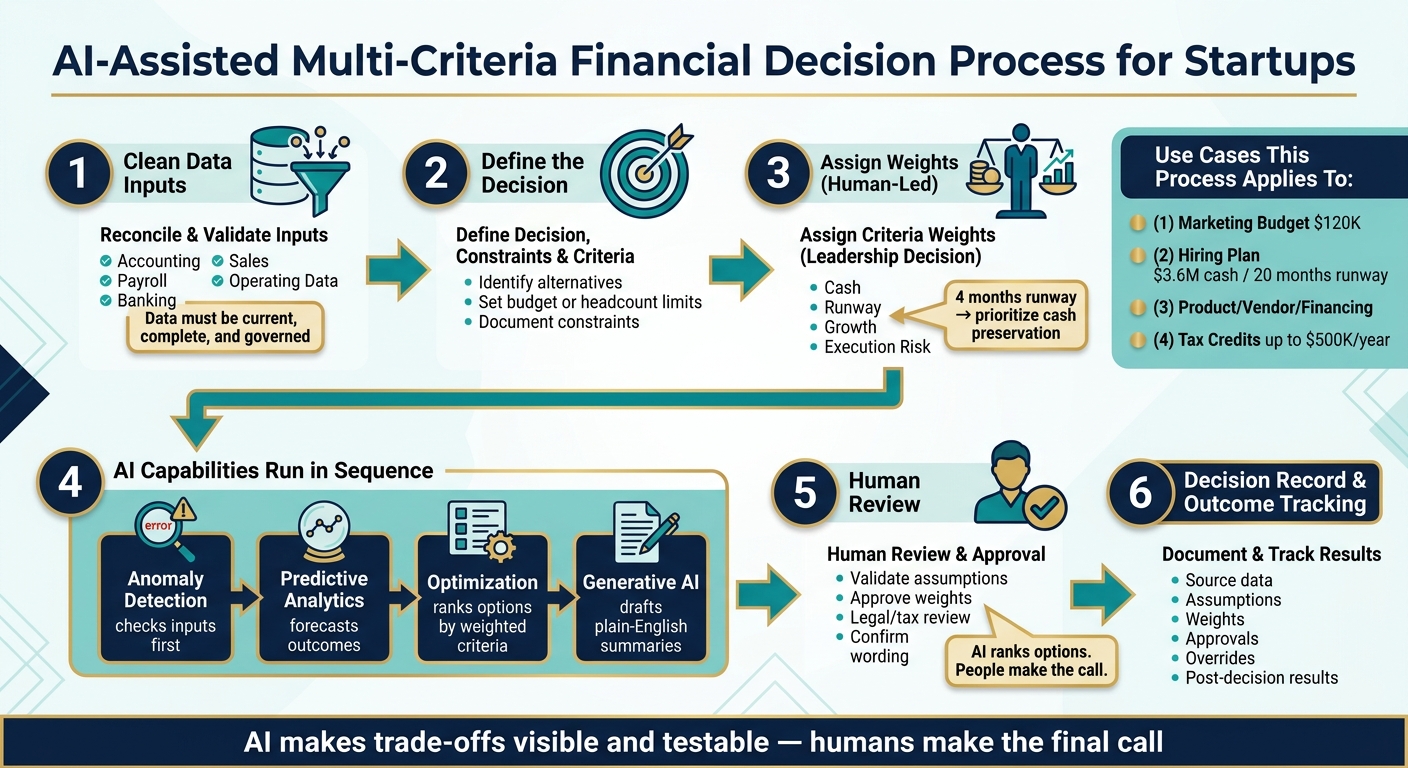
AI-Assisted Multi-Criteria Financial Decision Process for Startups
AI can rank options and show trade-offs once the data is clean, current, and complete. That matters because the next step isn't just about making forecasts. It's about comparing actual choices.
From Data to Decision: The Core Workflow
Start with reconciled accounting, payroll, banking, sales, and operating data in one governed model. If you're making a hiring decision, that means pulling in salary, payroll taxes, benefits, recruiting costs, ramp time, and expected revenue contribution.
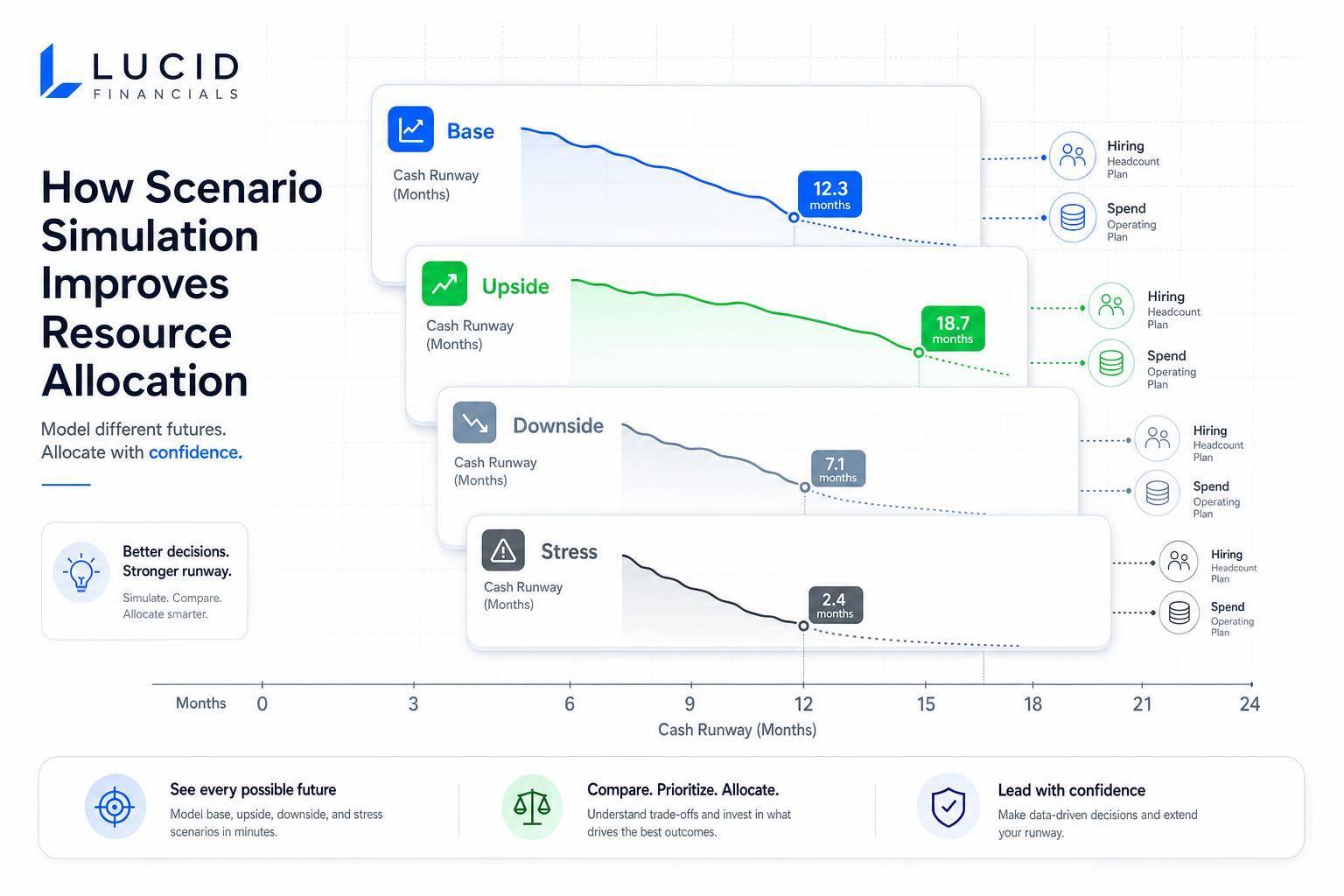
After the data is validated, define the decision and its constraints. Then assign documented weights to each criterion, such as cash, runway, growth, and execution risk. From there, score the options in a clear way, model base, upside, and downside scenarios, and send the output to the founder, CFO, or finance reviewer in charge. The source data, assumptions, weights, and final decision record should all stay visible.
Criteria weights are a leadership decision, not an AI decision. Set those weights before the model runs. A startup with four months of runway should lean toward cash preservation. A well-funded company can put more weight on growth.
What Each AI Capability Does Best
Four different AI capabilities support this workflow, and they don't do the same job. A forecast estimates what may happen. An optimizer recommends how to use limited resources based on the constraints you set. Generative AI explains the results in plain English. Anomaly detection spots data or transaction issues before they skew the analysis.
| AI Capability | Decision Input | Financial Output | Human Review |
|---|---|---|---|
| Predictive analytics | Historical revenue, pipeline, expenses, payroll, and cash collections | Revenue forecast, cash-flow forecast, burn, runway | Validate assumptions, review forecast error, approve planning baseline |
| Optimization | Alternatives, criteria, weights, constraints, and available budget or headcount | Recommended budget, hiring, vendor, or financing choice | Approve criteria, weights, constraints, and exceptions; confirm operational feasibility |
| Generative AI summaries | Forecasts, variances, scorecards, scenario results, and supporting records | Board-ready summary, variance note, management update | Verify every material number and claim; approve final wording before sharing |
| Anomaly detection | Transactions, invoices, payroll records, and journal entries | Flags for duplicate payments, unusual spend, or data issues | Investigate alerts and document the fix; an alert is not proof of wrongdoing |
These capabilities work best in sequence. Anomaly detection checks the inputs first. Forecasting adds likely outcomes. Optimization compares the options that fit the limits. Then generative AI drafts the explanation. The case studies below show how these capabilities support four startup finance decisions.
Case Studies: 4 Financial Decisions Where AI Helps Most
These four cases show where AI is most useful in finance decisions: weighing trade-offs across spend, hiring, product, financing, and tax choices. The process stays the same each time: define the criteria, assign weights, test scenarios, then review the output.
Allocating Growth Capital Across Marketing Channels
Start with marketing spend. This is where trade-offs show up fast.
Picture a startup with $120,000 to split across paid search, paid social, content and SEO, events, and partner marketing in one quarter. The goal isn't just to ask which channel drives the most revenue. It's to figure out which one gives the best mix of revenue, CAC, payback period, retention, gross margin, scalability, and execution risk based on what matters most right now.
Before running the model, set weights that match the company's current situation. In a cash-preservation plan, for example, you might weight contribution margin at 30%, payback period at 25%, expected pipeline at 20%, retention at 15%, and execution risk at 10%.
| Channel | Expected pipeline | CAC/payback | Retention and margin | Execution risk | AI score |
|---|---|---|---|---|---|
| Paid search | High | Strong | Medium | Low | 4.1/5 |
| Content & SEO | Low near-term, high long-term | Strong after ramp | High | Medium | 3.8/5 |
| Paid social | Medium | Variable | Medium | Medium | 3.3/5 |
| Events | Medium | Weak to variable | High (select accounts) | High | 2.9/5 |
AI can score each channel, test different weight sets, and flag concentration risk. What it can't do is solve bad attribution. Paid search often gets last-click credit for customers who may have converted anyway. Events can shape months of pipeline and still look unprofitable if you only track immediate revenue. So the ranking is a guide, not a final answer. Re-run the model when conversion rates, pricing, or channel costs shift in a material way.
Choosing a Hiring Plan Under Runway Constraints
When a startup has to choose between hiring now, waiting, or adding people in stages under a cash limit, AI helps sort the trade-offs.
Hiring is expensive to undo. Salary is only one piece of the bill. Payroll taxes, benefits, recruiting, onboarding, and ramp time all affect burn and runway.
Say a company has $3.6 million in spendable cash and a monthly net burn of $180,000. That gives it about 20 months of runway. If it adds six employees fast, monthly burn could go up by $90,000. A staged plan that adds two employees per quarter gets to the same headcount later, but it keeps more room to adjust.
| Hiring plan | Near-term burn | Cash remaining | Runway | Revenue contribution | Main risk |
|---|---|---|---|---|---|
| Delayed hiring | Lowest | Highest | Longest | Slower | Missed growth or execution milestones |
| Accelerated hiring | Highest | Lowest | Shortest | Potentially fastest | Productivity lag, cash pressure, poor hires |
| Staged hiring | Moderate | Moderate | Moderate | Tied to milestones | Slower scaling, management complexity |
The most useful output here is often a set of hiring gates. For example:
- Release the next tranche only after qualified pipeline passes a set threshold.
- Delay a role if runway drops below 12 months.
That said, some parts still sit firmly with people. Leadership fit, team dynamics, employment-law compliance, immigration issues, and the full cost of a bad hire all need human judgment.
Prioritizing Product, Vendor, and Financing Decisions
These choices often fight for the same cash, engineering time, and management attention.
| Alternative | Revenue/retention impact | Cash-flow effect | Cost or burden | Key downside | Human review |
|---|---|---|---|---|---|
| Build retention feature | Potentially high | Near-term engineering cost | Opportunity cost and delivery risk | Delayed other roadmap work | Product, finance, and legal if customer commitments change |
| Renegotiate vendor terms | Low direct revenue impact | May improve near-term cash | Possible relationship or service risk | Fees, lock-ins, or weaker service levels | Finance and legal |
| Use venture debt | No immediate ownership dilution | Provides cash but adds repayment obligations | Interest, fees, covenants | Default or refinancing risk | Finance, legal, and tax |
| Raise equity | Extends cash capacity | Inflow with dilution | Fundraising time and transaction costs | Valuation and control dilution | Finance and legal |
AI can rank these paths using weighted criteria like revenue impact, cash timing, cost, reliability, dilution, speed, and downside risk. That's useful, especially when everything feels urgent at once. But before any move is made, finance, legal, and tax professionals still need to review the terms and likely effects.
Using Tax Credits and Tax Timing to Preserve Cash
The same framework also works for tax decisions that help preserve cash, especially when timing matters as much as the credit itself.
If a startup is deciding how to handle eligible R&D expenditures, the federal R&D tax credit is one option to rank. It can apply against employer payroll taxes up to $500,000 per year. That can help preserve cash, but timing matters for both the election and the filing. Section 174 capitalization rules also make documentation and timing a big deal.
| Tax-related alternative | Immediate cash benefit | Compliance burden | Audit risk | Fundraising readiness |
|---|---|---|---|---|
| Document and claim eligible R&D credit | Potentially meaningful | High | Medium if records are weak | Positive if well documented |
| Accelerate permitted deductions | May improve near-term cash | Medium | Medium | Neutral if properly supported |
| Defer permitted deductions | May preserve deductions for a later period | Medium | Medium | Usually limited near-term benefit |
| Change entity or filing position | Highly fact-specific | High | High if poorly structured | Requires clear documentation |
AI can help by spotting missing records, reconciling payroll and project data, estimating cash-timing effects, and flagging inconsistencies before they turn into filing problems. Lucid Financials can keep books, tax data, and runway reporting current so scenario analysis starts with clean inputs. Founders and finance leaders still need to check source data, choose the decision criteria, approve assumptions, and get qualified legal or tax review when needed.
Controls, Metrics, and Operating Discipline for AI-Supported Decisions
Once AI ranks the options, the next step is simple: can your team control the process, repeat it, and audit it later? A one-off AI answer isn't a decision process.
Each decision needs a few basic pieces in place:
- A documented owner
- A clear question
- A deadline
- A one-page decision brief that covers feasible alternatives and constraints
- An approval trail
Before any analysis starts, get the inputs in order. Reconcile the books, verify classification, confirm headcount and payroll, and record the data cutoff. If inputs are missing, that should trigger either an exception or a range-based analysis. No guessing, no hand-waving.
How to Measure Whether AI Improved the Decision
The point isn't just to use AI. The point is to see whether it led to better results.
Track metrics like forecast accuracy, cash-flow variance, runway preserved, ROIC, decision cycle time from request to approval, exception rate, and override rate.
That said, metrics only help when the inputs and outputs are dependable. A lower override rate doesn't always mean things are going well. Zero overrides can be a warning sign. It may mean no one is pushing back on the model. On the flip side, if people keep overriding the same kind of recommendation for the same reason, that's often a sign that the data pipeline or the decision criteria need work.
Look at these metrics across more than one type of decision. Review them for marketing spend, hiring, vendor terms, financing, and tax timing. Then compare those results against the process the team used before. That's where you start to see whether AI made a difference or just added another layer of noise.
Risk Controls for Data Quality, Bias, and Auditability
Inaccuracy remains the most common AI failure mode, so confident output is not the same as reliable output.
| Risk | Example | Control to apply |
|---|---|---|
| Data drift | CAC or payroll costs shift materially from the historical period used | Monitor input distributions and forecast error; set review thresholds; retain drift reports |
| Incomplete inputs | Model excludes an upcoming vendor renewal or open payroll obligation | Require completeness checks, exception flags, and reviewer sign-off before approval |
| Biased training data | Historical channel data underrepresents a newer, potentially effective channel | Test performance across relevant segments; review whether historical patterns should be reproduced; document remediation |
| Fabricated explanations | AI cites a nonexistent invoice, tax rule, contract clause, or data source | Require source-linked explanations; independently verify material claims |
| Overconfident forecasts | A single precise runway figure hides substantial uncertainty | Use ranges, confidence intervals, downside scenarios, and explicit assumptions |
| Weak audit trail | The team can't reconstruct why a recommendation was accepted | Retain source data, assumptions, criteria, weights, prompts or model inputs, model version, outputs, approvals, overrides, and post-decision results |
This is where discipline matters. If an AI system sounds sure of itself but the source data is off, the answer can still be wrong. And if no one can trace how a recommendation was produced, you're flying blind.
The NIST AI Risk Management Framework specifically calls for documented human oversight, risk measurement, fairness evaluation, and ongoing assessment of whether controls remain effective. For any high-impact decision, a reviewer should be able to reconstruct what happened from the retained record.
Where Lucid Financials Fits in the Process
Good governance starts with current books, current payroll, and a traceable approval record. Lucid Financials helps provide clean inputs through its integrated bookkeeping and tax platform. It also gives founders direct access to current financial data in Slack and applies human review to AI-generated outputs before they shape hiring, capital allocation, or tax filing decisions.
That keeps scenario analysis tied to current data and ready for review before approval.
Conclusion: Use AI to Compare Trade-Offs, Not to Outsource Judgment
Startup finance is full of trade-offs. AI can help you compare choices across essential financial metrics like cash, growth, risk, and timing. But the final call still sits with the founder or finance lead. That same idea carries over to marketing budgets, hiring plans, vendor picks, and tax timing.
This works only if your inputs are clean and your review process is tight. Four controls matter most:
- clean data
- weighted criteria
- human review
- outcome tracking
For that workflow to hold up, your books need to stay current and outputs need fast review. Lucid Financials keeps books up to date, pushes real-time data into Slack, and sends AI-generated outputs through finance review before sign-off.
AI shouldn’t make the decision. Its job is to make trade-offs visible, testable, and easier to defend.
FAQs
How do I choose the right criteria weights?
Start by picking 10 to 20 metrics that have the biggest effect on cash burn, runway, and day-to-day business performance. Tie those metrics to your company’s stage and main goal, whether that’s growth, profit, or fundraising.
Then give each scenario a probability based on what your numbers and current conditions are telling you. Update those probabilities every month, and pressure-test them with board feedback and review from experienced people.
What data do I need before using AI for decisions?
Before you use AI for multi-criteria financial decisions, you need accurate, complete, up-to-date data from one trusted source of truth.
Start by pulling together historical financial data, operational metrics, and market context. Then clean the data so you’re not feeding the model bad inputs. A messy dataset is like a crooked measuring tape - it throws off everything that comes after.
It also helps to cross-check your sources instead of relying on a single feed without question. At the same time, write down the key assumptions behind your analysis and the KPIs you’ll use to judge success across the scenarios you plan to model.
When should you override an AI recommendation?
Override an AI recommendation when the call needs human judgment, business nuance, or context the system doesn’t have.
You should also step in when the output looks biased, leans on old or partial data, or misses shifts in the market. That human review helps make sure AI-led insights are accurate, compliant, and ready to use before they shape major business decisions.