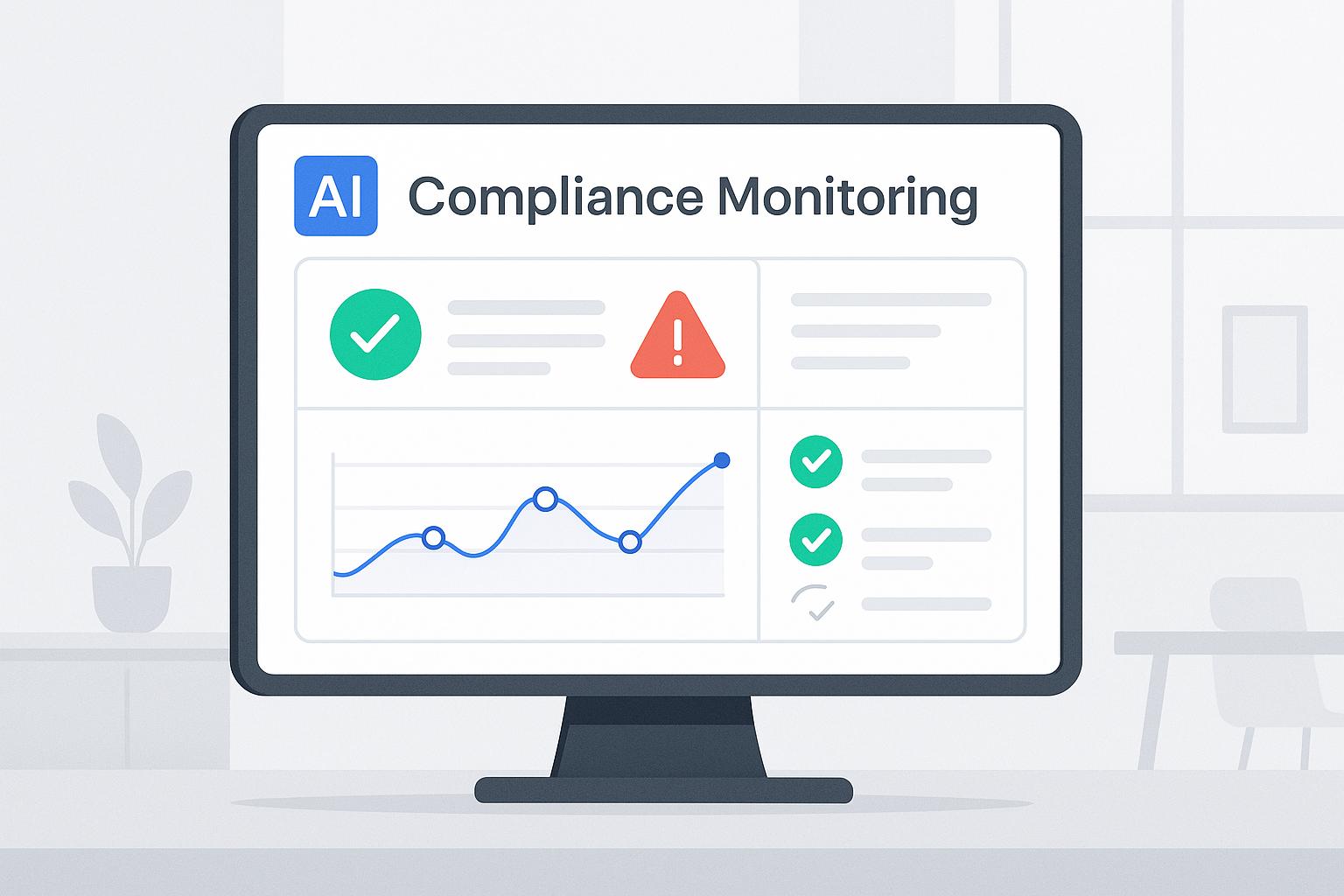
If I had to sum it up in one line: real-time compliance monitoring helps you catch reporting problems before month-end close, investor updates, or audit review.
If you run finance at a U.S. startup, here’s what matters most: you need live data feeds, rules tied to policy and reporting risk, alert workflows, case tracking, audit-ready evidence, and human review for material issues. The article also makes a clear point: software can flag risk, but people still decide what the issue means and what to do next.
Here’s the short version of what I’d want you to take away:
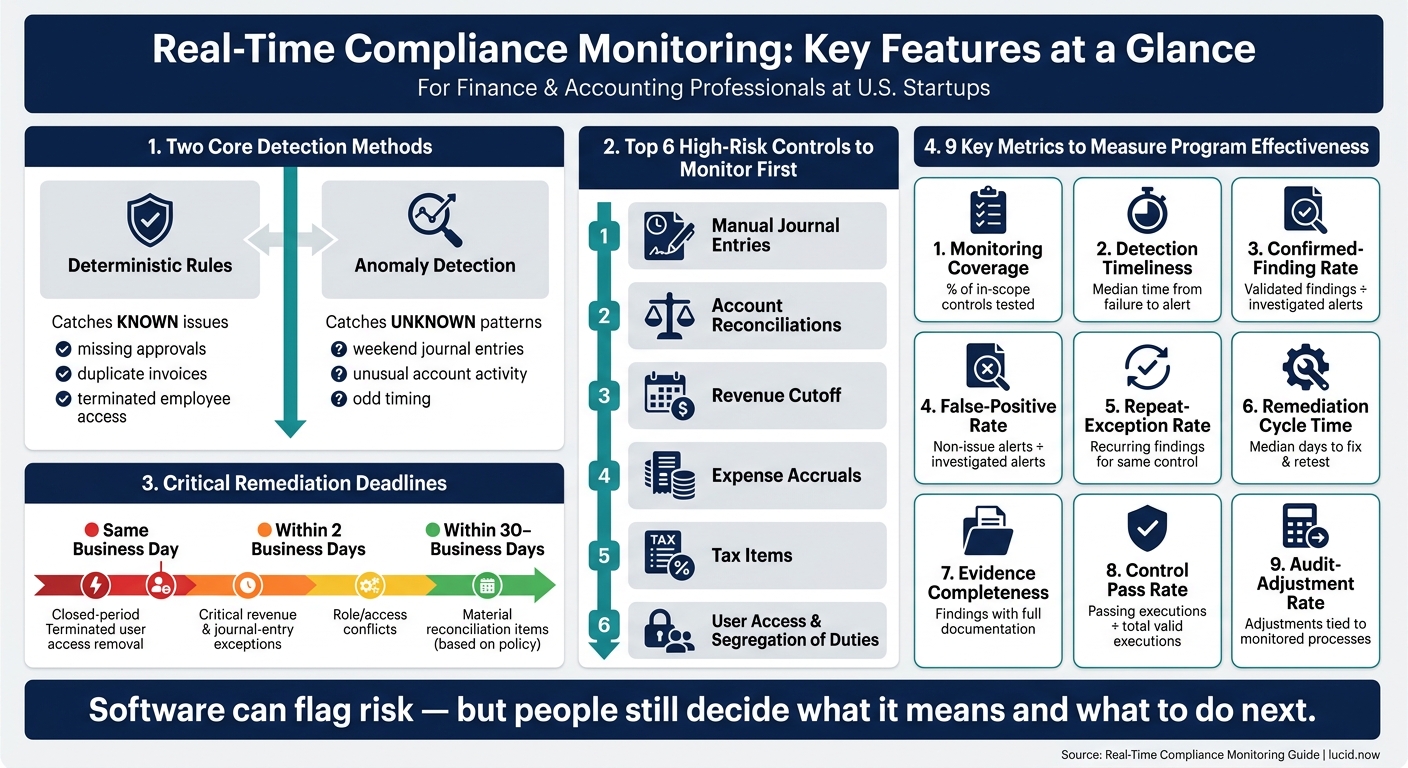
- Watch high-risk controls first: manual journal entries, reconciliations, revenue cutoff, expense accruals, tax items, and user access
- Use both rules and anomaly checks: one finds known issues, the other finds odd patterns
- Rank alerts by risk: amount, account, recurrence, and reporting effect should drive review order
- Keep case records clean: owner, due date, source data, comments, support, and closure reason
- Do not trust a “no issues” result if the data feed failed
- Measure results with hard numbers: coverage, false-positive rate, remediation time, repeat findings, evidence completion, and audit adjustments
A few facts from the article stand out:
- Continuous monitoring can review broad transaction populations, while periodic review often leans on sampling
- Access conflicts for former staff should be removed right away
- Material reconciliation items may need resolution within 30 or 60 days, based on policy
- Some close-related items, such as critical revenue or journal-entry exceptions, may need action within 2 business days
I’d describe the article as a guide to picking the right monitoring features, deciding which controls to test first, setting ownership, and proving the system works with data and evidence. In short: find issues early, fix them before close, and keep support that auditors can follow.
Real-Time vs. Periodic Compliance Monitoring: Key Features & Metrics
Compliance Monitoring Software That Finds High-Risk Transactions Automatically
sbb-itb-17e8ec9
Core Features to Evaluate
Focus on features that help teams close faster, improve reporting accuracy, and keep clean audit evidence.
Live Data Integration and Regulatory Mapping
A tool is only as current as the data flowing into it. It should connect live to the general ledger, bank feeds, AP, AR, payroll, expenses, HR, and identity/access systems.
But connection alone isn't enough. Data freshness and validation matter just as much. Every imported bank transaction should include a unique identifier, posting date, amount in U.S. dollars, account mapping, and import status. If records fail or show up twice, the system should send them to a review queue automatically.
Then comes rule mapping. This is where each policy or reporting requirement gets tied to the accounts, transaction types, workflows, approvers, and source records it covers. Look for a rules engine with version control and effective dates. That way, when an exception is flagged, you can see which rule version was active at that time. That keeps monitoring aimed at the reporting areas with the most risk.
Once data and rules are mapped, the tool can test them on a continuous basis.
Automated Testing, Exception Detection, and Risk Scoring
Strong tools usually rely on two methods: deterministic rules and anomaly detection.
Rules catch known issues, like a missing approval, a duplicate invoice, or a terminated employee who still has posting access. Anomaly detection helps spot odd behavior that rules may miss, such as a manual journal entry posted on a weekend to an account that rarely has activity.
At a minimum, the tool should test:
- Approval chains
- Duplicate payments
- Journal-entry anomalies
- Reconciliations
- Segregation-of-duties conflicts
- Access recertification
After detection, risk scoring decides what gets reviewed first. A strong scoring model weighs financial materiality, control criticality, recurrence, and possible impact on financial statements. The goal is simple: rank issues by how much they could affect close quality and reported numbers.
Those scores also need to be explainable. Reviewers should be able to see exactly which factors drove the ranking, and management should be able to adjust thresholds to fit the organization's own risk profile.
Detection only helps if exceptions move into review without delay.
Alerts, Audit Trails, and Reporting Dashboards
Detection should flow straight into a case workflow. Alerts need to be configurable by severity, financial impact, control owner, and reporting period. Delivery options should include email, dashboard notifications, or Slack. Each alert should automatically open a case with an assigned owner, due date, escalation path, and a documented resolution requirement.
The workflow should clearly separate false positives, accepted exceptions, corrected errors, and suspected fraud. It also should block silent closure by requiring a documented reason for every closed case. Alerts are there to drive resolution before month-end close, not just to ping users.
Each case should keep the triggering rule or model version, source records, timestamps, user identities, approvals, reviewer comments, remediation steps, and final disposition in an immutable or version-controlled format. That matters because management's control assessment needs clear support, and auditors will review the accuracy and completeness of the information used as audit evidence.
The table below maps each core capability to its financial-reporting use case, required data, alert output, evidence produced, and human-review requirement:
| Capability | Financial-reporting use case | Data required | Alert output | Evidence produced | Human-review requirement |
|---|---|---|---|---|---|
| Live integrations and data validation | Detect missing, duplicated, or stale ledger and bank data | General ledger, bank feeds, subledgers, integration logs | Data-quality exception | Import logs, lineage, validation results | Review failed or incomplete feeds |
| Approval testing | Confirm payments, expenses, and journal entries followed policy | Transaction amount, approver, role, timestamp, workflow record | Missing, late, or unauthorized approval | Approval history and policy version | Confirm exception or document approved override |
| Reconciliation monitoring | Identify unreconciled or aging balances | Bank, subledger, ledger, reconciliation status | Balance variance or overdue reconciliation | Reconciliation report, variance detail, preparer sign-off | Investigate and resolve variance |
| Journal-entry analytics | Detect unusual, unsupported, or high-risk manual entries | Entry lines, preparer, approver, posting time, account, description | Risk-ranked journal-entry case | Entry snapshot, anomaly factors, supporting documents | Assess business purpose and financial impact |
| Access and segregation-of-duties testing | Prevent incompatible access from enabling error or fraud | HR status, identity records, roles, permissions, workflow authority | Conflict or terminated-user access alert | Access snapshot, conflict rule, remediation history | Validate business need and remove or approve access |
| Risk scoring | Prioritize issues by materiality and reporting impact | Amounts, account risk, historical patterns, control results | Ranked queue with score explanation | Scoring factors, model or rule version, reviewer decision | Challenge score and determine response |
| Case management | Track exceptions through remediation and closure | Alert, owner, due date, comments, attachments, status | Escalation and overdue notifications | Complete case history and closure rationale | Assign, investigate, approve, and close |
| Management dashboard | Monitor control health and close readiness | Exceptions, control results, aging, remediation, account mappings | Trend or threshold alert | Periodic management report | Evaluate deficiencies and corrective action |
A good dashboard should do more than show open exceptions. It should let finance leaders drill from an executive summary all the way down to the underlying transaction and supporting evidence. COSO monitoring guidance emphasizes timely communication of deficiencies to those responsible for corrective action.
Financial Reporting Controls to Monitor First
Once you’ve picked your monitoring features, decide which controls get attention first. The tool only watches what you put at the top of the list.
Not every control carries the same risk. Start with the accounts and processes most likely to skew reported results. Use a top-down, risk-based order. In plain English: begin with the areas most likely to create a misstatement. Your monitoring priorities should match your company’s reporting duties, accounting policies, entities, systems, and any known control gaps.
Transaction Accuracy, Journal Entries, and Reconciliations
Transaction-level controls come first. They’re the base layer. Monitor whether each transaction lands in the right period, account, entity, and amount. If an invoice is posted to a closed period, or a transaction hits the wrong subsidiary, the system should flag it. Each exception should show the transaction ID, the rule that was broken, the owner assigned to fix it, and the deadline for remediation.
Journal-entry monitoring needs its own lane. PCAOB guidance specifically points to late or unusual journal entries and period-end adjustments as areas tied to internal control over financial reporting. Flag large month-end manual entries from unusual preparers by using materiality-based thresholds. Entries that approve themselves, lack support, or reverse soon after posting should also surface on their own.
Reconciliations close the gap between separate records. Make sure every material balance-sheet account has an owner, a due date, and documented sign-off. Keep aged reconciliation items and intercompany mismatches open until someone resolves them. Don’t let them roll forward unresolved.
Close, Revenue, Expense, Tax, and Access Controls
Monitor the close process itself. Track whether subledgers are certified before the general ledger is finalized, whether required accruals were posted, and whether any period was reopened after lock. A close dashboard should show unresolved reconciliations, open intercompany balances, and locked-period exceptions.
After close controls, move to the cutoff areas that most often move results from one period to another. That means revenue cutoff, expense accruals, and tax-code accuracy. Check them against your written policy and filing deadlines.
Access controls connect the whole setup. Monitor active access against HR records. Remove terminated users right away, and clear role conflicts within five business days.
Building a Risk-Based Control Matrix
Turn those priorities into a control matrix so every rule has a clear owner and deadline. A control matrix ties each reporting risk to a rule, owner, evidence, and due date. Update it when the company adds an entity, brings in a new system, changes a material accounting policy, or takes on a new reporting duty.
| Reporting risk | Control objective | Detection rule | Owner | Evidence | Remediation deadline |
|---|---|---|---|---|---|
| Revenue recorded in the wrong period | Record revenue only when recognition criteria and service period are supported | Compare service dates, contract schedules, invoice dates, and posting periods; flag mismatches | Controller or revenue owner | Contract, invoice, schedule, exception resolution | Before monthly close; critical exceptions within 2 business days |
| Manual journal entry causes a material misstatement | Ensure manual entries are valid, supported, and independently approved | Flag high-value, late, unusual, unsupported, reversed, or self-approved entries | Accounting manager | Journal, preparer, approver, support, review notes | Before close sign-off |
| Reconciliation difference remains unresolved | Ensure material accounts are complete, accurate, and supported | Flag unreconciled differences above threshold or items older than approved aging limit | Account owner | Reconciliation, bank or subledger support, reviewer sign-off | Within 30 or 60 days, based on policy |
| Intercompany balances don't eliminate correctly | Ensure reciprocal balances agree before consolidation | Match entity-level receivables, payables, invoices, currencies, and dates | Intercompany accountant | Confirmation, matching report, adjustment approval | Before consolidation close |
| Expense or liability omitted from the correct period | Ensure cutoff and accruals are complete | Compare post-close invoices and service dates with prior-period accrual needs | Controller or AP owner | Invoice, receiving evidence, accrual calculation | Before financial statements are finalized |
| Tax data inconsistent with the ledger | Ensure tax reporting is based on complete and accurate source data | Reconcile tax extracts, tax codes, filings, payments, and ledger balances | Tax owner or external tax adviser | Reconciliation, filing support, adjustment record | Before filing deadline |
| Unauthorized access enables improper activity | Restrict access according to role and remove access promptly | Compare active users with HR records and test incompatible role combinations | Finance systems owner and HR | Access review, termination record, approval ticket | Terminations immediately; periodic conflicts within 5 business days |
| Closed periods are changed without authorization | Preserve finalized reporting data and document approved adjustments | Flag postings or period reopenings after close lock | Controller | Reopening approval, change log, revised close evidence | Same business day for investigation |
Add the relevant assertion only where it helps clarify coverage.
These control priorities then feed the governance layer: ownership, evidence standards, and review thresholds.
Governance and Implementation Requirements
Once the control matrix is set, governance comes next: who owns each alert, how data gets checked, and when people need to step in. Monitoring falls apart without clear ownership. That means an executive sponsor, control owners, data owners, reviewers, remediation owners, written rules, approved thresholds, and human sign-off for material exceptions. The point is simple: resolve exceptions before they affect the close or financial reporting. Software can spot issues. People still make the call.
Data Quality, Explainability, and Human Oversight
Start with the data feeds. Check them for completeness, accuracy, timeliness, and consistency. Compare transaction counts and dollar totals in your accounting system against the source platforms, such as billing, payroll, banking, and payments. Keep data lineage records that show the source system, extraction time, transformations, destination, and the person responsible. If a critical feed is incomplete, mark the run as "data unavailable" instead of letting the system show a false clean result.
Each alert should make the situation plain. It should say what happened, why it was flagged, which rule or model triggered it, what data was used, how material it may be, and what action is needed.
You also need a record of what happened after the alert fired. Track whether each one was a true positive, false positive, false negative, accepted risk, or unresolved exception. Watch override rates too. If reviewers keep overriding alerts, that can point to poor thresholds or weak review. Keep a version-controlled register for every rule change, including the date, owner, reason, approval, and test results. And when your chart of accounts, ERP, billing logic, or close process changes, revalidate the rules.
The table below shows common failure modes and the safeguards that help prevent them.
| Failure mode | Typical consequence | Safeguard |
|---|---|---|
| Incomplete or delayed source data | System reports "no exception" because transactions were never received | Feed-health checks, record counts, control totals, freshness thresholds, and an explicit "data unavailable" status |
| Alert overload | Reviewers dismiss alerts routinely, leaving material issues unresolved | Rank by risk and materiality, tune thresholds, group duplicates, assign service-level deadlines, track dismissal reasons |
| Missed anomalies or false negatives | Errors or unusual transactions pass undetected | Combine deterministic rules, trend analysis, sampling, reconciliations, and periodic back-testing |
| Opaque outputs | Reviewers can't explain the alert to management or auditors | Show triggering fields, rule logic, comparison period, model version, risk score, and required action |
| Uncontrolled rule or model changes | Monitoring behavior shifts without approval or testing | Change management, version control, documented approvals, regression testing, and rollback procedures |
| Unresolved exceptions | Known issues accumulate and affect statements or filings | Assign owner and due date, record root cause, escalate overdue items, require human sign-off for material exceptions |
Material exceptions should go through documented human review and sign-off, not automatic closure.
With data and review standards in place, the next step is a phased rollout.
A Staged Rollout Plan for Startups
Start small. That gives you room to prove the rules, the data, and the workflow before you expand coverage. Roll out monitoring in stages, and prove one control set before moving to the next.
First, connect and normalize the data. Validate record counts and balances, document known gaps, and set up lineage before writing a single rule. After that, pilot a small group of high-value controls. Good places to begin include duplicate payments, manual revenue entries, unreconciled bank items, and unusual user access. Then check those results against prior close workpapers and manually reviewed samples before moving anything into production.
Test design effectiveness first. Then test operating effectiveness.
Only expand coverage once the pilot shows reliable data, outputs reviewers can understand, timely human review, and repeatable remediation.
Where Lucid Financials Fits in the Workflow
Execution depends on clean books and fast remediation, so the operating layer matters just as much as the software. Lucid Financials can support data readiness and exception remediation by keeping books reconciled, surfacing issues in Slack, and linking monitoring results to reporting decisions. It works as a workflow layer, not a substitute for control owners or human review.
How to Measure Results and Key Takeaways
Metrics That Show Whether Monitoring Is Working
Once monitoring is live, the goal is pretty simple: find real issues sooner, fix them faster, and keep evidence that can stand up in an audit. Put differently, once the control matrix is up and running, you want to know whether monitoring is spotting issues earlier and getting them closed the right way.
Track the program across four areas: coverage, detection, remediation, and evidence. It also helps to separate leading indicators from lagging indicators. Leading indicators include coverage, detection timeliness, evidence completeness, and control pass rates. Lagging indicators include audit adjustments, repeat deficiencies, and reporting delays. A program is getting better when it catches issues sooner and cuts down on late surprises, not just when it sends fewer alerts.
The table below shows the main metrics to track, how to calculate them, and who should own them.
| Metric | Calculation | Target-setting considerations | Reporting owner | Review frequency |
|---|---|---|---|---|
| Monitoring coverage | Monitored in-scope controls ÷ total in-scope controls × 100 | Set separate targets for critical, high-, and lower-risk controls; prioritize key financial-reporting risks | Controller or compliance lead | Monthly; before each close |
| Detection timeliness | Median time from transaction or control failure to alert | Set tighter limits for journal entries, access, and close controls; measure p50 and p90 to expose outliers | Compliance operations or controllership | Monthly |
| Confirmed-finding rate | Validated findings ÷ investigated alerts × 100 | Segment by rule and risk tier; a higher rate is useful only if coverage and sensitivity remain adequate | Compliance analytics owner | Monthly |
| False-positive rate | Alerts closed as non-issues ÷ investigated alerts × 100 | Reduce noise without weakening detection thresholds; review sudden changes after rule updates | Control owner and analytics owner | Monthly |
| Repeat-exception rate | Repeat findings for the same control or root cause ÷ total findings × 100 | Use a defined lookback period; prioritize recurring issues over isolated errors | Controller or process owner | Monthly and quarterly |
| Remediation cycle time | Median days from validated finding to effective remediation and retest | Set risk-based service levels; separate implementation time from retest time | Issue-management owner | Weekly for critical items; monthly overall |
| Evidence completeness | Findings with all required evidence ÷ total tested items × 100 | Define minimum evidence fields; test whether an independent reviewer could reproduce the conclusion | Controller or compliance lead | Monthly; pre-audit |
| Control pass rate | Passing control executions ÷ total valid control executions × 100 | Weight by risk; analyze failures and overrides rather than relying on one aggregate percentage | Control owner | Each close; monthly |
| Audit-adjustment rate | Audit adjustments attributable to monitored processes (count and dollar value) | Track both count and materiality; classify whether monitoring detected the issue before or after the audit | Controller and external-audit liaison | Quarterly and annually |
PCAOB inspection findings still point to weak control testing and incomplete source-data testing, which is why evidence quality needs to sit in the core metric set.
One more thing: don’t treat a finding as closed just because someone marked a ticket complete. It’s only closed when the team has proof that the fix worked.
Key Takeaways for Financial Reporting Teams
Four points sum up this guide.
Earlier detection matters only if it stops late adjustments, reopened close tasks, and audit surprises. Continuous monitoring can flag unusual journal entries, missing approvals, reconciliation breaks, access conflicts, and close delays before they spill into the audit. That gap between detection and the close is where the payoff sits.
Measure the program by risk coverage, confirmed findings, false positives, repeat exceptions, remediation speed, evidence quality, and audit adjustments - not alert volume. A pile of alerts may look busy, but busy doesn’t mean useful.
AI needs governance: data quality, explainability, version control, escalation, and human review for material exceptions. COSO treats monitoring as an evaluation activity that must identify whether controls are present and functioning and communicate deficiencies promptly. AI can sort anomalies and cut manual review time, but it does not replace control ownership or professional judgment.
Start with high-risk controls. Begin with manual journal entries, account reconciliations, privileged and terminated-user access, revenue and expense controls, tax-related processes, and close procedures. Expand coverage only after the program shows stable data feeds, accountable ownership, repeatable evidence, and effective remediation. For startups using Lucid Financials, keep monitoring rules, evidence, owners, and review cadence separate from the bookkeeping workflow.
FAQs
How is real-time monitoring different from periodic review?
Real-time monitoring keeps compliance active at all times, while periodic review tends to be manual and reactive.
Instead of reviewing just 5% to 10% of transactions on a set schedule, real-time monitoring checks 100% of data as it happens. So if there’s a duplicate payment or unauthorized access, the system can flag it right away, not weeks or months later during month-end or quarterly reviews.
Which controls should we monitor first?
Start with a risk assessment that ranks compliance issues by severity and likelihood. That gives you a clear way to sort what matters most from what can wait.
Put the highest-risk areas first, especially high-volume financial processes like accounts payable, expenses, and reconciliations. Those workflows handle a lot of activity, so small gaps can turn into big problems fast.
Then zero in on the compliance metrics that matter for your industry and regulatory rules. Not every metric deserves the same attention, and this is where teams often get stretched too thin.
Address the most serious risks first, such as missing tax filings or regulated data being used in uncontrolled tools. If those issues slip through, the fallout can be expensive and messy.
What if a data feed fails?
If a data feed fails, protect data integrity by pulling from live, accurate sources instead of cached or old reports.
Check input data on a regular basis, review data flows, and keep strong audit logs so you can reconstruct events and sort out discrepancies fast if a connection drops. Lucid Financials supports this with real-time insights and continuous monitoring.