AI-powered compliance reporting simplifies regulatory tasks by using machine learning (ML), natural language processing (NLP), and predictive analytics. Instead of spending hours manually gathering data, AI automates the process, integrates with tools like AWS and GitHub, and continuously monitors compliance. This ensures startups stay audit-ready, reduce errors, and save time.
Key Benefits:
- Automated Evidence Collection: Connects with tools like Slack, Jira, and QuickBooks to gather data and logs in real time.
- Control Mapping: Aligns internal processes with frameworks like SOC 2, ISO 27001, and HIPAA.
- Real-Time Monitoring: Flags risks and regulatory updates instantly.
- Audit-Ready Dashboards: Provides live compliance status and generates reports in minutes.
Why It Matters for Startups:
- Builds trust with investors and clients.
- Reduces regulatory penalties and reputational risks.
- Saves 60–80% of time spent on compliance tasks.
- Cuts operational costs by up to 40%.
AI transforms compliance from a reactive chore into a proactive, efficient workflow, allowing startups to focus on growth without compromising on regulatory standards.
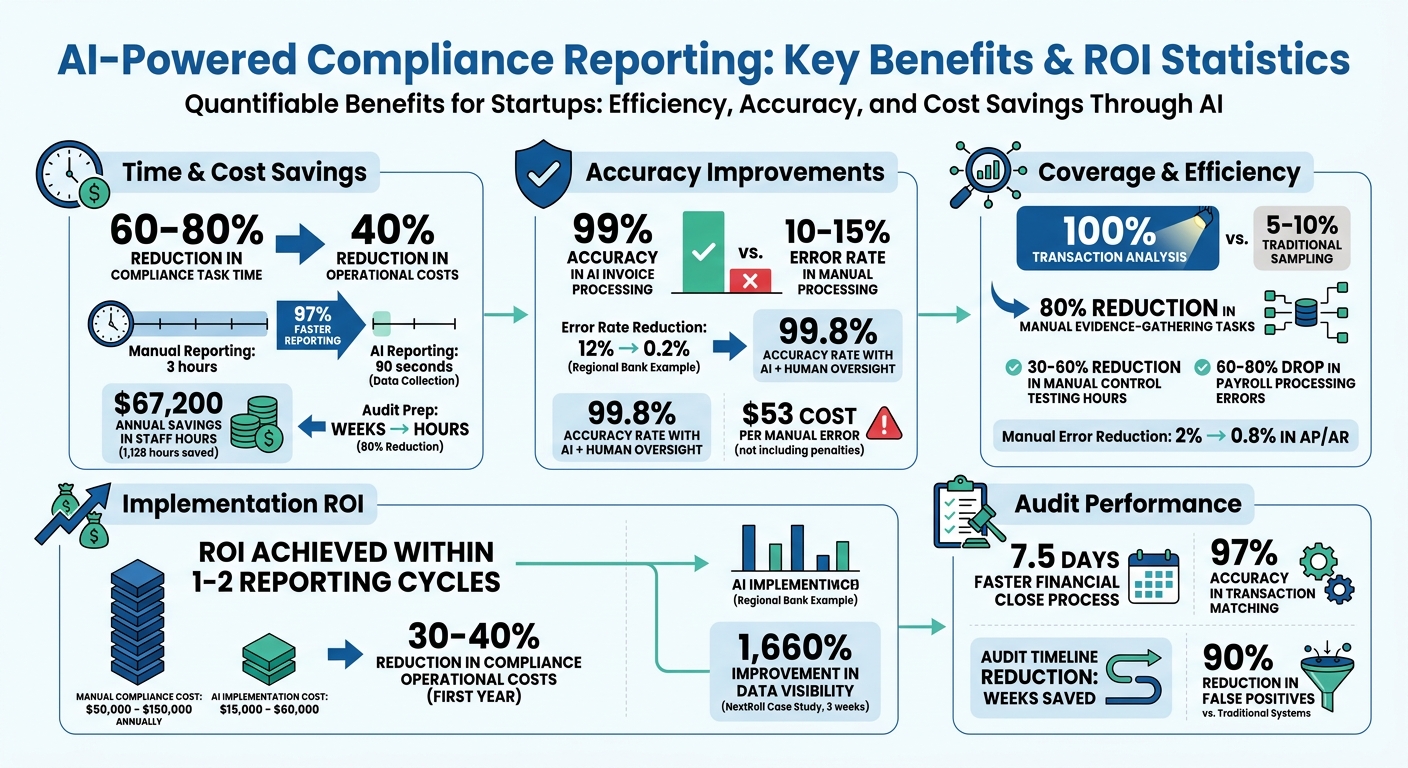
AI-Powered Compliance Reporting: Key Benefits and ROI Statistics for Startups
AI RegTech: Automating Financial Compliance and Regulation | Uplatz

sbb-itb-17e8ec9
Core Features of AI Compliance Systems
AI compliance systems take risk management to the next level by automating and streamlining key compliance processes.
Automated Evidence Collection and Integration
These systems connect seamlessly with tools you already use - cloud providers like AWS and Google Cloud, financial software such as QuickBooks, communication platforms like Slack, and project management tools including Jira and GitHub. Thanks to APIs, they eliminate the need for manual tasks like capturing screenshots, gathering logs, or compiling access reports. This drastically reduces the time needed to prepare for audits.
Evidence collection happens continuously. The system pulls data like configuration files, multi-factor authentication (MFA) logs, backup records, vulnerability scans, and CI/CD pipeline deployment records. All of this is automatically timestamped, organized, and ready for audits. Ravi Kumar, Senior Technical Account Manager at AWS, explains: "The process is consistent as the same evidence is collected every time, with the same naming conventions and organization". This approach minimizes human errors - AI-powered invoice processing, for example, achieves 99% accuracy compared to the 10-15% error rate typically seen with manual efforts. And fixing each manual error can cost around $53, not including the risk of compliance penalties.
Machine learning takes it a step further by classifying evidence and aligning it with compliance frameworks like SOC 2 or ISO 27001. Using natural language processing (NLP), the system ensures the evidence is both accurate and complete. This automation cuts manual evidence-gathering tasks by 80% and achieves up to 95% validation accuracy. For startups, this can shrink audit prep time from weeks to just a few hours.
Once the evidence is collected and organized, the system maps it to the necessary regulatory controls.
Control Mapping and Monitoring
AI simplifies compliance by linking internal controls to regulatory frameworks. Using machine learning, it maps transactions to specific requirements and employs NLP to interpret accounting and compliance policies. For instance, it can automatically align MFA enforcement with SOC 2 criteria and monitor its application across all user accounts.
One major advantage is the ability to analyze 100% of transactions, compared to the 5-10% sampling typical in traditional audits. This allows the system to flag anomalies like duplicate payments or off-hour transactions in real time. Continuous monitoring ensures data accuracy and identifies potential issues before financial statements are finalized. Companies using AI-powered payroll systems report a 60-80% drop in processing errors, while manual error rates in accounts payable and receivable decrease from 2% to 0.8%.
The system also keeps detailed audit trails for every transaction and updates workflows automatically when regulations change. This ensures that your compliance practices stay current, which is especially important for startups expanding into new regions.
Audit-Ready Reporting Dashboards
Say goodbye to static monthly reports. AI-powered dashboards provide real-time visibility into your compliance status. These interactive tools let you see which controls are fully documented, partially covered, or missing altogether. Real-time coverage maps help you spot and address vulnerabilities before an audit uncovers them.
The dashboards consolidate compliance data across multiple frameworks - SOC 2, ISO 27001, HIPAA, and more - into one place. This is particularly helpful when dealing with multiple auditors who require different certifications. As Quzara LLC puts it, "Transparent reporting is your secret weapon against audit surprises".
When it’s time for an audit, these systems can generate evidence binders in minutes. These binders include summaries, control IDs, and links to artifacts, cutting down weeks of manual preparation. Additionally, the dashboards track artifact update dates, allowing you to filter items older than 90 days and set reminders to keep evidence current. For startups using platforms like Lucid Financials, this integration ensures compliance reporting stays aligned with financial operations, offering a seamless experience.
How AI Automates the Compliance Workflow
AI has reshaped compliance workflows, turning what was once a manual and reactive process into an automated, continuous operation. With modern AI systems, tasks that used to take days can now be completed in minutes - and with far greater accuracy.
Scoping and Mapping Regulations
AI leverages Natural Language Processing (NLP) to interpret regulatory texts and align workflows with frameworks like GDPR, HIPAA, and SOX. It catalogs your technology stack to identify applicable regulations and uses Retrieval-Augmented Generation (RAG) to dynamically interpret and adjust to new regulatory requirements.
For instance, in October 2024, NextRoll implemented Relyance AI to automate the mapping of their data processing activities. Within just three weeks, the company achieved a staggering 1,660% improvement in visibility into its data flows and regulatory responsibilities. Deborah Usry, Product Counsel at NextRoll, highlighted the impact:
"With Relyance AI, we established enhanced visibility of data processing activities, seeing an impressive increase of 1,660% within three weeks of deployment".
This automation reduces the manual effort needed for regulatory alignment by 80% and slashes compliance-related operational costs by 30–40% in the first year.
AI systems can also map controls across multiple frameworks simultaneously, resolving potential conflicts between overlapping regulations. For example, they ensure that a HIPAA requirement doesn’t conflict with a SOX control. While the AI handles much of the heavy lifting, human experts still review its suggestions to maintain accountability and apply nuanced judgment.
This meticulous mapping process forms the foundation for advanced anomaly detection.
Anomaly Detection and Evidence Validation
Machine learning models define what constitutes standard behavior for users and systems, flagging deviations in real time. Unlike traditional audits, which rely on sampling, AI analyzes 100% of the data, uncovering all types of anomalies.
Take the example of a regional bank with 500 employees. In December 2025, the bank introduced Regulativ.ai's Compliance Monitoring Agent for monthly reporting. The AI cross-referenced data from its core banking and risk platforms, cutting the reporting error rate from 12% to just 0.2%. Reporting time dropped from 8 hours to just 15 minutes, saving the bank 1,128 staff hours annually - an estimated $67,200 in savings. Sarah, the bank’s Chief Compliance Officer, noted:
"Our error rate dropped from 12% to 0.2%. We went from regular resubmissions to consistently accurate first-time reports. Regulators noticed - our examination ratings improved significantly".
AI Compliance Monitoring Agents also examine data from multiple sources - like accounting systems, CRM tools, and cloud platforms - to spot inconsistencies and ensure data is complete. Moreover, NLP scans contracts and emails to detect non-compliant clauses or missing mandatory language, such as GDPR consent statements. These detections occur in milliseconds, flagging violations as they arise.
Automated Report Generation
Once regulations are mapped and anomalies are flagged, AI takes the next step: generating comprehensive reports. By connecting directly to data sources like accounting software, HRIS, and ERP systems, the system retrieves relevant records, normalizes data, cross-references inconsistencies, and produces audit-ready reports for frameworks such as SOX, GDPR, and PCI DSS.
The AI also creates an automatic audit trail, complete with timestamped metadata. For example, Align Technologies used MindBridge's AI-powered system to analyze billions of SAP transactions. By shifting from manual sampling to 100% transaction coverage, the company reduced audit preparation time by 80% and identified risks that traditional methods had missed.
With AI handling the heavy lifting, compliance officers can focus on strategic oversight. Instead of manually building reports, they review AI-generated outputs to ensure quality and accuracy. For startups using tools like Lucid Financials, this integration keeps compliance reporting in sync with financial operations, producing investor-ready documentation without the need for manual reconciliation.
Benefits of AI-Powered Compliance Reporting
AI takes compliance reporting to a new level by turning tedious, reactive tasks into streamlined, proactive processes. With advanced error detection, faster operations, and the ability to scale effortlessly, it’s a game-changer for businesses.
Error Detection and Correction
AI integrates directly with systems like your CRM, accounting software, HRIS, and banking platforms, enabling it to cross-check data in real time. Unlike manual processes that often catch errors only during end-of-month reviews, AI flags discrepancies as soon as they occur. This instant feedback allows teams to correct issues on the spot.
The impact of this improvement is clear. For instance, a regional bank reduced its error rate from 12% to just 0.2% after adopting AI for compliance monitoring in December 2025. Sarah, the bank's Chief Compliance Officer, shared:
"Our error rate dropped from 12% to 0.2%. We went from regular resubmissions to consistently accurate first-time reports. Regulators noticed - our examination ratings improved significantly".
AI doesn’t just identify errors - it validates calculations and ensures data completeness with an impressive 99.4% accuracy rate. Human compliance officers then review flagged items and make the final decisions. This collaboration between AI and human oversight achieves a 99.8% accuracy rate in compliance reporting.
Fixing manual errors can cost three to five times more than getting it right the first time, due to resubmissions and internal investigations. By drastically reducing errors, AI not only saves money but also ensures smoother compliance processes.
Speed, Cost Reduction, and Continuous Compliance
AI dramatically cuts down the time spent on compliance reporting - by as much as 97%. Tasks like data collection, which typically take three hours, can be completed in just 90 seconds with AI. This efficiency saves 1,128 staff hours annually, translating to $67,200 in direct labor savings.
For startups, manual compliance reporting can cost between $50,000 and $150,000 annually for 10–15 reports. AI automation often pays for itself within one or two reporting cycles, with implementation costs ranging from $15,000 to $60,000 depending on complexity.
Beyond speed and cost, AI ensures continuous compliance readiness. Instead of rushing to prepare for quarterly audits, you’ll have real-time visibility into your compliance status. AI actively monitors regulatory changes from government and industry sources, flagging updates months in advance. This eliminates the stress of last-minute preparations and keeps your business audit-ready year-round.
Manual reporting typically consumes 40–60% of compliance teams’ time. Automating these tasks frees up about 94 hours per month, allowing teams to focus on strategic activities like risk analysis and process improvements. Platforms like Lucid Financials integrate AI-powered compliance tools to keep financial and compliance operations aligned, producing investor-ready reports without manual effort. These efficiencies help businesses stay nimble and ready to grow.
Scalability for Growing Businesses
As transaction volumes increase, manual compliance processes often fall apart. Sampling-based controls can’t keep up with real-time transactions, and small teams struggle to handle the workload without significant hiring. AI solves this problem by enabling full-population testing, eliminating the reliance on small samples.
When expanding into new markets, AI adapts seamlessly to different regulatory requirements. Its configurable frameworks allow businesses to adjust reports for varying jurisdictional standards without overhauling the system. If new regulations, like updates to SOX or Basel, are introduced, AI monitors global regulatory sources and flags these changes well in advance.
By automating the labor-intensive tasks that consume 60–80% of compliance teams’ time, AI allows small teams to handle workloads that would typically require much larger staff.
For growing companies, this scalability is essential. Whether processing 1,000 transactions or 1 million, AI maintains the same level of accuracy and efficiency. You’ll stay audit-ready regardless of your growth stage, without needing to constantly expand your compliance team.
Implementation Guide for AI Compliance Systems
Implementing AI compliance tools is more than just plugging in software. It starts with building strong policies and involving the right people to create a solid foundation.
Prepare Data Governance and Audit Systems
Before integrating AI systems, it’s critical to understand your data and clarify responsibilities. Start by assigning a C-level Executive Sponsor and an AI Governance Lead. Create a governance charter that defines roles, responsibilities, and decision-making authority. This document will also serve as essential audit evidence.
Take inventory of all AI tools in use and map your data lineage. This means tracing every figure back to its source. Use technical logs, procurement records, and even employee surveys to uncover tools being used. Why? Because a staggering 80% of employees use unapproved AI tools, and 59% actively hide their usage.
Next, prioritize risks. For example:
- Critical risks (like regulated data used in uncontrolled AI tools or AI-assisted hiring) need immediate action.
- High-risk issues (such as confidential business data in AI systems) should be resolved within 30 days.
Tom Keaton, former Director of Internal Audit at Crown Castle, emphasizes the importance of addressing these risks:
"There are mission-critical risks outside of internal audit's typical scope. You can't fill your audit plan with these risks, but you have to incorporate them into your planning".
Set up AI Acceptable Use Policies and Output Review Policies before deploying technical controls. Test these policies with teams already using AI to ensure they’re practical and effective. Don’t jump straight into buying AI governance tools. Without a clear accountability structure, tools alone won’t solve the problem. This groundwork ensures your compliance reporting runs smoothly across the organization.
Integrate AI Analytics and Monitoring Tools
Once your governance framework is in place, connect your AI tools to your financial systems. This includes integrating with ERPs, CRMs, banks, and communication platforms like Slack or AWS. Design workflows that log every action in an immutable format, using hashing and time-stamping to ensure accuracy. This approach can significantly reduce "Prepared by Client" (PBC) churn during audits, cutting audit timelines by weeks.
Create a model registry to document the purpose, ownership, datasets, and versioning of every AI model impacting financial decisions. Add dual-control checkpoints for critical actions, such as journal entries and reconciliations. Ameya Deshmukh from everworker.ai highlights the importance of this approach:
"The fix is to design governance, evidence, and monitoring around the end-to-end AI lifecycle and the financial processes AI touches".
Start small - automate one high-control process, like Accounts Payable (AP) exceptions, before scaling up. Automation can reduce manual control testing hours by 30–60%. Once analytics and logging are in place, shift your focus to continuous monitoring for ongoing compliance.
Launch and Maintain Continuous Monitoring
With systems integrated, continuous monitoring becomes the final step in automating compliance workflows. AI enables Continuous Control Monitoring (CCM), which tests 100% of transactions instead of relying on traditional manual sampling. This ensures real-time oversight while improving error detection and efficiency. Convert approval rules and thresholds into "Policy-as-Code", executed by AI systems.
Configure your tools to scan regulatory sources like the SEC, Basel, and the EU AI Act. These systems can automatically update your control catalog to reflect changes. While SEC enforcement actions dropped 26% in fiscal year 2024 to 583 cases, penalties reached record levels, making proactive compliance even more critical.
Route exceptions to human reviewers with attached evidence, ensuring edge cases are handled effectively in a closed-loop remediation cycle. Focus your initial AI monitoring efforts on high-volume areas such as Accounts Payable, expenses, and reconciliations. Treat your AI compliance systems like models that need regular inventory, validation, and monitoring for issues like data drift or bias. Frameworks such as the NIST AI RMF or ISO/IEC 42001 can guide this process. Despite automation, schedule at least one manual policy review each year to stay aligned with organizational changes.
For example, Lucid Financials integrates AI-powered compliance monitoring directly into its platform. This setup provides startups with investor-ready reporting and continuous audit readiness, without requiring a separate governance infrastructure. The system maintains immutable audit trails and adapts automatically to regulatory updates, ensuring compliance as businesses grow. Learn more at Lucid Financials.
Conclusion
AI has transformed financial processes by automating time-consuming tasks, slashing manual reconciliation time from 7–11 hours to just 3–4 hours per month. This shift not only saves valuable time but also improves the precision of compliance reporting, allowing teams to focus on strategic priorities like risk assessment and growth.
With capabilities like 97% accuracy in transaction matching and 99% accuracy in invoice processing, AI speeds up financial close processes, reducing the time needed to finalize monthly statements by 7.5 days. Additionally, automated systems maintain detailed audit trails, capturing every action and clarifying discrepancies to ensure compliance with standards like SOX, GAAP, and IFRS.
Traditional systems often generate over 90% false positives when flagging anomalies. In contrast, AI leverages historical data to reduce noise and identify genuine issues in real time. By 2026, it’s projected that 90% of financial functions will incorporate at least one AI-driven tool, highlighting the growing importance of adopting these technologies early. AI platforms now go beyond efficiency, offering integrated and continuous compliance monitoring.
Lucid Financials exemplifies this shift by combining AI-powered compliance tools with full-service accounting. Their platform provides startups with clean financial records in just seven days, investor-ready reports delivered via Slack, and automated workflows that adapt to regulatory changes. Starting at $150 per month, Lucid handles bookkeeping, taxes, and CFO-level forecasting, giving startups the tools to scale while maintaining financial and regulatory integrity. For more details, visit Lucid Financials.
FAQs
What data sources should we connect first for AI compliance?
To kick off AI compliance reporting, begin by linking essential data sources such as bank accounts, credit cards, and payment platforms. These connections provide real-time financial data, offering up-to-date insights into cash flow and transactions. This foundation supports automated reconciliation processes and keeps compliance monitoring on track.
Don’t stop there - integrate sources like contracts, invoices, and expense records as well. These help identify irregularities and confirm that compliance standards are being met. Focusing on these key areas ensures your reporting remains accurate and timely, aligning seamlessly with regulatory requirements.
How do we validate AI-generated evidence before an audit?
To ensure AI-generated evidence holds up during an audit, a mix of technology and human judgment works best. AI excels at spotting anomalies and inconsistencies using pattern recognition and statistical analysis. However, flagged issues should always undergo manual review to double-check their accuracy. This combination not only ensures compliance but also minimizes false positives. By following this approach, you can maintain data integrity while staying ahead of potential risks.
What policies do we need before rolling out AI compliance tools?
Before rolling out AI compliance tools, it's crucial to set clear policies that promote responsible usage. Prioritize areas like regulatory compliance, data security, and risk management. To get started, make sure to:
- Document and validate AI models to ensure they meet necessary standards.
- Enforce encryption and access controls to safeguard sensitive information.
- Maintain detailed audit logs for accountability and tracking.
Additionally, conduct regular risk assessments and monitor compliance efforts. This approach helps maintain transparency and keeps sensitive data protected. With these policies in place, you create a solid framework for using AI tools securely and effectively.