If you wait to check rules by hand, you’re already late. I’d sum this up in one line: AI helps me find rule changes faster, sort what matters, assign owners, and tie each issue to cost, deadlines, and audit proof.
Here’s the short version:
- I start by listing the rules that affect my business by activity and state
- I rank them as Critical, Important, or Monitor
- I use AI to watch agencies like the SEC, IRS, FTC, CFPB, and state sites for changes
- I let the system do a first pass on obligations, deadlines, and affected policies
- I score each item by risk so my team works the highest-cost issues first
- I keep a dated record of decisions, owners, documents, and dollar impact
- I connect compliance items to forecasts, taxes, board updates, and audit files
A few numbers make the case fast:
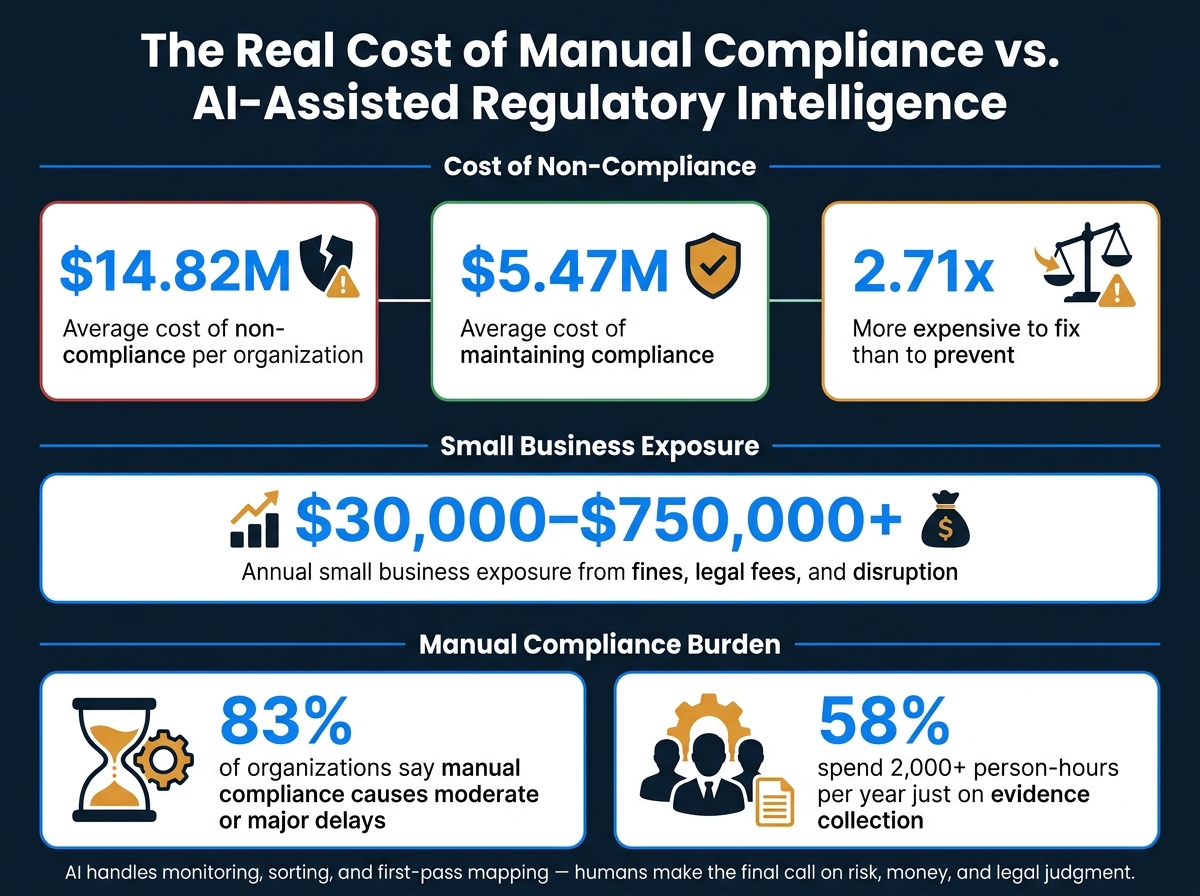
- 83% of organizations say manual compliance work causes moderate or major delays
- 58% spend more than 2,000 person-hours a year on evidence collection
- Non-compliance costs about $14.82 million on average, versus $5.47 million to stay compliant
- Small businesses can face $30,000 to $750,000+ a year in fines, legal fees, and business disruption
What changed for me in this model is simple: AI does the first pass on monitoring, sorting, and mapping. People still make the final call on risk, money, disclosures, and legal judgment.
The Real Cost of Manual Compliance vs. AI-Assisted Regulatory Intelligence
AI RegTech: Automating Financial Compliance and Regulation | Uplatz
sbb-itb-17e8ec9
Quick comparison
| Area | Manual process | AI-assisted process |
|---|---|---|
| Rule tracking | Staff checks sites and emails | Systems watch sites, feeds, and bulletins all day |
| Change review | Every update looks the same | Material edits get pushed to the top |
| Obligation mapping | Notes, spreadsheets, and back-and-forth | First-pass extraction of duties, triggers, and dates |
| Prioritization | Often based on arrival time | Based on exposure, deadline, and business impact |
| Audit prep | Scattered files and inbox threads | Time-stamped logs, linked docs, and decision history |
| Finance link | Often handled late | Costs, forecasts, and disclosures updated earlier |
I read this article as a simple playbook: define scope, automate monitoring, score risk, and connect compliance work to finance and board reporting. That’s the core idea.
Step 1: Define Your Regulatory Scope and Compliance Priorities
Before you add AI, get clear on which rules you need to track. Start with a focused inventory, not a perfect one.
List the Rules That Affect Your Business Model
Begin with your main exposure points: collecting data, paying workers, raising capital, filing taxes, and selling into regulated markets. Those are the places where one missed requirement can turn into a penalty or a cash-flow hit fast.
If you operate across multiple states or entities, things can get messy. Payroll tax, nexus, and privacy rules can overlap in ways that are easy to miss. A simple matrix - activity × jurisdiction - can help you spot where obligations pile up before you automate anything.
Then sort each obligation into one of three buckets:
- Critical
- Important
- Monitor-only
That way, limited legal and finance time goes to the highest-risk items.
Once your scope is clear, AI can monitor ONLY the rules that matter.
Measure the Cost of Slow Response
Next, set a baseline. Track the metrics that show how slow response is hurting you:
- Time to detect, interpret, and implement changes
- Missed deadlines
- Remediation cost
- Manual monitoring hours
- Audit findings
- Unclear ownership
The numbers here are hard to ignore. Research shows 83% of organizations say manual compliance work causes moderate or major delays in meeting regulatory requirements, and 58% dedicate more than 2,000 person-hours per year just to evidence collection. For a lean startup team, that’s time pulled straight from growth work.
The cost of doing nothing adds up fast. Non-compliance costs organizations an average of $14.82 million, compared with $5.47 million to maintain compliance - about 2.71x more expensive to fix than to prevent. For small businesses, annual exposure can range from $30,000 to $750,000+ once you include fines, legal fees, settlements, operational disruption, and lost business.
That baseline gives you something concrete to compare against when you move into AI monitoring in Step 2.
Step 2: Use AI for Monitoring, Obligation Mapping, and Alert Triage
Once you’ve set scope, AI can watch for rule changes and send your team only the updates that matter.
Automate Regulatory Monitoring and Change Detection
AI monitoring tools keep a constant eye on regulator websites, RSS feeds, API endpoints, and email bulletins. That includes sources like the SEC, IRS, FTC, CFPB, and state agencies. From there, the system sorts each document by jurisdiction, topic, and document type.
The big win here is change detection. AI can spot material updates instead of treating every edit the same way. So if a rule adds a new reporting threshold, updates a definition, or broadens enforcement scope, that gets flagged. If it’s just a formatting tweak or a cross-reference cleanup, it gets pushed down the list.
Each alert should carry a jurisdiction, topic, and urgency tag. A simple ranking system works well:
- Critical
- Important
- Monitor
That makes weekly review much easier and helps teams focus on what needs attention first.
The next job is turning those alerts into obligations people can actually work with.
Map New Rules to Policies, Controls, and Owners
Once a change is flagged, NLP-based obligation extraction can handle the first pass. The AI looks through the rule text for requirement language such as must, shall, or required to. It then turns each obligation into a structured record with fields like requirement, trigger condition, deadline, jurisdiction, and affected process.
Research shows strong accuracy when extracting obligations and linking them to related policy sections.
After that, the AI maps each obligation to the right policy, control, and owner through text matching. It should also attach citations to the source regulation, so legal or compliance reviewers can check the link back to the rule without digging around. Human review still matters here. AI does the first pass, and your team confirms the call.
Manual Tracking vs. AI-Enhanced Workflows: A Side-by-Side Look
The gap shows up fast: speed, accuracy, and the audit trail all improve.
| Dimension | Manual Tracking | AI Monitoring |
|---|---|---|
| Speed | Weeks between rule publication and awareness; 5–10 hours/week of staff time scanning sites | Updates surfaced within hours; dashboards refreshed daily |
| Accuracy | Prone to missed updates across multiple states; inconsistent interpretation | Broader coverage and more consistent classification; human review still required for final judgment |
| Audit Readiness | Scattered files and email trails; hard to prove when a rule was seen or acted on | Timestamped audit trail of alerts, assessments, decisions, and evidence attachments |
Once the AI has mapped the change, risk scoring shows what to fix first.
Step 3: Prioritize Compliance Action with AI Risk Scoring
Once AI maps obligations, the next move is to score each item by exposure, deadline, and business impact. That shifts alerts from a noisy stream into a ranked action list, providing real-time financial insights that help founders prioritize. And once the list is ranked, each item should move straight into reporting and evidence tracking.
Build Simple Risk Levels for Startup Decision-Making
A four-level model - Low, Medium, High, and Critical - gives non-specialists a simple way to act without a compliance background.
Use this rule set:
- Critical issues need CEO and CFO attention within 24–72 hours
- High issues need a clear owner and resolution within 7–14 days
- Medium items should be placed into a 30-day plan
- Low items should be monitored and grouped into routine cleanup over 60–90 days
That kind of structure matters. When everyone uses the same scale, decisions get a lot easier.
Use Risk Scores to Focus Limited Time and Budget
AI risk scoring works best when founders use it like a ranked to-do list, not a notification feed. The score shows where time and budget should go first.
For example, say your AI tool flags a Critical payroll tax alert tied to repeated late federal deposits, with estimated penalty and interest exposure of $35,000–$60,000. That should jump ahead of a Medium state sales tax rule change tied to less than $5,000 in exposure.
Even if the sales tax alert came in first, the score points to where the actual risk sits.
The rule of thumb is simple: Critical gets same-week executive attention, High gets scheduled work this sprint, Medium goes into the monthly compliance cycle, and Low stays on the radar without pushing aside higher-impact work.
Turn Risk Scores into Clear Action Plans
Risk scores only matter when they connect to clear next steps. The table below links each level to a recommended action, timeline, owner, documentation, and financial impact range.
| Risk Level | Recommended Action | Target Timeline | Owner | Documentation Needed | Example Financial Impact (USD) |
|---|---|---|---|---|---|
| Low | Monitor; batch routine cleanup. | 60–90 days | Operations or HR lead | Updated policies; internal process change logs | < $1,000 |
| Medium | Correct the filing and fix the process. | 30 days | Finance or compliance lead; payroll manager | Corrected filings; payroll or system reports; email confirmations with external advisors | $1,000–$10,000 |
| High | Treat as a project; assign budget and owner. | 7–14 days | CFO, controller, or head of people | Remediation plan; corrected filings; board minutes | $10,000–$100,000 |
| Critical | Escalate immediately; involve legal counsel. | 24–72 hours | CEO and CFO; legal counsel | Board minutes; investor communications; regulatory correspondence; evidence of remediation | > $100,000 |
AI platforms can attach evidence and keep a timestamped log for audits and investor diligence. Those records become the backbone for audit trails, board updates, and investor diligence. Once priorities are set, the next step is collecting the proof that shows each issue was handled.
Step 4: Connect Regulatory Intelligence to Finance, Reporting, and Investor Readiness
Once risk scores are set and action plans are assigned, regulatory intelligence should flow into budgets, forecasts, tax planning, and board reporting. In plain English: once an item is scored, it should turn into a budget line, a forecast update, or a disclosure item.
Build Evidence-Ready Reporting for Audits and Board Reviews
Every regulatory change your AI flags should leave a clear audit trail. That trail needs to connect the rule to a decision, a dollar amount, and a date. A simple decision log is often enough. Each entry should include the regulation reference, AI alert ID, owner, decision summary, approval date, assigned risk level, and estimated USD impact.
Supporting records - such as policies, SOPs, contracts, and vendor agreements - should sit in a document repository linked to the related regulation and decision entry, along with version history and last-updated dates. AI can auto-tag documents to the related rule, owner, and financial impact, while humans check the classification. That setup helps finance teams tie each obligation to a cost center or forecast line. You get a clean line from alert to financial impact.
Here’s what that can look like in practice:
- AI detects a new state privacy law
- The compliance owner estimates $25,000 to $50,000 in Q1 2027 spend for security tooling and legal review
- The team logs it as an operating expense line item
SEC ICFR guidance requires support for management's assessment, including control design documentation. For public companies, material changes in internal control over financial reporting must also be disclosed in quarterly and annual reports. A board package can then pull this together in one place, summarizing recent regulatory changes, top risks, and total financial impact, such as $120,000 in added Q2 2026 spend tied to privacy requirements.
Use Lucid Financials to Put Compliance Impact into Practice
A regulatory alert matters when it changes the forecast. That’s the moment when assumptions, runway, and tax treatment need to shift.
If a regulatory change affects your tax position - say, a newly available federal R&D credit or a change in payroll tax rates - Lucid can model the impact on after-tax cash flow, update forecast assumptions, and send the revised runway straight to Slack. If a compliance-driven expense, like legal review for a new data privacy rule or the rollout of new SOC 2 controls, needs to be booked, Lucid helps make sure it’s categorized the same way each time. That makes audit support much easier when someone asks, “Where did this compliance spend come from?”
Every AI-generated output is reviewed by a finance professional, so reporting stays accurate and ready for audit.
Conclusion: What AI Handles and Where Human Oversight Still Matters
AI speeds up detection and prioritization. Finance leaders still approve the money, disclosure, and risk decisions. The split is pretty clear: AI monitors rule changes, summarizes documents, maps affected policies, and creates first-pass risk scores. Founders and CFOs keep approval and disclosure authority, and every major compliance decision should be logged, time-stamped, and tied to a clear USD impact estimate.
FAQs
How do I decide which rules to track first?
Start with a gap analysis of your current operations.
Pull every requirement into one inventory:
Then map each one to your existing policies and controls. That makes it much easier to spot where you’re short on evidence, where a control doesn’t fully cover the rule, and where a standard still isn’t met.
Next, rank those gaps with a simple 3-point risk-and-effort rubric. Don’t try to fix everything at once. Start with high-risk, high-impact issues first, especially anything that blocks a launch or creates major day-to-day pain. After that, move to high-impact, low-effort work - the kind of tasks that can ease pressure fast without eating up weeks of time.
What parts of compliance can AI handle on its own?
AI can take on a lot of compliance work by itself, which cuts down on manual effort. It can review regulatory text in real time, connect new requirements to internal controls, and automate data collection, reconciliation, and validation across financial, payroll, and banking systems.
It can also monitor 100% of transactions for anomalies, screen against watchlists, and generate audit-ready reports with timestamped metadata.
How should startups review AI-generated compliance alerts?
Treat AI as a helper, not a stand-in for professional judgment.
Use a human-in-the-loop setup so clear owners - like legal, security, or finance leads - can check alerts against the company’s day-to-day context and fiduciary duties.
Put human review first for:
- High-stakes issues
- Low-confidence matches
- Complex judgment calls
If someone overrides an alert, document the decision and the reason behind it. That gives you an audit-ready trail.
It also helps to review alert rules every quarter to cut noise and improve accuracy.