If you wait for month-end reports, you can miss the moment to act. I’d sum it up this way: predictive risk assessment helps me spot cash pressure, slower collections, higher burn, tax payments, and runway drops before they turn into a problem.
Here’s the short version:
- It uses live financial data like bank activity, payroll, invoices, bills, and accounting records
- It turns that data into forecasts and alerts for cash, burn, runway, receivables, and tax timing
- It helps me act earlier on hiring, spending, collections, and fundraising
- It still depends on clean books and human review because bad data can lead to bad calls
A simple example shows why this matters. If cash is $600,000 and monthly net burn moves from $50,000 to $75,000, runway falls from 12 months to 8 months. That’s a 33% drop in runway. And with about 29% of startup failures tied to cash issues or an inability to secure more capital, early warning matters.
What I’d take from the article is simple: monthly reports tell me what already happened, while predictive monitoring helps me decide what to do next. The goal isn’t to replace finance review. The goal is to give me earlier signals, clearer scenarios, and more time to respond.
If I were putting the article into one plain takeaway, it would be this: better decisions come from seeing risk sooner, measuring its cash impact, and assigning a clear next step.
How Data Predicts Risk and Detects Fraud | Financial Analytics in Business
sbb-itb-17e8ec9
How Predictive Risk Assessment Works
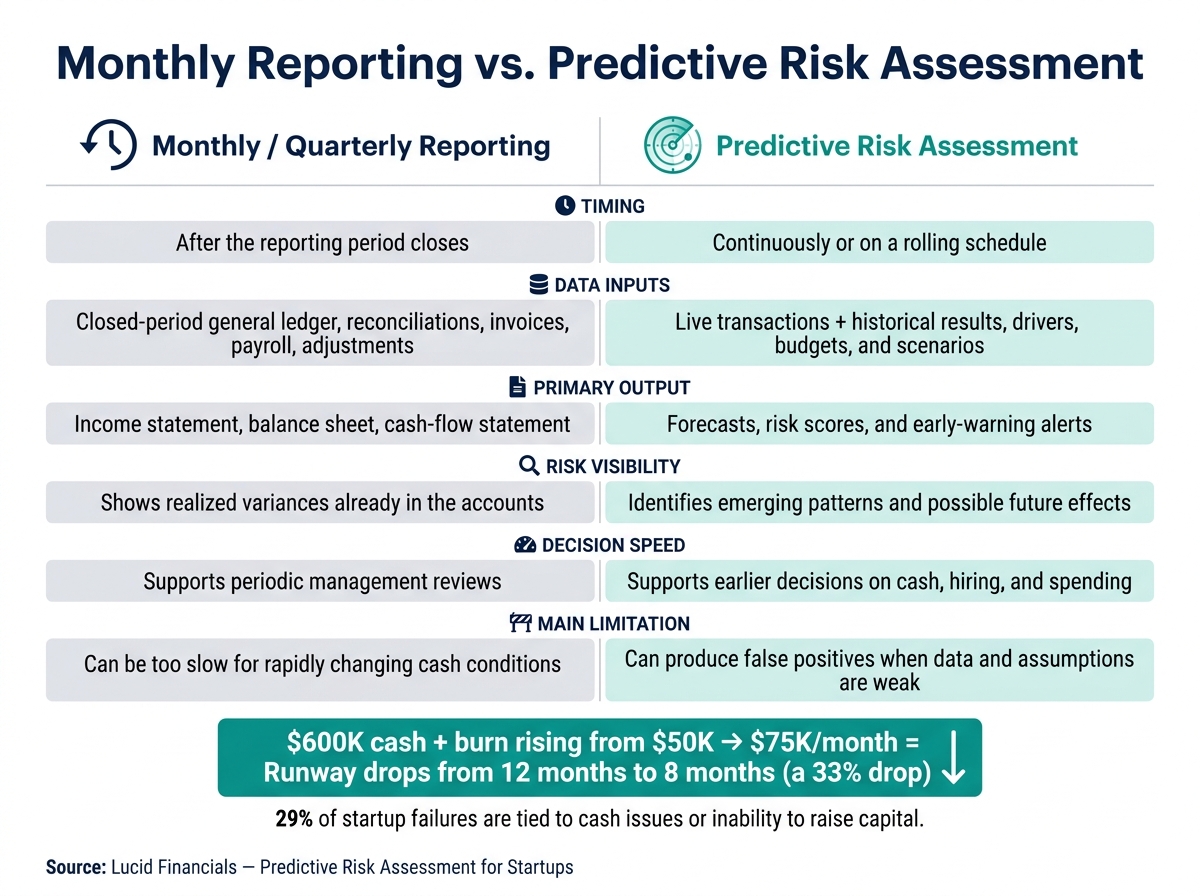
Monthly Reporting vs. Predictive Risk Assessment: Key Differences
From Live Financial Data to Forecasts and Alerts
The process starts with the raw financial data: the general ledger, bank and credit-card accounts, accounts receivable, accounts payable, payroll, billing systems, budgets, and tax records. If that data is messy or incomplete, the forecast won’t be much use. Weak inputs produce weak forecasts
After the inputs are cleaned up, the system starts looking for patterns. It checks current activity against historical trends, budgets, seasonality, and payment behavior. That’s how it spots signals like falling cash, a shorter runway, slower collections, or odd vendor charges.
From there, it turns those signals into forward-looking outputs, such as a cash forecast, risk score, or alert. A good alert shouldn’t just wave a red flag. It should explain what changed, why it matters, what the likely effect is, and what to check next. For example, runway could drop from 14 to 9 months over two quarters, which could push a team to review hiring plans and software spend that isn’t mission-critical
Monthly Reporting vs. Predictive Risk Assessment
Monthly reporting looks backward. Predictive monitoring looks ahead. You don’t pick one over the other. They work best side by side
| Dimension | Monthly/Quarterly Reporting | Predictive Risk Assessment |
|---|---|---|
| Timing | After the reporting period closes | Continuously or on a rolling schedule |
| Data inputs | Closed-period general ledger, reconciliations, invoices, payroll, and adjustments | Live transactions plus historical results, drivers, budgets, and scenarios |
| Primary output | Income statement, balance sheet, and cash-flow statement | Forecasts, risk scores, and early-warning alerts |
| Risk visibility | Shows realized variances already in the accounts | Identifies emerging patterns and possible future effects |
| Decision speed | Supports periodic management reviews | Supports earlier decisions on cash, hiring, and spending |
| Main limitation | Can be too slow for rapidly changing cash conditions | Can produce false positives when data and assumptions are weak |
That gap matters. Monthly reports tell you what already happened. Predictive risk assessment gives founders a shot to step in before month-end reporting catches up.
Why Model Quality Depends on Data and Review
Forecasts are estimates, not promises. A model can still point you in the wrong direction if the books are incomplete or the assumptions don’t line up with what’s happening in the business.
A few common issues show up again and again:
- Missing bank feeds, unrecorded bills, or unreconciled transactions can make cash and expenses look lower than they are
- Inconsistent categorization can throw off trend comparisons
- A forecast may assume every invoice gets paid on time even though the actual collection cycle is 45 days
That’s why forecasts still need review. Data quality shifts. Business conditions shift too. A new pricing model, a different customer mix, or a financing round can make past patterns less useful than they looked on paper.
Before any major decision, finance review still matters. When an alert shows up, it should kick off a review process: verify the source data, test the assumptions, look at the business context, and compare at least a base case with a downside scenario. The model points to the signal. Finance review decides whether that signal calls for action
How Early Warnings Lead to Better Financial Decisions
Using Alerts to Manage Cash, Hiring, and Spending Earlier
Once a risk signal is reviewed, the next step is simple: turn it into a decision.
If a signal shows up - say, collections are slipping or burn is creeping up - the first job is to find the cash-flow driver behind it and put a dollar figure on the change. A simple runway calculation is cash balance divided by monthly net burn.
Here’s what that looks like in practice: if a startup has $600,000 in cash and monthly net burn climbs from $50,000 to $75,000, runway drops from 12 months to 8 months. That four-month gap isn’t abstract. It gives a founder something concrete to act on.
Once the signal is measured, compare the updated runway with the minimum cash reserve. At that point, the menu of responses gets a lot clearer. You might pause nonessential software purchases, renegotiate vendor terms, speed up receivables collection, tighten payment terms for new customers when it makes sense, or rebuild the cash buffer.
The order matters. Start with moves that are easy to reverse, like pausing discretionary spend or delaying nonessential contractors. Those should come before permanent steps like cutting headcount.
Use the same lens for hiring. Before approving a role, compare its all-in monthly cost against runway and the milestones that role is supposed to help hit. A hire may look fine on paper, but if it shortens runway too much before the next key milestone, that’s a red flag.
The same thinking applies to bigger calls like fundraising and tax timing.
Improving Fundraising, Budgeting, and Tax Planning
Predictive monitoring also changes when teams make larger decisions.
On fundraising, a forecast might show 14 months of runway in the base case but only 10 months if a round closes two months late. That kind of gap gives the team a clear push to move earlier, not later. It can mean starting investor outreach sooner and trimming spend before the round turns urgent.
For tax planning, flag the next estimated-tax deadline, estimate the liability, and compare it with available cash. The forecast can also surface eligible research, hiring, or other credits early enough to gather supporting records before filing. Eligibility should still be confirmed with a qualified tax professional.
A Simple Response Framework for Each Risk Signal
Every alert should follow the same five-step sequence so it leads to action instead of just sitting in a dashboard:
- Identify the signal
- Estimate the impact
- Test two responses
- Assign an owner and deadline
- Measure the result
For example, a late-collections alert might lead to a hiring freeze, delayed spend, and collection of overdue invoices, followed by a forecast refresh two weeks later.
What a Reliable Real-Time Risk Monitoring System Requires
The Financial Data Foundation Startups Need First
Predictive monitoring is only as good as the data going into it.
Start with reconciled books. Your bank, card, payroll, AR, AP, debt, and tax balances should match the ledger. Then look at your chart of accounts. It needs to stay consistent from month to month. Payroll, contractors, software subscriptions, marketing, and cost of goods sold should be coded the same way each time. Even small coding slips can throw off burn trends and weaken forecasts.
You also need connections to the systems where financial activity starts: bank and credit-card accounts, payroll, billing and payment processors, accounts receivable, accounts payable, expense tools, and tax records. The point is simple: alerts need to show up early enough to change cash, hiring, and spending decisions.
If an integration breaks, the system can't quietly treat missing data as zero. That's how bad calls get made. It should flag the gap, show which metrics are affected, and follow a documented fallback process until the feed is back.
Two controls matter most here.
- Limit each employee to the data and actions their role needs. Where possible, split data entry, approval, payment, and reconciliation duties.
- Keep an audit log for changes to account mappings, forecast assumptions, and alert thresholds, so you can trace why a number moved.
Core Metrics to Monitor Continuously
Once the data layer is clean, watch the handful of metrics that shape cash and runway first. The table below covers the minimum set for tracking financial risk in real time.
| Metric | Why it matters |
|---|---|
| Cash balance | Immediate liquidity; should match bank after accounting for restricted or committed cash |
| Gross and net burn | Shows which expense categories are growing fastest and whether cash use is on plan |
| Runway | Cash balance ÷ net monthly burn; track under base, upside, and downside scenarios |
| Revenue and collections | Shows whether customers are paying on schedule, not just whether revenue is booked |
| Gross margin | Confirms that growth is producing enough contribution to support added spending |
| Accounts receivable and payable | Surfaces overdue invoices and upcoming vendor obligations before they turn urgent |
| Forecast-versus-actual variance | Shows which assumptions keep missing; variance above 15% should trigger an assumption review |
| Tax obligations | Payroll, sales, and estimated income taxes need cash reserved and deadlines tracked |
Some of these need close attention more often than others. Cash balance, burn, runway, collections, and large payments may need daily or weekly review. Payroll, accounts payable, accounts receivable aging, and forecast-versus-actual variance are often checked weekly. Revenue trends, gross margin, operating expenses, and headcount can usually sit in a formal monthly review. Tax obligations should be checked after taxable activity and again before each filing or payment deadline.
Benefits and Limits of Predictive Monitoring
Predictive monitoring can speed up decisions, but it doesn't remove uncertainty. It helps you see trouble sooner. It does not promise perfect forecasts.
| Aspect | What it means in practice |
|---|---|
| Earlier intervention | Falling collections or rising burn can trigger action before a crisis; set thresholds that route alerts to specific owners |
| Faster analysis | Automation cuts the time spent pulling together cash and spending data, but it doesn't replace review |
| Stronger scenario planning | Base, upside, and downside cases make hiring, fundraising, and spending decisions easier to stress-test |
| Data dependency | Stale feeds, duplicate entries, or miscategorized transactions distort results and create false signals |
| Model uncertainty | Forecasts depend on assumptions about revenue timing, churn, and costs - they show a range of outcomes, not a promise |
| Privacy exposure | Bringing payroll, banking, tax, and customer data into one place increases the stakes for access controls and secure integrations |
| False positives | A delayed bank transaction or one-time payment can trigger a misleading alert; investigate before acting |
| Human oversight | Finance teams must interpret unusual results and approve major decisions - automation supports judgment, it doesn't replace it |
Those controls are what make alerts useful instead of just more noise.
Applying Predictive Risk Assessment with Lucid Financials
How Lucid Financials Supports Earlier Financial Decisions
Once the data foundation is set, the next move is using it to make better calls. Predictive risk assessment works best when live financial data feeds forecasts, alerts, and next steps. Lucid Financials is an AI-powered accounting platform that brings bookkeeping, tax, forecasting, and CFO support into one workflow built for startups.
That setup matters when teams need to act early, not late. Say payroll is about to climb after a planned hiring round. Scenario modeling can show how that shift changes monthly burn and runway before the first offer goes out. If a quarterly estimated tax payment is around the corner, it can be built into the cash forecast so founders don’t confuse earmarked cash with money they can spend on operations. What-if modeling lets teams test hiring, fundraising, and spending before they commit.
Lucid also makes day-to-day decision-making easier. Founders can ask in Slack for real-time answers on runway, spend, and performance. Investor-ready reports are available right away, which helps teams stay ready for board meetings and diligence requests.
Why Clean Books and Human Review Matter
None of that works if the books are out of date or messy. Lucid’s AI-powered bookkeeping and reconciliation process delivers clean books soon after onboarding, so forecasts and alerts rely on current, accurate data instead of stale or miscategorized transactions. With always-updated reporting, runway and burn calculations reflect the latest position.
Automation does a lot of the heavy work, but it doesn’t act alone. Every AI-generated output is reviewed by Lucid’s finance professionals before it shapes a decision. That human check helps sort out a real trend from a timing issue, so founders can move with more confidence.
Conclusion: From Reactive Reporting to Better Financial Control
Clean data, clear thresholds, and human review help turn alerts into better financial control. Used this way, predictive monitoring helps startups act earlier on cash, hiring, and spend.
FAQs
How is predictive risk assessment different from a cash forecast?
A cash forecast estimates future income and expenses so you can see your expected cash position. Predictive risk assessment takes that a step further by spotting threats that could throw those numbers off.
Put simply, a cash forecast shows what’s likely to happen to your bank balance. Predictive risk assessment works like an early warning system for problems such as slow-paying customers or unusual spending spikes.
What data do I need before predictive monitoring works well?
Predictive monitoring works best when your data is clean, consistent, and pulled together in one place.
That usually means centralizing core systems like accounting, banking, payroll, and CRM. You’ll also want standardized historical financial statements and transaction logs, with 12 to 18 months of data if possible.
Consistency matters more than people think. Use the same format across the board, including dates like MM/DD/YYYY and currency like $1,000.00. On top of that, keep a close eye on key metrics such as burn rate, cash runway, CAC, and churn.
It also helps to review your data on a regular basis. Fix duplicates, fill in missing fields, and clean up labeling problems before they turn into bigger reporting headaches.
How often should I review risk alerts and update assumptions?
Use a tiered schedule. Review live risk alerts - like transaction velocity and utilization shifts - weekly so you can spot early warning signs before they turn into bigger problems.
Then, during monthly closes, check model calibration and drift, including PSI, to make sure predictions still line up with actual outcomes. As market conditions and business needs shift, revisit assumptions on a regular basis with financial experts.