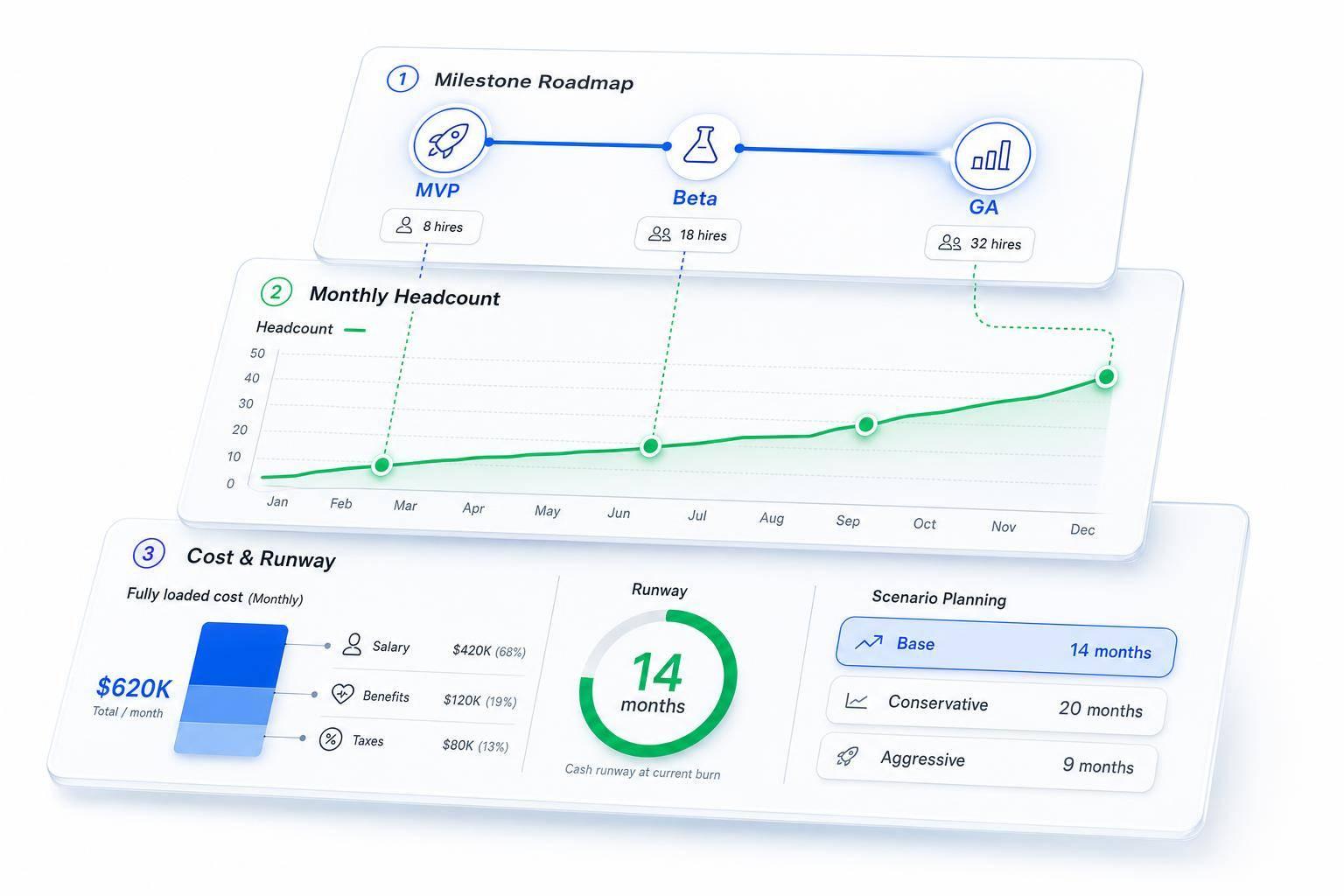
If I had to cut this down to one takeaway, it would be this: the right finance tool depends on whether you need runway tracking, SaaS revenue planning, board reporting, or an all-in-one finance setup.
I’m comparing six tools here: Lucid Financials, Fathom, Finmark, LivePlan, ChartMogul, and Float. The article looks at how each one handles forecasting, cash runway, integrations, reporting, and startup fit. It also points out the main tradeoffs, like depth vs. simplicity and cash tracking vs. full finance planning.
A few points stand out right away:
- Lucid Financials fits startups that want forecasting, bookkeeping, tax help, and CFO support in one place.
- Fathom is more about reporting and multi-entity views than active planning.
- Finmark is aimed at SaaS forecasting, especially headcount, churn, and runway.
- LivePlan works for founders who want simple planning without much setup.
- ChartMogul is best for subscription revenue tracking, not full cash planning.
- Float is built for real-time financial insights and runway monitoring at a lower monthly cost.
The article also ties this back to startup decisions you may be making now, such as:
- hiring
- changing spend
- fundraising
- board updates
- tracking runway month to month
And the big warning is simple: even the best forecast breaks if the source data is messy.
One stat sets the context: 68% of finance leaders said they saw fewer reporting errors after using AI-driven financial modeling tools. So this is not just about saving time. It can affect how clean your numbers are and how fast you can make a call.
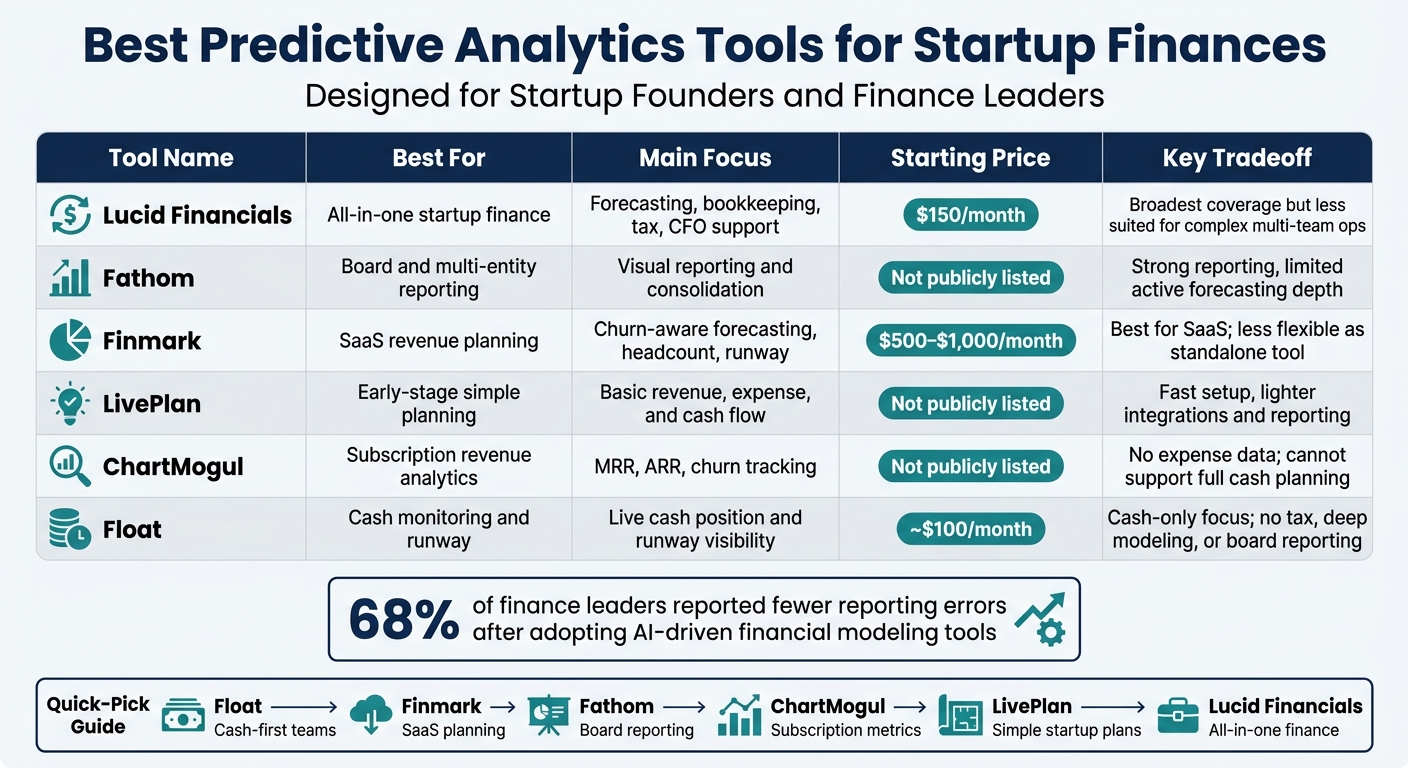
Best Predictive Analytics Tools for Startup Finances: Side-by-Side Comparison
Quick Comparison
| Tool | Best For | Main Focus | Starting Price / Range |
|---|---|---|---|
| Lucid Financials | All-in-one startup finance | Forecasting, bookkeeping, tax, CFO support | $150/month |
| Fathom | Board and multi-entity reporting | Visual reporting and consolidation | Not listed in the article |
| Finmark | SaaS planning | Forecasting, churn, headcount, runway | $500 to $1,000/month |
| LivePlan | Early-stage planning | Basic revenue, expense, and cash flow planning | Not listed in the article |
| ChartMogul | Subscription analytics | MRR, ARR, churn tracking | Not listed in the article |
| Float | Cash monitoring | Live cash position and runway | About $100/month |
If you want the short version, I’d frame it like this: Float is for cash-first teams, Finmark is for SaaS planning, Fathom is for reporting, ChartMogul is for subscription metrics, LivePlan is for simple startup plans, and Lucid Financials is for founders who want more finance work handled in one system.
sbb-itb-17e8ec9
1. Lucid Financials
Lucid Financials combines bookkeeping, tax, and CFO support with AI-driven planning for startups. What stands out is the way it ties forecasting to the financial data behind it, so teams aren't planning off stale numbers.
Pricing starts at $150/month.
Scenario Planning
Lucid uses AI scenario planning and what-if analysis to model hiring, marketing spend, burn rate, runway, and milestone timing.
That means a startup can test a few paths before making a move. Add a new hire? Increase ad spend? Push back a launch by a month? Lucid maps out how those changes affect the numbers, and that flows straight into cash planning.
Cash Runway Monitoring
Lucid tracks cash flow and runway in real time. It also sends Slack alerts when spending patterns point to runway risk.
For lean teams, that's a big deal. Instead of digging through spreadsheets to spot trouble, they can get a heads-up while there's still time to act.
Data Integrations
Lucid pulls live data from accounting, bank, and payment systems so forecasts stay current. It connects to QuickBooks, Xero, bank feeds, and payment processors, and it supports multi-entity setups.
In plain English: the forecast updates off the systems a company already uses. That's a lot better than copying numbers by hand and hoping nothing gets missed.
Planning and Reporting Fit
Lucid produces investor-ready projections and board reports, which helps during fundraising and board meetings. CFO support is available through Slack, and Lucid presents it as a lower-cost option than hiring a full-time finance lead.
For startups that want forecasting, reporting, and finance operations in one place, Lucid keeps the workflow centralized.
2. Fathom
Fathom stands out here when a startup needs clear forecasting, reporting, and planning in one place. It connects to accounting platforms and turns the numbers into performance reports, essential financial metrics tracking, and consolidated financials.
The product leans heavily on visual reporting and multi-entity consolidation. That makes it a good fit for founders who need clean, board-ready reports and a simple way to see how the business is doing over time.
3. Finmark
Finmark is built for startups that want simple forecasting and budgeting without a lot of setup. It shows how hiring plans, spending, and churn can change your runway, which is often the number founders and finance teams watch most closely.
Forecasting Depth
Finmark leans more into active planning than backward-looking reporting. In plain English, it helps teams shape the plan, not just review what already happened.
It supports scenario modeling, AI-driven churn prediction for more accurate revenue forecasting, and headcount planning that factors in salary costs, benefits, onboarding expenses, and productivity ramp-up by department.
Cash Runway Monitoring
Cash can change fast at a startup. Finmark pulls data from accounting systems and bank feeds to give teams real-time burn rate and runway visibility. It also sends AI alerts when spending patterns shift, so finance leaders can spot changes before they turn into a bigger problem.
Startup Data Integrations
Those alerts only matter if the source data stays up to date. Finmark connects to QuickBooks, Xero, and NetSuite for accounting, Stripe for payments, payroll platforms for headcount costs, and CRMs like Salesforce and HubSpot for revenue forecasting. Implementation usually takes one to two weeks.
Planning and Reporting Fit
Finmark also helps with the work that tends to eat up time every month. It automates board reports with consistent metrics and variance analysis, and it generates investor-ready projections for fundraising.
Pricing sits in the $500 to $1,000 per month range. That puts it in a solid middle ground for startups that need fast planning and cleaner reporting, but don't want the weight of more complex finance software.
4. LivePlan
LivePlan is built for straightforward startup planning. It helps founders turn assumptions into simple cash decisions.
The tool projects revenue, expenses, and cash flow. It also tracks burn rate and runway, so founders can test hiring, marketing, and product spend against cash limits.
That matters when you need to make fast calls. Instead of staring at static projections, founders can use LivePlan to see how spending choices might affect the business before they commit.
5. ChartMogul
For subscription startups, the focus shifts from broad company planning to the health of recurring revenue.
ChartMogul is built for subscription businesses.
Forecasting Depth
ChartMogul tracks MRR, ARR, and churn, which gives subscription startups a tight view of recurring revenue trends. It’s a revenue analytics tool, not a full planning system.
Cash Runway Monitoring
For cash planning, the gap is pretty clear: ChartMogul pulls billing data but doesn’t bring in expense data, so payroll, rent, and other operating costs don’t show up in the picture.
Planning and Reporting Fit
ChartMogul works best as a subscription revenue dashboard. You can use it to see whether recurring revenue looks strong enough to back hiring or expansion. Its strength is visibility into subscription revenue, not full financial planning.
6. Float
Float is built for one job above all: showing founders their cash position and runway in real time. That matters when you're trying to decide whether it's safe to hire, increase spend, or hit pause on growth.
Forecasting Focus
Float centers on live cash visibility and runway tracking. It pulls in current data so founders can see where cash stands right now and how long it may last.
Cash Runway Monitoring
Float tracks burn rate and runway in real time. AI alerts point out spending changes that could put runway at risk. At about $100 per month, it's one of the lower-cost options for runway tracking.
That tradeoff stands out when a founder has to pick between clear runway visibility and deeper planning tools.
Startup Data Integrations
Float connects with QuickBooks, Xero, direct bank feeds, and Stripe to keep cash flow data up to date.
Planning and Reporting Fit
Float includes scenario modeling for hiring and marketing changes, so founders can test those moves against cash flow before making them. It also automates recurring board reports.
That makes Float a strong fit for runway monitoring first, while broader planning needs come up in the tradeoffs section. Those differences matter most when you compare tools based on use case.
Tradeoffs by Use Case
No tool fits every startup. The best pick comes down to your stage, your finance setup, and the decision in front of you.
This table turns product differences into day-to-day startup choices. In plain terms: it matches common startup scenarios with the tool that makes the most sense.
| Startup Use Case | Best-Fit Tool(s) | Primary Strength | Key Tradeoff |
|---|---|---|---|
| Pre-seed runway planning | Lucid Financials, Float | Live runway visibility | Float is narrower; Lucid adds broader finance operations. |
| SaaS revenue forecasting | Finmark | Churn-aware revenue forecasting | Best when churn forecasting matters enough to move off spreadsheets. |
| Fundraising prep | Lucid Financials | Multi-statement projections for investor review | Only works well with clean, current data. |
| Ongoing board reporting | Lucid Financials | Live variance tracking for board updates | Reporting quality depends on upstream data hygiene. |
| Short-term cash management | Float, Lucid Financials | Live cash position and runway visibility | Float stays focused on cash tracking, while Lucid bundles bookkeeping, tax, and CFO support. |
Setup speed is the next filter. Lighter tools can go live fast. More configurable platforms usually take longer to set up, which can be fine if you need more depth.
Then there’s the tradeoff between automation and control. AI-native platforms cut down manual finance work, which is a big deal for lean teams. But there’s a catch: they rely on clean source data from day one. If the numbers going in are messy, the output will be too.
Pros and Cons
Use this table as a fast filter after the use-case comparison.
| Tool | Key Pro | Key Con | Best-Fit Startup Profile |
|---|---|---|---|
| Lucid Financials | All-in-one platform covering bookkeeping, tax, and CFO support with real-time visibility | Less useful for complex multi-team finance operations | Seed to Series A U.S. startups that want a single finance layer |
| Fathom | Strong visual reporting and multi-entity consolidation for board-ready output | Limited forecasting depth; better for reporting than active planning | Startups with multiple entities that need clean, consolidated financials |
| Finmark | Churn-aware revenue forecasting built for SaaS planning | Less flexible as a standalone tool | SaaS startups focused on subscription metrics and headcount planning |
| LivePlan | Fast setup for basic revenue, expense, and cash flow projections | Lighter on integrations and reporting depth | Early-stage founders who need simple planning without a finance team |
| ChartMogul | Tight visibility into MRR, ARR, and churn trends | No expense data, so it can't support full cash or runway planning | Subscription startups tracking revenue health, not total financials |
| Float | Narrower cash-only visibility with fast setup | Doesn't cover tax, deep modeling, or board reporting | Cash-conscious startups prioritizing runway management above all else |
These tradeoffs usually come down to three things: data depth, workflow breadth, and how much manual finance work your team can take on.
Conclusion
After looking at the features and tradeoffs, the choice comes down to three things: your stage, how fast you need to make decisions, and the quality of your data. Pick the tool that fits those three factors.
If you're an early-stage founder and just need a clear view of cash flow plus basic projections, you probably don't need a complex platform.
If your startup wants bookkeeping, tax support, R&D credits, CFO support, and real-time forecasting in one place, Lucid Financials starts at $150/month.
Before you commit, clean up your books first. A forecast is only as good as the data behind it.
Go with the tool your team will actually use, keep it tied to live data, and make sure it fits where your company is right now.
FAQs
How do I know which finance tool fits my startup stage?
Pick the tool that fits the main problem in front of you. For early-stage teams, that usually means getting to cash flow fast, seeing runway clearly, modeling different paths with very little past data, setting things up without a long delay, and keeping data clean in one place.
You’ll also want to make sure it connects to the systems you already rely on, such as accounting, banking, and payroll. On top of that, it should support real-time forecasting and give you best-case, worst-case, and base-case scenarios, along with reports you can put in front of investors without a scramble.
Lucid Financials checks those boxes with real-time data, AI scenario forecasts, and clean books delivered quickly.
What data do I need before using predictive finance software?
Before you use predictive finance software, get your data in shape first. Clean, centralized data is the starting point. If your numbers live in different places and don’t match, the software won’t help much.
Connect your core systems - accounting, banking, payroll, and CRM - so data moves in real time. That way, you’re not piecing together reports by hand or working from stale numbers.
Then pull together and standardize your historical financial statements, transaction logs, and core metrics like burn rate, cash runway, CAC, and churn. Keep categories and formatting consistent across the board. For example, use MM/DD/YYYY for dates and $1,000.00 for amounts.
It also helps to fix data quality issues before you do anything else. Duplicate entries, missing fields, and messy labels can throw off forecasts fast.
Can predictive analytics improve runway and fundraising decisions?
Yes. Predictive analytics helps founders make better runway and fundraising calls by moving them away from static, error-prone spreadsheets and into dynamic, real-time forecasting.
It gives you a way to model scenarios like delayed funding, hiring plans, or market pivots and see how each one affects cash flow and runway. With 92–97% forecasting precision, it can spot funding gaps months in advance and help teams make stronger, investor-ready decisions.