A founder exit can create wealth fast, but it can also leave you with tax bills, stock risk, and no clear income plan. If you want the short version: build a personal balance sheet, hold at least 12 months of living costs in cash, reduce concentrated stock over time, and update your estate and family plans soon after the deal closes.
Here’s what matters most:
- 70% of business owners expect sale proceeds to fund life after exit
- Many founders still have wealth tied up in lockups, earn-outs, or retained shares
- A written sale plan can help you avoid emotional decisions
- Tax timing matters for capital gains, QSBS, RSUs, and options
- Estate documents and family governance often lag behind new wealth levels
- Only 30% of family businesses make it to the second generation
- Firms with a formal succession plan are 2.5x more likely to outperform peers on revenue growth and market share
If I were summarizing the article in one line, it would be this: after an exit, my job shifts from building the company to protecting cash, lowering stock concentration, and setting up long-term wealth transfer.
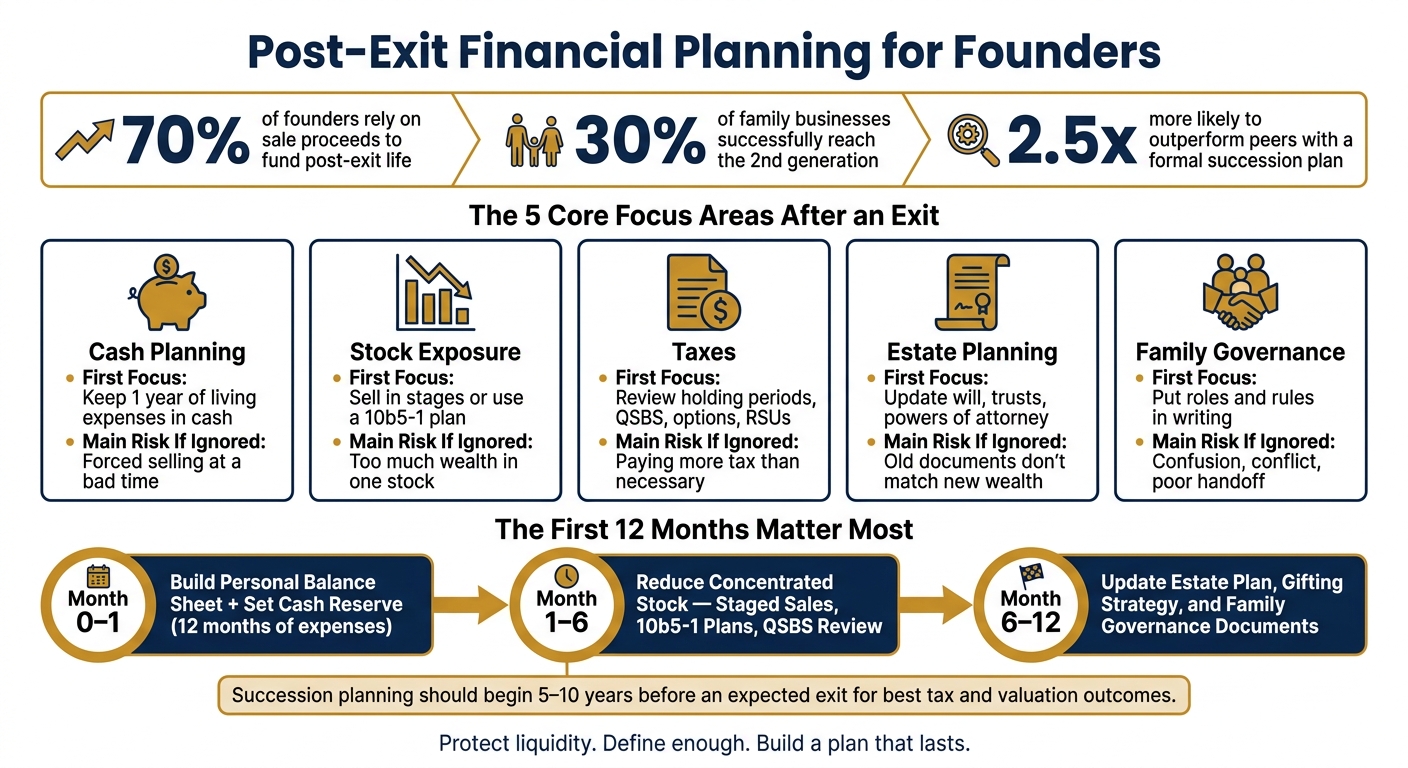
Post-Exit Financial Planning: Key Areas, Actions & Risks for Founders
Quick Comparison
| Area | What I’d focus on first | Main risk if ignored |
|---|---|---|
| Cash planning | Keep 1 year of living expenses in cash | Forced selling at a bad time |
| Stock exposure | Sell in stages or use a 10b5-1 plan if needed | Too much wealth in one stock |
| Taxes | Review holding periods, QSBS, options, and RSUs | Paying more tax than needed |
| Estate planning | Update will, trusts, and powers of attorney | Old documents no longer fit new wealth |
| Family governance | Put roles and rules in writing | Confusion, conflict, and poor handoff |
This article is about what to do after the money hits: slow down, make a plan, and decide what “enough” looks like before making big moves.
sbb-itb-17e8ec9
What Studies Show About Founder Wealth After a Liquidity Event
Common Wealth Patterns After an Exit
Most founders come out of a liquidity event with a lot of their wealth still tied to company stock, no matter how the exit happens.
That matters more than it may seem at first glance. Earn-outs, lockups, and unvested equity can keep a founder’s money tied up for years after closing. On paper, the number may look big. In practice, that wealth can still carry heavy concentration risk.
How the exit is set up affects how soon a founder can do anything about it.
| Exit Structure | Liquidity Timing | Key Financial Risk |
|---|---|---|
| Full Acquisition | Mostly immediate | Market entry timing |
| IPO with Lock-Up | Delayed by lock-up period | Concentration in public stock |
| Earn-Out | Phased over years | Delayed diversification and tax complexity |
| Secondary Sale | Partial and staggered | Planning lag |
The structure sets the limits. Behavior decides how fast risk comes down.
How Founder Goals Shape Financial Decisions
Founders often place too much value on stock they know well. That familiarity can feel safe, even when the case for diversification is plain.
There’s also a big mental shift after an exit. Going from salary to living on investment income can feel unsettling. And that stress can lead people in two bad directions at once: chasing yield or putting off diversification. Both can damage long-term results.
In partial exits, retention equity changes the mindset too. Instead of trying to get the highest return, many founders start leaning toward reducing uncertainty.
Where Founders Are Often Underprepared
The studies point to a simple issue: deal structure is only half the story. Execution is the other half.
After the exit closes, mistakes tend to show up in a predictable order. First in behavior. Then in taxes. Then in legacy planning.
Written plans are uncommon, and many founders react to market moves instead of sticking to a written sell plan. Sale schedules are often missing, so decisions get made in the moment.
Tax coordination is another weak spot. Poor timing around RSU vesting, option exercises, and reinvestments can increase taxes.
Estate planning is often behind too. Wills and broader estate plans may no longer match the new size of a founder’s wealth.
That’s why the first 12 months matter so much for taxes, liquidity, and diversification.
The First 12 Months: Tax, Liquidity, and Diversification
Build a Personal Balance Sheet and Cash Plan
Once the exit closes, the first move is simple: steady the cash and get a clear view of what you own and what can still swing in value. Put everything in one place: exit proceeds, retained shares, unexercised options, RSUs, real estate, insurance policies, debt, cash, and any equity that hasn’t settled yet.
That gives you a personal balance sheet you can actually use. Not a pile of accounts and PDFs. One view of assets, liabilities, cash, and pending equity.
Next, set a cash reserve. Founders should keep at least one year of living expenses in cash right after a liquidity event. That buffer buys time. It helps you avoid selling stock or making rushed money moves just to cover day-to-day spending.
It’s also smart to review umbrella liability coverage after the liquidity event. A sharp jump in liquid net worth often means your old coverage no longer matches your situation.
Manage Concentrated Stock and Tax Exposure
Once cash is set aside, the next job is reducing concentration without creating taxes you could have planned around. After an exit, the target changes. This is no longer about squeezing out every bit of upside. It’s about cutting risk in a measured, tax-aware way.
That usually means selling in steps instead of all at once.
A few rules matter here:
- Holding appreciated assets for more than 12 months can qualify gains for lower long-term capital gains rates.
- If your company went public, a 10b5-1 plan can schedule sales in advance and help lower concentration risk while staying within trading rules.
- Check whether your shares qualify for Section 1202 (QSBS), which can exclude up to 100% of federal capital gains on eligible stock.
This is where planning matters most. The wrong sale timing can turn a smart de-risking move into a bigger tax bill than needed.
Comparison Table: Diversification Approaches After an Exit
Founders tend to use a small set of tools to diversify after an exit. Each comes with trade-offs around cash access, setup difficulty, and taxes. Some are simple and direct. Others ask for patience or more legal and tax work.
| Diversification Approach | Liquidity | Complexity | Tax Impact | Founder Fit |
|---|---|---|---|---|
| Staged Sales | High | Low | Immediate capital gains tax | Founders needing immediate cash flow |
| 10b5-1 Plans | Moderate | Moderate | Standard capital gains, spread over time | Insiders and executives with trading restrictions |
| Exchange Funds | Low (typically 7-year lockup) | High | Tax-deferred diversification | Founders with highly concentrated stock |
| Installment Sales | Low | Moderate | Tax liability spread over payment years | Founders who don't need all proceeds upfront |
| Charitable Trusts (CRAT/CLT) | Low | High | Income and estate tax deduction | Founders with significant philanthropic goals |
"Define how much is enough before deciding how much to sell and how fast to diversify." - Matthias Giezendanner, San Francisco Wealth Planning
Long-Term Wealth, Family Planning, and Governance
After the first-year de-risking phase, the job changes. It’s no longer mostly about trimming exposure. Now it’s about setting up wealth to last.
Portfolio Design After Founder Wealth Becomes Liquid
Liquidity usually doesn’t show up all at once. Lock-ups, earn-outs, and unvested equity can spread cash inflows across months or even years. That’s why the long-term allocation plan matters more than any one move you make right after liquidity hits.
A sensible approach is to build around a diversified mix of cash, public equities, bonds, real assets, and a small private allocation.
Once that portfolio is in place, the next issue is just as big: how the assets move from one generation to the next.
Estate, Gifting, and Legacy Planning in the U.S.
In the U.S., the core estate plan usually starts with a will, a durable power of attorney, and the right trust setup. Revocable trusts can help avoid probate. Some irrevocable trusts can also add creditor protection and remove assets from your taxable estate. Dynasty trusts are built for multi-generational wealth and can help keep assets in the family for future generations where the trust structure permits it.
Gifting is another major tool. The federal annual gift tax exclusion lets you give $18,000 per recipient, or $36,000 for married couples, without filing a gift tax return. The lifetime exemption is $13.61 million per person and $27.22 million for married couples. Many founders choose to gift assets with strong upside instead of cash, so future growth happens outside the taxable estate before that value builds further.
Philanthropy often fits neatly into this stage too. Donor-advised funds, or DAFs, give you an immediate income tax deduction and allow assets to grow tax-free until they’re granted to charity. If tighter control matters more, a private foundation can do that, though the deduction limits are stricter, generally 30% of adjusted gross income for cash contributions.
If family or operating-company interests are still in the picture, the planning can’t stop at tax tools and legal documents. Governance needs to line up with the transfer plan.
Succession Planning for Family and Business Interests
When ownership or control stays in place after an exit, informal family understanding isn’t enough. Written governance starts to matter a lot more. Founders who keep board seats, family ownership stakes, or operating businesses take on real risk if nothing is documented.
The numbers make that plain. Only 30% of family businesses successfully make it to the second generation, and companies with a formal succession plan are 2.5 times more likely to beat peers in revenue growth and market share.
What helps? Clear structure.
- Set up an independent board or advisory council
- Document standard operating procedures
- Hold formal family meetings to align on values and expectations
Those steps form the base of governance that can hold up over time. A documented plan and a credible valuation can also improve buyer confidence and support value. Research points to an early start as well: succession and estate planning should begin 5 to 10 years before an expected exit to improve valuation and tax outcomes.
"A proactive and meticulously crafted executive transition framework is no longer merely prudent; it is a fiduciary duty." - JRG Partners
Conclusion: What Founders Should Do Based on the Evidence
Key Takeaways for Founders and Startup Operators
An exit is a financial and governance shift. It changes the job from chasing growth to managing what you've built. In the first year, the goal is simple: turn a sudden liquidity event into a calm, written plan. A sell plan, a cash reserve, and staged diversification can help cut concentration risk and keep emotion from driving big money calls. And because many founders lean on sale proceeds for what comes next, it helps to define "enough" before making any move you can't easily undo.
After those first-year risks are under control, the focus shifts to the longer game. That means portfolio decisions, estate planning, and succession planning. Start succession and exit planning early enough to shape tax, governance, and liquidity choices while you still have room to act.
A trusted advisor can help sort through goals, timing, and trade-offs before any permanent decision is made.
The exit starts a new planning cycle: protect liquidity, define enough, and line up taxes, investments, estate, and succession in one plan.
FAQs
What should I do first after my exit closes?
First, put a financial structure in place so you don't make snap decisions under pressure. Start with a long-term plan for your wealth, including goals for philanthropy, legacy building, or future investments.
Then deal with cash flow. Replace your old salary with steady investment income, set up short- or medium-term liquidity buffers, and review or create estate planning documents.
How much cash should I keep after a liquidity event?
After a liquidity event, deciding how much cash to keep comes down to your own needs and long-term goals.
A lot of founders hold at least one year of living expenses in cash. That cash buffer can give you stability and help you avoid snap decisions, like selling assets at a bad time.
The idea is simple: keep enough cash on hand to create some financial calm and separate your money by time horizon and purpose.
When should I update my estate plan after an exit?
Update your estate plan as early as you can to match your new wealth and personal goals, ideally 18 months before your exit.
A liquidity event can make an old plan obsolete almost overnight. If you work with an estate lawyer early, you’ll have time to deal with tax rules, put trusts in place, and set clear directives before the deal closes.