Fiscal policy can change your startup’s cash flow before your product or sales plan changes. In this piece, I’d boil it down to seven pressure points: corporate taxes, stock and exit taxes, R&D credits, clean-energy credits, government contracts, state incentives, and stimulus or spending cuts.
If I were a founder reading this, I’d focus on one question: which policy changes hit my runway first? The short answer is:
- R&D credits can lower payroll tax by up to $500,000 per year
- State tax nexus can start with just one employee or about $100,000 in in-state sales
- Clean-energy credits can change hardware unit economics by thousands of dollars per unit
- Government contracts can help, but cash may lag by 6 to 24 months
- State and local incentives can add cash rebates, payroll refunds, or tax cuts, but many require pre-approval
- Stimulus and budget cuts can swing demand, funding, and hiring plans fast
What stands out most is this: the same rule does not hit every startup the same way. AI and SaaS often feel payroll tax credits and multi-state hiring issues first. Biotech feels long R&D cycles and grant timing. Climate tech lives and dies by subsidy math. GovTech and defense tech depend more on budget flow and contract timing.
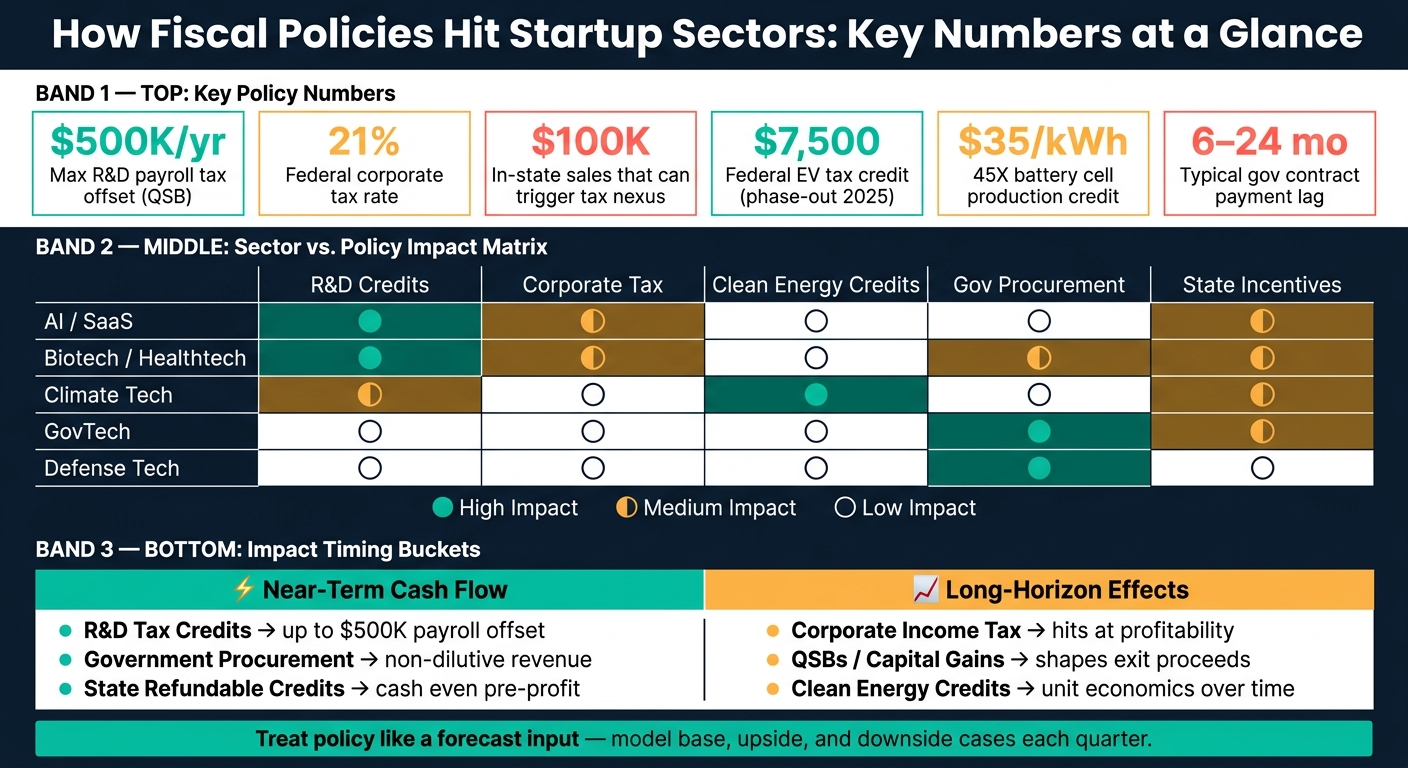
Fiscal Policy Impact on Startups by Sector: Key Numbers & Timing
Tax Considerations for Startups
Quick Comparison
| Policy area | What it changes | Sectors hit first | Main founder concern |
|---|---|---|---|
| Corporate taxes | Profit tax, state exposure | SaaS, e-commerce, hardware | Cash outflow as profit grows |
| Stock and exit taxes | Option tax, founder proceeds | Venture-backed startups | Employee tax bills and exit value |
| R&D credits | Payroll tax relief, tax savings | SaaS, biotech, hardware | Near-term cash flow |
| Clean-energy credits | Unit economics, demand | Climate tech, manufacturing | Credit loss or weaker demand |
| Government procurement | Direct revenue | GovTech, healthtech, defense | Slow payment and compliance |
| State incentives | Rebates, grants, tax offsets | All sectors | Qualification and clawbacks |
| Stimulus / austerity | Customer demand, funding climate | Consumer, GovTech, defense | Mistaking a spike for steady demand |
My main takeaway is simple: treat policy like a forecast input, not background news. I’d model a base case, upside case, and downside case for each item above, then update it every quarter.
How Founders Should Read These Policies
Every policy here hits one or more of five core levers: demand, cash flow, hiring, fundraising, or runway. So before you react to any policy change, slow down and ask: which of those five does it move, and by how much? Read each policy through that lens before you put anything into the forecast.
A common mistake is treating tax policy like a compliance task instead of a cash flow issue. That’s a miss. These policies are incentives that change what you keep. Credits reduce tax dollar for dollar. Deductions reduce taxable income.
State and local rules matter just as much as federal ones. Use the same framework across all three levels. A policy might help in one state and increase costs in another, so the details matter.
Before you count any incentive in your forecast, verify that you qualify. Build the model in USD on an accrual basis, update it quarterly, and treat any unverified incentive as upside only.
Start with corporate income taxes, because they affect almost every startup balance sheet.
1. Corporate Income Tax Rates and State Tax Exposure
The federal corporate income tax rate is a flat 21%. For seed and early-stage startups, that usually isn't the main pain point because net income is often low or nonexistent. But once a company starts growing, that tax bill can hit cash flow and valuation much harder. And the moment a startup starts operating across state lines, things get a lot messier.
Sector Exposure
Software and e-commerce startups tend to run into sales-tax nexus rules early. Since Wayfair, economic nexus can require sales tax collection once in-state sales hit about $100,000. Even one employee in a new state can set off state income tax, payroll tax, and business registration rules.
Hardware and robotics startups face a different issue: physical nexus. A manufacturing facility will usually create nexus right away, which puts state corporate tax, payroll tax, and property costs directly into the model. Climate and defense tech companies often gather in states with friendlier rules or no state income tax, such as Texas, to help offset heavy R&D and hardware spending.
For founders, this isn't just a legal or accounting issue. It shows up in runway, hiring plans, and what they keep at exit.
Cash Flow Impact
Where a company is based can change founder proceeds in a big way. On a $10 million exit, a founder may keep about $1.3 million more in Austin than in San Francisco because of state tax differences.
Startup hubs also vary a lot when it comes to founder tax burden:
| Metro | State Income Tax |
|---|---|
| SF Bay Area | 13.3% |
| New York | 10.9% |
| Boston | 5.0% |
| Denver | 4.4% |
| Austin | 0% |
| Miami | 0% |
Policy Volatility
California's $800 minimum franchise tax and Massachusetts' $500 registration fee should be in the model from day one. The 2025 OBBBA made key deductions and Section 179 limits permanent, which cuts some planning uncertainty. Before hiring in a new state, run a nexus study. Then review your entity structure each year. Those aren't just back-office tasks. They're part of financial forecasting.
Next, stock option and capital gains taxes shape how startups pay talent and reward exits.
2. Capital Gains and Stock Option Taxation
Capital gains tax usually becomes a big issue at exit. Stock option tax shows up sooner, when employees exercise ISOs or NSOs.
That means founders need to model taxes for compensation, not just for the big payday at the end. ISOs can defer tax until the shares are sold, and if the holding rules are met, the gain gets long-term capital gains treatment. NSOs work differently: they’re taxed at exercise as ordinary income, which can create a painful cash bill before there’s any liquidity.
Sector Exposure
Exit timing changes when capital gains tax starts to bite. A faster path to exit brings those concerns forward. A longer R&D cycle pushes them back.
That’s why SaaS often hits exit-sensitive stages sooner. Biotech and deep tech, on the other hand, usually stay in R&D much longer, so income and corporate taxes stay in play for a longer stretch.
Cash Flow Impact
A higher CGT rate at exit doesn’t just cut founder proceeds. It also changes how a deal looks to late-stage investors who are judging their own after-tax returns.
Once a company reaches the expansion stage, taxes start to matter more in valuation and investor return math. In plain English, the tax rate can change how much a company feels worth on paper and in a deal room.
Policy Volatility
Before an IPO or acquisition, model after-tax exit proceeds under a few federal and state CGT scenarios. Small rate changes can lead to a big swing in take-home proceeds.
Next: R&D tax credits, which can lower near-term tax cost and free up cash for hiring and product work.
3. R&D Tax Credits
The federal R&D tax credit (IRC §41) can cut a startup’s federal tax bill on a dollar-for-dollar basis when the company has qualified research expenses, or QREs. If your company meets the Qualified Small Business rules - usually less than $5 million in gross receipts and within five years of first revenue - you may use up to $500,000 per year to offset employer payroll taxes before the business is profitable. That limit was $250,000 before it doubled for tax years beginning after December 31, 2022.
For startups that burn cash on product development, this can make a real difference. It’s one of the few tax rules that may extend runway before you reach profitability.
Sector Exposure
This credit shows up across a wide range of startup categories. Software, biotech, hardware, cleantech, and advanced manufacturing can all qualify when the work involves experimentation, process improvement, or technical uncertainty.
State-level credits can add even more on top of the federal credit. That matters a lot for companies with large U.S. engineering teams or heavy domestic build costs.
Cash Flow Impact
Here’s what that can look like in practice. A SaaS startup with $3 million in engineering wages and 70% QREs might produce about $210,000 to $273,000 in credits, based on effective rates of about 10% to 13%.
If the startup qualifies, those credits can go straight against employer payroll taxes. That means lower cash outflows now, instead of waiting years to use the benefit against income taxes later.
Policy Volatility
Don’t build your whole plan around this credit. A safer approach is to assume lower credit values and stricter qualification rules, especially for projects that are already on shaky ground.
There’s also been movement on the deduction side. The "One Big Beautiful Bill Act," effective January 1, 2025, brought back the option to immediately deduct 100% of domestic R&D costs in the year they’re incurred. That helps, but founders should still run a few downside cases. Caps can tighten. Standards can shift. And if a product only works on paper because the credit is there, that’s a red flag.
These credits tend to matter most when R&D spending leads to equipment, fabrication, or deployment.
4. Clean Energy Subsidies and Industrial Tax Credits
R&D credits lower development spend. Clean-energy credits do something different: they lower manufacturing cost and help prop up demand. For battery, EV, solar, and industrial hardware startups, that matters a lot. A policy change can swing unit economics, slow or pull forward revenue, and reshape capex plans and cash conversion.
Sector Exposure
The 45X credit gives battery makers $35/kWh for cells and $10/kWh for modules. That adds up fast. A 100 kWh battery pack generates a $4,500 credit - $3,500 for cells and $1,000 for modules.
Demand can shift just as fast as cost. The $7,500 federal EV tax credit and the 30% rooftop solar credit have both been curtailed, with phase-outs effective in 2025. If a startup sells into either market, it shouldn’t treat demand as fixed. It should model a slowdown through 2026.
Cash Flow Impact
The big draw here is transferability. Transferable credits can be sold to profitable companies for immediate liquidity, which turns a future tax benefit into working capital now. For pre-revenue developers, that can mean cash for construction, equipment, or early manufacturing runs instead of waiting for a later tax event.
Demand Sensitivity
Climate tech demand can move on policy news almost overnight. Investment cancellations tied to IRA uncertainty have already reached tens of billions of dollars. That’s the kind of shift that can throw off a hardware roadmap in a hurry. Founders leaning on federal demand signals need to plan for volatility, not assume those incentives will hold.
Policy Volatility
Eligibility now hinges on sourcing rules too. Domestic-content thresholds are rising to 60% in 2026 and 85% by 2030. In plain English, one noncompliant part can wipe out eligibility and change unit economics. So sourcing can’t sit in the ops bucket alone. It needs to show up in the financial model as a core forecast input.
When tax incentives move demand, public spending can have a similar effect through direct purchasing.
sbb-itb-17e8ec9
5. Government Procurement and Public Spending
Unlike tax credits, procurement creates demand directly. In FY2024, the U.S. federal government committed about $755 billion to contracts, which means a huge market for govtech, healthtech, and edtech startups. But there’s a catch: sales cycles are often slow, and the compliance load can be heavy.
Sector Exposure
For govtech and healthtech startups, procurement and grants can extend runway without dilution. That can be a big deal when cash is tight. Still, getting in the door is slow and competitive. A larger share of federal spending is now going to a smaller pool of established companies, which puts new entrants at a clear disadvantage even as total budgets grow.
Cash Flow Impact
The main problem is timing, not just access. Budget approvals, contracting, and implementation often take 6 to 24 months, so revenue may arrive long after an award is announced. If you’re counting on government money, bake that delay into your runway model before you make hiring or product bets.
Demand Sensitivity
Government demand can change from one fiscal year to the next. One year a program gets funding; the next year it stalls. That’s why it helps to track how much of your revenue depends on government contracts and pressure-test your plan for delayed awards or late payments.
Policy Volatility
Rules can shift midstream. CMMC, supply-chain rules, and the 2026 FAR overhaul can knock out startups that aren’t prepared during the contract process. So compliance can’t be an afterthought - it needs to be part of the sales model early.
State and local incentives can also change the math, especially for startups selling into specific regions or sector niches.
6. State and Local Tax Incentives by Sector
Federal policy gets most of the attention, but state and local incentives can change the math too. There are more than 2,400 state and local incentive programs across the U.S. They differ by sector, location, and company stage. For startups, that matters. A state tax break can extend runway almost as fast as a federal one.
Sector Exposure
The right incentive depends on what you do, where you operate, and how far along you are.
Software and digital media startups should pay close attention to Louisiana's 25% cash rebate on software development payroll. That can have a direct effect on hiring costs.
Manufacturing startups have options in states such as Alabama, Mississippi, and South Carolina, where investment tax credits range from 1.5% to 5% of qualified capital investment in buildings and equipment. If you're spending heavily on facilities and machinery, that kind of credit can matter fast.
Climate tech companies often benefit from sales and use tax exemptions for pollution control machinery. And e-commerce and logistics startups in Texas can use Enterprise Zone programs that offer sales and use tax refunds tied to capital investment and job creation or retention.
Cash Flow Impact
Not all incentives help in the same way. Some put cash back in your business. Others only help if you already owe tax.
Refundable credits matter most for early-stage startups. Programs like Ohio's Job Creation Credit or North Carolina's Job Development Investment Grant can pay cash even if your tax bill is small or zero. North Carolina's program can refund up to 80% of income taxes tied to new jobs for up to 12 years.
By contrast, nonrefundable credits only reduce taxes you already owe. For a pre-revenue startup, that may not do much. For a company with taxable income, it's a different story.
So the rule of thumb is simple:
- Early-stage startups should lean toward cash grants and refundable credits
- Later-stage companies that owe tax may get more from straight tax offsets
Policy Volatility
These programs can shift fast, and the paperwork can be strict. Some of the richest programs, including Alabama's Jobs Act and discretionary cash grants, require pre-approval before any public announcement about a project. Miss that step, and the deal may be gone.
Clawbacks are another thing to watch. Most job tax credits require you to keep those jobs in place for five or more years or risk losing the credit. That's a big deal. A credit on paper isn't the same as money you can bank on.
Build these incentives into your model only after pre-approval.
Use this snapshot to match each incentive to the right sector and cash-flow profile.
| State | Key Incentive | Benefit | Sector Focus |
|---|---|---|---|
| Louisiana | Digital Media Credit | 25% cash rebate on software development payroll | Software/Digital Media |
| North Carolina | JDIG | Up to 80% refund of income taxes tied to new jobs for up to 12 years | General |
| Ohio | Job Creation Credit | Refundable credit based on state income tax withheld for up to 15 years | General |
| Georgia | Investment Tax Credit | 1%–8% of capital investment | Manufacturing/Telecom |
| Texas | Enterprise Zone | Sales/use tax refund (up to $2,500/job) | E-commerce/Logistics |
| Alabama | Jobs Act | 4% cash refund of gross payroll for up to 10 years | Industrial |
Treat location as a financial decision, not just an operating one. Talk to state economic development offices before you announce a project. These local incentives can offset policy pressure, but they can also vanish fast when state budgets get tight.
7. Fiscal Stimulus and Austerity Policies
Tax policy isn't the only thing that moves a startup. Big shifts in government spending can change demand fast too. Stimulus tends to push demand up. Austerity tends to pull it down. If you can spot where policy is heading - and how fast - you have a better shot at protecting revenue and managing runway before the change shows up in your numbers.
Sector Exposure
Consumer-facing startups usually feel stimulus first. That includes e-commerce, retail, and digital payments. When people get direct cash, they spend it - and that money often moves online. In Q2 2025, PayPal reported a 12% year-over-year increase in gross payment volume, tied in part to the jump in digital transactions after $1,390 federal stimulus payments. One policy move, one clear bump in volume.
Startups tied to government budgets face the other side of the coin. Gov-tech companies and defense-adjacent firms can get hit hard when spending is cut. In those cases, customer mix matters just as much as the policy shift itself. Timing does too.
Cash Flow Impact
Stimulus can make a quarter look stronger than it is. That's the trap.
If your business depends on consumer spending, a stimulus-fueled jump in revenue can look like normal growth when it's just a short-term burst. And if you treat that spike like a new baseline, it's easy to hire too fast or spend too much.
Austerity brings a different kind of pressure. In 2023, global VC funding fell by more than 35% year over year, and the average time to exit stretched from 7 years to over 10 years by late 2023. That points to slower customer demand and a tougher fundraise at the same time.
Policy Volatility
For founders, the job is simple in theory and hard in practice: separate short-term demand from demand that sticks.
Some of the clearest early fiscal signals are:
- Budget cuts
- Spending freezes
- Lower government outlays
When federal discretionary spending pulls back, capital usually gets tighter for unprofitable startups across the board.
The practical move is pretty plain. Don't build your hiring plan or growth model around stimulus-driven demand. Treat it as upside, not your base case. And when austerity signals start showing up, tighten your focus on unit economics and extend runway before the market makes that choice for you.
Sector-by-Sector Snapshot
This snapshot turns the policy levers above into a simple sector view: who feels what first, and where forecasts can get thrown off.
AI and SaaS tend to feel changes first when the issue is R&D credits, payroll tax offsets, or state nexus rules. Why? Because engineering payroll is heavy, hiring often spans multiple states, and cash flow can shift fast when tax treatment changes.
Biotech and healthtech are tied closely to R&D credits, grant funding, and the tax treatment of long development cycles. These companies often spend big for a long time before revenue shows up, so even small policy shifts can hit hard.
The next group plays a different game. It’s less about software costs and more about hardware economics shaped by subsidies.
Climate tech is tied most closely to clean-energy credits, industrial tax credits, and subsidy changes that can alter unit economics.
GovTech and defense tech depend more on procurement, public spending, and compliance rules. In these sectors, contract delays and eligibility changes often affect revenue timing more than most tax moves.
The table below pulls each sector into one view.
| Sector | Key policy driver | Main risk |
|---|---|---|
| AI / SaaS | R&D credits, payroll tax offsets, state nexus rules | Tax drag from multi-state hiring |
| Biotech / Healthtech | R&D credits, grant funding, long-cycle tax treatment | High R&D burden |
| Climate Tech | Clean-energy credits, industrial tax credits, subsidy changes | Unit economics shift on policy change |
| GovTech | Government procurement, public spending, cybersecurity compliance | Procurement cycle delays |
| Defense Tech | Defense budgets, dual-use procurement | Geopolitical tension shifts |
Policy Comparison Table
This table breaks down how each policy works, where it hits hardest, and when you’re likely to feel it. The big idea is simple: some policies affect cash flow now, while others matter more over a long stretch through taxes, demand, or exit outcomes.
| Policy | Primary Mechanism | Most Affected Sectors | Typical Upside | Main Downside Risk | Impact Timing |
|---|---|---|---|---|---|
| Corporate Income Tax | Federal and state profit taxes on taxable income | Profitable SaaS, hardware, multi-state startups | Higher after-tax retained earnings once profitable | Double taxation if profits are distributed as dividends | Long-term |
| Capital Gains, Stock Options, and QSBS | 100% capital gains exclusion on gains up to the greater of $15,000,000 or 10x basis for stock held 5 years | Venture-backed startups | Potentially tax-free exit; important for long-term talent retention | Strict eligibility rules | Long-term (exit) |
| R&D Tax Credits | Near-term payroll-tax relief and faster deduction of qualified R&D | Software, Biotech, Engineering | Immediate cash flow; up to $500,000 in payroll tax offset | High audit scrutiny over qualifying research activities | Immediate |
| Clean Energy Subsidies and Industrial Tax Credits | Production credits and investment incentives tied to domestic sourcing | Climate tech, Manufacturing | Lower cost of domestic production | Complex compliance; policy dependence on favored sectors | Long-term |
| Government Procurement and Public Spending | Contracts and grants from federal agencies | Biotech, Defense, AI | Non-dilutive capital; market validation | Slow awards, compliance burden, and delayed payment | Immediate |
| State & Local Tax Incentives by Sector | Location- and sector-specific credits, exemptions, and grants | All sectors - varies by state | Can reduce effective tax rate; some states offer payroll credits | Remote hiring in a new state can trigger nexus and unexpected state income, payroll, and sales tax obligations | Mixed |
| Fiscal Stimulus & Austerity Policies | Higher or lower public spending changes customer demand | Consumer startups, GovTech, Defense | Expanded budgets can open new contract and grant opportunities | Budget shifts can quickly change demand and funding availability | Mixed |
A good way to read this table is to split policies into two buckets.
The first bucket is near-term cash flow. That includes moves like R&D tax credits and government procurement, where the effect can show up fast in payroll tax savings, grant money, or contract revenue. If you’re trying to stretch runway, these are usually the first places to look.
The second bucket is long-horizon effects. That includes items like Corporate Income Tax, QSBS, and clean energy credits. These usually matter more when the company is profitable, scaling production, or heading toward an exit. They may not save you this quarter, but they can shape returns in a big way over time.
Some policies sit in the middle. State & Local Tax Incentives by Sector and Fiscal Stimulus & Austerity Policies can swing either way depending on where you hire, who buys from you, and how public budgets move. One remote employee in a new state can create tax exposure. On the demand side, a shift in government spending can open doors just as fast as it can shut them.
Use the table to separate immediate cash-flow effects from long-term tax and demand effects.
Next, translate the biggest exposures into forecast assumptions and scenario ranges.
Turning Policy Changes Into Financial Plans
Reading the table above is only step one. The harder part is turning those policy signals into numbers your business can use.
Use the table as forecast inputs by modeling three policy cases for each exposure. Run a base case, an upside case, and a downside case so you can see how policy shifts change your runway. That gives you a clearer view of what happens if rules stay steady, move in your favor, or get more expensive than planned.
Separate qualified R&D expenses from day one. R&D credits and other incentive programs are only as good as your records. If your bookkeeping mixes qualified expenses with general operating costs, you'll miss credit opportunities. Clean books are what make those credits claimable.
Before hiring in a new state, model nexus, payroll tax, and entity impact. Add those costs to your runway and hiring plan before you expand. It’s much easier to price this in early than to clean up a tax mess later.
Lucid Financials combines bookkeeping, tax services, tax credits, and CFO support in one platform, with Slack access and investor-ready reporting.
Roll these assumptions into your next quarterly forecast update.
Conclusion
Fiscal policy shapes demand, funding, and runway in direct ways. State incentives and public spending can change hiring costs and shift where demand shows up.
The same policy doesn’t hit every sector equally. Defense tech, cybersecurity, and AI kept attracting capital during the 2023 downturn because those sectors lined up with government priorities and near-term demand. That’s the key point. A policy that gives one sector a tailwind can quietly create a headwind for yours.
Track federal budgets, state incentives, and legislative changes before they show up in your model. Founders who treat fiscal policy as a live input tend to build companies that last longer.
FAQs
Which fiscal policy affects my startup first?
For most startups, payroll tax obligations show up first. The moment you hire your first employee or start operating in a new state, you may trigger an employment tax nexus. That can mean you need to register for state income tax withholding and unemployment insurance, even if your company hasn’t brought in any revenue yet.
Miss those rules, and the fallout can sting. You could face penalties and, in some cases, personal liability for unpaid withholdings.
How do I know if my startup qualifies for R&D tax credits?
Your startup may qualify if its work meets four tests: permitted purpose, technical nature, elimination of uncertainty, and a process of experimentation.
Put simply, the IRS wants to see that your team was trying to build or improve something, that the work was technical, that there was a real unknown to solve, and that you tested different ways to get there.
Common qualifying work includes:
- Software development
- Algorithm improvements
- Prototype creation
Paperwork matters here. You’ll need detailed records that show what happened and when, including project timelines, technical challenges, resource usage, and time logs.
And there’s one part you can’t miss: if you want to apply the credit against payroll taxes, you need to make that election on your original tax return.
When should I model state tax nexus in my forecast?
Model state tax nexus as soon as you plan to hire a remote employee in a new state or expect to hit economic nexus thresholds based on revenue and transaction counts.
Build these costs into your expansion plans early. Why? Because even one remote employee or other business activity in a new state can trigger filing and compliance duties. And those bills aren’t small: regulatory costs can range from $10,000 to $50,000 annually.