If your investor reporting still lives in spreadsheets, it will start to fail as your company grows. The fix is simple: use one data source, lock metric definitions early, and send the same board-ready package on a set schedule.
Here’s the short version:
- Manual reporting often takes 2–5 days per month
- Many finance teams still need 6+ business days to close the month
- Spreadsheet errors are common, with 88% to 94% containing at least one error
- Automated workflows can cut close and reporting prep time by 30% to 50%
- Audit prep time can drop by 50%
What investors want is not complicated. They want:
- clean financial statements
- cash, burn, and runway
- budget vs. actuals
- KPIs that match your business model
- short variance notes that explain what changed
- a clear audit trail
What I’d take from this article is straightforward: investor-ready reporting means current books, fixed formulas, one reporting format, and fast answers. If the numbers change depending on which file someone opens, the process is already broken.
A few points matter most before the next board cycle:
- Close by about the 10th business day after month-end
- Give each KPI one owner
- Tie each metric to one source system
- Keep the board pack layout the same every month
- Set alerts so reporting and compliance deadlines do not slip
The article also makes one point clear: reporting needs change after funding. At 10 employees, one person can often keep things together. At 25 to 50 employees, payroll, budgets, and vendors add more work. At 50 to 100 employees, more entities, revenue lines, and investor requests make manual reporting harder to keep under control.
For different startup types, the KPI layer changes, but the reporting setup should not:
- SaaS: ARR, NRR, churn, CAC payback
- Fintech: TPV, take rate, fraud, KYC metrics
- E-commerce: GMV, contribution margin, CAC by channel, LTV:CAC
The main idea is simple: stop rebuilding reports by hand every month. Use one reconciled dataset, send standard outputs, and keep a record of what was sent and when.
That is the core message of the article.
Automating Investor Communication with AI Agents | Investor Relations Agent
sbb-itb-17e8ec9
The problem: manual compliance reporting breaks as startups scale
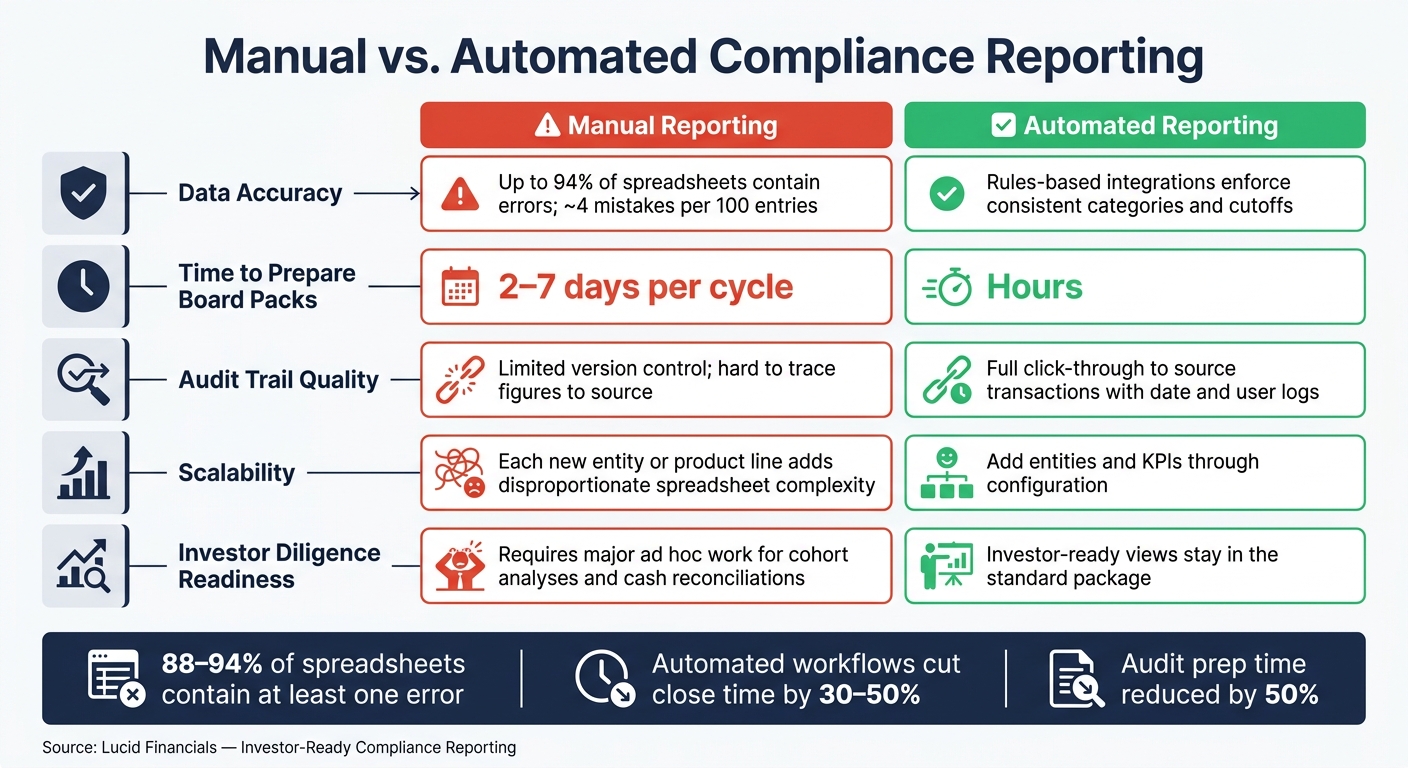
Manual vs. Automated Compliance Reporting: Key Differences for Startups
Early-stage startups often pull reports from accounting, banking, payroll, and revenue systems that don't sync in real time. Then they export CSVs and reconcile everything in spreadsheets before each board or investor update. That process often eats up 2–5 days per month. And that handoff between systems? That's usually where errors, delays, and reconciliation gaps begin.
Where manual workflows create errors and delays
Cash, MRR, burn, and tax liability figures start to drift when systems use different dates or different definitions. The result is messy board packs with mismatched balances, overstated runway, and stale liabilities.
Spreadsheets make this worse. 88% to 94% contain at least one error, and manual reporting averages about 4 mistakes per 100 entries. Each error takes roughly 8 hours to find and fix. That's a lot of time spent hunting down one bad number.
And when there's no clear drill path back to source transactions, the finance team has to dig through emails, PDFs, and general ledger exports just to explain a variance.
How reporting pressure grows from 10 to 100 employees
At 10 employees, one person can usually keep the books under control.
By 25 to 50 employees, budgets, multi-state payroll, and a larger vendor base add more reporting work. Then, at 50 to 100 employees, multi-entity structures, more revenue streams, and more frequent investor requests make monthly close and board reporting much harder.
That strain shows up in the numbers: 50% of finance teams take 6 or more business days to finish a month-end close. So even when leaders want current data, investors often get it late.
Fixing this takes three things:
- One source of truth
- Standard outputs
- An audit trail built into the workflow
Manual reporting vs. automated reporting
The difference between manual and automated compliance reporting isn't just speed. It affects accuracy, traceability, and how well a startup stands up to investor scrutiny.
| Manual Reporting | Automated Compliance Reporting | |
|---|---|---|
| Data accuracy | Prone to copy-paste errors, broken formulas, and inconsistent cutoff dates | Rules-based integrations enforce consistent categories and cutoffs |
| Time to prepare board packs | Typically 2–7 days per cycle | Hours |
| Audit trail quality | Limited version control; hard to trace figures back to source transactions | Click through to source transactions with date and user logs |
| Scalability | Each new entity or product line adds disproportionate spreadsheet complexity | Add entities and KPIs through configuration |
| Readiness for investor diligence | Requires major ad hoc work to produce cohort analyses, revenue bridges, and cash reconciliations on demand | Investor-ready views stay in the standard package |
Manual patches can buy time. They don't fix fragmented data or weak audit trails. Automation does.
The solution: core building blocks of automated compliance reporting
Those requirements get a lot easier to handle when reporting is automated from start to finish.
Automated compliance reporting links financial systems, builds reports from one reconciled dataset, and records an audit trail at each step. Put simply: instead of chasing numbers across spreadsheets, finance teams work from one clean system.
Unified financial data and standardized formatting
The base is a single source of truth: one governed dataset that pulls from bookkeeping, bank and card feeds, payroll runs, revenue tools such as Stripe, and tax filings and accruals. When those systems feed into a central accounting system, every report - P&L, cash flow, runway - uses the same reconciled numbers, along with standardized currency, date, and number formats.
That matters more than it may seem. If one deck pulls from a spreadsheet and another pulls from the ledger, small mismatches can snowball into investor questions. A unified system helps stop that before it starts.
Integrated systems can cut month-end close and reporting prep time by 30% to 50% and lower the risk of misstatements in board decks.
Once the data is standardized, the work shifts from cleanup to explanation.
Automated reports, variance narratives, and audit trails
After the data layer is clean, a reporting engine can generate board packages, investor updates, and compliance-ready exports on a set cadence. Before a report goes out, validation checks confirm reconciliations, tie-outs, and correct categorization.
One of the most useful parts for investor communication is automated variance commentary. The system flags changes, links them back to tagged data, and drafts a plain-English explanation. Finance still reviews and edits it, of course. But the first draft is already there, and it stays consistent from month to month.
That consistency matters because investors usually want the same things explained each cycle:
- runway
- spend
- milestones
Every approved report is also logged, so investors can trace what was sent, when it was sent, and which dataset it came from. That submission history can speed up investor due diligence and make audit prep much less painful. This type of automation can cut audit prep time by 50%.
Automation framework at a glance
| Layer | Key Responsibilities | Impact on Investor Compliance |
|---|---|---|
| Unified Data | Connects and reconciles bookkeeping, bank, payroll, revenue, and tax data | Eliminates conflicting numbers; creates a trusted single source of truth |
| Reporting Engine | Generates standardized P&L, cash flow, runway, and KPI reports on a set cadence | Delivers consistent, comparable board and investor reporting every cycle |
| Narrative Automation | Creates automated variance, runway, and hiring/spend explanations | Speeds up investor Q&A and improves the clarity of the financial story |
| Controls | Tracks deadlines, approvals, and audit trails; logs submissions and versions | Demonstrates control and reliability; supports due diligence and audits |
With that base in place, reporting can then be shaped around the metrics each startup's investors care about most.
How startups can tailor reporting automation to investor needs
Once your data and controls are lined up, the next move is simple: show each investor group the metrics they care about most. Automation keeps the process consistent. What changes is the KPI layer, based on the startup model. In other words, the same reporting system can support different metric sets without rebuilding the whole thing every time.
The board pack should fit the business. Investors want to see the numbers that actually drive value for that kind of company.
Key metrics by startup type
Keep the foundation the same: GAAP/ASC 606-compliant financials in USD, a monthly close calendar, cash and runway views, headcount, and a fixed board-pack structure. The part that shifts is the KPI layer added on top.
| Startup Type | Key Investor Metrics | Investor Focus |
|---|---|---|
| SaaS | ARR, Net Revenue Retention (NRR), gross revenue retention, logo churn, CAC payback | Subscription quality, expansion potential, and sales efficiency |
| Fintech | Total processed volume (TPV), take rate, loss and fraud rates, KYC completion, required compliance metrics | Transaction economics, risk discipline, and regulatory health |
| E-commerce | GMV, net revenue, contribution margin per order, CAC by channel, LTV-to-CAC ratio | Unit economics, payback period, and repeat purchase behavior |
For SaaS, NRR above 100% signals net expansion despite churn. For e-commerce, contribution margin - net revenue minus variable costs such as COGS, shipping, and payment processing - should tie back to the P&L so investors can trust that CAC payback reflects actual economics, not spreadsheet assumptions.
Those KPIs only mean something if the source, owner, and formula stay fixed.
What to standardize before the next board cycle
Before the next board meeting, standardize five things.
- Set the close deadline at about 10 business days after month-end. That gives the team enough time to review results and build materials before the board meeting.
- Assign one owner to each KPI. Finance usually owns financial KPIs like runway and margin. RevOps or sales owns pipeline and sales efficiency metrics. Product or data teams own usage metrics. Compliance or legal owns regulatory KPIs.
- Lock the board pack template. Core sections like P&L vs. plan, cash flow, burn, headcount, and compliance status should come from the same layout every cycle.
- Map every metric to its source system and document the formula. For example, ARR should pull from the billing system and reconcile to recognized revenue on the general ledger, not from a manually maintained spreadsheet.
- Set automated alerts for recurring investor and compliance deadlines so nothing slips.
Once the KPI layer is fixed, the next job is turning it into board-ready reporting without the usual manual prep.
How Lucid Financials makes investor-ready compliance reporting easier
Once the reporting structure is in place, execution is the last step. At that point, the main issue is staying current: clean books, accurate reports, and fast answers when investors or board members ask for them.
Lucid Financials is an AI-powered full-stack accounting firm that combines bookkeeping, tax, tax credits, and CFO support. That setup keeps bookkeeping, tax, and reporting aligned from day one. It helps with compliance, monthly reporting, and fundraising prep, while making board and compliance reporting faster and easier to repeat.
From clean books to board-ready reporting
Good investor reporting starts with books that are accurate and up to date. Lucid's AI-powered bookkeeping and reconciliation can get a startup's books into clean books within seven days. That gives leadership a clear view of current cash balances, department-level spend, and month-end performance numbers before the next board meeting.
Lucid's CFO support then helps turn reconciled data into board-ready reporting, forecasts, runway updates, and variance commentary. Since bookkeeping, tax, and CFO support all work from the same data foundation, teams don't run into the gaps that show up when numbers have to be rebuilt across separate systems.
Slack-based access for runway, spend, and reporting questions
Lucid's Slack integration lets founders ask runway, spend, and reporting questions in the channel they already use. That might mean checking runway after a planned hire, asking about budget variance, or getting the latest close. It's a simple setup, but it can save a lot of back-and-forth.
Because AI outputs are reviewed by a finance team, the answers combine speed with accounting judgment. And since those answers stay current between board cycles, teams aren't stuck waiting until the next reporting round to get a clear picture.
Conclusion: what investor-ready reporting should look like going forward
Manual reporting gets too slow and too messy as startups grow. The answer is simple: move away from ad hoc spreadsheets and build a reporting system you can run the same way every time.
Automation makes reporting repeatable. It pulls reconciled data into one place, sets fixed metric definitions, and cuts reporting time - so each cycle ends with reconciled, standardized, audit-ready reporting.
Set ARR, burn, runway, and net dollar retention definitions early. Then close by the 10th of each month. When everyone works from the same numbers, board meetings stay focused on performance instead of data cleanup.
Investor-ready by default should be the bar. That means current books, standardized core metrics, accessible audit trails, and answers for investors in minutes instead of days. Lucid Financials supports that bar with AI-powered bookkeeping, tax, tax credits, CFO support, clean books in seven days, and Slack access for fast answers. In practice, investor-ready reporting comes down to three things: current books, fixed definitions, and fast answers.
FAQs
When should a startup automate reporting?
A startup should automate investor reporting as soon as manual data collection starts slowing the team down. In most cases, that happens when regular reporting kicks in.
For seed-stage startups, reporting is often quarterly. By Series A and beyond, it’s usually monthly.
Starting early swaps manual data pulls and spreadsheet reconciliation for a smoother, real-time process. That means fewer errors, more consistency, and financials that are ready to share with investors when it’s time to line up the next round.
What should be included in an investor-ready board pack?
An investor-ready board pack should include the three core financial statements: Income Statement, Balance Sheet, and Cash Flow Statement.
It should also cover:
- An executive summary
- Company and product updates
- Forecasts or scenario planning
On top of that, include the numbers board members care about most, such as revenue growth, burn rate, runway, high-level KPIs, and variance analysis.
Lucid Financials can help make sure these reports are GAAP-compliant, professionally formatted in USD, and shaped to fit what each stakeholder needs.
How do you create one source of truth?
Create a single source of truth by centralizing and standardizing your financial data. Start by identifying each data source, assigning a clear owner, and cleaning and normalizing the data so terms, labels, and formats stay consistent.
Next, bring everything into one platform like Lucid Financials to automate reconciliation and support real-time validation. That cuts down on manual errors, gives you a traceable audit trail, and keeps your team, board, and investors working from the same up-to-date numbers.