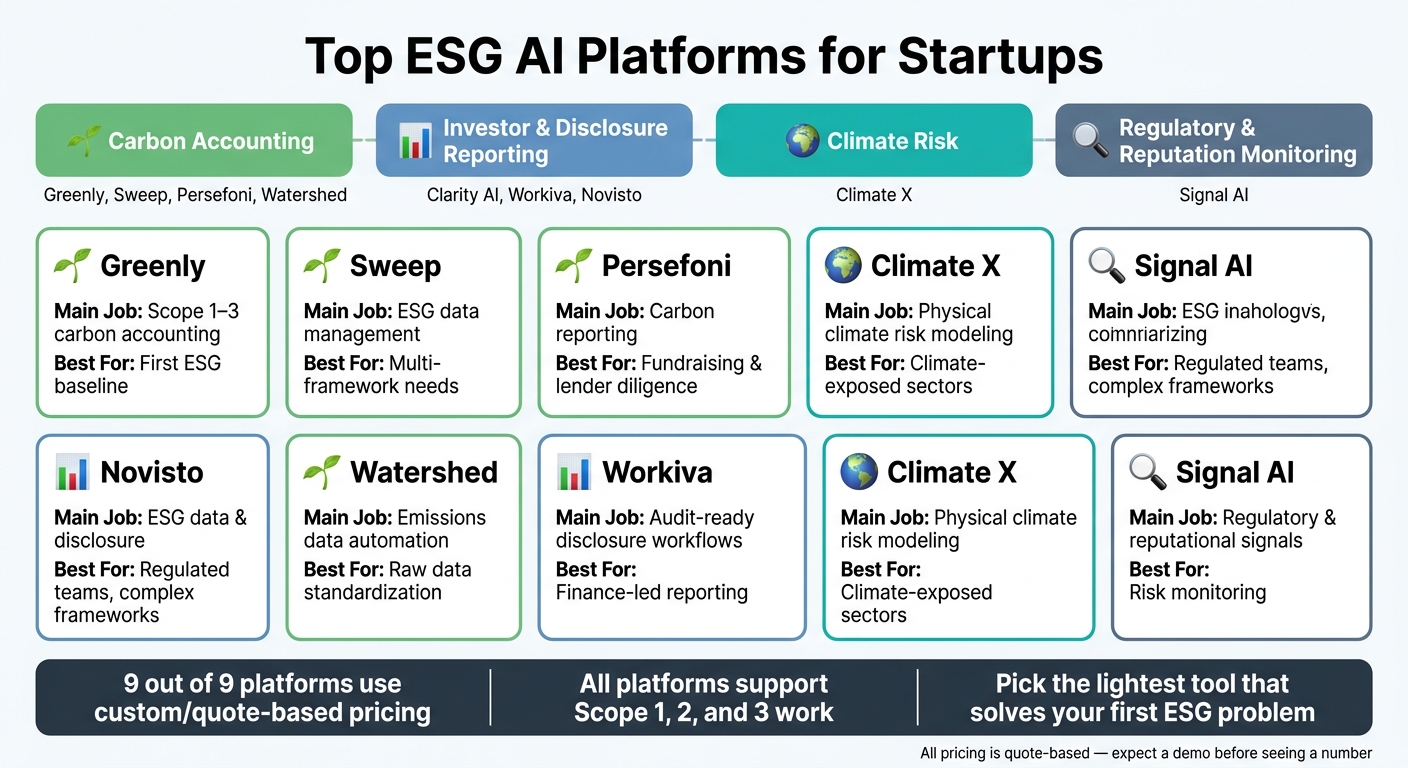
If you need ESG software as a startup, the right pick depends on your first reporting job. In this list, I’d sort the 9 tools into 4 buckets: carbon accounting (Greenly, Sweep, Persefoni, Watershed), investor and disclosure reporting (Clarity AI, Workiva, Novisto), climate risk (Climate X), and regulatory/reputation monitoring (Signal AI).
Here’s the short version:
- Greenly and Sweep fit teams building a first baseline
- Persefoni fits fundraising and lender diligence
- Watershed fits teams cleaning raw emissions data
- Clarity AI and Workiva fit formal reporting
- Climate X fits physical climate exposure work
- Signal AI fits rule and reputation tracking
- Novisto fits teams with multi-framework disclosure needs
A few points stand out fast:
- 9 out of 9 tools use custom pricing
- Most are built for Scope 1, 2, and 3 work, disclosures, or risk review
- Early teams should buy for the current ask, not a long feature wishlist
- Bad finance data leads to bad Scope 3 estimates
Top ESG AI Platforms for Startups: Side-by-Side Comparison
AI Agents for Sustainability | ESG | Carbon Footprint | Carbon Accounting
sbb-itb-17e8ec9
Quick Comparison
| Platform | Main job | Best for | Pricing |
|---|---|---|---|
| Clarity AI | ESG scoring and framework mapping | Investor-facing reports | Custom |
| Climate X | Physical climate risk | Climate-exposed startups | Custom |
| Workiva | Disclosure workflows | Finance-led reporting | Custom |
| Greenly | Carbon accounting | First ESG baseline | Custom |
| Sweep | ESG data management | Multi-framework needs | Custom |
| Persefoni | Carbon reporting | Fundraising and lender diligence | Custom |
| Watershed | Emissions data cleanup | Teams with raw data to standardize | Custom |
| Signal AI | Rule and reputation signals | Risk monitoring | Custom |
| Novisto | ESG data and disclosure | Regulated teams | Custom |
What I’d keep from the full article is simple: pick the lightest tool that solves the first problem in front of you, and make sure your books are clean before you start pushing spend data into any ESG system.
Top ESG AI Platforms for Startups
Pick the tool based on the first ESG problem you need to fix: carbon accounting, ESG reporting, climate risk, or investor disclosures. The platforms below are grouped by the first ESG task most startups need to handle.
Clarity AI, Climate X, and Workiva
Clarity AI, Climate X, and Workiva are strong starting points for startups that need structured ESG data and investor-ready reporting. Clarity AI provides AI-driven ESG scoring and maps output to major regulatory frameworks. Climate X models physical climate risk using forward-looking scenario data. Workiva gives finance teams audit-ready disclosure workflows built for formal reporting.
This group makes sense for lean finance teams that need credible, framework-aligned output fast.
Greenly, Sweep, and Persefoni
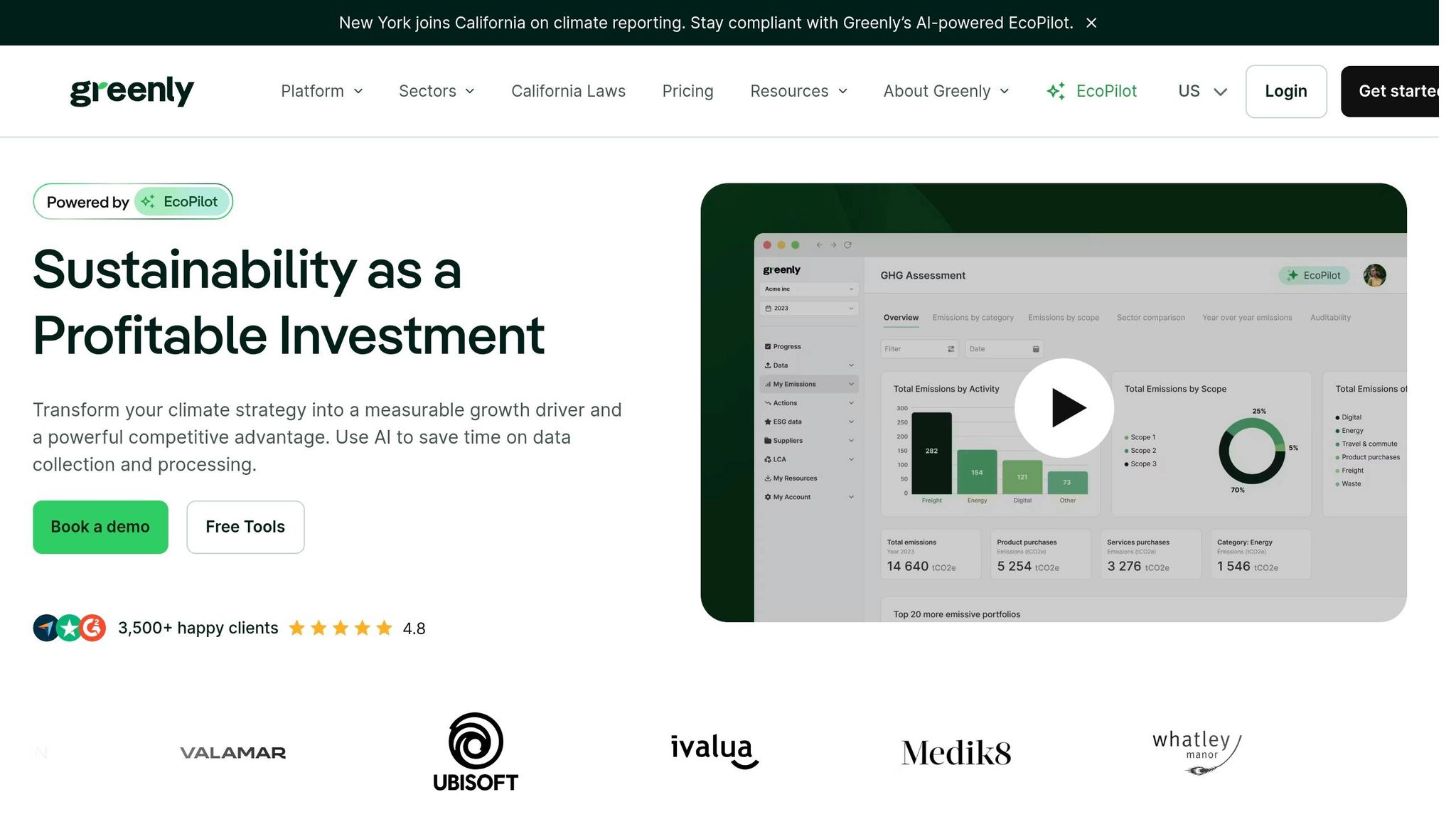
Greenly, Sweep, and Persefoni are built for guided carbon accounting workflows and ESG baseline reporting. Greenly automates Scope 1, 2, and 3 data collection through direct integrations. Sweep brings ESG data into one place and maps it to reporting frameworks. Persefoni is geared toward investor and lender diligence, with audit-ready carbon reporting aligned to TCFD and GHG Protocol standards.
These tools fit startups heading into diligence-heavy fundraising rounds.
Watershed, Signal AI, and Novisto
Watershed, Signal AI, and Novisto focus on climate-risk modeling and sector-specific compliance. Watershed uses purpose-built AI agents to clean and standardize raw emissions data. Signal AI tracks ESG-related regulatory and reputational signals in real time. Novisto centralizes ESG data collection and supports configurable frameworks for audit-ready reporting.
This set is a good fit for regulated startups and teams dealing with complex disclosure requirements.
Use the table below to compare use case, startup fit, and pricing at a glance.
| Platform | Primary Use Case | Best Fit | Pricing |
|---|---|---|---|
| Clarity AI | ESG scoring and regulatory alignment | Investor-facing reporting | Quote-based |
| Climate X | Physical climate risk modeling | Climate-exposed sectors | Quote-based |
| Workiva | Audit-ready disclosure | Finance teams with formal reporting needs | Quote-based |
| Greenly | Scope 1–3 carbon accounting | Early-stage teams building a baseline | Quote-based |
| Sweep | ESG data management | Teams with multi-framework reporting needs | Quote-based |
| Persefoni | Carbon reporting for investors and lenders | Diligence-heavy fundraising | Quote-based |
| Watershed | Emissions data automation | Lean teams needing fast data standardization | Quote-based |
| Signal AI | ESG signal monitoring | Regulatory and reputational risk tracking | Quote-based |
| Novisto | ESG data collection and disclosure | Regulated startups with complex frameworks | Quote-based |
Side-by-Side Comparison: Features, Use Cases, and Pricing
What the Comparison Table Covers
The table below lines up each platform on automation, integrations, and pricing. It’s a fast way to size up startup fit, how much automation you get, and what to expect on pricing.
| Platform | Focus | AI Features | Best For | Integrations | Pricing Model | Entry Price |
|---|---|---|---|---|---|---|
| Clarity AI | ESG scoring and regulatory alignment | AI-driven ESG scoring, framework mapping | Investor-facing reporting | Not public | Custom quote | N/A |
| Climate X | Physical climate risk modeling | Forward-looking scenario analysis | Climate-exposed sectors | Not public | Custom quote | N/A |
| Workiva | Audit-ready disclosure | Disclosure workflow automation | Finance teams with formal reporting needs | Enterprise integrations | Custom quote | N/A |
| Greenly | Scope 1–3 carbon accounting | Automated data collection, emissions calculations | Pre-seed to Series A teams building an ESG baseline | Direct integrations | Custom quote | N/A |
| Sweep | ESG data management | Framework mapping, data consolidation | Teams with multi-framework reporting needs | Not public | Custom quote | N/A |
| Persefoni | Carbon reporting for investors and lenders | Audit-ready carbon reporting, TCFD alignment | Diligence-heavy fundraising | Not public | Custom quote | N/A |
| Watershed | Emissions data automation | AI agents for data cleaning and standardization | Lean teams needing fast data standardization | Not public | Custom quote | N/A |
| Signal AI | ESG signal monitoring | Real-time regulatory and reputational signal tracking | Regulatory and reputational risk tracking | Not public | Custom quote | N/A |
| Novisto | ESG data collection and disclosure | Configurable framework support, audit-ready reporting | Regulated startups with complex frameworks | Not public | Custom quote | N/A |
Prices above are entry points, not fixed all-in costs. Final quotes can change based on data volume, entity count, frameworks, and implementation scope.
Quote-Based Pricing vs. Public Pricing: What to Know
Pricing transparency matters most when you need a fast shortlist. Here, pricing falls into two camps: public entry pricing and custom quotes.
In this roundup, all nine platforms use quote-based pricing. So before you see a number, you’ll need a demo or a direct sales conversation. That extra step can slow things down a bit, especially for smaller teams that want to compare tools fast.
In practice, pre-seed to Series A teams often move faster with public pricing. Series B+ teams usually need quote-based pricing because their setup, reporting scope, and data needs are more involved.
Pros and Cons by Startup Use Case
This table makes the tradeoffs easier to spot. Instead of looking at features in a vacuum, it ties each tool to the job you’re trying to get done.
| Use Case | Best Fit | Main Advantage | Main Tradeoff |
|---|---|---|---|
| First ESG baseline | Greenly or Sweep | Guided setup and multi-framework mapping | Quote-based pricing adds a step before you start |
| Audit-ready carbon accounting | Persefoni or Greenly | GHG Protocol alignment and investor-ready output | Requires a demo to scope and price |
| Physical climate risk | Climate X | Forward-looking scenario data for climate-exposed sectors | Narrow focus; not a full ESG suite |
| Investor and regulatory reporting | Clarity AI or Workiva | Framework-aligned output and audit-ready workflows | Heavier lift for small teams |
| Emissions data automation | Watershed | AI-driven data cleaning for lean teams | Quote-based; best suited to teams with raw data already in hand |
| Complex disclosure requirements | Novisto or Signal AI | Configurable frameworks and real-time signal tracking | Quote-based pricing and more setup than point tools |
Use the fit above to trim your shortlist based on reporting scope and team size.
How to Choose the Right ESG AI Platform for Your Startup
Key Questions for Pre-Seed to Series B Teams
Before you book a demo, get clear on why you need the platform in the first place. For most early-stage teams, that means finding something that works without a sustainability hire.
Start with the trigger. Is this coming from:
- an investor request
- a customer or lender demand
- regulatory reporting
- an internal baseline
That one detail should shape your choice. In most cases, you want the lightest platform that still gets the job done.
A Series B company with several enterprise contracts that require Scope 3 documentation is dealing with a very different problem than a pre-seed startup answering one investor question. Same category of software, very different level of need.
The right AI tool can cut report prep from weeks to about a day. But that only happens when the tool fits the work.
Carbon Tool vs. Broader ESG Platform: When Each Makes Sense
A common mistake is buying too much platform - or too little.
If emissions reporting is the main job, start with a carbon accounting tool. If you also need governance, social metrics, materiality, and multi-framework disclosure, go with a broader ESG platform. And if labor metrics, CSRD, or GRI reporting are on the list, carbon-only software won't cover it.
Once you've nailed down the reporting scope, the next call is how much depth you need.
| If your main need is… | Start with… |
|---|---|
| Scope 1–3 baseline for investors or buyers | Carbon accounting tool |
| Multi-framework disclosure (CSRD, GRI, TCFD) | Broader ESG platform |
| Physical climate risk modeling | Specialized climate risk platform |
| Governance + social + environmental reporting | Full ESG suite |
Where Lucid Financials Fits Into the Workflow
No matter which platform you choose, the output depends on the financial data going in. Spend-based Scope 3 calculations rely directly on clean, categorized transaction records. If your books are messy or months behind, your emissions numbers will be messy too.
Lucid Financials keeps books clean and current. That makes spend-based Scope 3 data easier to pass into ESG reporting. When your financials are up to date and investor-ready, the handoff to any ESG tool is much simpler instead of turning into a cleanup job.
Conclusion: Match Your ESG Platform to Your Reporting Goals
Picking the right ESG AI platform comes down to one thing: fit. Choose the tool that matches your current reporting scope without paying for extras you won't use. In plain English, start with the first reporting job you need to handle now, not a big future wishlist.
No single platform works for every ESG reporting need. What matters is simple: does it support your frameworks, fit your team size, and line up with your current reporting scope?
The fastest way to narrow your options is to test each tool against your actual reporting workflow. That shows you pretty fast where a platform helps and where your team still has to do the heavy lifting.
Key Takeaways
AI claims are easy to make and hard to verify. When you look at any platform, compare the promised automation with the manual work still needed to finish an investor-ready report. The goal is straightforward: cut the time from raw data to a solid report draft.
Clean financial data is the foundation. If your books are clean, emissions data is much easier to compile and disclose. As SustainLabs AI put it:
"Sustainability reporting is no longer voluntary. It is now a mandatory financial compliance regime."
Upstream financial data quality affects every downstream report. Lucid Financials helps keep your books current and investor-ready, so the financial inputs are already in good shape when ESG data needs to flow into reports. Giorgio Riccio, Founder of Lumino Technologies, described it this way:
"We pulled up the Lucid platform in a meeting with a VC and they were extremely impressed. His jaw just about dropped when he saw October was even up to date."
Choose the platform that gets you to accurate, investor-ready ESG reporting the fastest.
FAQs
How do I know if I need a carbon tool or a full ESG platform?
It comes down to two things: how mature your reporting process is and how much regulation you deal with.
A dedicated carbon tool is often enough if your main goal is to track emissions for customer disclosures or your first footprinting work.
You’ll likely need a full ESG platform if you also have to manage a broader set of sustainability metrics, like governance data, social data, and reporting across many frameworks. These platforms pull financial and sustainability data into one place for audit-ready, investor-grade reporting.
What data should I prepare before booking ESG software demos?
Before you book ESG software demos, get clear on which reporting frameworks matter most for your startup. That could mean GRI, SASB, or TCFD.
Then pull together the data you already have on hand. This often includes:
- Utility bills
- Financial records
- Labor practice documentation
You’ll also want to know where that data lives. Can your team pull it from your ERP, HRIS, or cloud-based tools without a lot of manual work? And if some of your information sits in messy formats like PDFs or email threads, be ready to explain how you deal with that too.
When does quote-based ESG pricing become worth the extra sales step?
Quote-based ESG pricing is usually tied to enterprise platforms, and for startups, it can slow things down and make costs harder to predict.
That extra sales step is usually only worth it at enterprise scale - often above 1,000 employees - when a company needs things like multi-entity structures, deep ERP integrations, and audit-grade compliance that call for custom setup and tailored service agreements.