I use forecasts to set the plan - and scenarios to decide when to change it. Start with a 12–18-month cash forecast, then test slower sales, higher churn, and delayed funding before committing to hiring or spending.
Here’s what I focus on:
- Forecasts: Expected revenue, expenses, hiring costs, cash flow, and runway.
- Scenarios: Base, downside, and upside cases, each tied to an owner and a response.
- Cash controls: For example, a funding delay of more than 60 days could trigger spending cuts. Set thresholds that fit your business.
- Monthly reviews: Replace estimates with actuals, check assumptions, and review decisions with finance or CFO support.
<u>Expected funding is not available cash.</u> I keep unsigned funding separate and use monthly cash projections - not just average burn - to test whether a plan is affordable.
Quick Comparison
| Criteria | Baseline forecasting | Dynamic scenario planning |
|---|---|---|
| Purpose | Set budgets and targets | Prepare responses to different outcomes |
| Assumptions | One expected path | Several linked cases |
| Horizon | Usually 12–18 months | Same horizon, plus event-specific tests |
| Updates | Monthly or when inputs change | Scheduled reviews and trigger checks |
| Uncertainty | Revised inputs and variances | Alternative outcomes and early warning signs |
| Cash decisions | Estimate burn and runway | Set thresholds for hiring, spending, and funding |
| Output | An expected plan | An owner, trigger, and action |
My starting point: choose one hiring or funding decision due in the next 3–6 months, test its cash impact, and agree on when to act.
Scenarios and Forecasting: Planning for Uncertainty | SDG Decision Education Center
sbb-itb-17e8ec9
Dynamic Scenario Planning vs. Baseline Forecasting
Baseline forecasting projects expected revenue, expenses, cash flow, and runway. It supports budgets, targets, investor reporting, and fundraising.
Dynamic scenario planning tests several plausible outcomes and links each one to a response. The difference isn't how complex the model is. It's whether the model includes alternative outcomes and what to do about them.
| Dimension | Baseline forecasting | Dynamic scenario planning |
|---|---|---|
| Purpose | Estimate expected performance and set targets | Prepare for materially different outcomes and define responses |
| Assumptions | Most likely growth, pricing, churn, hiring, expenses, and financing | Alternative assumptions, such as slower growth, higher churn, delayed fundraising, or faster hiring |
| Model structure | One primary projection, often supported by actual-versus-forecast analysis | Linked cases - such as base, downside, and upside - with actions attached |
| Planning horizon | Rolling horizon, with shorter-term cash planning when needed | Same rolling horizon, plus event-specific stress tests |
| Update cadence | Monthly, quarterly, or when actual results materially change assumptions | On a scheduled cycle and when a trigger suggests a different case may be taking shape |
| Uncertainty | Reflected in revised assumptions or forecast variance | Shown through ranges, alternative outcomes, early indicators, and response plans |
| Cash management | Estimates cash balance, burn, runway, and financing needs | Defines actions when cash, burn, collections, or runway cross set thresholds |
| Decision outputs | Targets, budgets, hiring capacity, fundraising timing, and investor reporting | Trigger-based decisions, such as pausing hiring, cutting discretionary spending, shifting investment timing, or accelerating fundraising |
Baseline Forecasting: Uses and Limits
A useful forecast connects revenue, expenses, cash flow, and runway - not just an annual revenue target. Hiring plans should include start dates, benefits, employer taxes, and ramp time. Fundraising plans should show when cash runs short. When collections or spending vary, use monthly cash flow rather than average burn.
| Strength | Limitation to manage |
|---|---|
| Gives teams shared performance targets | Can become outdated if assumptions aren't updated |
| Connects expenses to available cash to support spending discipline | Can suggest false precision when uncertain inputs appear as exact numbers |
| Provides a consistent benchmark for variance analysis | A single expected path may understate downside or upside possibilities |
| Helps coordinate hiring, budgeting, and fundraising | Often shows what might happen without defining management's next steps |
| Can respond to change as a driver-based rolling forecast | Weak data, unreconciled books, or disconnected assumptions can undermine results |
These limits usually come from how the process is designed and maintained, not from forecasting itself. Separate actual results from assumptions, assign an owner to each major driver, and record why variances occurred. A well-maintained, driver-based rolling forecast can remain highly useful.
Dynamic Scenario Planning: Outcomes and Responses
Build cases with assumptions that work together to guide hiring pauses, discretionary spending cuts, and fundraising timing. Slower growth and higher churn should flow through revenue, headcount, and cash - not just one line item.
Faster growth may support more investment, but hiring costs and ramp time still matter. Financing delays should change spending decisions. Scenarios prepare leaders for change; they don't predict outcomes.
| Benefit | Requirement |
|---|---|
| Makes downside and upside exposure visible | Reliable, reconciled accounting and operating data |
| Shows how changing conditions affect cash burn and runway | Linked assumptions across revenue, hiring, expenses, and cash |
| Supports staged hiring and discretionary spending | Current actuals and regularly updated business drivers |
| Gives leaders response options before a crisis | Named decision owners and documented approval rights |
| Helps teams work toward the same plan | A review schedule and a process for comparing actuals with scenarios |
Tie those response options to decisions about when to slow hiring, cut spending, or seek capital.
When to Use Each Method
Use the baseline to coordinate operations, set a budget, or report against targets. Use dynamic scenarios when uncertainty could materially change a decision. Most scaling startups should use both: a rolling baseline forecast for the expected path and scenario cases for material risks.
Both methods can use the same rolling horizon. Baseline forecasts often cover 12 to 18 months, with shorter-term cash planning added for liquidity decisions. Keep the horizon consistent so a shifting endpoint doesn't hide changes.
| Situation | Baseline forecast supports | Dynamic scenarios support |
|---|---|---|
| Stable operations | Revenue, expense, and staffing targets | Focused stress tests for material risks |
| Fast hiring | Planned start dates and full employment costs | Testing delayed revenue, slower ramp, or a hiring pause before making commitments |
| Limited runway | Monthly cash and expected financing needs | Spending cuts and escalation triggers if runway deteriorates |
| Uncertain fundraising | Expected closing date and proceeds | Responses to delays, smaller proceeds, or no close |
Next, turn these methods into scenarios for hiring, spending, and fundraising.
Build Scenarios for Hiring, Spending, and Fundraising
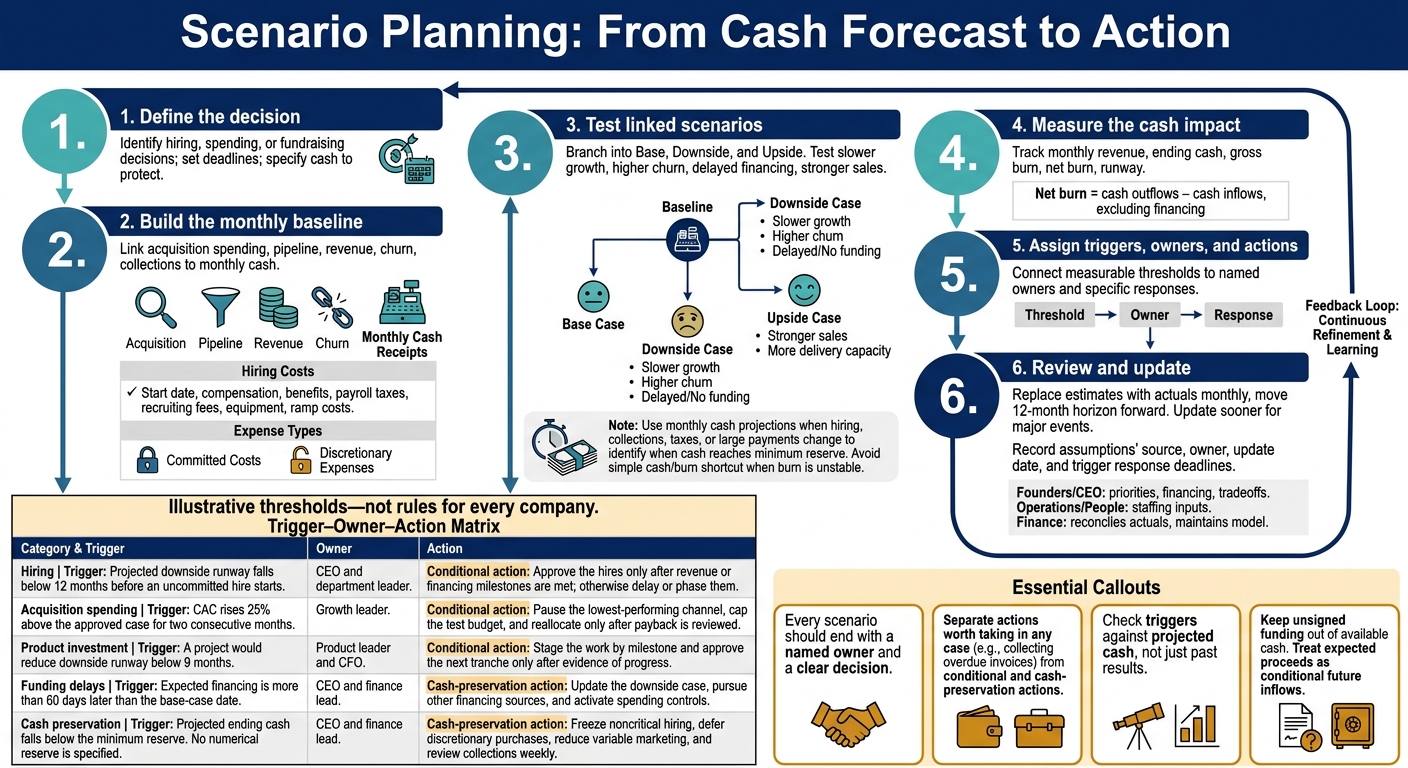
Scenario Planning: From Cash Forecast to Action
Turn those cases into monthly models that guide hiring, spending, and fundraising. Start with the decision, its deadline, and the cash you need to protect. Then build the baseline, test scenarios, measure the cash impact, and set triggers and actions. Every scenario should end with a named owner and a clear decision. Separate spreadsheets alone don’t create dynamic planning.
Model Revenue, Headcount, Burn, and Runway
Link acquisition spending, sales pipeline, conversion, revenue per customer, churn, and collections to monthly revenue and cash receipts. For each role, connect the start date, compensation, benefits, employer payroll taxes, recruiting fees, equipment, and ramp costs to spending. Keep committed costs separate from discretionary expenses.
Build base, downside, and upside cases whose assumptions work together. Stronger sales may require more delivery capacity. Delayed funding may require slower spending - not just a later financing date.
Track monthly revenue, ending cash, gross burn, net burn, and runway. Net burn means cash outflows minus cash inflows, excluding financing. Dividing cash by monthly net burn works only as a shortcut when burn is stable. If hiring, collections, taxes, or large payments change, use monthly cash projections to see when the company reaches its minimum reserve.
Set Cash Triggers and Spending Actions
Separate actions worth taking in any case, such as collecting overdue invoices, from conditional actions, such as milestone-based hiring, and cash-preservation actions, such as freezing discretionary spending. Check triggers against projected cash, not just past results.
Once the model shows how cash moves, pair each threshold with a specific response. These thresholds are examples, not rules for every company.
Decision area Measurable trigger Owner Action Hiring Projected downside runway falls below 12 months before an uncommitted hire starts CEO and department leader Conditional: approve the hires only after revenue or financing milestones are met; otherwise delay or phase them Acquisition spending CAC rises 25% above the approved case for two consecutive months Growth leader Conditional: pause the lowest-performing channel, cap the test budget, and reallocate only after payback is reviewed Product investment A project would reduce downside runway below 9 months Product leader and CFO Conditional: stage the work by milestone and approve the next tranche only after evidence of progress Funding delays Expected financing is more than 60 days later than the base-case date CEO and finance lead Cash-preservation: update the downside case, pursue other financing sources, and activate spending controls Cash preservation Projected ending cash falls below the minimum reserve CEO and finance lead Cash-preservation: freeze noncritical hiring, defer discretionary purchases, reduce variable marketing, and review collections weekly
Review Assumptions and Assign Owners
Scenario planning works only when owners update assumptions and act on triggers. At each monthly close, replace estimates with actuals and move the 12-month horizon forward one month. Update sooner after major customer wins or losses, hiring changes, or financing delays.
Founders or the CEO own business priorities, financing assumptions, and final tradeoffs. Operations or people leaders own staffing inputs. Finance support reconciles actuals and maintains the model.
Record each assumption’s source, owner, and update date, along with each trigger’s response deadline. Test funding dates and amounts, including a case where funding doesn’t close. Keep unsigned funding out of available cash and treat expected proceeds as conditional future inflows.
Support Financial Planning with Lucid Financials
Lucid Financials brings bookkeeping, tax, tax credits, and CFO support together so scenario planning stays tied to current books and cash.
Start with Current Books and Business Assumptions
Once you’ve defined scenarios and triggers, keep their inputs up to date. Bookkeeping and reconciliation set the baseline for bank and credit-card accounts, accounts receivable, accounts payable, payroll, debt, and tax obligations.
Revenue is not cash. Founders still need to provide hiring dates, conversion rates, churn, collection timing, and planned spending. If you use Lucid’s seven-day cleanup process, check its scope and timing against your records.
Use Slack for quick answers, but act only on reconciled books. Record tax payments as dated cash outflows. Treat tax credits as conditional inflows until eligibility and timing are clear. With clean books, finance can test how each scenario affects runway and cash needs.
Review What-If Models with CFO Support
Use Lucid’s forecasts and what-if models to compare hiring, spending, and fundraising choices in base, downside, and upside cases. Check each case against cash flow and runway. Use alerts to flag changes in assumptions, then review those changes against your triggers before approving spending.
Fast answers still need current inputs. Confirm which figures are reconciled and which are estimates. Have finance or CFO support check the source data, assumptions, and calculations, including whether:
- Payroll includes benefits and employer taxes, and revenue isn’t double-counted.
- One-time costs have the correct dates, and debt or tax obligations haven’t been left out.
Founders still own the growth-versus-runway decisions. Use CFO review to check the case before acting.
Conclusion: Combine Forecasts with Scenario Actions
Use the baseline to plan and scenarios to act when conditions change. For scaling startups, this means protecting runway while keeping growth plans flexible.
Link cash outcomes to conversion, churn, and hiring dates. Update the forecast monthly so assumptions match actual cash and hiring pace. Keep each trigger’s owner, action, and review date current.
Choose one hiring or fundraising decision due in the next 3–6 months. Use the model’s monthly cash, burn, and runway figures to check whether the plan fits your runway. Agree with owners on trigger points, then confirm the trigger, owner, and response at the next review.
FAQs
How do I choose realistic downside assumptions?
Replace static, manual spreadsheets with AI-driven tools that simulate “what-if” scenarios. Focus on the financial drivers that affect your business: revenue fluctuations, unexpected expenses, and market shifts.
Use historical data and real-time indicators to spot patterns. Then check AI-generated assumptions against your business plans and professional judgment.
Keep worst-case projections up to date as market conditions change. Regularly compare forecasts with actual results to improve accuracy.
How do I set a minimum cash reserve?
Set aside 5% to 20% of your total budget for unexpected opportunities and market shifts. Use Lucid Financials to fine-tune that range by modeling growth scenarios and tracking your cash runway in real time.
Integrated financial data helps you monitor your burn rate and adjust spending priorities, so you have enough cash to keep operating as your business grows.
What if my scenario triggers conflict?
Human judgment should guide the final decision when AI projections clash with your internal knowledge or business intuition.
For example, if AI predicts steady cash flow but you know a client contract might change, manually adjust the forecast to account for that possibility.
Lucid Financials lets you refine AI-generated scenarios using your expertise, helping keep forecasts accurate without losing machine learning’s analytical depth.