More cash does not fix weak planning. After a funding round, I need a simple model that shows how hiring, sales spend, product work, and fixed costs change burn, runway, and milestone timing.
Here’s the short version:
- I start with a current model: cash, monthly burn, runway, headcount, revenue, gross margin, churn, and taxes
- I test three cases: base, upside, and downside
- I tie each case to clear goals, like $2,000,000 ARR or 18 months of runway
- I treat hiring as a gated move, since payroll often makes up 50%–55% of monthly cash outflow
- I watch for lag in new hires, because they can take 3–6 months to add output
- I review plan vs. actuals every month and reset assumptions every quarter
A few numbers make the point fast:
- A founder may think they have 14 months of runway, then find it drops to 9 months after adding hiring plans, renewals, and collections
- A fully loaded hire often costs 1.25x to 1.4x base salary
- Rolling forecasts can improve forecast accuracy by 30%–40% compared with a static annual budget
The core idea is simple: I should spend against milestones, not mood. That means setting rules in advance for when to hire, when to push growth, and when to cut back.
This article explains how I’d build that plan, what to test, and how to keep it current once spending starts.
Scenario Planning for Small Business Survival in 2025 | Cash Flow Forecasting Walkthrough
sbb-itb-17e8ec9
Build the financial model before you allocate capital
Scenario planning falls apart if the numbers underneath it are stale or messy. Before you run a single what-if, build a current operating model with clean inputs.
At a minimum, include:
- Cash balance
- Monthly burn
- Runway
- Headcount plan
- Revenue by stream
- Gross margin
- Churn
- Known tax liabilities
Once those inputs are in place, trim the model down to the handful of drivers that can change runway fast.
Choose the drivers that actually move runway
Not every input matters the same way. For most growth-stage SaaS companies, the biggest runway drivers are headcount, payroll, revenue growth, churn, CAC, gross margin, and marketing spend.
Payroll and benefits usually make up 50% to 55% of monthly cash outflow, and new hires can drain cash 30 to 90 days before they produce revenue.
That’s why it helps to keep these assumptions in a dedicated tab. You can test hiring dates, churn, and CAC without rebuilding the whole model.
Once you’ve set the key drivers, connect them to the outcomes the round needs to fund.
Set milestone-based planning goals
Scenarios only help when they’re tied to milestones. In plain English, each scenario should point to a target you’re trying to hit, like reaching $2,000,000 ARR, moving into a new customer segment, or keeping at least 18 months of runway at all times.
Those milestones give each scenario a clear pass/fail test. Instead of asking, "what does our burn look like?" - which is too broad to guide a decision - you’re asking, "does this hiring plan get us to $2M ARR before the next raise?" That’s the kind of question a model can answer.
Start with clean books and current reporting inputs
Scenarios are only as good as the accounting data behind them. Timely closes, clean categorization, updated payroll, and current revenue reporting keep the model tied to reality.
The three post-funding scenarios that matter most
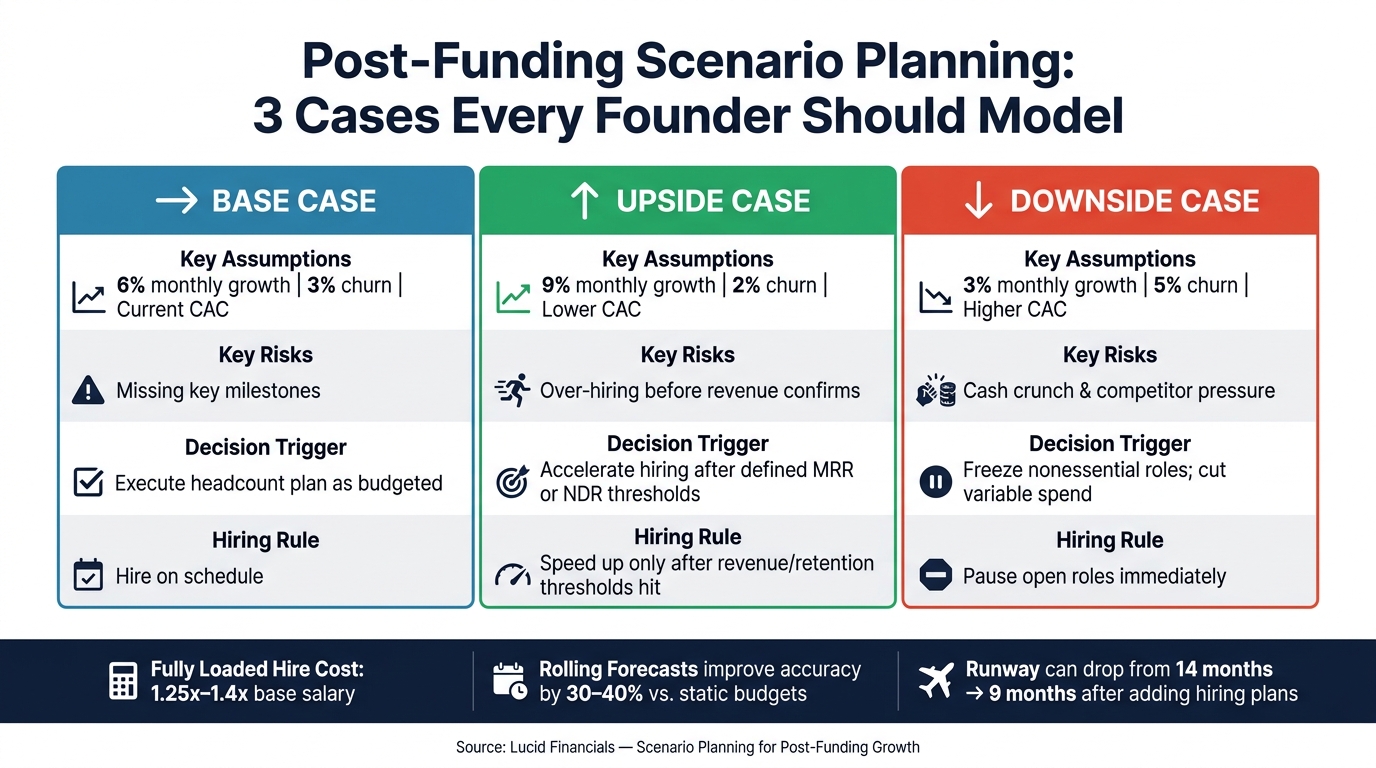
Post-Funding Scenario Planning: Base vs. Upside vs. Downside Cases
After a fundraise, it helps to work from three cases: base, upside, and downside.
The base case is your operating plan. The other two show how spending should shift if growth comes in above plan or below it. Each case should point to a different spending rule. That’s how you decide when to hire, when to spend harder, and when to sit on cash.
| Scenario | Key Assumptions | Key Risks | Decision Trigger |
|---|---|---|---|
| Base Case | 6% monthly growth, 3% churn, current CAC | Missing key milestones | Execute headcount plan as budgeted |
| Upside Case | 9% monthly growth, 2% churn, lower CAC | Over-hiring before revenue confirms | Accelerate hiring after defined MRR or NDR thresholds |
| Downside Case | 3% monthly growth, 5% churn, higher CAC | Cash crunch, competitor pressure | Freeze nonessential roles, cut variable spend |
The first call is usually where to add people, because hiring changes burn faster than almost anything else.
Headcount growth versus runway preservation
Treat headcount as a gated spend decision. In the base case, hire according to plan. In the upside case, speed up only after you hit defined revenue or retention thresholds. In the downside case, freeze nonessential roles.
That shifts the question. It’s not simply whether to grow. It’s how much runway each hire eats up.
A new hire’s fully loaded cost is usually 1.25x to 1.4x base salary once you include taxes, benefits, and equipment. And the cost of a bad hire can reach 30% of that employee's first-year earnings. Put plainly, hiring too early is one of the fastest ways to squeeze runway.
The next trade-off is what gets funded first: product work that makes the business run better, or sales spend that pushes top-line growth.
Product and AI investment versus go-to-market spend
Put money into product and AI when it improves retention, lowers CAC, or shortens sales cycles more than added go-to-market spend would.
The right split isn’t the one that looks even on a spreadsheet. It’s the one that moves the main constraint. For most SaaS companies, MRR growth is the main lever, with churn and CAC right behind it.
If product work keeps users longer or helps sales close faster, that may do more than adding budget to paid acquisition. On the other hand, if demand is already working and the bottleneck is pipeline volume, go-to-market spend may win. The point is to fund the constraint, not the mood of the room.
The last piece is how much room you keep for later budget changes.
Fixed commitments versus flexible spending
Fixed commitments can look easy to approve in the base case and painful to unwind in the downside case.
Annual software contracts, office leases, cloud commitments, and agency retainers often seem efficient at first. But if growth slows, they turn into locked-in burn. The average company wastes up to 30% of its software spend on unused licenses or duplicative tools, which is a good reason to review fixed costs closely before they stack up.
Flexibility matters more after funding than many teams expect. A simple spending gate can help keep it in place:
- Under $1,000: pre-approved
- $1,000 to $5,000: VP approval
- Long-term contracts: founder review
It also helps to lean toward usage-based pricing and variable services. If the downside case kicks in, those are much easier to trim than locked contracts.
Turn scenario planning into an ongoing decision-making process
A scenario plan only matters if it shapes what you do each month, especially around spending and hiring.
Set guardrails for spending and hiring decisions
The simplest guardrails tie cash limits to preset moves. For example, trigger fundraising when runway drops to 9 months and start cost cuts at 6 months.
Hiring should follow the same logic. If MRR growth comes in 20% below the base case for two straight months, pause open headcount roles. If Net Dollar Retention stays above 115% for two months, move ahead with the next hiring wave or sales push. The point is to agree on the rules ahead of time, so decisions don't drift with mood or pressure.
Track variance between plan and actuals
After each monthly close, compare actual ARR, cash, burn, and hiring pace against the plan. Then sort each gap into one of two buckets: timing or structural. A timing issue might be a late invoice or a delayed start date. A structural issue might be higher churn or rising CAC. Timing gaps are noise. Structural gaps need action.
| Planned Metric | Actual Metric | Variance | Recommended Action |
|---|---|---|---|
| Monthly Net New ARR: $120K | $90K | −25% miss | Review sales pipeline; pause non-essential GTM spend |
| Monthly Burn: $680K | $730K | +$50K overspend | Audit vendor subscriptions; delay next engineering hire |
| Cash Runway: 14 months | 11 months | −3 months | Re-evaluate hiring plan; check AR aging for collection delays |
| Churn Rate: 0.8% | 1.5% | +0.7pp | Activate CS retention playbook; escalate to CEO |
Don't let those gaps sit around until the next board meeting. Feed them into the next forecast right away.
Reset assumptions at each monthly and quarterly review
Once you've tagged the variances, update the model based on what they mean now. After each monthly close, roll the forecast forward by swapping forecasts for actuals and adding one more month. Done this way, a rolling forecast improves accuracy by 30% to 40% versus a static annual budget.
Quarterly reviews are the time to show Bear, Base, and Bull cases alongside the response tied to each one. It also helps to give every key assumption a clear owner. Sales can own MRR. Customer Success can own churn. That way, the team sees changes early and can react before small misses turn into bigger problems.
Conclusion: Spend with control, not optimism
Post-funding mistakes usually start with weak visibility, not bad intent. Money shows up faster than the numbers do, and spending can run ahead of the plan. The fix isn't more optimism. It's a model that shows what each choice will cost before cash leaves the account.
Scenario planning turns hiring, product, and spending trade-offs into clear rules. That way, capital follows milestones instead of momentum. Downside, base, and upside cases don't predict the future. They show the cost of each decision before you make it. And that gives you a calmer path when pressure starts to build.
Once those scenarios are in place, the next job is keeping them current. Monthly variance reviews and quarterly resets help tie spending back to milestones. The goal after funding is simple: spend only when the model supports the next milestone.
That only works if the books are current. If your books are stale or your reporting lags, Lucid Financials can help keep them clean, current, and ready for investor review.
Scenario planning isn't prediction. It's preparation: clear rules for how to respond when growth doesn't go as planned.
FAQs
How detailed should my post-funding model be?
Your post-funding financial model should be a lean decision-making tool, not a giant spreadsheet that tries to predict every twist and turn.
Build three core scenarios: base, upside, and downside. Center them on the 4 to 5 key variables that have the biggest effect on your business, like revenue growth, churn, sales cycle, customer acquisition cost, and hiring timelines.
Keep everything else the same. That way, you avoid extra complexity and can make decisions faster.
What milestones should I tie hiring to?
Tie hiring to clear business milestones instead of putting every role on a fixed calendar. That way, each hire has to earn its place through growth.
Use your operating plan to connect hiring decisions to KPIs such as user adoption, MRR goals, or expansion into a new market. Then set if-then spend triggers that either pause or greenlight hiring when growth or revenue hits specific marks. If revenue shifts, you can slow down headcount before costs get out of hand.
When should I update my scenarios?
Update your scenarios monthly so you can compare actual performance against your base case and refresh projections with current accounting data.
You should also update them when key assumptions change in a meaningful way, like changes to hiring plans, revenue trends, or fundraising timing. That keeps your runway and capital needs accurate and useful.