I start multi-currency bookkeeping with three checks: the right currency, the right rate, and the right date. Before automating entries, I set rules under U.S. GAAP and keep book and tax calculations separate.
Here’s my 10-point checklist:
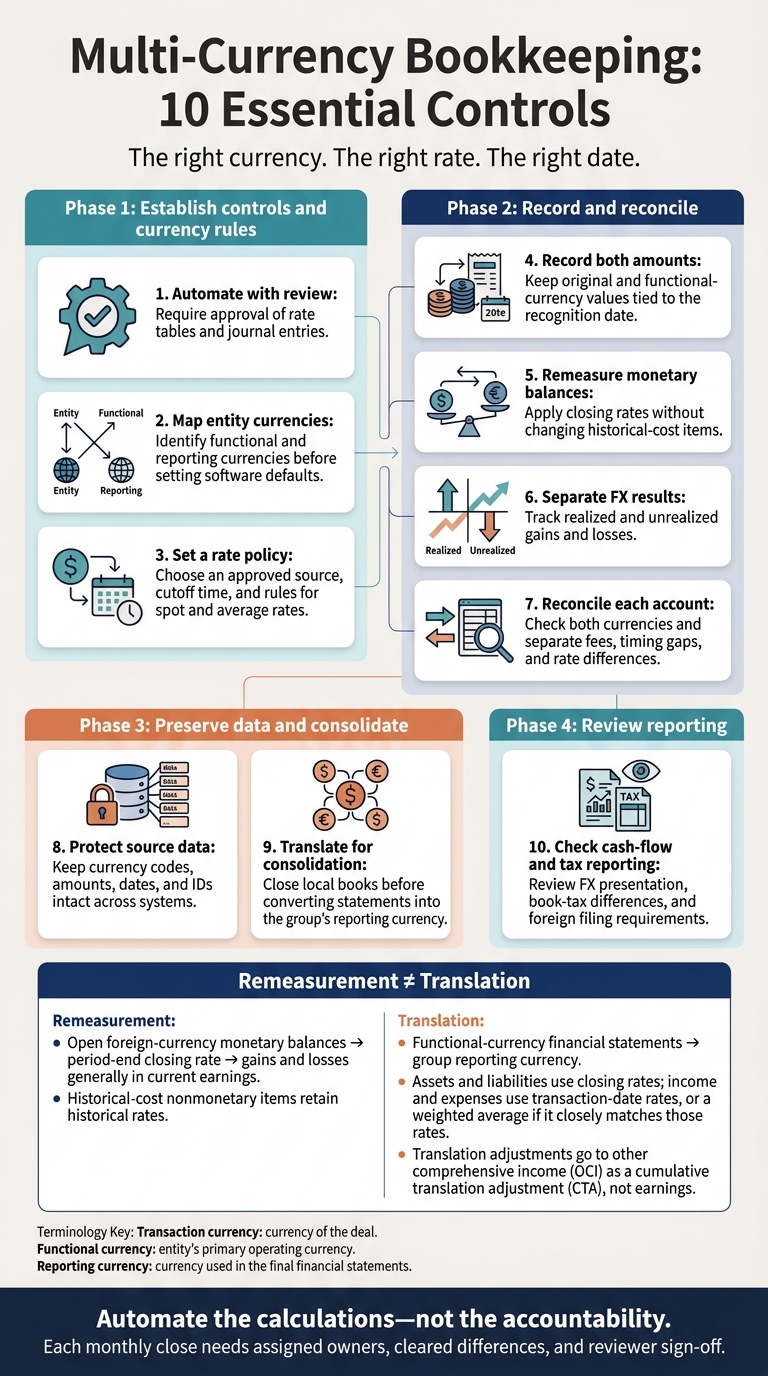
- Automate with review: Require approval of rate tables and journal entries.
- Map entity currencies: Identify functional and reporting currencies before setting software defaults.
- Set a rate policy: Choose an approved source, cutoff time, and rules for spot and average rates.
- Record both amounts: Keep original and functional-currency values tied to the recognition date.
- Remeasure monetary balances: Apply closing rates without changing historical-cost items.
- Separate FX results: Track realized and unrealized gains and losses.
- Reconcile each account: Check both currencies and separate fees, timing gaps, and rate differences.
- Protect source data: Keep currency codes, amounts, dates, and IDs intact across systems.
- Translate for consolidation: Close local books before converting statements into the group’s reporting currency.
- Check cash-flow and tax reporting: Review FX presentation, book-tax differences, and foreign filing requirements.
My rule: <u>automate the calculations - not the accountability.</u> Each monthly close needs assigned owners, cleared differences, and reviewer sign-off.
Multi-Currency Bookkeeping: 10 Essential Controls
Understand Currency Accounting Rules
ASC 830 distinguishes between three currencies: transaction currency is the currency of the deal, functional currency is the entity’s primary operating currency, and reporting currency is the currency used in the final financial statements.
Record foreign-currency transactions in the functional currency using the spot rate on the transaction date. At period-end, remeasure monetary balances and record the resulting gains and losses in income.
When translating a foreign entity’s functional-currency statements into the reporting currency, record translation adjustments in other comprehensive income (OCI) as a cumulative translation adjustment (CTA) - not in earnings.
Translate foreign-currency cash flows using the exchange rate on each cash-flow date. Show the exchange-rate effect separately in the cash-flow reconciliation.
Keep GAAP and tax separate. IRC Section 988 generally recognizes currency gains and losses when realized, while GAAP may recognize unrealized amounts. Track transaction dates, original amounts, exchange rates, and settlement records. Maintain separate book-and-tax gain/loss schedules to support the workflow, rates, and close process that follow.
sbb-itb-17e8ec9
1. Automate Currency Workflows With Human Review
Once the accounting rules are set, automate routine tasks while keeping people in control. Import approved rates automatically, lock historical tables, and assign a reviewer to approve the final monthly table.
The goal is consistency - not hands-off posting.
| Task or control | Spreadsheet workflow | Automated workflow | Required review |
|---|---|---|---|
| Manual entry | Enter amounts and rates by hand | Sync data from approved sources | Spot-check source data |
| Rate consistency | Separate files can drift apart | Use centralized, locked rate tables | Check rates against market benchmarks each month |
| Remeasurement | Calculate and post entries manually | Post recurring period-end entries | Approve journals before posting |
| Reconciliation | Match payments by hand | Match settlements automatically | Clear exception items before close |
| Audit trails and errors | Track file versions and check formulas | Log rate and setting changes; flag errors | Review access, changes, and error logs |
2. Identify Functional and Reporting Currencies
With the accounting rules clear, map each entity to the currency that drives its business. Assign its functional currency based on the currency that drives prices, costs, financing, and cash flow. Assess separable operations individually - don’t rely on the currency selected in the software settings.
Automation depends on an accurate entity currency map. Set default currencies for transaction entry and reporting, adjust entity-level settings where needed, and apply the same currency rules across all entities. A wrong default means every downstream report and remeasurement entry starts from the wrong base. This map also determines which exchange rate to use in the next step.
3. Set an Exchange-Rate Policy
Set clear rules for which exchange rates the team can use - and when. Choose one approved source, plus a cutoff time and time zone for the daily spot rate. Use this policy to keep transaction-date rates and averaging rules consistent.
Apply transaction-date spot rates to large, nonrecurring transactions, such as asset purchases and intercompany loans. Reserve daily or monthly averages for routine, high-volume activity when rates are stable. That way, automated postings follow the same rule every time. Apply the same discipline to period-end remeasurement and financial statement translation.
Keep remeasurement and translation rules separate. Specify which balances use period-end closing rates and which stay at historical rates. Record separate controls for each process and each rule in the close checklist.
4. Record Transactions in the Functional Currency
Once the rate policy is set, record each transaction on the correct date and in the correct currency. Keep both the original and functional-currency amounts. Each entry should include the original currency, functional-currency amount, recognition date, exchange rate, rate source, and source document. Store the entity’s functional currency on every posting.
Use the recognition date - not the date cash moves. Recognition and payment dates often differ. The correct date is when the transaction meets the recognition criteria under your accounting policy. Don’t default to the payment, import, or settlement date.
Validate date fields in automated feeds before posting, and apply the same controls to manual entries. Flag missing recognition dates and source documents. Block payroll and banking mappings that replace recognition dates with import or settlement dates. At period-end, check entry dates against supporting documents so late payments don’t shift transactions into the wrong period or lead to misdated adjustments.
5. Remeasure Monetary Balances at Period-End
Once transactions are recorded in functional currency, remeasure open monetary balances at period-end. Under ASC 830, apply the closing rate at each balance sheet date to foreign-currency cash, receivables, payables, loans, and intercompany monetary balances. Generally, record the resulting exchange gains and losses in current earnings.
Nonmonetary items carried at historical cost keep their historical rates. This includes inventory, property and equipment, intangibles, and prepaid expenses. For nonmonetary items measured at fair value, use the exchange rate on the fair-value measurement date. This accounts for exchange-rate exposure without remeasuring historical-cost items.
Handle long-term intercompany balances separately. If settlement isn't expected in the foreseeable future, document the basis for that assessment and apply the treatment consistently at each reporting date.
Identify open monetary balances and apply approved closing rates. Have a reviewer check both the rate selection and account classification. Use scheduled reversal entries only when required, and check that new calculations don't double-count earlier adjustments. These entries feed the realized and unrealized gain or loss analysis in the next step.
6. Track Realized and Unrealized Currency Gains and Losses
After remeasurement, classify each foreign exchange (FX) difference as realized or unrealized, and track them separately in the ledger. Realized gains and losses occur when a foreign-currency item settles. Unrealized gains and losses arise from period-end remeasurement.
Review these balances by account and entity to keep settlement and remeasurement entries consistent through close.
7. Reconcile Each Foreign-Currency Account
After remeasurement, reconcile each account to catch posting errors and timing gaps. Match bank statements, processor settlements, open invoices, bills, and intercompany balances against the ledger. Check balances in both the original currency and functional currency using approved rates.
Separate timing differences, processor fees, exchange-rate differences, and missing entries. Check posting dates before treating a difference as an error. Only rate-driven differences belong in FX gains or losses.
Automate statement imports and transaction matching. Keep currency settings and accounting rules consistent across entities so automated checks apply the same standards.
Give each account an owner who reviews exceptions, documents their causes and resolutions, and clears stale differences before close. Unresolved reconciliation differences often point to inconsistent data across connected systems.
8. Keep Currency Details Across System Integrations
Reconciliation depends on integrations that keep source-currency details intact. Store both source and converted values in every integration. Bank, processor, and accounting feeds should retain the original currency and amount, functional-currency amount, settlement date, fees, and transaction ID. Never replace source amounts with converted values.
Check field mappings before importing bank files or CSVs. Make sure currency codes, amounts, dates, and IDs go into the correct fields. Map each transaction to the right entity and functional currency. Don’t let a default reporting-currency setting overwrite source-currency data.
Test settlement matching from start to finish. Trace gross foreign-currency amounts through conversion, fees, and net settlements. Send unmatched payments and fee variances for human review. Keeping these fields also supports translation and consolidation. This data integrity is essential for generating real-time financial insights that drive growth.
9. Translate Foreign Financial Statements for Consolidation
Once transactions are recorded, remeasured, and reconciled, close the local books before translation. For consolidation, translate a foreign operation’s financial statements if its functional currency differs from the group’s reporting currency.
Use the current rate method: translate assets and liabilities at the closing rate, and income and expenses at transaction-date rates. You can use a weighted average rate if it closely matches the transaction-date rates.
These translation entries feed into consolidation and period-end reporting.
10. Review Cash-Flow and Tax Reporting
After posting translation entries, review cash-flow presentation and tax reporting before the final close. Check that cash flows use transaction-date exchange rates and that any weighted average closely matches those rates. Show the FX effect on cash and cash equivalents separately in the cash-flow reconciliation.
Keep book and tax treatment separate. Track timing differences in Schedule M-1 or M-3 so book-reporting differences don’t carry into the tax return.
Have your CPA check functional currency designations, Section 988 treatment, and FBAR exposure against IRS guidance. Aggregate foreign account balances above $10,000 at any point during the year can trigger an FBAR filing requirement.
Use reconciled multi-currency records to check international filing requirements, including Form 5471, Form 8858, Section 482 transfer pricing, state adjustments, and foreign-source income reporting. Resolve any tax and reporting exceptions before the final close.
Build a Consistent Multi-Currency Close
Once remeasurement, reconciliation, and translation controls are in place, turn your currency policies into a monthly close checklist. Assign owners, set cutoffs, and define approval steps.
Keep source amounts, currency codes, and converted values linked to each journal entry. Reviewers should be able to trace every balance to its source. This helps speed up month-end review and makes exceptions easier to resolve.
Automate imports and calculations, but require reviewer sign-off on rates, entity mappings, and AI-generated entries.
Use this checklist each month:
- Post period-end entries.
- Clear exceptions.
- Obtain sign-off.
- Retain rate tables, workpapers, system logs, and reviewer sign-offs for financial reporting and tax review.
FAQs
How do I correct an exchange-rate error after closing?
If your automated system flags a discrepancy after a period closes, compare the original invoice or bank record with the recorded entry to find the difference. Fixing it typically requires a manual journal entry to adjust the gain or loss account, with an offset that reflects the correct exchange rate on the transaction date. Document why you made the adjustment to keep the audit trail clear and ready for investor review.
How do I avoid double-counting FX gains at settlement?
Use automated reconciliation to align transaction timing with the underlying currency exposures. Connect your bookkeeping system to live exchange rate feeds so it can match payments to open invoices, adjust balances in real time, and record gains and losses against the correct currency pair.
Multi-currency accounts help you avoid unnecessary conversions, repeated spread costs, and manual accounting errors. Maintain a clear audit trail that keeps external transactions separate from internal settlements.
Which multi-currency tasks should I automate first?
Start with high-volume account feeds, such as primary checking accounts. Use API integrations to standardize USD imports and recognize recurring patterns.
Next, connect real-time exchange rate feeds to automate currency translations and period-end adjustments for receivables, payables, and cash balances [2].
Then use AI to classify transactions and flag foreign exchange exposure breaches. This reduces manual work and improves accuracy compared with spreadsheets [3][4][5].