If you're running a startup, better sales forecasts can help you protect cash, plan hiring, and avoid bad timing on fundraising. The article’s main point is simple: AI forecasting tools usually beat spreadsheets because they pull live data from CRM, accounting, and bank systems, reduce manual mistakes, and make scenario planning easier.
Here’s the short version:
- Spreadsheet forecasts often fail on data quality and manual errors.
- AI tools can improve forecast accuracy by 20% to 40% compared with spreadsheet-based work.
- Automated forecasting can improve accuracy by up to 30%, especially when teams move away from manual models.
- Finance teams also report fewer reporting errors, with 68% saying error rates dropped after using AI tools.
- For early-stage startups, this matters because cash risk is high and nearly half of startup failures happen after running out of cash.
- AI works best when it uses:
- CRM pipeline data
- accounting data
- bank feed data
- probability-weighted deal stages
- scenario models for best, base, and worst cases
- These tools are most useful for:
- revenue planning
- burn and runway tracking
- hiring timing
- spend control
- fundraising prep
- But AI is not enough on its own. Bad CRM data, short company history, and business model changes can weaken forecasts fast.
What I’d take from the article is this: AI forecasting is not magic, but it can give startups a better view of revenue and cash than static spreadsheets. The biggest gains come when founders use it as support for decisions, not as the only answer.
The rest of the article explains where AI forecasting performs well, where it breaks, what tools startups tend to use, and how finance platforms like Lucid Financials connect revenue forecasts to cash flow and runway planning.
EP 106 - Mark Roberge on AI Sales, Revenue Velocity & the Future of Startup GTM
sbb-itb-17e8ec9
Quick Comparison
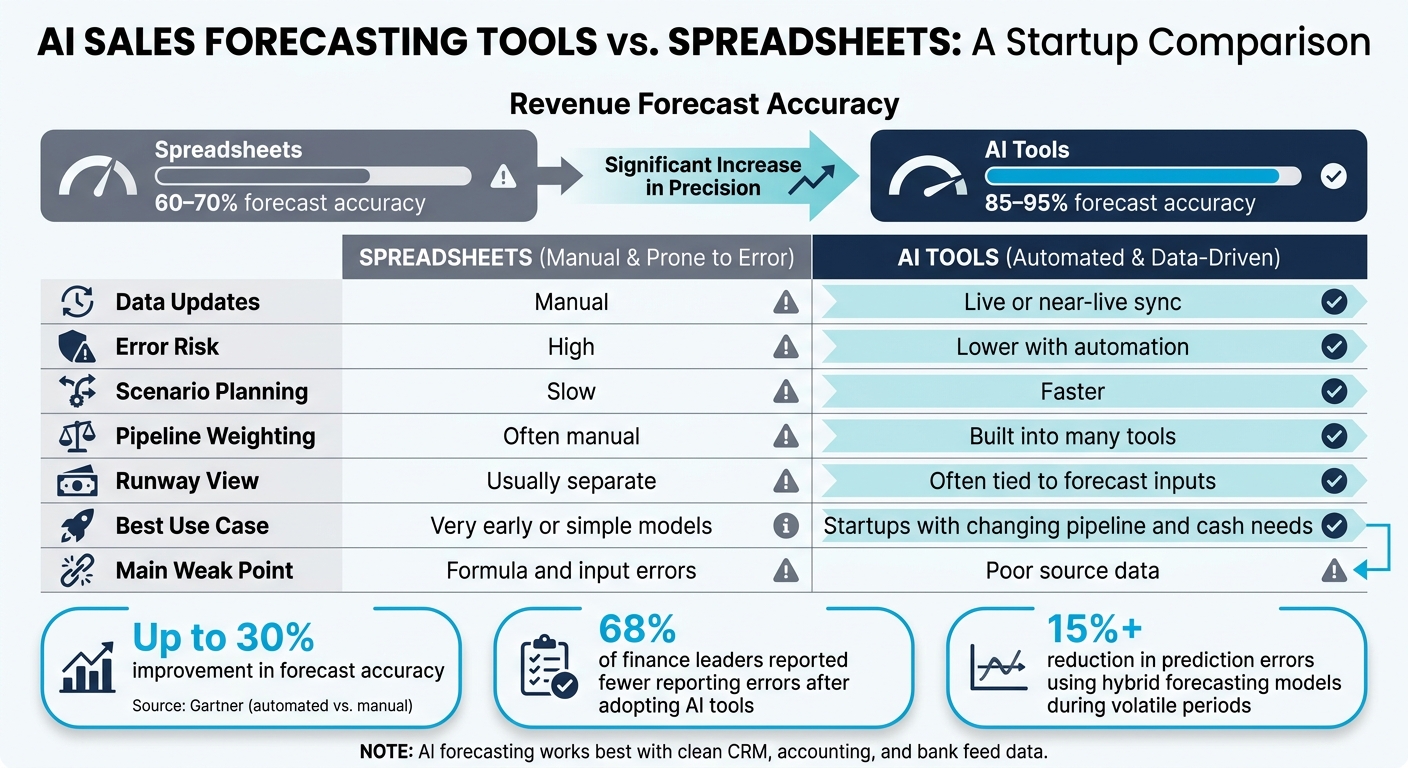
AI Forecasting vs. Spreadsheets: Key Stats & Differences for Startups
| Area | Spreadsheets | AI forecasting tools |
|---|---|---|
| Data updates | Manual | Live or near-live sync |
| Error risk | High | Lower with automation |
| Scenario planning | Slow | Faster |
| Pipeline weighting | Often manual | Built into many tools |
| Runway view | Usually separate | Often tied to forecast inputs |
| Best use case | Very early or simple models | Startups with changing pipeline and cash needs |
| Main weak point | Formula and input errors | Poor source data |
What Recent Research Says About AI Forecasting Performance
Gartner found that automated forecasting can improve accuracy by up to 30%, especially when it replaces manual spreadsheet workflows. For startups watching cash runway, hiring plans, and pipeline confidence, that kind of lift matters. The next step is figuring out which approach holds up best when sales don't follow a neat pattern.
AI vs. Spreadsheets and Basic Time-Series Forecasts
AI tools tend to deal better with irregular deal sizes, churn spikes, and uneven closes because they pull in live CRM, accounting, and bank data. In plain terms, basic statistical models work best when patterns stay steady. Once revenue starts bouncing around, AI and hybrid models usually do a better job.
Finance teams are seeing that show up in day-to-day work too. 68% of finance leaders reported a measurable drop in reporting errors after putting AI tools in place. Automated forecasting cuts down on manual reconciliation and helps keep the forecast tied to cleaner inputs. That's a big deal when forecasts shape pipeline reviews, hiring plans, and cash decisions.
Which Models Perform Best in Volatile Sales Environments
For startups with uneven revenue, hybrid models that blend market signals with pipeline data often give the most dependable forecasts. During periods of economic turbulence, businesses using combined forecasting methods cut prediction errors by more than 15%.
Probability-weighted pipeline forecasting adds another layer of control. Instead of treating every pipeline dollar the same, it uses CRM data to assign confidence levels to open deals. Anomaly detection can also spot deal slippage early, before it turns into a bigger problem. For enterprise sales with a lot of variation, it helps to pair AI forecasts with input from the sales team so shifts in the market don't slip past the model. That forecast quality shapes revenue planning and growth calls in a very direct way.
How AI Forecasting Shapes Revenue Planning and Growth Decisions
Better forecast accuracy makes budgeting, hiring, and fundraising less of a guessing game. You see that most clearly in pipeline quality and cash planning.
Pipeline Diagnostics and Lower Forecast Bias
The next problem usually isn’t the model itself. It’s forecast bias.
Sales reps often overstate close probabilities on deals they feel good about. That can distort the pipeline view and push teams to plan around numbers that don’t hold up. AI helps spot sales optimism bias by weighing stage movement, engagement, past close rates, and slipping dates.
When that bias drops, the forecast becomes much more useful for planning spend and headcount.
Planning Spend, Headcount, and Fundraising With Better Forecasts
A cleaner forecast flows straight into day-to-day operating calls. When the numbers are more dependable, it’s easier to defend decisions on spend, hiring, and timing.
AI can model salary, benefits, and ramp time before a new hire starts adding revenue. That matters because personnel costs usually run 20% to 30% above base salary. A small change in those assumptions can change the answer by a lot.
AI tools can also give teams real-time runway visibility. That helps founders adjust marketing spend and hiring pace without waiting for month-end reconciliations. And when it comes to fundraising, that same visibility makes it easier to start a round before runway pressure backs the company into a corner.
For planning, simple usually works best:
- Keep best-case, base-case, and worst-case scenarios.
- Update them as pipeline data changes.
AI Sales Forecasting Tools Startups Use and What to Look For
A cleaner forecast only matters if it changes how you plan. The big issue isn't just what the forecast says. It's how that forecast turns into hiring plans, cash decisions, and day-to-day calls.
CRM-Based Forecasting Tools and Revenue Intelligence Platforms
For many startups, forecasting begins with CRM data. The best tools connect systems like Salesforce or HubSpot with accounting software and bank feeds, so teams can build probability-weighted pipeline forecasts and cut manual entry mistakes.
Revenue intelligence platforms go a step further. They use machine learning to scan CRM and transaction data for patterns people often miss, like seasonal payment behavior or deals that keep slipping.
When you're looking at tools, focus on whether they can:
- Sync CRM, accounting, and bank data
- Weight deal probability
- Show the impact on runway
That last point matters more than it may seem. A forecast isn't just a sales number. It should help you see what happens to cash if deals land late, close early, or disappear.
Where Lucid Financials Fits in the Forecasting Stack
For startups that need forecasting tied straight to cash and runway, the finance layer matters just as much as the sales layer.
Sales forecasting tools show what revenue may look like. Lucid Financials sits on the financial planning side and connects those signals to cash flow projections, hiring scenarios, and board reporting. It pulls in QuickBooks and bank data, models cash flow and runway, surfaces answers in Slack, and generates investor-ready reports.
Limits, Data Requirements, and Key Takeaways
Common Failure Points in Early-Stage Forecasting
Once the tool is set up, data quality becomes the bottleneck. Poor data quality drives 60% of AI failures, so clean accounting, steady transaction tagging, duplicate cleanup, and clearly defined CRM stages matter a lot. If CRM records are messy or pipeline stages are too vague, the model is stuck working with weak history.
Limited historical data is another issue. Startups with short track records won't get the same confidence level as companies that have more clean pipeline data. A practical way to handle this is to support thin internal data with industry benchmarks and use rule-based forecasts until more history builds up. This is also why business-model changes can hit hard.
Product pivots and go-to-market changes can break forecasting models fast. When the business changes, past patterns stop being useful, and the model needs retraining.
AI is good at spotting patterns, but it struggles in new situations or when business context matters most. So it's best to treat AI output as decision support, not the final call. Founders should be able to explain the assumptions behind a forecast to investors or board members instead of handing over a black-box number.
Conclusion: What Founders Should Take From the Research
The research points to a clear takeaway: AI-driven platforms reach 85–95% accuracy in revenue forecasting, while spreadsheet-based methods usually land at 60–70%. That's a big gap when major planning decisions are on the line.
What matters most isn't just the tool. It's the mix of AI vs. traditional scenario planning, earlier risk detection, and better decisions. Human review, clean data, and clear business drivers are what separate forecasts you can use from forecasts that send you in the wrong direction. The tool is only one input.
FAQs
When should a startup switch from spreadsheets to AI forecasting?
Startups should move from manual spreadsheets to AI-driven forecasting after about 18 months of transaction history. Some teams need to make that move even earlier if growth starts to make manual data work hard to keep up.
By then, spreadsheets often start to crack under static inputs and more complex variables. If manual work is slowing your team down, Lucid Financials can help with real-time updates, scenario modeling, and better accuracy.
How much historical data does AI forecasting need to work well?
There’s no fixed amount. What matters most is data quality and consistency.
Many models work best with 12 to 24 months of history because that gives them enough data to spot seasonality and conversion patterns. But startups can begin with less if they back up their assumptions with industry benchmarks and market research.
It also helps to standardize metrics like monthly recurring revenue, pipeline stages, and bookings. When those numbers are defined the same way across the business, forecasts tend to be more accurate.
How can founders tell if their forecast data is reliable?
Founders should judge reliability by looking at data quality first, not model complexity.
Start with clean, current, connected data like MRR, past bookings, and pipeline metrics. Then audit that data so it follows the same rules across the board:
- Standardize opportunity stages
- Require amounts in USD
- Use MM/DD/YYYY close dates
- Deduplicate accounts
Next, check that data against source systems like your CRM and general ledger.
After that, compare AI projections with human commits every week, log overrides, and run quarterly backtests to spot bias.