AI-powered forecasting is transforming how businesses predict profitability. It replaces outdated methods that rely on static data and manual processes, offering faster, more accurate, and dynamic financial insights. By analyzing large datasets in real time, AI reduces forecast errors by 30–50%, improves cash flow predictions, and helps businesses respond quickly to market changes. Companies using AI save time, cut costs, and make better decisions about hiring, spending, and growth.
Key takeaways:
- AI forecasts are up to 85% more accurate than older methods.
- Real-time updates reduce risks, improve cash flow management, and prevent costly errors.
- AI handles hundreds of variables, integrating data from multiple platforms for a complete financial view.
- Businesses save 15–20 hours monthly on forecasting tasks, translating to significant cost savings.
Switching to AI-driven tools like Lucid Financials ensures startups and growing companies can manage finances with precision, meet investor expectations, and focus on scaling effectively.
How to Develop More Accurate Financial Forecasts With ML and AI
sbb-itb-17e8ec9
Problems with Traditional Profitability Forecasting
To appreciate how AI can reshape forecasting, it’s crucial to first understand why traditional methods often fall short. These older approaches rely heavily on manual processes and historical data, both of which struggle to keep up with today’s fast-changing markets.
Dependence on Past Data
Traditional forecasting models lean heavily on historical metrics like closed deals, past spending patterns, and previous quarter trends. While this might sound logical, it’s a flawed approach in dynamic markets. As Perceptive Analytics points out:
"Lagging data... tells leaders what already happened, not what is likely to happen next".
This reliance on outdated information becomes a major issue when market conditions shift unexpectedly. Imagine a forecast made in January predicting an 8% revenue growth based on last year’s performance. If a competitor slashes prices mid-year, that forecast could miss the mark by as much as 22%.
The problem deepens because traditional spreadsheet models can only handle a limited number of variables - usually between 5 and 10 - while real-world business outcomes are shaped by hundreds of interconnected factors. For startups, this reliance on historical data is even more problematic. When launching a new product or entering an unfamiliar market, there’s simply no past performance data to guide predictions. As the Superdots Team aptly puts it, spreadsheets are no match for a rapidly evolving world.
These weaknesses are further compounded by the errors that stem from manual processes.
Manual Work and Human Errors
Relying on manual forecasting introduces countless opportunities for mistakes. A single typo, an incorrect formula, or a misinterpreted data input can throw off an entire financial model. Additionally, consolidating data across departments often results in inconsistent definitions and duplicated records, further undermining accuracy .
Human bias adds yet another layer of complexity. Sales teams may unintentionally distort forecasts with overly optimistic assumptions, deliberate underestimations (known as "sandbagging"), or pressure-driven adjustments. The result? Traditional forecasting methods typically hover around just 51% accuracy. Without AI, fewer than 20% of sales teams achieve accuracy rates above 75%.
These inefficiencies make it even harder for businesses to react quickly to changes in the market.
Slow Response to Market Changes
Traditional methods are notoriously slow to adapt to market shifts. Manual adjustments to forecasts can take days, meaning the data is often outdated by the time the forecast is complete. As Perceptive Analytics explains:
"By the time a forecast is assembled, the inputs have already changed".
This lack of agility is particularly dangerous for startups operating in volatile industries. Traditional forecasting tools focus on past events rather than incorporating real-time signals like buyer engagement patterns or deal velocity. When unexpected challenges arise - such as supply chain disruptions, regulatory shifts, or aggressive moves by competitors - these models fail. Without prior data to guide them, they simply can’t provide actionable insights.
Nathan Thompson, an expert in revenue forecasting, captures the issue perfectly:
"The end of the quarter often relies on rep opinion, manager overrides, and optimism. This gut-driven approach produces inaccurate revenue predictions, weakens trust, and puts growth at risk".
These limitations highlight the urgent need for more adaptive, data-driven forecasting methods.
How AI Improves Profitability Forecasting
AI transforms profitability forecasting by addressing the limitations of traditional approaches. By processing data at incredible speeds and learning from real-time updates, AI delivers predictions that are 30% to 50% more accurate than those generated with spreadsheets.
Processing Large Datasets
AI's ability to handle massive and diverse datasets is one of its strongest advantages over manual methods. While traditional spreadsheets typically manage 5 to 10 variables, AI models can process hundreds at once. These variables include historical financial data, CRM pipeline details, market indices, and external factors like commodity prices or regulatory changes. This enables AI to dive deep into specifics, such as customer behaviors, SKU performance, and regional trends.
Machine learning algorithms excel at uncovering intricate relationships across thousands of data points - patterns that might go unnoticed by human analysts. For instance, an AI model could reveal how certain macroeconomic indicators influence revenue months down the line or how shifts in sales cycle lengths affect cash flow. When trained effectively, these models can achieve accuracy rates as high as 95% to 98% for sales bookings forecasts.
Additionally, AI integrates data from multiple sources - ERP systems, CRM platforms, billing software, and even external feeds like Bloomberg or S&P Global - creating a unified and comprehensive view that traditional tools can't replicate . Between 2024 and 2026, 58% of finance functions are already leveraging AI, with predictions that this number will climb to 90% by 2026.
Live Forecast Updates
Unlike spreadsheets that rely on static assumptions, AI models continuously update forecasts based on new data. This ensures predictions reflect the latest market conditions rather than outdated information from weeks or months ago .
Real-time updates act as early warning systems, allowing leadership to address potential issues before they escalate. For example, if an AI model detects a likely shortfall by week six of a quarter, finance teams can intervene in April instead of scrambling to fix things in July . As the Superdots Team puts it:
"The result is not perfect forecasting - nothing is - but it is forecasting that adapts when conditions change instead of pretending they did not".
This adaptability replaces static averages, such as days sales outstanding, with real-time distributions based on current customer behaviors and payment patterns. AI also automates frequent reporting, like rolling 13-week cash forecasts delivered every Monday morning, ensuring decisions are always grounded in the most up-to-date information.
Beyond just updating predictions, AI learns from past discrepancies, which leads to even greater accuracy over time.
Algorithms That Learn Over Time
AI models stand apart from older methods by continuously improving their forecasts. Rather than repeating the same calculations, these algorithms learn from past variances. For example, if customer payment patterns shift, the model adjusts future cash flow predictions accordingly.
Advanced techniques like regime shift analysis and drift detection allow models to adapt to changing market conditions by re-weighting features and avoiding outdated logic. Algorithms such as gradient boosting and random forests enable hyper-parameter optimization, helping finance teams fine-tune predictions for specific datasets.
Austin Braham from Everworker highlights this adaptability:
"Modern pipelines track regime shifts, detect drift, and re‑weight features so the model learns as your market changes, rather than locking yesterday's logic into tomorrow's plan".
The most advanced AI systems go beyond single-point predictions, offering probability-weighted scenarios. For instance, they might indicate a 70% chance of achieving a specific revenue range, updating these probabilities as new data becomes available . This move from static assumptions to dynamic, adaptive models marks a major step forward in profitability forecasting.
Business Benefits of AI-Powered Forecasting
Switching from spreadsheets to AI isn't just a tech upgrade - it delivers real, measurable improvements in accuracy, speed, and strategic planning. These changes save time, cut costs, and help businesses make smarter decisions with confidence.
Better Accuracy and Fewer Mistakes
AI-powered forecasting slashes errors by 20–50% compared to manual methods, offering startups financial projections they can actually trust. For example, manual spreadsheet forecasting often results in a median quarterly revenue error of 25% to 40%, while AI brings this down to 10% to 15%. Similarly, for 30-day cash flow predictions, manual methods miss the mark by 20% to 35%, but AI reduces that range to just 6% to 12%.
What makes AI so precise? It dives deep into granular details - like SKU, customer, and regional data - that traditional spreadsheet averages often overlook. Plus, it eliminates human bias. As Austin Braham from EverWorker puts it, AI removes "fossilized judgment" buried in outdated Excel models. By automating processes and minimizing human error, AI delivers numbers you can rely on for board meetings and investor pitches.
Faster Analysis That Scales
AI dramatically speeds up financial planning. Tasks that typically take 8–15 hours per month can be done in just 1–2 hours, saving small and medium businesses 15–20 hours monthly. For a company earning $500,000 to $2 million annually, that’s a labor savings worth $2,000 to $4,000 per month.
The setup is quick, too. Connecting platforms like QuickBooks or Xero to AI systems takes only 30 to 60 minutes. Once connected, AI models automatically retrain as new data comes in, so there's no need for manual updates. This frees up finance teams to focus on interpreting the data and planning ahead, rather than spending hours fixing formulas or inputting numbers. And as businesses grow, AI scales effortlessly - running 500+ scenario permutations in seconds to project cash flow and revenue probabilities. This efficiency not only reduces labor costs but also makes financial planning far more dynamic.
Stronger Financial Planning
AI doesn’t just make forecasts faster and more accurate - it also makes financial planning smarter. By turning guesswork into reliable insights, businesses can make better decisions about hiring, marketing budgets, and runway calculations.
For example, AI can identify at-risk subscription accounts 30 to 60 days before human analysts typically would, giving teams the chance to act early and reduce churn. It also improves cash flow management, helping businesses avoid costly last-minute credit lines with high interest rates - like 18% APR, which can cost $500 to $2,000 per month.
Instead of relying on outdated "best case/worst case" scenarios, AI provides probability distributions. For instance, it might show a 70% chance that revenue will land between $480,000 and $540,000. This level of detail helps leaders assess risks more effectively. AI also boosts accuracy in specific areas, like infrastructure expenses, where forecasting errors drop from 15% to 25% to just 5% to 10% by modeling usage-driven patterns. The result? A financial plan that reflects real-time data, not outdated assumptions.
Lucid Financials: AI-Powered Tools for Startups

Startups often face a tough challenge when it comes to financial forecasting - they don’t have the historical data that traditional methods rely on. Instead, they’re left to depend on qualitative insights, which can be risky. Add to that the constant need to manage burn rate and cash flow, and it’s clear why delayed manual updates can throw everything off track.
Enter Lucid Financials. This AI-powered, full-stack accounting platform is built specifically for startups and fast-growing companies. By combining bookkeeping, tax services, tax credits, and CFO support, Lucid delivers speed, accuracy, and strategic insights. It’s designed to tackle the unique financial hurdles startups face, offering real-time, tailored solutions that help founders stay ahead.
AI-Generated Financial Forecasts
Lucid leverages AI to create real-time projections for revenue, cash flow, and runway. These forecasts aren’t static - they adapt as conditions change, making them ideal for scenario modeling. Whether it’s hiring, spending, or fundraising decisions, Lucid’s dynamic forecasts provide clarity where traditional methods fall short. With 58% of finance teams expected to pilot AI in 2024, Lucid ensures startups can access cutting-edge tools without delay.
Slack Integration for Instant Answers
Lucid’s Slack integration makes financial insights instantly accessible. Founders can simply ask questions like, “What’s my runway?” or “How will a new hire impact my burn rate?” and get immediate answers. This feature keeps financial data at your fingertips without disrupting your workflow. And if a deeper dive is needed, Lucid’s human finance team is always available to provide expert guidance.
Clean Books and CFO Support
Using AI automation, Lucid completes transaction matching and reconciliation in just seven days. No more waiting weeks to close the books or rushing to prepare for investor meetings. Beyond efficient bookkeeping, Lucid provides CFO-level support, offering clear cash flow visibility, board-ready reports, and strategic planning for fundraising. These tools free up CFO teams to focus on strategy and risk management. With 57% of CFOs seeing fewer sales forecast errors after adopting AI, Lucid ensures financial planning is fast and dependable.
Lucid’s pricing starts at $150 per month, with transparent, startup-friendly plans and no hidden fees. It’s a solution designed to empower startups to make smart, data-driven decisions in a fast-paced market.
Traditional vs. AI-Powered Forecasting: Side-by-Side Comparison
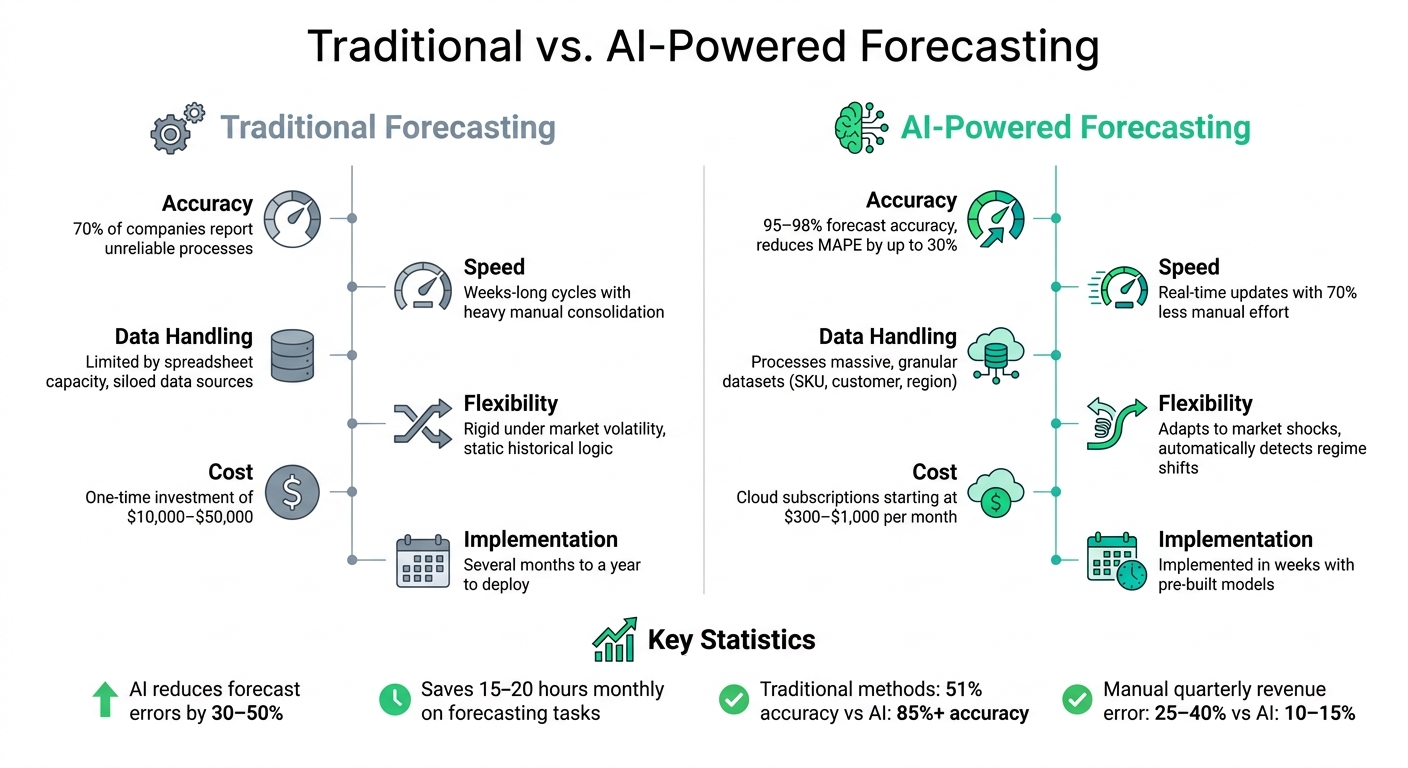
Traditional vs AI-Powered Forecasting: Accuracy, Speed, and Cost Comparison
Switching from manual spreadsheets to AI-driven forecasting completely changes the way financial predictions are made. Traditional forecasting relies heavily on static historical averages, which makes the process slow and prone to errors. In fact, 70% of companies acknowledge that their traditional forecasting methods are either inaccurate or unreliable. On the other hand, AI-powered systems continuously analyze large datasets in real time and adapt as new information becomes available.
Take Walmart, for instance. In 2025, they managed to lower their Mean Absolute Percentage Error (MAPE) by 25%, which significantly reduced inventory costs. Similarly, General Electric cut its forecast bias by 40%.
Traditional forecasting often requires weeks to complete a single cycle. AI systems, however, provide constant updates by pulling data directly from platforms like ERP, CRM, and billing systems. For example, startups can now receive a rolling 13-week cash forecast every Monday morning instead of waiting until the end of the month. Below is a table that highlights the main differences between these two approaches.
Comparison Table
| Feature | Traditional Forecasting | AI-Powered Forecasting |
|---|---|---|
| Accuracy | 70% of companies report their processes are unreliable | Can reduce MAPE by up to 30% and achieve forecast accuracies of 95–98% |
| Speed | Weeks-long cycles with heavy manual consolidation | Real-time updates with up to 70% less manual effort |
| Data Handling | Limited by spreadsheet capacity and siloed data sources | Processes massive, granular datasets (SKU, customer, region) |
| Flexibility | Rigid under market volatility and based on static historical logic | Adapts to market shocks and automatically detects regime shifts |
| Cost | Entails a one-time investment of $10,000–$50,000 | Cloud subscriptions starting at $300–$1,000 per month |
| Implementation | Can take several months to a year to deploy | Implemented in weeks with pre-built models |
This side-by-side comparison clearly shows how AI-powered forecasting offers more accuracy, speed, and adaptability, making it a game-changer for financial planning in today’s fast-paced market.
Conclusion
Relying on traditional profitability forecasting methods often leaves high-growth companies struggling to see the full picture. When you depend on cash-basis thinking and manual spreadsheets, you miss out on the forward-looking clarity needed to make confident decisions.
AI changes the game by offering real-time profitability insights in one unified view. It handles massive datasets, adapts to market changes, and integrates information from platforms like Amazon, Shopify, and your accounting systems. This streamlined approach ensures you have actionable insights when you need them most.
For startups and fast-growing businesses, this shift is all about speed and smarter decision-making. Lucid Financials brings AI-powered forecasting directly to your fingertips, giving you the financial clarity investors expect and the efficiency your business needs. Whether you're planning your next hire, running cash flow scenarios, or preparing for a funding round, Lucid ensures your financial data is always up-to-date and actionable - so you can focus on growing your business instead of wrestling with spreadsheets.
The transition from traditional forecasting to AI-driven tools isn’t a distant future - it's happening now. Businesses using AI have already reduced forecast errors by up to 30% and slashed manual work by 70%. Are you ready to leave outdated methods behind and embrace the clarity modern tools offer?
FAQs
What data does AI need to forecast profitability?
AI uses historical financial data, real-time updates, and external market inputs to create precise profitability forecasts. By analyzing trends, adapting to current conditions, and factoring in broader market dynamics, AI offers a well-rounded perspective on your financial future.
How long does AI forecasting take to set up?
Setting up AI forecasting typically takes anywhere from a few days to a week, depending on how complex the system is and the level of data integration required. Tools like Lucid Financials simplify this process, delivering actionable insights in just seven days. This quick implementation allows businesses to start using AI right away for more precise profitability predictions.
How do I trust AI forecasts when markets change?
AI-powered forecasting tools adjust in real time to shifting market conditions by incorporating up-to-date data from sources like economic indicators, business metrics, and broader market trends. Using techniques such as machine learning and scenario analysis, these systems refine predictions and explore potential "what-if" scenarios. While forecasts aren’t flawless, their strength lies in delivering ongoing, data-backed insights that enable businesses to react swiftly and make smarter decisions in unpredictable markets.