Most U.S. startups should start with one setup: 4-year vesting, a 1-year cliff, founder reverse vesting, double-trigger acceleration, and a 90-day post-termination exercise window. That mix helps limit dead equity, keeps the cap table cleaner, and matches what many investors expect.
Here’s the short version:
- Use 4 years + 1-year cliff for most grants
- Put every founder on reverse vesting from day one
- Use double-trigger acceleration in change-of-control cases
- Pick the right grant type: ISOs, NSOs, or RSUs
- Set a clear 90-day exercise window after departure in most cases
- Write grants in plain English
- Model dilution and refresh grants before a round
- Track vesting data monthly for accounting, tax, and cap table records
A few numbers stand out:
- 94% of VC-backed startups use 4-year vesting with a 1-year cliff
- About 22% of startup employees leave before the 1-year cliff
- About 96% of options give leavers 3 months or less to exercise
- Investors often look for a 10%–20% fully diluted option pool
If I were setting this up, I’d keep the plan simple, write every rule down before grants go out, and make sure legal, tax, payroll, and cap table records all match. That is the main job of a vesting policy.
The Essential Guide to Startup Vesting & Equity Allocation: Understanding Vesting Schedules
sbb-itb-17e8ec9
Why Vesting Structure Matters Before You Grant Equity
Vesting is a control tool, not just paperwork. Before you grant equity, you need to decide how ownership will be earned, protected, and changed if someone leaves. That choice should happen before any grant documents go out.
Not every role should follow the same vesting setup. Founders often use reverse vesting so the company stays protected if a co-founder leaves early. Early employees usually get standard time-based vesting, which rewards staying with the company as it grows. Later-stage executives may get performance-based vesting tied to revenue goals or product milestones. Setting these rules up front keeps the system consistent and helps you avoid awkward renegotiations later. It also lines up with what investors usually expect.
The type of equity instrument matters too. Your choice affects how vesting works in practice, along with tax treatment and what ownership looks like on the cap table.
From a risk-management angle, vesting helps limit the damage when people leave early. Carta-based data shows that about 22% of startup employees leave before the one-year cliff, which means they forfeit 100% of their equity under a standard cliff structure. Another analysis found that about half of startup employees leave within about three years - before full vesting under a four-year schedule. Without a vesting structure in place, those departures can leave equity sitting on the cap table with people who are no longer helping build the company. That’s why most startups set a vesting framework before the first grant goes out.
1. Use a 4-Year Vesting Schedule With a 1-Year Cliff
Once the structure is in place, stick with the market standard unless you have a clear reason not to. In the U.S. startup world, that usually means 4 years of vesting with a 1-year cliff, followed by monthly vesting over the next 36 months.
Here’s what that looks like in practice: with a 48,000-option grant, 12,000 options vest at month 12, then 1,000 options per month through month 48. If an employee leaves at month 8, they lose all unvested equity. The cliff gives the company a built-in test period before any ownership changes hands.
The vesting schedule gets most of the attention, but the cleanup rules matter too. Your grant documents should spell out where forfeited equity goes and whether the company can put those shares back into the pool for future grants.
Timing matters for taxes as well. If founders receive restricted stock, they need to file the 83(b) election within 30 days of the grant date.
After the cliff, use monthly vesting. And make sure the grant documents clearly list the vesting start date, cliff date, leave-of-absence rules, and cap table updates. Founders should use the same timing setup through reverse vesting.
2. Apply Founder Reverse Vesting From Day One
Founder reverse vesting is the founder version of the vesting setup most companies already use for employees. It protects ownership from day one.
Here’s how it works: founders usually get their shares when the company is formed, but the company keeps a repurchase right over any unvested shares if a founder leaves early. That repurchase price is often just $0.0001 to $0.001 per share. Use the same vesting timeline described above. So if a founder leaves at month 18, the company can buy back the unvested 62.5% of that founder’s shares at that nominal price. That’s why the grant paperwork needs to be signed before funding talks start.
This matters because it protects the cap table. Without reverse vesting, a co-founder who leaves after six months could still walk away with 20% to 30% of the company. That can make it harder to bring in senior hires and can hurt investor confidence. Founder vesting is now standard in Seed deals. Seed and Series A investors usually treat it as a basic diligence item, not something to debate.
Apply reverse vesting to every founder, including the CEO. If one co-founder is exempt, even because of title, investors may read that as misalignment. The company also has to exercise the repurchase right on time, usually within 90 days after the founder leaves.
To set this up the right way, you’ll need:
- A Founders Stock Purchase Agreement with a clear repurchase-right clause
- Board resolutions approving each grant
- A timely 83(b) election
Put these documents in place at incorporation.
3. Align Acceleration Terms With Investor Expectations
Once vesting sets the schedule, acceleration decides what happens in a sale.
Acceleration clauses spell out how much unvested equity vests early after a change of control. This is one area where balance matters a lot. If you give too much, retention gets weaker. If you give too little, founders can end up exposed. And if the wording is sloppy, you can either weaken retention or give too much protection to people who are already on the way out.
Single-trigger acceleration means equity vests automatically when a change of control happens, even if the person keeps their role. Double-trigger acceleration requires two things: a change of control and a qualifying termination within 12–18 months after closing.
In U.S. venture-backed deals, double-trigger is the market standard. Investors tend to push back on single-trigger terms for a simple reason: they wipe out retention leverage after an acquisition. If a founder’s equity fully vests at closing, there may be little financial reason to stick around and help with the handoff. On top of that, acquirers may lower their offer when they see heavy single-trigger provisions.
A practical setup looks like this:
- Use double-trigger for founders and CEOs.
- If you use single-trigger at all, limit it to 25–50% of remaining unvested equity.
- For C-level and VP-level executives, cap acceleration at 25–50% of unvested equity.
- For everyone else, use no automatic acceleration.
The definitions matter too. Write "cause" to cover serious misconduct or an uncured material breach. Write "good reason" to cover a material pay cut, a major demotion, or a forced relocation. Using standard NVCA-style language helps keep the terms familiar to investors and acquirers.
4. Pick the Right Equity Instrument: ISOs, NSOs, or RSUs
Once the vesting schedule is set, the next call is deciding which instrument sits underneath it. That choice shapes how vesting is taxed, how people get shares, what gets reported, and how much of the upside they may keep after taxes.
Incentive Stock Options (ISOs) are usually the go-to choice for full-time U.S. employees at early-stage startups. If the employee meets the holding-period rules - in most cases, two years from the grant date and one year after exercise - the gain may qualify for long-term capital gains treatment. But there’s a catch: exercise can trigger AMT.
ISOs also come with a $100,000 annual limit. That limit is based on the grant-date fair market value of shares that first become exercisable in a calendar year. Any amount over that line is generally treated as an NSO.
Nonqualified Stock Options (NSOs) work for a broader group. You can grant them to contractors, advisors, and board members - people who aren’t eligible for ISOs. When someone exercises an NSO, the bargain element is taxed as ordinary income. That amount is reported on a W-2 for employees or a 1099 for non-employees, and there’s no AMT issue. In practice, NSOs are the default for non-employees and the backup option when ISO limits are exceeded.
RSUs skip exercise entirely. Once the vesting conditions are met, the shares are delivered. At that point, the full fair market value of the shares is taxed as ordinary income. Early on, options often make more sense. As company valuations climb and teams want grants with a more predictable dollar value, many companies move toward RSUs.
| Instrument | Who Can Receive It | Tax at Exercise/Vest | Best Stage Fit |
|---|---|---|---|
| ISO | W-2 employees only | No regular income tax; AMT may apply | Early-stage, especially pre-seed through Series B |
| NSO | Employees, contractors, advisors, board members | Ordinary income on the bargain element | Any stage; non-employees |
| RSU | Employees (typically) | Ordinary income on full FMV at vest | Series A/B and later |
The key point is simple: this is a tax and admin decision, not an ownership-percentage decision. ISOs, NSOs, and RSUs all dilute the cap table. What changes is the tax treatment and the mechanics of exercise or share delivery. That’s why it helps to model all three in your fully diluted share count from day one.
5. Set Clear Post-Termination Exercise Windows
Once you’ve picked the equity instrument, set a clear deadline for how long vested options stay exercisable after someone leaves. This post-termination exercise window is the period after departure when a former team member can still exercise vested options. When that window closes, any unexercised options expire and go back into the pool.
In the U.S., 90 days is the standard for employee stock options. For ISOs, federal tax rules usually require exercise within 90 days after termination to keep ISO tax treatment. A lot of startups use that same 90-day limit for NSOs too. Put that deadline in every grant agreement so everyone is working under the same rule.
The data backs up how common this is. A Carta analysis found that 96% of options on its platform gave employees three months or less to exercise after leaving. Index Ventures also reported that only about 60% of leavers in the U.S. actually exercised their options, even at companies whose valuations had gone up by more than 10x. Some startups stretch the window to several years as a hiring perk. That can sound great on paper, but it can weaken ISO treatment and leave options sitting on the cap table for a lot longer.
If you decide to extend the window, do it on purpose and write down the tax and cap-table tradeoffs. For most early-stage startups, the simple path is to use a 90-day baseline in every grant agreement, spell out ISO vs. NSO treatment clearly, and let the board approve exceptions case by case. When someone leaves, send a written notice that lists the deadline, vested shares, and exercise cost.
6. Write Equity Agreements in Plain English
Once you've set exercise deadlines, the next step is simple: write the rules so people can understand them.
If an employee can't tell when vesting starts, what service ends means, or how acceleration works, trouble starts early. That's how companies end up with cap-table disputes, missed deadlines, and exits that get messier than they need to be. Plain-language agreements help stop that.
The need is pretty clear. Only 36.4% of respondents understood what a stock option is, and just 28.3% could correctly answer basic questions about their own equity.
So keep the writing tight. Use short sentences. Define each key term once, then stick with the same wording every time. Put terms like cliff, exercise price, fully diluted, and service ends in one glossary section. After that, use them the same way across every document.
It also helps to spell out what happens in each exit scenario. Don't leave people guessing. Cover cases like:
- resignation
- termination with cause
- termination without cause
Employees should know what they lose, what they keep, and what happens to any unexercised options.
A good setup is a one-page summary paired with the formal grant agreement. The formal agreement still matters for enforceability. The summary is there for clarity. It should include the core terms employees look for right away:
- number of shares or units
- vesting schedule
- exercise price
- post-termination exercise window
- any acceleration triggers
This also matters well beyond HR. Clean, consistent grant language makes cap-table reconciliation, investor diligence, and audit review faster and less error-prone. Even small mismatches between the offer letter, cap table, and grant agreement can create confusion during fundraising, audits, or employee departures. Clear grants also make dilution modeling and refresh planning easier.
On the formatting side, make the key details hard to miss. Bold key dates and dollar amounts. Use short section headings that match the questions employees are already asking, such as "When do my shares vest?" or "What happens if I leave early?" And don't hide critical numbers inside long, dense paragraphs.
Clear wording also helps with day-to-day administration. When grant terms are plain and unambiguous, vesting is easier to track, updates are easier to make, and enforcement is far less likely to go sideways.
7. Model Dilution and Refresh Grants Before Funding Rounds
A clean grant agreement helps. But it doesn't protect your cap table by itself.
Before a funding round, you need to model the pool and any refresh grants before the deal closes. The best way to do that is with a pro forma cap table that shows current ownership after all outstanding equity. Then add the proposed round size, pre-money valuation, and any option pool increase the investor wants. Most of all, split investor dilution from option-pool dilution.
That split matters because U.S. VC term sheets usually push option pool expansion into the pre-money math. In plain English, existing shareholders take that hit, not the new investors. So if an investor wants a 15% post-money pool and your current pool is only 5%, that change by itself can add about 10 percentage points of dilution on top of the dilution from the financing round. If you lump it all together, it's easy to miss what the pool is costing you.
Once you've nailed down the pool math, the next step is retention. A common approach is to hold back 25% to 40% of the expanded pool for refresh grants for key team members who have less than 1.5 to 2 years of vesting left. The goal is simple: keep key people in place through the next vesting cycle. These refresh grants are often sized at 25% to 75% of the person's original grant.
There's one more layer here: tax and accounting. Refresh grants create stock-based compensation expense under ASC 718, which flows through the income statement. And the grant type matters. ISOs, NSOs, and RSUs each come with different tax results for both the company and the employee. Lucid Financials can model stock-based compensation, sync cap table data, and keep reporting current.
Use those assumptions to set the key terms below.
8. Track Vesting Data With Startup-Focused Financial Support
After you model dilution and refresh grants, the next job is simple: keep vesting data current.
ASC 718 says stock-based compensation has to be recognized over the vesting period. That means every grant, exercise, cancellation, and modification needs to hit the cap table and journal entries on time. If the records are off, the vesting schedule stops being something you can rely on.
For each grant, the main data points to track are:
- Grant date
- Instrument
- Shares or units
- Vesting terms
- Strike price
- FMV at grant
- Acceleration terms
- Termination date
- Vested and unvested balance
That list becomes your monthly reconciliation checklist. Update it every month and keep it in sync with the close.
It helps to treat vesting data like a core ledger, not just a spreadsheet sitting in a folder somewhere. Each month, reconcile new grants, exercises, cancellations, and terminations. Then book the journal entries and update the cap table. Done right, equity records stay tied to the income statement and balance sheet. It also makes board decks and investor updates more dependable.
Lucid Financials can reconcile vesting events, keep stock-based compensation booked correctly, and keep reporting investor-ready.
These records also make the key vesting terms easier to read.
Examples and Key Terms Founders Should Know
These are the terms behind the schedules above and the table below. You'll see them in grant documents, board consents, and cap-table models. A few short examples make them much easier to follow.
A cliff is the minimum amount of time someone has to stay before any equity vests. Say an employee gets 20,000 ISOs with a $0.50 strike price on a standard 4-year vesting schedule with a 1-year cliff. For the first 12 months, nothing vests. Then, at month 12, 5,000 options vest all at once. That's 25% of the grant. If the employee leaves before that cliff date, they get nothing.
Monthly vesting means equity builds up in small, regular chunks after the cliff, usually about 1/48th of the full grant each month. Reverse vesting works the other way around for founders: the shares are issued upfront, but the company can buy back the unvested portion if the founder leaves. Repurchase rights are what allow that buyback to happen, and the repurchase price is usually the original issue price.
Single-trigger acceleration means equity vests automatically when there's a change of control. For example, if a CEO holds 480,000 RSUs and has 50% single-trigger acceleration, the remaining 240,000 RSUs would vest at closing. Double-trigger acceleration needs two events: first, the acquisition closes; second, the executive is terminated without cause, or resigns for "good reason", during a set window, often 12 months.
The exercise window is the amount of time a departing employee has to pay the strike price and turn vested options into shares. For ISOs, the default post-termination exercise window is 90 days if the holder wants to keep ISO status. Some startups give people more time, but 90 days is still the default.
One more term matters for strike price and taxes: the 409A valuation. This is an independent appraisal of the fair market value of your common stock, and the IRS requires it so companies can set strike prices that comply with the rules. Preferred stock usually comes with liquidation preferences and other protections, so common stock is priced well below the preferred share price. A 409A valuation sets the fair market value used for strike prices, and it has to be updated at least once a year or after a material financing event.
Use these definitions as you read the comparison table below.
Comparison Table: Common Vesting Structures and When to Use Them
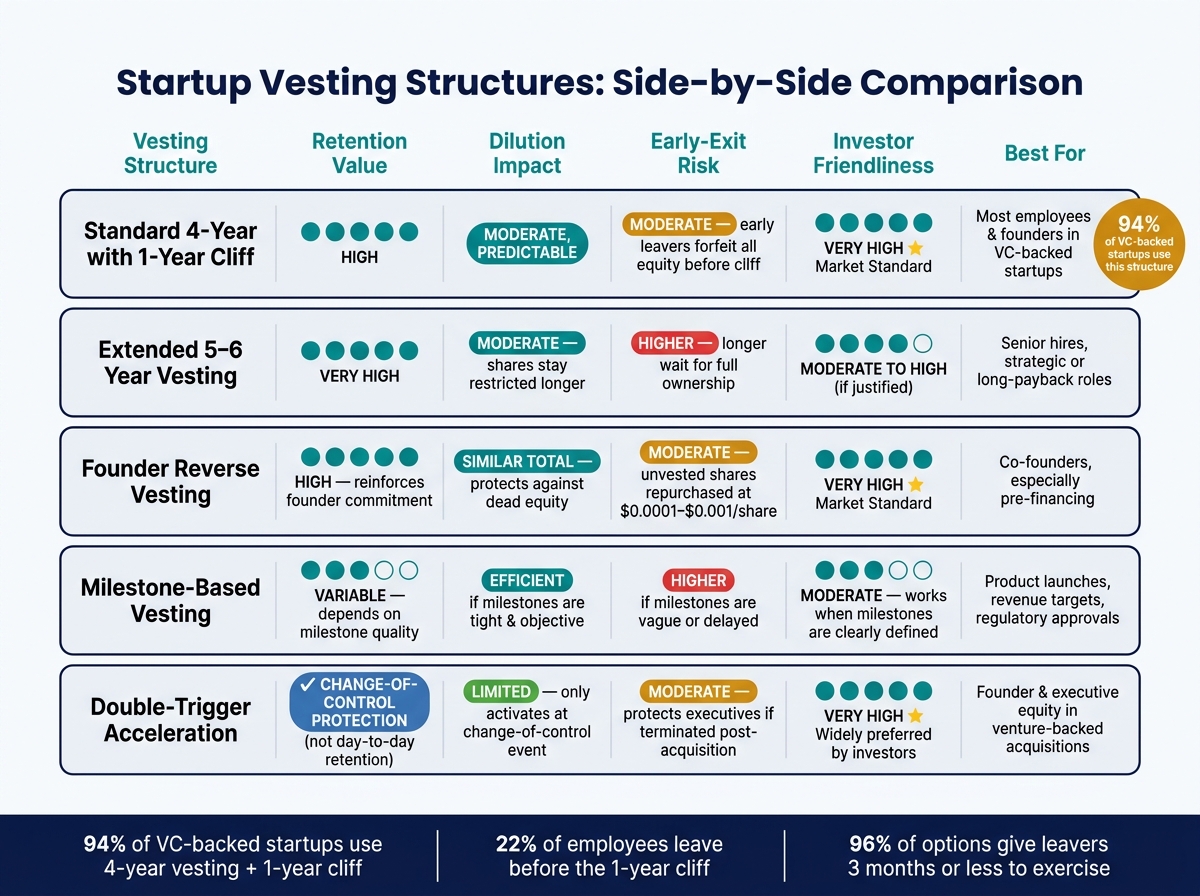
Startup Vesting Structures Compared: Retention, Dilution & Investor Fit
The table below gives you a quick side-by-side look at the vesting setups founders and operators see most often. And that matters, because the wrong setup doesn’t just create people problems. It can also lead to cap table friction and investor pushback.
According to Carta data, 94% of VC-backed startups use a 4-year vesting schedule with a 1-year cliff for founders and employees, which makes it the clearest starting point for most teams.
| Vesting Structure | Retention Value | Dilution Impact | Early-Exit Risk | Investor Friendliness | Best For |
|---|---|---|---|---|---|
| Standard 4-year with 1-year cliff | High | Moderate, predictable | Moderate; early leavers get little or nothing before the cliff | Very high; market standard | Most employees and many founders in VC-backed startups |
| Extended 5- to 6-year vesting | Very high | Moderate; shares stay restricted longer | Higher; longer wait for full ownership | Moderate to high if justified | Senior hires, strategic roles, or long-payback roles |
| Founder reverse vesting | High; reinforces founder commitment | Similar total dilution, but protects against dead equity | Moderate; unvested shares can be repurchased if a founder exits early | Very high; market standard | Co-founders, especially before outside financing |
| Milestone-based vesting | Variable; depends on milestone quality | Efficient if milestones are tight and objective | Higher if milestones are vague or delayed | Moderate; works when milestones are clearly defined | Product launches, revenue targets, or regulatory approvals |
| Double-trigger acceleration | Change-of-control protection, not retention | Limited effect until a change-of-control event | Moderate protection in an acquisition if termination follows | Very high; widely preferred by investors | Founder and executive equity in venture-backed acquisitions |
A simple way to read this table: start with the Best For column and match the structure to the role. Then pressure-test the tradeoffs around dilution, early departures, and investor reaction.
These choices also shape tax treatment, accounting expense, and reporting. Once you pick the structure, the next step is to turn it into the right finance, tax, and reporting workflow.
Connecting Vesting to Finance, Tax, and Reporting
Once your vesting schedule is in place, the next job is tying it to accounting, tax, and reporting. This isn't just an HR or legal detail. Vesting touches finance, too. Every grant, cliff date, and employee departure can change your cap table, your books, and your tax filings.
Model the option pool before term-sheet talks start. Investors often expect a 10%–20% fully diluted option pool, and vesting patterns shape how much new dilution that creates. That same planning also matters for 409A timing.
A 409A valuation is often good for 12 months, but you should refresh it after a priced round or another material event. A common move is to approve bulk grants right after a new 409A. Once valuation is handled, the next checkpoint is accounting.
Under ASC 718, grant-date fair value is spread over the vesting period. Changes like accelerations, repricings, or extensions can add expense. And here's where teams can get tripped up: the cap table and the general ledger should be reconciled separately. One tracks legal ownership. The other records the accounting effect.
Tax reporting adds one more layer:
- NSO exercises create ordinary income that runs through payroll and appears on Form W-2
- ISO exercises require Form 3921 reporting and can trigger AMT exposure
- RSU vesting is taxed as ordinary income at delivery
Each event needs to land in the correct pay period with the correct withholding.
Lucid Financials can connect vesting data to accounting, payroll, tax reporting, and investor-ready reporting.
Conclusion
A good vesting schedule does three big jobs: it protects ownership, rewards people who stick around, and keeps the cap table clean. That makes it a core part of protecting the company, keeping talent in place, and building investor trust.
Taken together, these defaults give most startups the simplest setup for balancing retention, tax, and investor expectations. In practice, that usually means 4-year vesting with a 1-year cliff, founder reverse vesting, double-trigger acceleration, and plain-English agreements. The type of equity matters too. ISOs, NSOs, and RSUs can change when taxes hit and what employees may have to pay.
The aim is simple: build a vesting program that rewards long-term contribution, protects the cap table when someone leaves early, and stays easy enough to run without confusion or disputes.
When vesting data matches accounting and tax records, reporting stays reliable. Lucid Financials helps startups keep vesting data connected to clean books, tax reporting, and investor-ready financials.
FAQs
When should a startup deviate from 4-year vesting?
A startup doesn’t always stick to the standard four-year vesting schedule with a one-year cliff. The setup can change based on the company’s stage, how long it wants people to stay, and how mature the business is.
For example, some companies use a back-weighted schedule like 5% / 15% / 40% / 40%. That gives a smaller share up front and more later, which can help keep people around for the long haul.
Others move to six-year vesting when projects take more time to play out. If the company wants more flexibility, it might use annual sequential grants instead of one fixed grant at the start.
And as liquidity events or higher valuations get closer, some startups shift to RSU structures with double-trigger requirements. In plain English, that usually means the equity doesn’t fully turn into owned shares until two things happen, such as a company sale and the employee meeting another vesting condition.
How does reverse vesting work if a founder leaves early?
Reverse vesting means a founder keeps only the equity they’ve earned by staying and working at the startup over time.
A common setup is a four-year vesting schedule with a one-year cliff. That means no equity vests during the first year.
If a founder leaves before the cliff, they usually forfeit all of their shares. If they leave after the cliff, they keep only the part that has vested month by month or quarter by quarter.
That setup helps prevent dead equity.
What should we check before extending the exercise window?
Before you extend an exercise window, make sure your cap table is accurate and fully reconciled. That includes equity grants, board approvals, and 83(b) filings. Your equity practices should also be documented in writing.
Extending post-termination exercise periods can change dilution and tax outcomes. So don’t make the call on instinct alone. Model a few scenarios first, then look at how each one affects your company’s financial health.