
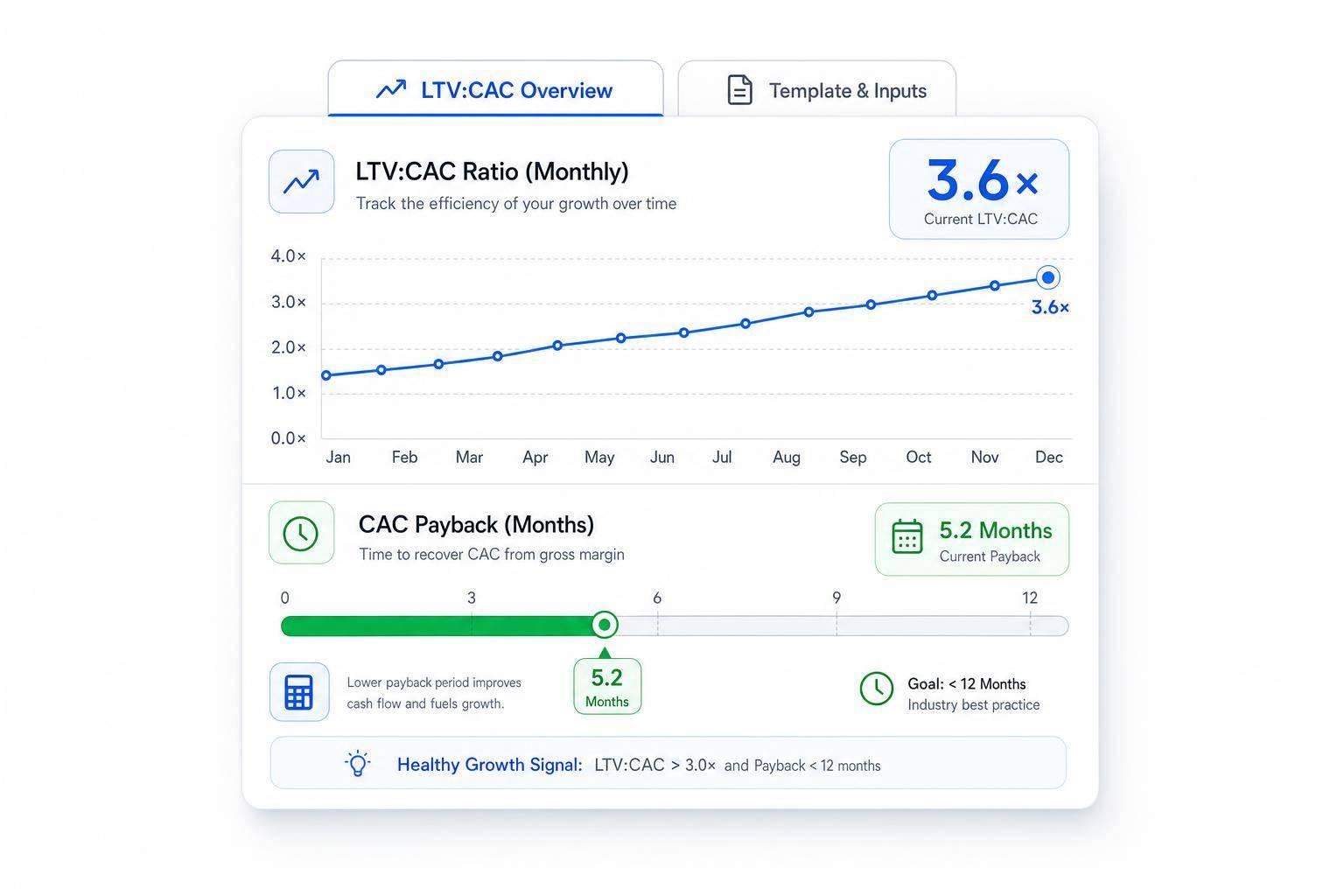
A medical practice owner reviewing marketing spending needs to answer a practical question: Has the contribution collected from newly acquired patients covered what the practice spent to acquire them—and how long did that take?
A conventional lifetime value-to-customer acquisition cost ratio, or LTV:CAC, can obscure that answer. Patient visits are not recurring subscriptions. Future care needs, payer participation, patient movement and collection outcomes make lifetime value uncertain. Charges and revenue also overstate the money available to recover acquisition costs when the cost of delivering care is ignored.
Use this spreadsheet-style alternative instead:
Observed collected contribution over a stated period ÷ fully loaded acquisition spending assigned to that cohort.
Pair that ratio with acquisition-cost recovery time. This article walks through the definitions, worksheet structure and interpretation. All numerical examples below are illustrative, using synthetic aggregate data—not patient records or practice benchmarks.
Why the standard LTV:CAC formula needs limits
A subscription-style LTV formula often divides monthly customer margin by monthly churn. That approach assumes a recurring economic relationship that does not reliably describe a medical practice.
A patient who has not returned may have completed appropriate care, moved, changed insurance or simply not needed another appointment. Absence is not necessarily subscription cancellation. Likewise, an appointment on the schedule is not a guaranteed visit, and a completed visit is not an immediate collection.
Three distinctions matter:
- Charges are not collections. Contractual adjustments, patient responsibility and unpaid balances affect what the practice receives.
- Collections are not contribution. Provider time, clinical staff, supplies and other delivery costs consume part of the receipts.
- Observed contribution is not lifetime value. A completed observation window provides evidence about that period, not a promise about future visits.
The template therefore measures observed economics without assigning patients a speculative lifetime. It is a management analysis, not a valuation model or a reason to encourage medically unnecessary utilization.
sbb-itb-17e8ec9
Step 1: Define the cohort before entering numbers
Create a Definitions tab before building formulas. A cohort is a defined group acquired under the same inclusion rules. For this template, use new patients whose first completed visit occurred in a specified month, grouped by attributed acquisition source.
Do not use inquiries or bookings as the CAC denominator. They can be useful operational counts, but they are not completed acquisitions under this definition.
| Definition field | What to record |
|---|---|
| Acquisition event | First completed visit by a new-to-practice patient |
| Cohort period | Calendar month of that first completed visit |
| Practice scope | Included entities and locations |
| Attribution rule | One consistently applied method, such as documented first source |
| Spending assignment | Which campaign periods and shared expenses are assigned to the cohort |
| Observation window | Stated number of months from the cohort month |
| Data cutoff | Latest reconciled collection and cost period |
| Delivery-cost policy | Included costs and allocation methods |
| Recovery convention | First month cumulative collected contribution covers assigned acquisition spending |
For multi-location practices, count a patient transferring between offices only once at the practice level. If location-level reporting treats that person differently, label the view clearly. Otherwise, internal transfers can look like new acquisitions.
Acknowledge what attribution cannot prove
A patient may see an advertisement, receive a referral and later search for the practice by name. A single-source field cannot fully describe that path. Staff-entered source data may also be incomplete.
Keep an Unknown/unattributed group. Do not assign uncertain patients to the channel that makes the results look strongest. Use one primary source per acquisition in the main table to avoid double counting.
Attribution is not proof of causation: some attributed patients might have joined without the campaign. Describe the result as an attributed cohort analysis, not incremental return on advertising.
Step 2: Build the acquisition spending tab
Use an Acquisition Costs tab with one row per expense or allocation. Record the accounting period, amount, channel, benefiting cohort and allocation basis.
Fully loaded acquisition spending includes more than media invoices. Include acquisition-related labor and shared support costs, but do not assign the entire front desk payroll to marketing simply because staff answer new-patient calls.
Illustrative acquisition-cost input table
| Cost category | Assigned amount | Allocation basis |
|---|---|---|
| Paid media | $6,000 | Campaign records |
| Agency and creative work | $2,000 | Work attributable to acquisition campaigns |
| Acquisition-related admin payroll, taxes and benefits | $2,500 | Documented share of staff time |
| Marketing tools | $500 | Consistent acquisition-use allocation |
| Shared acquisition support | $1,000 | Documented allocation policy |
| Total assigned acquisition spending | $12,000 | Sum of included costs |
Include attributable owner work where material, with a disclosed valuation assumption if it is not already an expense in the books. Keep imputed owner time separate so readers can distinguish recorded spending from an economic-cost adjustment.
Campaign spending and first visits often occur in different months. A campaign may generate appointments completed later. Assign spending using a documented conversion window, avoid charging the same expense to multiple cohorts, and reconcile assigned and unassigned costs to the expense ledger.
Separate broader brand spending when a cohort assignment would be arbitrary. Show it in a practice-wide acquisition view rather than quietly excluding it from every analysis.
Fully loaded CAC = Assigned acquisition spending ÷ Attributed new patients with a completed first visit.
In this illustrative example, $12,000 divided by 40 patients gives a CAC of $300. If the count is zero, report CAC as not calculable rather than forcing a zero result.
Step 3: Build the collections and delivery-cost tab
Create a Cohort Activity tab with one row for each cohort, source and observation month. Use aggregate data exported through an appropriate workflow; the financial worksheet does not need patient names or clinical details.
Include these fields:
| Field | Entry rule |
|---|---|
| Cohort key | Acquisition month, source and reporting scope |
| Observation month | Month 1, month 2 and onward |
| Payer receipts | Receipts attributable to that cohort's services |
| Patient receipts | Patient payments attributable to those services |
| Refunds and recoupments | Reductions attributable to the cohort |
| Net collected receipts | Payer receipts + patient receipts − refunds and recoupments |
| Delivery costs | Costs attributable to services delivered to the cohort in that month |
| Monthly collected contribution | Net collected receipts − delivery costs |
| Cumulative collected contribution | Running total from month 1 |
Include provider and clinical staff compensation attributable to care delivery, supplies, outside service costs and collection-related fees where applicable. Allocate shared staffing costs consistently, using a reasonable basis such as documented service time. Do not count the same payroll amount as both acquisition labor and care-delivery labor.
State whether delivery costs include only incremental costs or allocated compensation for existing capacity. The latter can be useful for sustainable staffing decisions, even when payroll would not immediately fall if volume declined.
Keep facility costs and other excluded overhead visible in a separate reconciliation. Collected contribution is not practice net income. It may still need to cover rent, general administration, financing costs and other expenses.
Handle collection lag explicitly
Costs may arise when care is delivered, while payer receipts and patient balances arrive later. Record delivery costs in the service month rather than postponing them until the related bill is paid. Later receipts increase the cohort's contribution in the month collected.
This creates a conservative timing view for recent cohorts, but it is not a complete cash-flow statement: accrued payroll and other costs may be paid on different dates. If liquidity is the decision, add actual payment timing to a separate cash schedule.
Do not add open receivables to observed collections. Show outstanding balances and estimated future receipts separately, clearly labeled as uncertain.
Step 4: Add the calculation formulas
On a Summary tab, place these inputs and formulas in column B. The cell references below form a reusable layout.
| Cell | Metric | Entry or formula |
|---|---|---|
| B2 | Cohort patient count | Input |
| B3 | Assigned acquisition spending | Input from Acquisition Costs |
| B4 | Net collected receipts through cutoff | Sum from Cohort Activity |
| B5 | Delivery costs through cutoff | Sum from Cohort Activity |
| B6 | Observed collected contribution | =B4-B5 |
| B7 | Fully loaded CAC | =IF(B2>0,B3/B2,"Not calculable") |
| B8 | Collected contribution per acquired patient | =IF(B2>0,B6/B2,"Not calculable") |
| B9 | Collected contribution-to-acquisition-spend ratio | =IF(B3>0,B6/B3,"Not calculable") |
| B10 | Contribution after acquisition spending | =B6-B3 |
B9 is the practice-specific alternative to a projected LTV:CAC ratio. Label it with its observation window—for example, six-month observed collected contribution/acquisition spend. Do not call it lifetime value.
When the same patient count underlies both figures, contribution per patient divided by CAC produces the same ratio as total contribution divided by total acquisition spending.
Calculate recovery from cumulative results
Acquisition-cost recovery occurs in the first observation month when cumulative collected contribution equals or exceeds assigned acquisition spending.
Do not divide CAC by an assumed constant monthly margin. Receipts are uneven, care delivery varies and later services create additional costs.
Illustrative six-month cohort schedule
This synthetic example uses 40 acquired patients and $12,000 of assigned acquisition spending.
| Observation month | Net receipts | Delivery costs | Monthly contribution | Cumulative contribution |
|---|---|---|---|---|
| 1 | $8,000 | $6,000 | $2,000 | $2,000 |
| 2 | $4,000 | $2,000 | $2,000 | $4,000 |
| 3 | $6,000 | $2,000 | $4,000 | $8,000 |
| 4 | $3,000 | $1,500 | $1,500 | $9,500 |
| 5 | $3,000 | $1,500 | $1,500 | $11,000 |
| 6 | $3,000 | $1,000 | $2,000 | $13,000 |
| Total | $27,000 | $14,000 | $13,000 | $13,000 |
The six-month contribution-to-spend ratio is $13,000 ÷ $12,000, or 1.08x. Contribution per acquired patient is $325, compared with $300 CAC. Acquisition spending is first recovered in month 6.
The $1,000 remaining after acquisition spending is not net profit. Excluded overhead still needs funding. Later refunds, recoupments or delivery costs could also reduce cumulative contribution, so retain the latest recovery status alongside the first recovery month.
Step 5: Test sensitivity without disguising forecasts as facts
Keep actual results unchanged. Put sensitivity calculations on a separate tab and label them hypothetical.
Illustrative sensitivity table
| Hypothetical change to the six-month example | Contribution | Acquisition spending | Ratio |
|---|---|---|---|
| Observed base example | $13,000 | $12,000 | 1.08x |
| Receipts 20% lower; costs unchanged | $7,600 | $12,000 | 0.63x |
| Delivery costs 20% higher; receipts unchanged | $10,200 | $12,000 | 0.85x |
| Acquisition allocation revised to $15,000 | $13,000 | $15,000 | 0.87x |
Other useful sensitivity inputs include collection delays, refunds, attribution uncertainty and staff-time allocation. Change one assumption at a time before combining scenarios.
An estimated receipt arriving after the cutoff belongs in a forecast, not in the observed ratio. Changing receipt timing can delay recovery even when eventual total collections are unchanged.
Step 6: Interpret results at the monthly close
There is no universal medical-practice equivalent of a subscription-business “healthy LTV:CAC” benchmark.
A ratio below 1.0x means observed contribution has not yet covered assigned acquisition spending. It does not establish lifetime unprofitability. A ratio above 1.0x means spending has been covered under the chosen cost definition—not that the practice has earned an adequate overall return.
Compare cohorts at the same age, with consistent scope and cost policies. A six-month cohort should not be ranked against a two-month cohort without making the maturity difference explicit. Also review cohort size, payer mix, location and available provider capacity before interpreting differences as channel performance.
At each close:
- Reconcile collection totals to supporting reports and accounting records.
- Update refunds, delivery costs and spending allocations.
- Preserve a dated version and explain revisions.
- Review the ratio alongside recovery time and outstanding balances.
- Record the decision: continue observation, investigate data quality, revise an allocation or reconsider the acquisition budget.
The IRS guidance on business records supports complete records and bank reconciliation; the cohort schedule should supplement, not replace, those records.
Use aggregate financial reporting wherever practical. The HHS minimum necessary guidance provides context for limiting information in applicable workflows. Do not place patient-identifiable data in ordinary Slack or general-purpose AI tools.
Lucid Financials provides CPA-led bookkeeping, tax and CFO services for staffed US private medical practices. Clean books and location/entity financial visibility provide a stronger foundation for reviewing acquisition costs alongside the practice's broader financial results.
FAQs
Can a medical practice calculate patient lifetime value?
It can model future contribution, but that requires assumptions about future appropriate care, payer mix, collections and costs. Keep any projection separate from observed results, disclose its horizon and test sensitivity. The template above deliberately measures a stated observation period rather than claiming lifetime value.
What if a cohort has not recovered acquisition spending by the cutoff?
Report “Not recovered through month X.” Review collection lag, unpaid balances, delivery costs and acquisition allocations. Do not assign a future recovery date unless it is explicitly labeled as a forecast. Recent cohorts may simply lack enough observation time.
Should repeat visits count toward the cohort's contribution?
Yes, when they occur within the stated observation window and are attributable to the cohort. Include both their collections and delivery costs. Do not assume repeat visits will occur, and do not use the analysis to recommend medically unnecessary care.
How should shared costs across locations or entities be handled?
Use a documented allocation basis tied to the expense, such as acquisition staff time or campaign scope. Reconcile allocations to source accounts, prevent duplicate counting across entities and keep location-level views consistent with the practice-wide total. Show material allocation uncertainty in sensitivity analysis.