Most exit problems start before the deal does. If I want a sale at $150 million and one investor is holding out for $500 million+, conflict is almost built in.
Here’s the short version: I need to align investors early, show payout math in actual dollars, explain how fees and preferences cut into proceeds, and set a clear update rhythm. I also need to be direct about stock deals, earnouts, escrows, approval rights, and timing so nobody is surprised when a $50,000,000 headline deal turns into $34,000,000 for equity holders after debt, fees, and retention costs.
If I want exits to stay calm, I focus on four things:
- Set an exit range early with board members and major investors
- Show low, base, and high payout cases with waterfall math
- Use one update format and share material changes within 24–72 hours
- Explain structure risk upfront, including lockups, escrows, earnouts, and consent rules
A few numbers make the point fast:
- A company that raised $40 million may see investors treat $150 million–$300 million as acceptable, while others want $500 million+
- In a $50,000,000 exit, stacked preferences can leave far less for common than people expect
- Deal costs like $10,000,000 of debt, $2,500,000 in banker fees, $1,500,000 in legal/accounting, and $2,000,000 for retention can cut equity proceeds to $34,000,000
- IPO or stock deals can delay liquidity by 180 days or more
My takeaway: I should not sell the headline price. I should show the net outcome, document what people agreed to, and keep updates plain and steady from first talks through close.
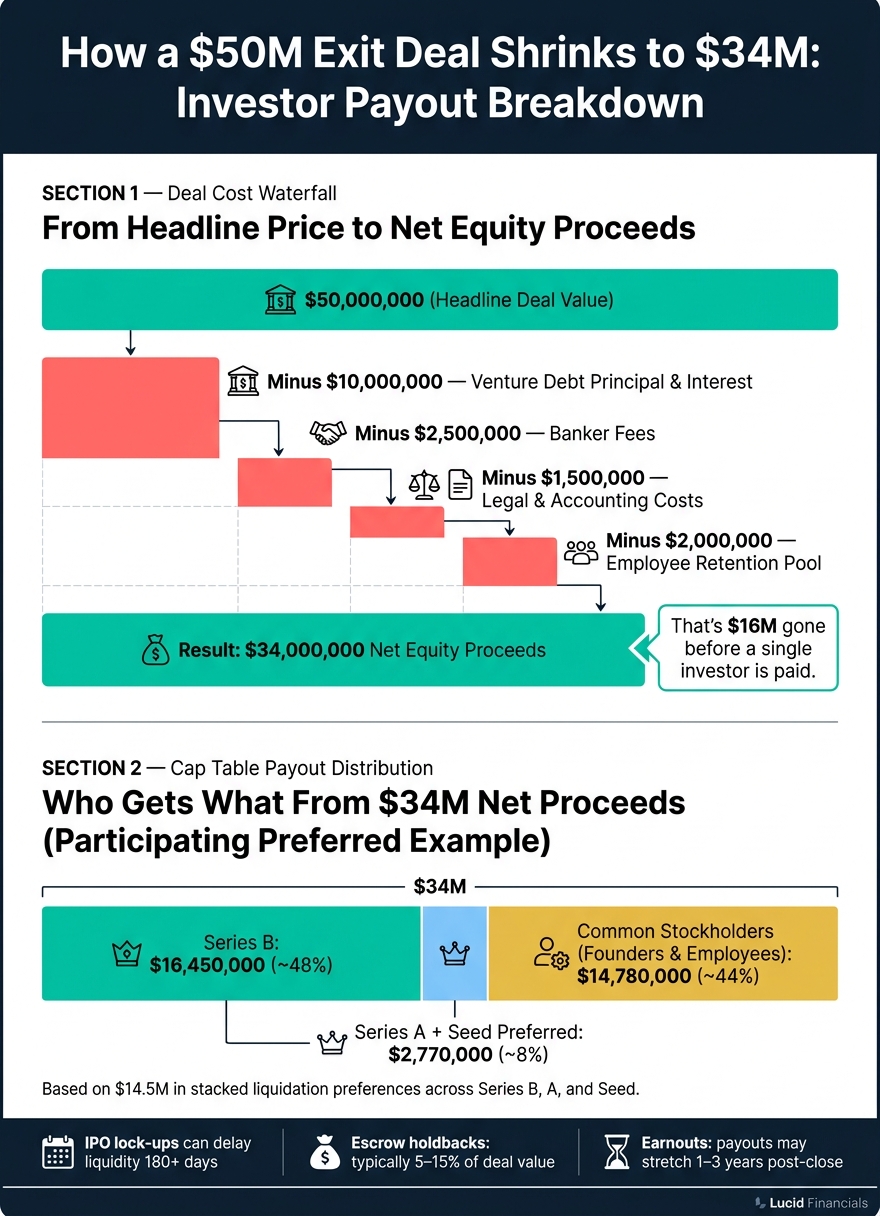
How a $50M Exit Deal Shrinks to $34M: Investor Payout Breakdown
1. Align on exit goals before the process gets serious
A lot of exit tension starts long before anyone is haggling over terms. It usually starts when founders assume everyone on the cap table wants the same thing.
That’s often not the case. A year-8 investor in a 10-year fund may be much more open to near-term liquidity than another investor who came in later or is under different portfolio pressure.
The move here is pretty simple: talk about it early. Start 12–24 months before you expect a serious process. Ask each major investor four direct questions:
- What’s your target time horizon for liquidity?
- What return would you call strong versus acceptable?
- What exit path do you prefer?
- What deal-breakers would stop you from backing a deal?
Those questions bring tradeoffs into the open while there’s still time to deal with them. The range you hear back becomes the baseline for valuation and payout talks.
Define strong, acceptable, and weak exit outcomes
Put real numbers on what “good” means. And do it for each investor group, not just at a high level.
For a U.S.-based startup that has raised $40 million, a practical starting point might look like this:
| Outcome | Exit Valuation | Implied Return |
|---|---|---|
| Strong | $500 million+ | 5–10x+ on invested capital |
| Acceptable | $150 million–$300 million | 2–4x; most preferred shareholders fully in the money |
| Weak | Below the last post-money valuation (for example, under $120 million) | Some later investors may only break even; limited common proceeds |
These lines will change by investor type. Institutional VCs usually need much bigger outcomes because fund returns often ride on a small number of big wins. A 3x fund-level return is strong, and many funds don’t get there. Angels and early-stage investors may see a 2–3x return in three to five years as a strong result. Once you know where each investor stands, the conversation gets a lot more honest.
Separate founder goals from investor goals
Founders often dodge this part because it can feel awkward to say, out loud, that they want to keep building. But not saying it usually makes things worse.
If you want to keep building toward an IPO and one of your key investors needs liquidity in the next 18 months, that conflict will show up sooner or later. The only mystery is how disruptive it’ll be when it does.
A practical way to handle this is to split the conversation into three layers: your personal and team goals, the company’s strategic position, and investor economics under different outcomes. Presenting those as separate topics in a board meeting gives people room to be candid. Investors can say they’d rather see a near-term acquisition without sounding like they’re attacking your vision. You can say you’d rather run a dual-track process - looking at both acquisition offers and growth financing - without making it sound like you’re brushing off their interests.
The point isn’t to force everyone into one view before the facts are in. It’s to get to a structured compromise.
Record decisions in board materials and investor notes
Verbal alignment disappears fast once deal pressure kicks in. What sounded crystal clear in a board meeting can turn into three different memories by the time an LOI shows up.
Write it down. A Board Alignment Slide in your recurring deck should spell out the agreed strong, acceptable, and weak valuation ranges, the preferred time horizon, and the current exit path. Date it using U.S. style, like March 15, 2026. Formal meeting minutes should record specific calls, such as whether the board agreed that offers below the last post-money valuation need unanimous approval. After one-on-one investor calls, send a short follow-up memo that sums up what was discussed, what numbers came up, and what happens next.
Keep those records in one board portal, and have counsel review the minutes. A written record makes it much harder for people to argue later about who agreed to what.
Once the target range is set, the next step is to turn it into payout scenarios investors can read in actual dollars.
2. Walk investors through valuation, cap table, and payout scenarios
Once investors agree on what “strong,” “acceptable,” or “weak” looks like, the next job is simple: show what each path means in U.S. dollars.
After you set the exit range, turn the headline number into net proceeds. That difference is where tension usually starts. It’s better to show the math early than let investors do it on their own.
Model low, base, and high exit cases in U.S. dollar terms
Build three cases: $25,000,000, $50,000,000, and $75,000,000. For each case, show:
- enterprise value
- how much is paid in cash at close
- how much is paid in stock consideration
- when each piece gets paid
For example, a base case might show $30,000,000 in cash at closing and $20,000,000 in acquirer stock with a 180-day lock-up.
Be clear about which assumptions are fixed and which are just model inputs. If the purchase price comes from a signed term sheet, mark it confirmed. If you’re modeling the acquirer’s stock at $20.00 per share, mark that illustrative and also show the result at $15.00 per share. That one move can head off a lot of later debate about what people thought was on the table.
Explain waterfall mechanics before negotiations intensify
Start with the fully diluted cap table. Lay out the share class, ownership, liquidation preference, seniority, and participation rights. Then map the payout order: debt first, preferred next, common last.
Here’s why that matters. In a $50,000,000 exit with stacked preferences totaling $14,500,000 across Series B, Series A, and Seed, only $35,500,000 remains for distribution. Under a participating preferred setup, common stockholders, including founders and employees, might take home about $14,780,000, while Series B collects $16,450,000 from that same $50,000,000 headline price.
That’s the kind of gap that surprises people if you wait too long to explain it.
Show how fees, debt, and deal costs reduce net proceeds
Lead with net proceeds, not the headline value. A $50,000,000 deal can shrink fast once real costs hit the page.
The math might look like this:
- $10,000,000 in venture debt principal and accrued interest
- $2,500,000 in banker fees
- $1,500,000 in legal and accounting costs
- $2,000,000 in employee retention pool
That leaves $34,000,000 in net equity proceeds for the cap table distribution, not $50,000,000.
Add a short note next to each line item so investors know why that money comes out before payouts are split. People tend to push back less when they can see where each dollar went.
Use investor-ready financials to support the story
Scenario models only work if the financials behind them hold up. If a buyer is willing to pay $50,000,000 instead of $25,000,000, the reason usually shows up in clean revenue detail, accurate gross margins, and a history of hitting the forecast.
When a company has landed within ±5% of its quarterly revenue and EBITDA projections, investors and buyers are much more likely to trust the base and high cases, including any upside tied to stock consideration.
Clean books make payout scenarios easier to trust, which can cut down on disputes during exit talks. Lucid Financials helps keep books clean, reporting board-ready, and scenario models current during diligence.
With the math laid out, the next step is deciding how often to share it.
3. Build a communication plan for the exit process
Once your scenario models are ready, the next step is straightforward: decide who needs to hear what, and when. If you leave gaps, investors will fill them on their own. And those guesses usually lean negative.
Tie every update to value, timing, and closing risk. Also, keep using the same low, base, and high scenarios you've already shared with investors. That way, every update has a clear point of reference instead of feeling like a moving target.
A set rhythm helps here. Investors stay informed, but they don't end up hovering over every step.
Set update timing, owners, and channels
Before the process gets busy, align with your board on three things: cadence, owner, and channel.
For active exits in the U.S., a common setup looks like this:
- The CEO is the main voice to the board and lead investors
- The CFO or finance lead handles financial details, dashboards, and waterfall models
- Written updates go out every 1–2 weeks during active diligence and negotiation
- Milestone updates go out only when something material changes
- Board calls happen at major points like LOI signing, entering exclusivity, signing the definitive agreement, and closing
Don't send updates just because the calendar says it's time. Send one when the deal has changed in a way that matters.
Share major changes quickly, but avoid play-by-play updates
If something changes the value, risk, timeline, or odds of closing, share it within 24–72 hours. That includes:
- A key buyer dropping out
- A valuation revision
- A serious diligence finding
- A timeline slip
- A new regulatory hurdle
What doesn't call for an instant email? Every markup round or small negotiation move.
Instead, roll smaller items into your next scheduled update and frame them as summary themes. For example:
the buyer is pushing for a 10% escrow; we're countering with 5% and a shorter survival period.
That gives investors the signal without dragging them through every back-and-forth. They need the material shifts, not a live transcript of the negotiation. Too much reporting tends to invite second-guessing and can slow the deal down.
Use a standard format for investor updates
Use the same format every time so investors can scan updates fast and compare one update to the next. Each one should answer three basic questions: what changed, what it means, and what needs approval.
| Section | What to include |
|---|---|
| Current Stage | One-line label such as In exclusivity with Buyer A; target signing in 3–4 weeks |
| What Changed | 3–5 bullets on what materially changed since the last update |
| Risk Level | Categorized as high, medium, or low with a short note on each |
| Next Milestone | Clear expected date in MM/DD/YYYY format |
| Decisions Needed | Explicit board asks with deadlines, such as approval to extend exclusivity by 14 days |
Put decisions needed first and background second. That keeps board members focused on action instead of getting lost in status notes.
sbb-itb-17e8ec9
4. Set expectations on deal structure, risk, and post-close outcomes
Once you've set the update cadence, shift to the terms that decide what investors actually receive - and when they receive it. Headline value isn't the same as final value. Timing and structure shape when cash shows up.
Explain tradeoffs across acquisition and IPO structures
Each exit structure changes two things: how fast investors get cash and how much risk they still carry.
An all-cash deal is usually the most straightforward path to liquidity. A cash-plus-stock deal puts some money in hand now, while leaving part of the outcome tied to the buyer's future stock price. Earnouts and rollover equity can make the top-line number look higher, but they often push part of the payout into the future or tie it to milestones, post-close execution, or a later exit. In an IPO, investors may end up with public shares, but that doesn't always mean immediate cash. Lockups, trading windows, and market swings can all slow down when those shares can actually be sold.
Put simply: signing tells you the terms; closing tells you the cash.
| Structure | Expected time to liquidity | Investor risk | Control effects |
|---|---|---|---|
| Cash at close | Immediate at closing | Lowest | Minimal ongoing exposure |
| Cash plus stock | Immediate cash; stock later | Moderate | Investors remain exposed to the buyer's performance |
| Earnout | 1–3 years | Higher | Seller has limited control after close |
| Escrow / holdback | 6–24 months | Moderate | Proceeds are restricted pending claims |
| Rollover equity | Next liquidity event, often uncertain | Higher | Seller becomes a continuing owner |
| IPO with lock-up | Often 180 days | Moderate to high in the short term | Shares can't be freely sold during lock-up |
Address downside scenarios directly
Once the structure is on the table, talk plainly about the terms that can shrink or delay proceeds. This is where investors stop looking at the headline and start asking, "What might actually hit my account?"
Buyer concentration risk matters if the deal leans heavily on one acquirer's financing, strategy, or willingness to close. Escrow holdbacks are often 5%–15% of deal value, which means part of the proceeds stays tied up until indemnity claims are sorted out. Earnouts add uncertainty because some of the purchase price depends on future performance, and those targets may not be fully met. Market volatility can also change the picture, especially in an IPO or when stock is part of the consideration. And delayed liquidity matters a lot in IPOs and rollover equity deals, where investors may hold something with paper value but still can't turn it into cash right away.
Use plain facts. Spell out the metric, the measurement period, the escrow percentage, and the lock-up period. Show best-case, base-case, and worst-case outcomes in plain English and U.S. dollars.
Set expectations for board approvals and investor consents
Preferred holders may have class consent rights over a sale or merger, so flag that early. Tell investors which approvals are needed, what the voting thresholds are, and about how long legal review may take. That way, people read these items as normal process steps - not signs that the deal is slipping.
Close the loop after signing and after close
Signing matters, but it isn't the end of the story.
After signing, send a clear update with the expected closing timeline, any remaining conditions, and a plain-English summary of the payout structure. That summary should cover escrow terms, earnout mechanics, and any stock consideration.
After close, investors still need the practical details: when cash is expected to arrive, how the escrow will be handled, and which tax forms they should expect - including Form 8594 for asset acquisitions. If earnout tracking continues after close, explain how performance will be measured and how updates will be shared. If post-close reporting will continue, say that upfront.
5. Common mistakes that hurt investor trust during exits
Even when goals line up, the model is clear, and the update plan is set, a few common mistakes can still chip away at trust.
Focusing too much on headline valuation
A big top-line number can sound good at first. But if you present valuation without showing what each investor class actually gets paid, people start to question the deal.
Investors don't judge an exit on the headline figure alone. They care about net proceeds. So the issue usually isn't the valuation itself. It's talking about that number without the payout mechanics or the deal structure behind it.
Show per-share waterfalls by investor class at key exit values so everyone sees the same math. And use the same waterfall format in every investor conversation. That way, the story doesn't shift depending on who's in the room.
When the math feels fuzzy, bad news hits harder.
Waiting too long to share bad news
This is where trust can slip fast.
If founders sit on news about a diligence issue, buyer hesitation, or a timeline delay, investors often hear about it somewhere else first, whether that's through advisors, co-investors, or the buyer's own messages. Once that happens, the main problem isn't the setback. It's the silence. The whole process starts to look less controlled.
Don't wait for the next scheduled update if a material issue comes up. Send an out-of-cycle note within 24–48 hours. It also helps to define those triggers with the board ahead of time, before pressure starts to build.
That gets even messier when investors aren't aiming for the same finish line.
Assuming all investors want the same outcome
Not every investor sees the same exit the same way.
Two investors can look at one deal and come away with very different views because their fund timelines and return targets are different. If those mismatched preferences stay hidden until approval or negotiation, they can slow things down or even block a decision.
Map investor preferences early. Then record them in board materials before exit talks start heating up.
Conclusion: Keep exits calm with clear numbers and a clear process
Once the math, structure, and cadence are in place, execution comes down to consistency. Exits start to go sideways when expectations drift. The fix is simple: get specific early, put it in writing, and show the numbers.
Keep the agreed exit range, payout math, and update cadence visible from start to finish. Those numbers only hold up when the books behind them are current.
Accurate financial reporting keeps the whole process on track. Clean books and investor-ready reporting make exit numbers easier to defend. When the numbers are stable and the process is documented, the last piece is steady communication.
Written communication is the last line of defense when disputes show up later. If key decisions - exit ranges, deal structure tradeoffs, board approvals - are documented in board materials and investor updates, you can point back to what was agreed instead of arguing from memory when the pressure is on.
The best founders keep investors informed, keep the math honest, and document decisions.
FAQs
When should I align investors on exit goals?
Get investors on the same page about exit goals as early as you can - ideally when you're just starting to build the company. That early clarity can head off future conflict, keep everyone focused on the same end result, and make expectation-setting a lot easier when the market shifts.
Then back that up with clear communication. Spell out your mission, your long-term vision, and the exit paths you may pursue. From there, keep the conversation active with regular updates and honest strategic reviews.
How do liquidation preferences affect payouts?
Liquidation preferences decide who gets paid first when a company exits. In most cases, investors get paid before founders and other common stockholders. That means your ownership percentage on paper may not match what you actually take home.
With non-participating preferences, investors pick one of two paths: they either take their original investment back or convert their shares to common stock. With participating preferences, they get both. And that can cut into the founders’ share in a big way.
Things can get even more lopsided after several funding rounds. Later investors may have payment priority too, which puts them ahead in line before earlier holders of common stock see any money.
What should investors know about stock deals and earnouts?
In an exit, investors care a lot about deal structure and clear reporting.
With stock deals, liquidation preferences decide who gets paid first. A 1x non-participating preference usually leaves more money for founders. By contrast, participating preferences can cut founder proceeds in a big way.
Earnouts make part of the payout depend on future performance. Buyers and investors often use them to close a pricing gap when the two sides don't agree on value.
Investors also want GAAP-compliant financials and a clear liquidation waterfall so they can see exactly how the proceeds will be split.