If AI helps make hiring, pay, leave, or layoff decisions, I treat it as a legal risk area from day one. More than 90% of employers use automated tools in hiring, and new state rules now make it easier for workers to challenge AI-driven outcomes.
Here’s the short version:
- AI can create liability even without intent
- Leave, disability, pregnancy, and race-related risks show up fast
- Employers still own the result, even when a vendor built the tool
- State rules in places like Illinois, New York City, and Colorado add extra duties
- The first steps are simple: log each tool, test outputs, and require human review
What stood out to me most is how often the risk comes from normal-looking metrics. A score tied to activity, speed, or output can hurt workers on protected leave or workers with disabilities if the system does not account for approved time away. The legal issue is usually not the use of AI by itself. It is how the tool was trained, what it measures, and how people rely on it.
A few facts frame the issue:
- More than 99% of Fortune 500 companies use AI in some part of hiring
- Only 13% of organizations have hired AI compliance staff
- Only 12% have formal human oversight policies
- Only 25% have fully put AI governance programs in place
I’d boil the article down to this: find every HR tool that uses AI, check whether it affects protected employment decisions, and put a named person in charge of review. That is the clearest way to cut legal exposure while keeping the tool use in check.
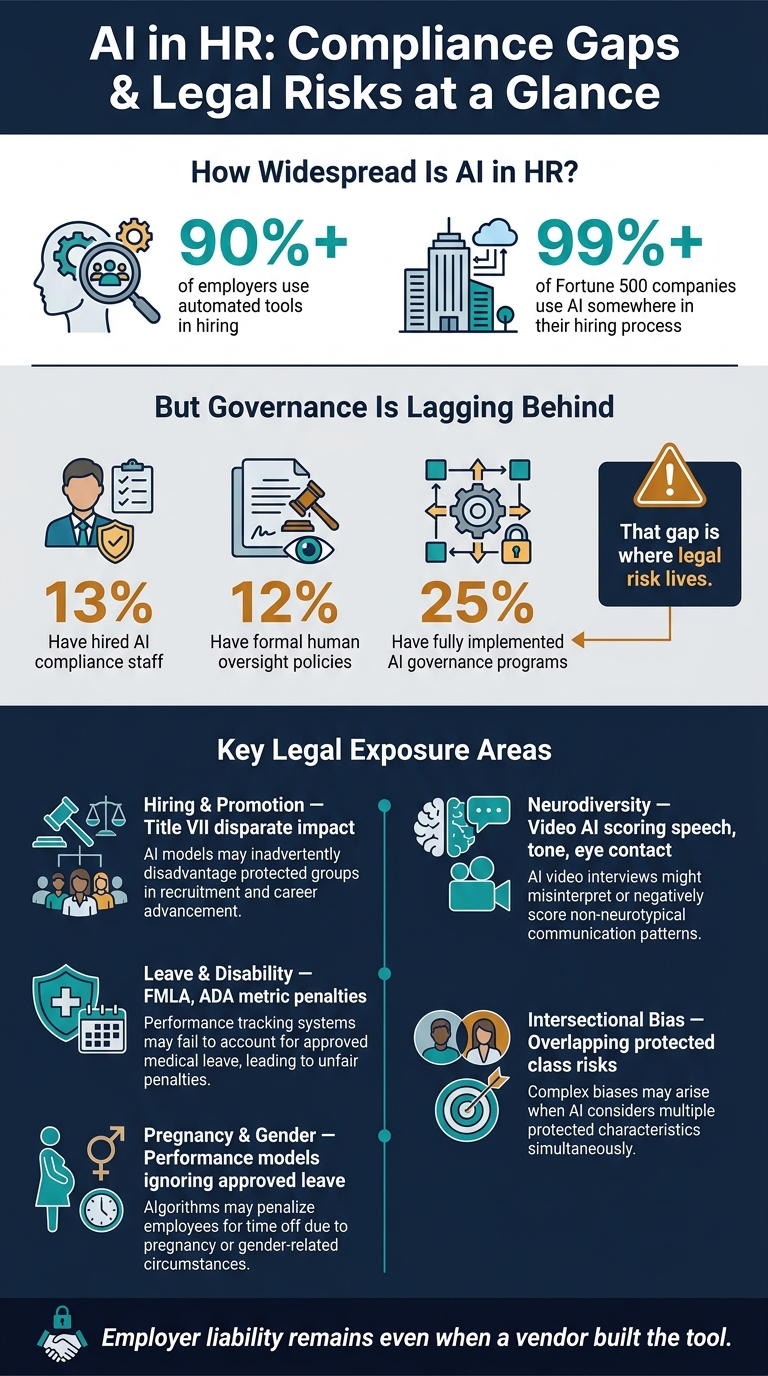
AI in HR: Compliance Gaps & Legal Risks at a Glance
Where AI Fits Into Employment Law Compliance
Hiring, Promotion, and Performance Decisions
AI now plays a part in candidate scoring, résumé resurfacing, and video interview review, including analysis of speech and tone. The big compliance issue is simple: do those outputs shape protected employment decisions? In many cases, they do. And this isn't a niche issue either. More than 99% of Fortune 500 companies use AI-based tools somewhere in their hiring process.
These tools can move hiring along faster. But speed cuts both ways. If a system is trained on flawed historical data, it can repeat old bias instead of removing it. The same thing happens in promotion and performance workflows. AI-generated ratings and productivity scores can influence performance reviews, promotion recommendations, and layoff selections. Those same systems may also affect pay, scheduling, and leave outcomes.
Wage, Hour, and Leave Administration
AI also shows up in timekeeping, overtime, payroll, and leave administration. Under the FLSA and FMLA, the employer is still on the hook for accurate pay and lawful leave handling. That duty doesn't disappear just because software is doing part of the work.
A common problem comes from AI-driven performance metrics that don't account for approved time off. In plain English, the system may treat protected leave like poor performance. That can lead to scores or flags that punish employees for approved medical or family leave. When that happens, the legal risk can spread across four main federal statutes.
Key U.S. Laws That AI Intersects With
Four federal frameworks shape most of the legal risk here.
- Title VII covers disparate impact in hiring and promotion. An AI tool doesn't need discriminatory intent to create liability.
- The ADA comes into play when AI evaluates physical or cognitive traits, including gamified assessments or video-based emotion recognition.
- The FLSA governs pay accuracy, no matter how automated the calculation process is.
- The FMLA applies when productivity metrics or leave data are used in decisions affecting employees on protected leave.
Automation doesn't excuse inaccurate citations or bad facts. The next issue is how bias gets into these systems and then spreads at scale.
Key Research Findings on Bias, Disparate Impact, and Audit Risk
How Bias Enters AI Systems
These risks usually show up in three places: the data, the model, and the people using the output.
Training data can bake in old patterns. Model inputs can slip in signals that stand in for protected traits. And employers can lean too heavily on AI scores when making hiring or workplace decisions. Proxy variables are a major problem here. Illinois HB 3773 specifically flags zip codes as proxies for protected classes.
Model design can create risk too. A video interview tool might score people based on speech patterns, tone, or eye contact. On paper, that can sound neutral. In practice, it can put some applicants at a disadvantage, including people with demographic differences or disabilities. The human backstop is often weak as well. Only 12% of organizations have policies for meaningful human oversight of AI systems. That leaves plenty of room for automated outputs to slide straight into decisions with little review.
Why Intersectional Bias Is Harder to Detect
A lot of audits look at one protected class at a time. That can miss what happens when traits overlap, like race and gender or race and disability.
Opacity makes this worse. If an employer can't explain what drove a score, it's much harder to show that the result was job-related and necessary. That's the heart of the issue: auditability matters just as much as model accuracy.
Illinois HB 3773 points to a change in how risk is viewed. The focus is moving toward liability based on effect, not intent.
Table: Bias Type, Technical Cause, and Legal Exposure
The table below links common bias patterns to the technical issue behind them and the legal risk that may follow.
| Bias Type | Technical Cause | Legal Exposure (U.S. Law) |
|---|---|---|
| Racial/Socioeconomic Bias | Zip codes used as proxies for race or class | Title VII disparate impact; Illinois Human Rights Act |
| Gender/Pregnancy Bias | Performance models that ignore approved time off | Title VII; Pregnancy Discrimination Act (PDA) |
| Disability/Leave Bias | Productivity metrics that penalize gaps in activity | FMLA; ADA; state leave law violations |
| Neurodiversity Bias | Video AI evaluating speech patterns, tone, and eye contact | ADA (failure to provide reasonable accommodation/discrimination) |
| Intersectional Bias | Model design optimized for a majority profile | Title VII (combined claims); NYC Local Law 144 (audit risk) |
Regulatory Guidance and Practical Controls for Employers
Federal Guidance From the EEOC and DOL
These bias risks aren't just abstract anymore. They create direct compliance duties for employers. Existing laws already apply to AI outputs, and both the EEOC and DOL have warned that using AI in hiring, performance management, scheduling, payroll, or leave administration can trigger duties under anti-discrimination, wage-and-hour, and disability accommodation laws.
The core point is simple: "the AI did it" is not a legal defense. Employers are still on the hook for what their tools produce. And regulators are moving past broad advice toward rules that focus on transparency, discrimination, privacy, security, and accountability.
State and Local Rules on Automated Employment Decision Tools
States and cities have stepped in with their own rules. Federal law sets the floor. Local law now often decides what testing, notice, and recordkeeping look like in practice.
| Jurisdiction | Compliance Action | Enforcement |
|---|---|---|
| New York City (Local Law 144) | Annual independent bias audits; notice to candidates before use | Civil penalties of $500–$1,500 per violation |
| Illinois (HB 3773, eff. Jan. 1, 2026) | Prohibits AI with discriminatory effects; bans zip code proxies | Private right of action for employees |
| Colorado (SB 24-205, eff. June 2026) | Documented risk management programs and impact assessments | Attorney General enforcement; $20,000 per violation |
Illinois HB 3773 stands out for one reason: it lets employees sue directly, instead of only filing a complaint with a government agency. That's a big shift in litigation risk for any company with Illinois-based workers.
Controls That Research and Regulators Consistently Recommend
Across regulators and studies, the message is pretty consistent. AI in employment law is a compliance issue, not something employers can dump on a vendor. The controls below go straight at the audit gaps, proxy bias, and disparate-impact risks discussed earlier.
Start with an AI system register. Some products don't make it clear that AI is built in at all. That's why visibility comes first. Employers should log each HR tool's purpose, inputs, outputs, and decision owner.
After that, the main controls are pretty direct:
- Log every HR tool in use, including standard platforms with embedded AI.
- Review outputs with human oversight before any employment decision is final.
- Document that each AI-scored metric ties directly to job requirements.
- Reject vendor "bias-free" claims; require training-data disclosure and periodic independent audits.
- Audit on a periodic, independent basis. Using the NIST AI Risk Management Framework (RMF) or ISO/IEC 42001 can help support compliance in places like Colorado.
sbb-itb-17e8ec9
AI in the Workplace: Employment Law & Data Privacy Risks Employers Need to Know
Conclusion: What Startups Should Take From the Evidence
Those controls matter because the ways these systems fail are pretty predictable: proxy metrics, black-box scoring, and weak human review. The evidence points to a simple fact: AI can make decisions more uniform, but it does not make them compliant on its own. Even neutral-looking metrics can penalize protected leave, disability, or other protected traits. And when that happens, the employer is on the hook.
Despite that, only 25% of organizations have fully put AI governance programs in place, and just 12% have formal human-oversight policies. That's where legal risk starts to creep in.
3 Practical Takeaways for Founders and Operators
For startups, the response is straightforward: find the systems, test the outputs, and make one person accountable. The legal risk isn't theoretical. It comes from the way everyday HR metrics are built, used, and reviewed.
- Inventory every HR workflow where AI affects decisions, including built-in features inside tools you already use. If you don't know where AI is showing up, you can't govern it.
- Test performance and layoff tools for disparate impact, especially when metrics may penalize protected leave. Check for that risk directly.
- Assign a named reviewer with the power to override any high-risk AI output. Document that process. It can matter a lot if a decision gets challenged.
AI is useful only when people govern it with human review, documented criteria, and auditability.
FAQs
How can we tell if an HR tool is using AI?
It can be tough to tell because AI often gets used as a catch-all term for software.
Here, it means a machine-based system that takes inputs and produces outputs such as predictions, recommendations, or decisions.
Look for signs like:
- automated scoring or ranking
- predictive insights
- candidate matching
- real-time compliance monitoring
It also helps to check the tool’s documentation or ask the provider directly whether the product uses AI under that definition.
What should a human reviewer check before approving an AI-driven decision?
Before approving an AI-driven decision, a human reviewer needs to make sure it is accurate, fair, and in line with the laws that apply.
That review should cover the inputs, the decision logic, and the parameters behind the output. The goal is simple: catch flawed data, spot protected characteristics or discriminatory metrics, and confirm that the decision matches internal policies and authoritative sources.
Which state AI employment rules should multi-state employers watch first?
Employers that operate in more than one state need to keep a close eye on state laws that govern AI in employment. The main pressure points are hiring tools, discrimination, and transparency rules.
There’s no single federal AI law right now. So the safer move is to treat employment AI like a regulated product. That means running bias testing, documenting job-relatedness, and doing periodic audits to cut risk in hiring, performance reviews, and termination.