If your numbers, cap table, and risk disclosures do not match, investors slow down - and legal risk goes up.
When I look at investor disclosure standards, I boil them down to 4 jobs:
- Pick the right offering path first, because disclosure rules change under Rule 506(b), Rule 506(c), Reg CF, and Reg A.
- Build one clean disclosure package with financials, cap table details, debt, related-party deals, contracts, and risk factors.
- Set basic internal checks so books, investor materials, and ownership records stay aligned.
- Keep reporting after closing, with regular updates on cash, burn, runway, KPIs, headcount, and material events.
A few points stand out:
- Under Rule 506(b), even one non-accredited investor can trigger much heavier disclosure work.
- Rule 506(c) allows public promotion, but sales are limited to accredited investors only.
- Reg CF and Reg A come with set filing and reporting duties.
- Across all paths, Rule 10b-5 still matters: if a statement leaves out a material fact and becomes misleading, that can create trouble.
Here’s the short version: legal compliance is only part of the job. Investor-grade disclosure means your financials tie out, your cap table is current, your risks are specific, and your updates stay consistent before and after the round.
Use this article if you want a plain-English system to lower diligence delays, reduce mismatch across documents, and stay ready for investor questions at any time.
Securities law compliance - Reg D and private placements
sbb-itb-17e8ec9
Step 1: Identify which U.S. disclosure rules apply to your offering
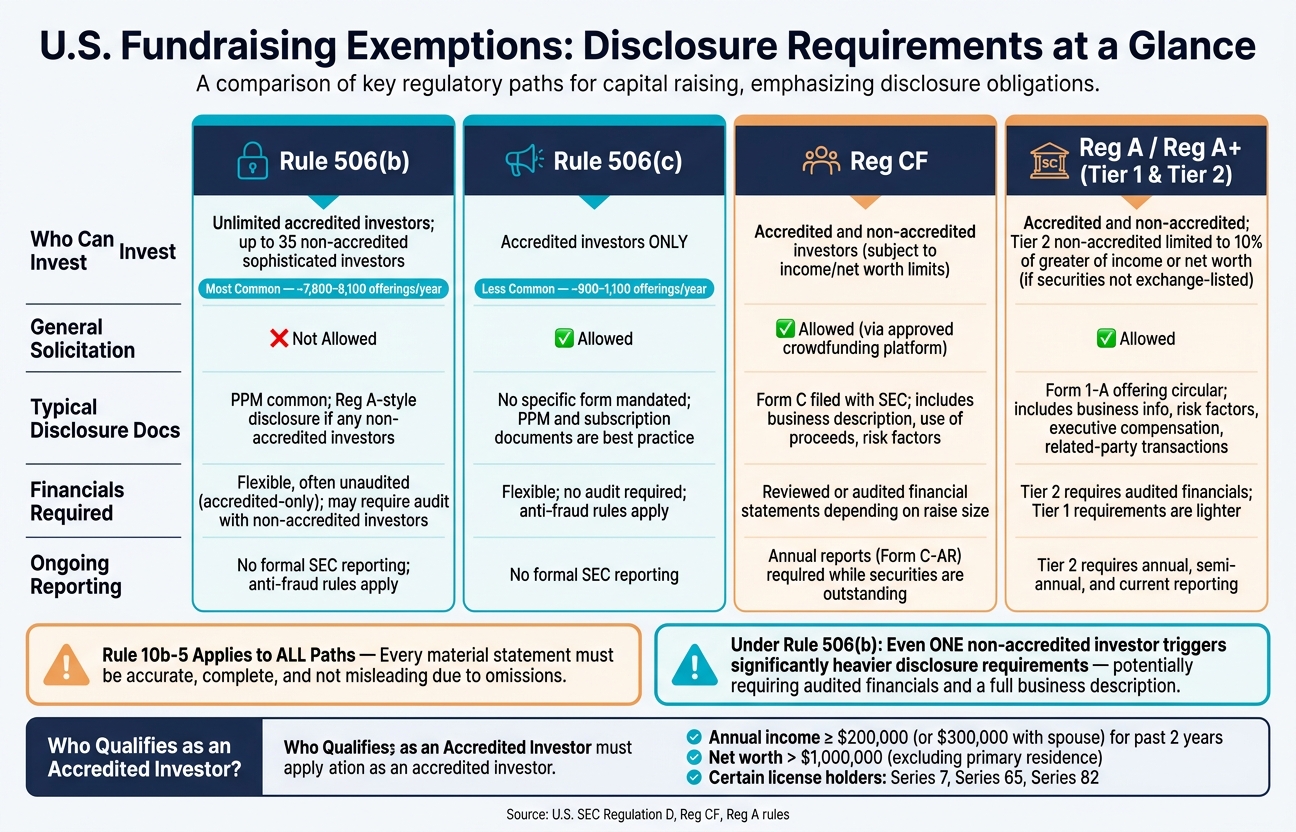
U.S. Fundraising Exemptions: Disclosure Requirements at a Glance
Start by figuring out which fundraising exemption you're using. That choice sets the disclosure standard for the whole round. In the U.S., the main paths are Rule 506(b), Rule 506(c), Reg CF, and Reg A (Reg A+). Each one comes with a different set of disclosure duties, and if you get the exemption wrong at the start, legal trouble can show up later. Put simply: the exemption you choose determines the disclosure package you need to prepare next.
A simple way to sort this out is to ask two basic questions.
- Will you publicly promote the round? That includes social media posts, open demo days, or broad email blasts. If the answer is yes, Rule 506(b) is off the table because it bans general solicitation.
- Will any investors be non-accredited? That answer shapes a big part of your disclosure workload.
How investor type changes your disclosure obligations
If you're raising only from accredited investors, you usually have more room to work. Once non-accredited investors come in, the disclosure burden gets much heavier.
For individuals, accredited investor status usually means one of the following:
- Annual income of at least $200,000, or $300,000 with a spouse, for the past two years
- Net worth over $1,000,000, not counting the primary residence
- Certain license holders, including Series 7, Series 65, and Series 82
That extra room disappears fast when even one non-accredited investor joins the round. Under Rule 506(b), bringing in a single non-accredited investor triggers a much tougher disclosure standard, closer to what you'd see in a Regulation A offering. That can mean a full business description, detailed risk factors, and financial statements that may need an audit. For an early-stage startup, that's a sharp jump in cost and paperwork.
Underneath all of this is the anti-fraud rule. It applies no matter which path you choose: every material statement has to be accurate, complete in context, and not misleading because of what it leaves out. A short memo doesn't save you if it skips over a major risk, heavy customer concentration, or open litigation.
Fundraising regime comparison table
| Regime | Who can invest | General solicitation | Typical disclosure documents | Financial statement expectations | Ongoing reporting |
|---|---|---|---|---|---|
| Rule 506(b) | Unlimited accredited investors; up to 35 non-accredited "sophisticated" investors | Not allowed | PPM is common for accredited-only offerings; Reg A-style disclosure if any non-accredited investors participate | Accredited-only: flexible and often unaudited; with non-accredited investors: financial statements may need to be audited | No formal SEC reporting; anti-fraud rules apply |
| Rule 506(c) | Accredited investors only | Allowed | No specific form mandated; a PPM and subscription documents are common best practice | Flexible; no audit is specifically required, but anti-fraud rules still apply | No formal SEC reporting |
| Reg CF | Accredited and non-accredited investors, subject to investment limits based on income and net worth | Allowed through an approved crowdfunding platform | Form C filed with the SEC; includes business description, use of proceeds, and risk factors | Reviewed or audited financial statements depending on raise size | Annual reports (Form C-AR) required while securities are outstanding |
| Reg A (Reg A+) (Tier 1 / Tier 2) | Accredited and non-accredited investors; in Tier 2, non-accredited investors are limited to 10% of the greater of income or net worth if the securities are not listed on an exchange | Allowed | Form 1-A offering circular; includes detailed business information, risk factors, executive compensation, and related-party transactions | Tier 2 requires audited financial statements; Tier 1 requirements are lighter | Tier 2 issuers have ongoing annual, semi-annual, and current reporting obligations |
Rule 506(b) is still, by far, the exemption founders use most often. SEC data shows about 7,800 to 8,100 offerings per year under 506(b), versus roughly 900 to 1,100 under 506(c). The reason is pretty simple: when the round is limited to accredited investors, 506(b) comes with very little required disclosure. But that easy setup can vanish the minute a non-accredited investor lands on the cap table.
Once you've pinned down the exemption, you can build the disclosure package that fits it. From there, the next move is pulling together the financial and legal disclosure materials.
Step 2: Build a disclosure package with the right financial and legal details
Once you know which exemption fits your raise, use it to set the scope of your disclosure package. Then build one package that lines up with that exemption and helps you answer diligence questions without scrambling. That kind of consistency also lowers misstatement risk. Done right, disclosure stops being a one-off file drop and starts working like a repeatable diligence system.
What to include in your baseline disclosure set
Your baseline disclosure set should cover four areas: business and market context, financial position, ownership, and legal obligations.
On the financial side, include 24 months of monthly P&L, a current balance sheet, and a cash flow statement. Spell out cash and cash equivalents as of a specific date, average monthly burn for the last 3 to 6 months, runway, a 24–36 month forecast with written assumptions, and a use-of-proceeds split tied to that model.
For ownership, include a fully diluted cap table that lists every shareholder, option holder, SAFE, convertible note, and warrant - with both share counts and percentage ownership before and after the financing. Add a short summary of SAFE and note terms, including valuation caps, discounts, and maturity dates, so investors can see how those instruments convert and how much dilution they may create. This is one of the first places investors look when they want to spot hidden dilution from stacked convertibles.
The legal side needs to match the round’s burden, not just the finance model. Clean numbers alone won’t do it. Investors also want contract, debt, and conflict disclosures in the same package. That means adding a schedule of material contracts - usually any customer agreement tied to more than 5% of revenue, major vendor, cloud, or infrastructure agreements, plus any exclusivity or IP licensing deals.
You should also include a debt schedule showing principal outstanding, interest rate, maturity, covenants, and any liens. Separately, document related-party transactions. U.S. accounting guidance under ASC 850 and SEC rules require disclosure of transactions above $120,000 where a related party has a material interest, including the relationship, transaction terms, dollar amounts, and any outstanding balances.
Finally, complete bad actor questionnaires for directors, officers, 20% owners, and paid solicitors, then record the results in a short internal memo. Prior disqualifying events do not kill a Rule 506 offering, but they must be disclosed in writing before closing.
Disclosure contents versus risk mitigation table
| Disclosure item | Regulatory basis | Investor expectation | Risk reduced |
|---|---|---|---|
| Historical financial statements (P&L, balance sheet, cash flow) | Anti-fraud rules; GAAP presentation | Accrual-basis financials for 24 months or since inception | Misrepresentation of financial health; revenue recognition disputes |
| Cap table (fully diluted) | Anti-fraud rules; securities agreements | Complete view of ownership, options, SAFEs, convertibles, and warrants | Hidden dilution surprises; governance disputes post-close |
| Risk factors | Anti-fraud rules; Reg CF Form C; Reg A offering circular | Specific, tailored risks - not boilerplate | Omission claims; investor fraud allegations |
| Related-party transactions | ASC 850; SEC Reg S-K Item 404 (>$120,000 threshold) | Clear description of relationship, terms, amounts, and balances | Conflict-of-interest claims; governance red flags |
| Debt obligations | Anti-fraud rules; lender agreements | Principal, rate, maturity, covenants, and any liens or personal guarantees | Undisclosed encumbrances; covenant breach surprises |
| Material contracts | Anti-fraud rules; diligence standards | Contracts >5% of revenue, key vendors, IP licenses, exclusivity deals | Revenue concentration risk; contract termination exposure |
| Bad actor disclosures | SEC Rule 506(d)/(e) | Written disclosure of any pre-existing disqualifying events before sale | Loss of Regulation D exemption; rescission claims |
Once the package is done, tie these disclosures to a recurring review cycle so the numbers stay current. After that, put controls around the materials so they stay ready for investors.
Step 3: Put controls in place so your numbers stay accurate and investor-ready
Once the disclosure package is built, keep every number and file in sync with a simple control process. A disclosure package is only as good as the process behind it. If your books don’t close on time, your cap table still reflects the period before your last SAFE, or your investor materials pull from old spreadsheets, the package you send investors will have holes - and they’ll spot them. These controls help keep the disclosure package current as the round moves forward.
Create a simple disclosure control process
The goal isn’t to build a public-company compliance team. It’s to set up a light, steady rhythm that keeps your numbers reliable at any point in the fundraising cycle.
Start with a monthly close target. Close the prior month by the 10th business day. During that close, review revenue recognition and expense classifications. Reconcile every bank account, credit card, and payment processor - including Stripe or PayPal, if applicable - to the general ledger. If something doesn’t match, fix it before you mark the period final. Then lock the period so entries can’t be backdated without approval.
After each financing event - a SAFE, note, or option grant - update the cap table that same day. Then check that the fully diluted share count in your investor materials matches. Give one person ownership of the cap table, and keep a change log that records every update. That simple habit can save you from a messy diligence process with multiple versions floating around.
Version control matters just as much for investor materials. Store only approved, current files in a dedicated Investor Materials folder. Archive older versions with clear date labels, and use one naming convention across the board. For example: CompanyName_InvestorDeck_SeriesA_v3_2026-07-15.
Before anything goes out externally, the finance lead and the CEO should both sign off. They should confirm that every financial figure ties back to the most recently closed books. It also helps to log what was shared, with whom, and when.
Assign clear ownership across the team:
- Founders own the narrative
- Finance owns the numbers
- Counsel owns the offering documents
Use reporting tools that pull from the same source data
Tools that sync with banks, payroll, and billing systems cut down on manual mistakes and help keep reconciliations current. That supports cap table updates and helps keep reporting aligned throughout the fundraising cycle.
Lucid Financials combines bookkeeping, tax services, tax credits, and CFO support in one platform. It integrates with Slack and delivers investor-ready reporting reviewed by experienced finance professionals. These same controls feed the monthly and quarterly reporting standard in Step 4.
Step 4: Set an ongoing investor reporting standard and close with a compliance checklist
Closing a round doesn’t end your disclosure duties. It changes them.
At this stage, the reconciled books and current cap table from Step 3 become your single source of truth for every investor update. The fundraising package you built in Steps 1 through 3 sets the baseline. From there, the job is to create a steady reporting rhythm that meets information rights, keeps investors in the loop between board meetings, and stops small issues from turning into ugly surprises at the next financing.
That same source of truth should feed every monthly or quarterly report.
What to send investors each month or quarter
Start with the information rights in your signed financing documents. That’s the first place to look.
A lot of startups send monthly updates to all investors, then share a deeper quarterly package with major investors and board members. Some priced equity rounds also require annual audited or reviewed accounts. SAFEs and notes often come with lighter reporting expectations.
Each monthly update should use the same format every time. That way, investors can scan it fast and compare one month to the next without digging around.
Start with a clear subject line, such as Acme Inc – Investor Update – June 2026. Then open with 3 to 5 highlights and 2 to 4 honest challenges. That balance matters. Investors usually respond well to candor. If you missed targets or churn jumped, say so. Just pair the issue with your plan to deal with it.
The financial snapshot is the heart of the update. Always show figures in USD with U.S. currency formatting. For example:
Cash on hand: $1,850,000 as of June 30, 2026; monthly net burn: $185,000; runway: ~10 months based on 3-month average burn.
Pull those numbers straight from your reconciled books, not from some side spreadsheet that may have drifted from the accounting records.
Then round out the update with headcount changes, key operating KPIs like MRR, churn, and CAC - whatever fits your model - plus any material developments, such as new partnerships or regulatory changes. Add one ask at the end. A plain, specific ask can make a big difference. Something like We’re looking for intros to VP of Marketing candidates in the Bay Area gives investors a clear way to help.
Investor reporting components table and final checklist
| Component | Purpose | Recommended Frequency |
|---|---|---|
| Highlights & challenges | Quick view of progress and honest issues; builds trust | Monthly |
| Cash on hand, burn, runway | Clarifies liquidity position and funding needs | Monthly |
| Core financial metrics (MRR/ARR, gross margin) | Shows growth trajectory and unit economics | Monthly + Quarterly rollup |
| Budget vs. actuals | Reveals planning accuracy and execution quality | Quarterly (monthly for later-stage) |
| Operating KPIs (churn, CAC, daily or monthly active users) | Tracks product-market traction and efficiency | Monthly |
| Headcount & org changes | Shows hiring pace and key departures | Monthly |
| Cap table & equity updates | Keeps investors current on ownership and dilution | Quarterly and after major equity events |
| Material developments | Flags risks, contracts, litigation, or pivots in real time | As they occur; confirmed in next update |
| One ask | Converts reporting into active investor engagement | Monthly |
Before sending anything, run through this checklist:
- [ ] Your update cadence matches the reporting rights in the signed financing documents
- [ ] All material facts are disclosed accurately and consistently across every document
- [ ] Financial records are reconciled and pulled from a single source of truth
- [ ] Investor materials reflect the most recently closed books, with clear date labels
- [ ] Cap table is current and matches the share counts in your investor materials
- [ ] Investors are receiving updates on a predictable, documented schedule
- [ ] Material developments are disclosed promptly, not deferred to the next board update
FAQs
Which offering path fits my round?
The right offering path depends on what you're trying to do.
A fundraising model works best when you need to show runway, growth milestones, and future capital needs. An operational model is better for tracking budget-versus-actual performance and managing resources day to day.
Lucid Financials supports both paths with AI-driven scenario modeling, cash flow projections, and automated hiring plans, so your financial story stays in line with your business goals.
When do I need audited financials?
Audited financials usually come into play at the Series A stage, during major fundraising rounds, or anytime investors want extra proof that your financial records hold up.
Day to day, you still need clean, GAAP-compliant books. But an audit is something different: it’s a CPA’s formal review and opinion on your financial statements.
That’s why it pays to build audit-grade record-keeping early. If you wait until a fundraise is already in motion, things can get messy fast. Starting early can help you avoid delays and keep audit fees lower.
What should I update after closing?
After closing, update your systems and records so they match the business’s new status. Start by reconciling your cap table against signed agreements and bank statements. Then clean up your virtual data room: archive old files, add “as of” dates, and shift to quarterly updates.
It also helps to reconcile balance sheet accounts every month, update your remediation log for prior-year audit findings, and confirm that your API integrations reflect any new revenue streams or software changes.